Weekend Redemption Pressure: Building a Saturday You Can Repeat

The Saturday That Felt Like a Final Warning
When Maya (name changed for privacy) sat down with me, I recognized the look immediately. If a free Saturday feels less like time off and more like your last shot to prove you are not falling behind at adult life, I know that look. I hear some version of that question in readings about weekend redemption pressure all the time.
She described 10:15 a.m. in her small Toronto apartment kitchen so clearly I could almost hear it myself: the coffee going lukewarm beside her laptop, Google Calendar and Notes both open, a grocery cart tab and a banking app waiting, the laundry basket still parked by the bedroom door. The fridge hummed. A streetcar rattled past outside. Her phone felt warm in her hand from checking and rechecking the plan. Her jaw kept locking as she rewrote the order of tasks for the third time.
"I do not need a break," she told me. "I need to catch up. If I waste today, the whole week is going to start wrong." There it was in one breath: getting on track versus wasting the one free Saturday and somehow falling even further behind. The urgency in her body sounded to me like she had swallowed a smoke alarm. Everything in her was blinking red before the day had even properly begun.
I nodded and let that truth land without trying to pretty it up. Then I told her what I have learned after many long seasons with people who think pressure will save them: a free day is support, not a final exam. "We are not here to judge your Saturday," I said. "We are here to draw a map of the pressure, so you can stop mistaking it for your personality and start finding clarity inside it."

Choosing the Ladder Instead of a Crystal Ball
I asked Maya to place both feet on the floor and take three slower breaths before we touched the deck. Not as theatre, and not as some mystical test. Just as a way to let her nervous system arrive in the same room as her question. Then I shuffled slowly and asked her to hold one thought only: Why does one free Saturday feel like my last chance to get on track?
For her reading, I chose the Four-Layer Insight Ladder · Context Edition. This is how tarot works best for me with Saturday reset anxiety and weekend productivity guilt: not as fortune-telling, but as card meanings in context. Her question was not really asking for a prediction. It was asking why an ordinary day off had become so psychologically overcharged. So I wanted the smallest spread that could trace the full chain clearly: symptom, fear, reframe, and grounded action.
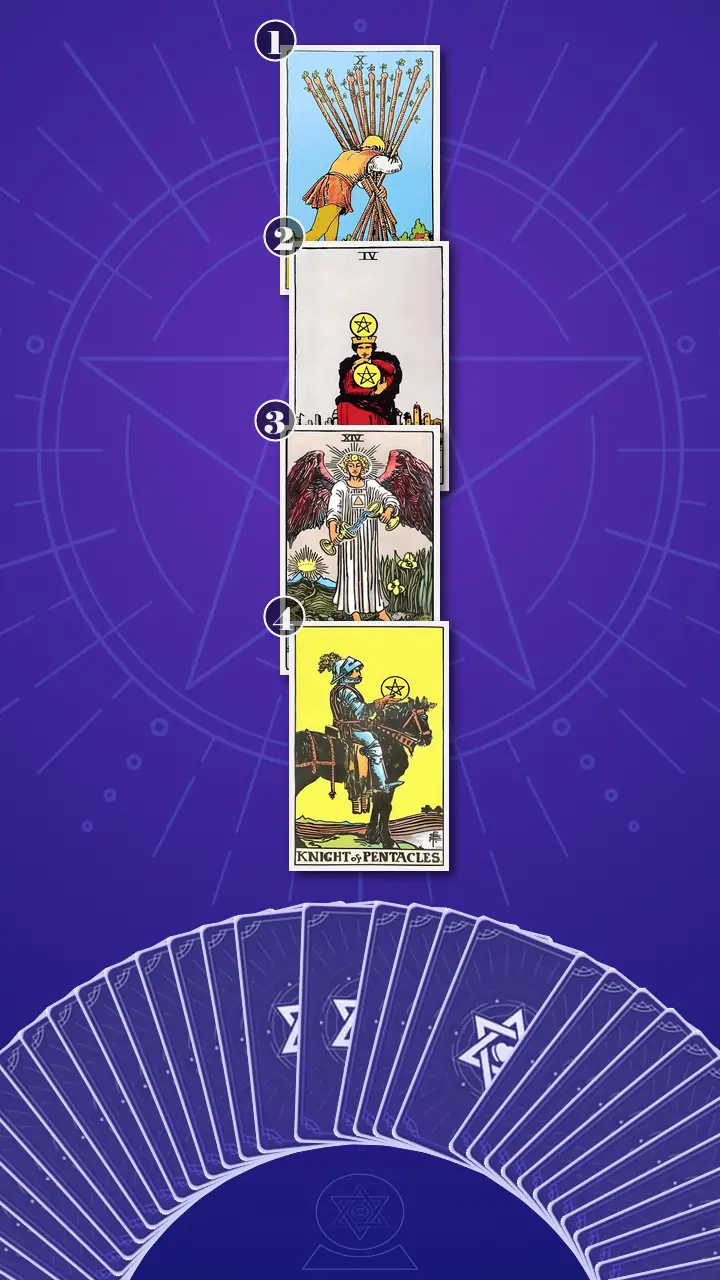
I told her what each rung would show. The first card would name the visible Saturday pattern she keeps living out. The second would reveal the deeper fear and scarcity logic underneath it. The third—our turning point—would show the core shift needed for transformation. And the fourth would ground the whole reading in one lived experiment, a small repeatable practice that could make a free day usable again.
Reading the Weight in the Room
Position 1: The Bundle That Blocked the Horizon
I turned the card representing the visible Saturday symptom: Ten of Wands, upright.
I told Maya this was almost painfully literal. It looked exactly like her trying to use one free Saturday to carry chores, life admin, self-improvement, and emotional recovery all at once. Laundry, groceries, inbox cleanup, budgeting, exercise, texting people back, maybe even becoming a calmer and more evolved person before dinner. In the Rider-Waite image, the bundle of wands blocks the figure's line of sight. In modern life, that becomes too many tabs, too many categories, too many mini-deadlines in one day until the next real move disappears behind the plan.
Energetically, I read it as excess fire under compression. There is energy here, but it is so overloaded that it stops being useful. It bends the back instead of moving the feet. I told her, gently but directly, "Planning can feel like control while quietly stealing the energy to begin." The day starts to resemble 27 browser tabs eating all your battery while you keep deciding what to click first.
Her reaction came in three small waves. First her fingers froze around her mug. Then her eyes narrowed in that quick inward wince people make when a card catches them too cleanly. Finally she gave a short, dry laugh and said, "That is so accurate it feels a little rude." I smiled. "Good," I said. "Then the card is looking at the right Saturday."
Position 2: The Day Clutched Like Low Battery
I turned the card representing the deeper control-based fear and scarcity logic beneath the pattern: Four of Pentacles, upright.
I told her this card showed why rest feels stressful when chores are undone. In her life, it looked like clutching her free hours the way people protect the last 12 percent of their phone battery. She tightens the plan, postpones food, delays showering, keeps lunch on hold, and treats thirty minutes of sitting down as if that would be reckless spending. The day becomes proof that life is still under control, so every minute feels too precious to use imperfectly.
Here the energy was defensive earth—solid, closed, guarded, and stuck. The figure on the card holds one pentacle to the chest and pins the others underfoot. I told Maya that when time is gripped this tightly, flexibility disappears first. And once flexibility goes, starting becomes harder, not easier. This was the moment I named another lens I use, one I call Social Clock Decoupling. I said, "The second you measure your Saturday against productivity reels, soft-weekend posts, or what twenty-eight is supposed to look like, your day stops belonging to you. It becomes an exam you think everyone else already passed."
She stared down at the card and pressed her lips together. I asked, "If you did 'waste' this Saturday, what exactly would your mind say that meant about you by Sunday night?" She answered without hesitation. "That I cannot manage basic adult life." There was the root. Not laziness. Not lack of ambition. Fear that one imperfect day could expose a deeper loss of control.
When Temperance Poured Between Two Cups
Position 3: The Antidote in Plain Sight
When I reached for the third card, the room went noticeably quieter. Even the traffic outside my window seemed to flatten into the distance. I turned the card representing the central reframe needed for transformation: Temperance, upright. I have lived enough winters to know the feeling that came over me then. Not drama. Relief.
Whenever Temperance appears in a reading like this, I use my Seasonal Energy Diagnostics lens. I look for the place where someone is trying to force a spring harvest during a winter dormancy phase. Maya was not failing at being an adult. She was trying to squeeze bloom, harvest, repair, and future planning out of one tired morning. No field responds well to that. Neither does a nervous system.
I named the moment she knew too well: cold coffee, six tabs open, laundry still untouched, and her whole body acting like noon is already too late to recover the week. That is the weather this card interrupts.
Saturday is not a verdict you have to survive; like Temperance pouring between cups, let one manageable task and one act of care coexist, and trust balance to rebuild momentum.
Her first reaction was not relief. It was resistance. Her breath paused. Her fingers stopped tapping against the mug. Then her gaze drifted slightly past me, as if she were replaying that bright kitchen-counter scene with the unopened mail, the banking alert, and the lunch she felt she had not earned yet. Only after that came the release: a long, shaky exhale that seemed to come from somewhere behind the ribs. I watched her jaw loosen by degrees. Her shoulders lowered, and with that softening came the strange little dizziness that often follows clarity—the body letting go of an emergency while the mind is still catching up.
"But if I make it smaller," she said, and there was a flash of anger in it, "doesn't that mean I am admitting I cannot handle normal life?"
"No," I told her. "It means you are finally working with your real energy instead of against it. You do not need a rescue Saturday. You need a Saturday you can repeat." I let that sit for a moment. Then I asked, "Now, with this new angle, think back to last weekend. Was there a moment this would have changed how you felt?"
She nodded once, slowly. "Lunch," she said. "If I had just eaten, paid the hydro bill, and moved the laundry, I probably would have felt human again. I kept acting like eating meant I was quitting."
That was the hinge of the whole reading. Not from chaos to perfection. From deadline panic and guilt-driven overplanning toward the first believable inch of steadier self-respect through moderation and follow-through.
Position 4: The Still Horse and the Human Pace
I turned the card representing the grounded next step, the lived experiment that could replace binge-repair with self-trust: Knight of Pentacles, upright.
I love this card because it is gloriously unimpressed by drama. I told Maya it looked like a phone note with three anchors instead of a full reset manifesto. One realistic practical task. One maintenance task. One restorative thing. Not a cinematic comeback. More like boring autopay for life maintenance: not glamorous, just reliable.
Energetically, this was grounded earth in balance. The horse is still. The knight is focused. Nothing is rushing, which is exactly why something gets done. I told her, "Completion builds trust faster than intensity." In other words: carry one meaningful thing well instead of carrying your whole life badly.
This time she did not laugh. She just gave me the kind of nod people give when their body has decided before their brain has fully drafted its opinion. "Boring is fine," she said. "Honestly, boring sounds amazing."
A Saturday You Can Repeat
Once all four cards were on the table, the story was clean. First came the Ten of Wands: an overloaded day, stacked so high with chores, admin, self-repair, and ideal-self goals that perspective vanished. Then the Four of Pentacles: the deeper fear that one wasted day means life is slipping, so time gets gripped so tightly it stops being usable. Temperance interrupted that whole loop by replacing redemption pressure with measured exchange—effort and care in the same day, not competing for permission. And the Knight of Pentacles brought it down to earth: fewer commitments, slower pacing, ordinary follow-through.
I told Maya the blind spot was not a lack of discipline. It was the belief that more pressure would create more control, when in fact the pressure itself was what made Saturday unusable. Her transformation direction was simple, but not easy: stop using one day to prove she is finally fixed, and start using one day to practice a limited rhythm she can return to. A support-not-exam Saturday. A completion-first weekend. Something human.
Then I gave her the practical part, because insight matters most when it can walk out the door with you. I reminded her of something I say often in readings like this: rest is not the prize at the end of perfect admin.
- Build a Saturday 1+1+1 note. In your phone, make a note called 'Saturday 1+1+1' with exactly three items: one practical task like paying the hydro bill, one maintenance task like one load of laundry, and one restorative thing like a 20-minute walk with no podcast. If your mind says three things are not enough, keep the cap anyway. That protest is the pattern, not a command.
- Use a 15-minute visible start. Before you open planning apps, do one physical task that changes the room: start the laundry, clear the sink, or sort the mail into three piles. Set a timer and stay with only that task until it ends. Choose the task with the clearest physical starting point, not the one with the biggest symbolic meaning. Traction first, optimization later.
- Try my Winter Dormancy Ritual for one week. For the next seven days, do nothing about the blocked goal of 'getting fully back on track.' No redesigning your Notion life-admin system. No heroic Saturday makeover plan. No productivity videos for inspiration. Let the rescue fantasy go dormant and protect only the smaller rhythm. Guilt may flare up immediately. Treat that flare as weather, not instruction. The ritual is not laziness; it is how you stop trying to force spring out of frozen ground.
Maya looked at the list for a long moment and then said, very quietly, "That feels possible." For me, that is always the real threshold. Not whether advice sounds impressive. Whether it sounds doable in the actual apartment, with the actual laundry basket, and the actual version of you who woke up tired.

A Week Later, the Quiet Proof
A week later, Maya sent me a message just after mid-afternoon. She had paid the hydro bill, run one load of laundry, eaten before 2 p.m., and taken a short walk without a podcast. The apartment was not transformed. Her life was not suddenly color-coded into peace. But she told me she had finished her three anchors by 2:40, then sat alone in a coffee shop for forty minutes feeling oddly tender about the extra space instead of guilty for it.
She added one more line: the old thought had still shown up the next morning—What if I am still behind?—but this time it sounded less like a judge and more like weather. I smiled when I read that. That is the kind of clarity I trust. Not certainty. Ownership.
And if I can leave you with the heart of this journey, it is this: when a quiet Saturday makes your chest tighten instead of soften, the day has usually stopped feeling like time and started feeling like evidence.
So when your next free day arrives, what would your own cup-to-cup rhythm be—one practical task, one maintenance act, and one kind thing that proves you can return without punishing yourself?
Every reading at AceTarot is a journey to connect with inner wisdom and empower your next step. The stories shared here are psychological mirrors, not private records—crafted to reflect universal emotional loops and help you find your own clarity. Learn more about our Journey to Clarity.