When One Missed Day Becomes a Verdict: Returning Without Starting Over

The Unchecked Box at 9:40 p.m.: Why One Missed Day Can Make You Quit a Routine
If your Notes app has more Monday restart plans than actual follow-through, especially after one late work night, you already know broken streak anxiety. When Jordan (name changed for privacy) asked me, ‘Why do I give up on a routine after one missed day?’, I did not hear laziness. I heard the familiar thud of all-or-nothing habit collapse.
She described 9:40 p.m. in her downtown Toronto condo kitchen so clearly I could almost hear it myself: the fridge humming, blue phone light washing the counter, her coat still half on after a delayed TTC ride, the room carrying that faint clean-laundry smell that never quite makes a person feel reset. She opened her habit app, stared at one unchecked box, locked the screen, and opened Notes to design next week’s ‘better’ version instead.
‘It wasn’t just a missed day,’ she said. ‘It felt like evidence.’
That was the real knot. She wanted a steady routine because it helped her feel less scattered, yet the second one day slipped, she treated the whole thing like proof she was not disciplined enough to keep anything alive. I could hear that strange Severance split so many young professionals carry: competent, deadline-reliable, generous for everyone else — then suddenly harsh and suspicious with themselves. The shame in her voice had the body-shock of missing the last stair in the dark: one fast drop in the stomach, a chest that cinches tight, and that hot private wish to disappear before the feeling finishes landing.
I nodded. ‘I know this pattern well,’ I told her. ‘And I do not think the missed day is the whole story. Let’s make a map for the part your mind keeps speeding past, and see where the clarity actually begins.’

Choosing the Compass: The Situation-Obstacle-Advice-Outcome Spread
I asked her to place both feet flat on the floor and say the habit aloud. Then I shuffled slowly on the table in front of me — not as theatre, but as a way to give her nervous system one quiet bridge between spiralling and seeing. A breath. A pause. A softer entry.
I chose a Situation-Obstacle-Advice-Outcome spread. For a question like this — quitting a routine after one missed day because a broken streak feels like failure — I do not want a sprawling layout. This classic four-card spread is the smallest structure that still tells the truth. It shows the visible pattern, the inner blockage beneath it, the medicine that challenges the pattern directly, and the grounded next step. This is how tarot works when it is useful: not as fate, but as pattern recognition with better lighting.
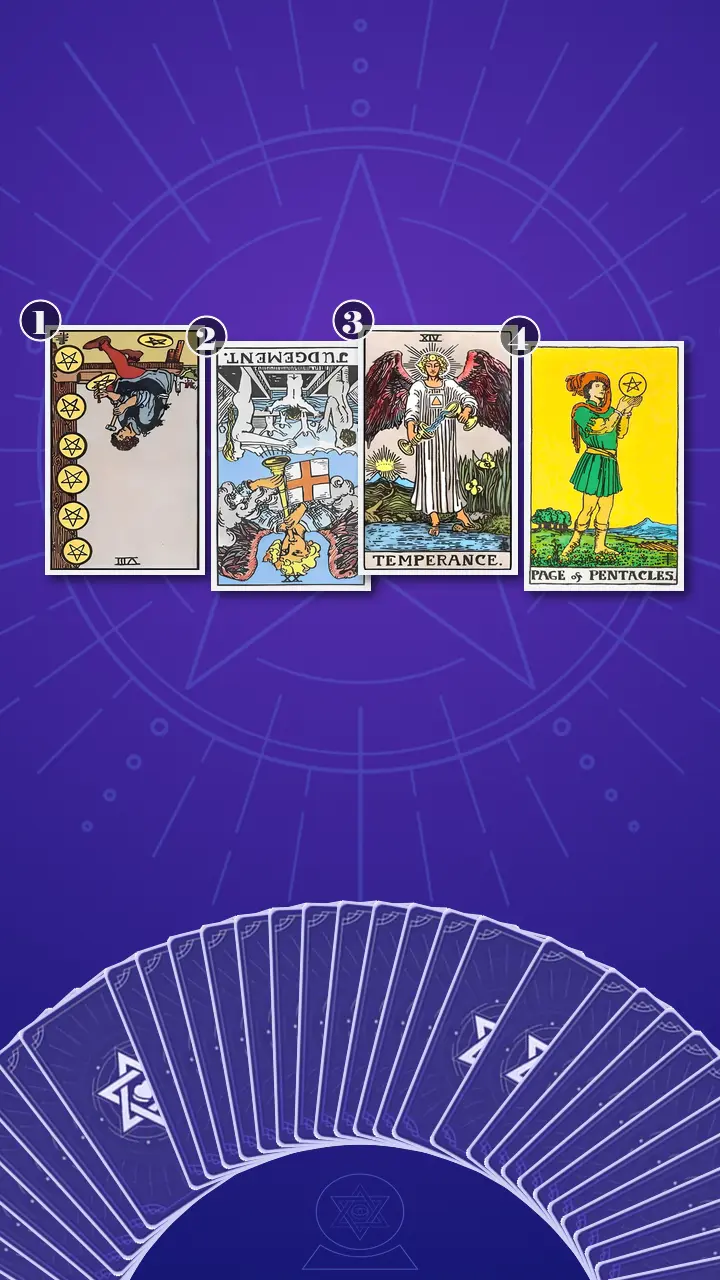
I told her what we would be watching for as I laid the cards from left to right like four stepping stones across shallow water. The first card would show what actually happens in the first minutes after the routine breaks. The second would reveal the fear that turns a lapse into an identity sentence. The third — the hinge of the whole reading — would offer the key reframe. The fourth would bring everything back into ordinary life: one next step sturdy enough to survive a tired evening, a late commute, or a day that does not look Instagram-clean.
Reading the Four Stepping Stones
Position 1: The Bench You Keep Leaving
I turned over the first card. ‘Now we’re looking at the position that shows the visible symptom loop: how one missed day turns into stopping the routine altogether.’
Eight of Pentacles, reversed.
The translation into Jordan’s real life was immediate. At 9:40 p.m., after a long commute, she sees the unchecked box, closes the app, hides the widget, and starts rebuilding next week’s ‘real’ routine in Notion because tonight no longer feels valid. In the card, the craftsman has left the bench — not because the work is impossible, but because one imperfect coin suddenly makes the whole row feel spoiled. This is blocked earth energy. The structure itself is not missing, but it has gone brittle. Practice stops the moment it stops looking clean. Like deleting a whole Spotify playlist because one song skipped.
Jordan let out a short, bitter laugh and rubbed her thumb against the side of her mug. ‘That is painfully accurate,’ she said. ‘I always act like the night is already lost.’
‘Yes,’ I said. ‘And notice how fast you move from doing the habit to curating the idea of the habit. Planning can look productive when it’s really a hiding place.’
Position 2: When the Inner Courtroom Takes the Case
I touched the second card. ‘This position reveals the inner blockage and core fear that turns a lapse into a verdict on identity.’
Judgement, reversed.
This card did not feel abstract at all. It felt like the streetcar home, lights reflected in the window, Jordan mentally pulling up every abandoned routine — yoga, journaling, skincare, meal prep, bedtime resets — and using tonight’s broken streak as evidence that she is simply the kind of person who cannot keep anything going. Judgement reversed is punitive fire. The missed repetition is small; the sentence that follows it is enormous. ‘I missed Tuesday’ becomes ‘I never follow through.’ The angel’s trumpet becomes that loud internal voice that turns one unchecked box into a full performance review in your own head.
This is where I quietly use what I call Somatic Fatigue Diagnosis, because the body often tells the truth before the mind finishes the speech. I asked her, ‘When that sentence hits, where does it land first?’ She did not answer with a theory. Her hand moved to the centre of her chest. Then to her stomach. Tight there. Heavy there. Contracted. That told me something important: her system was not responding to a scheduling issue alone. It was bracing for judgment.
She winced, looked down at the card, and shook her head once. ‘The internal courtroom line got me,’ she said. ‘It’s always way bigger than the actual missed day.’
‘Exactly,’ I said. ‘The missed day isn’t the collapse. The verdict is.’
Position 3: When Temperance Poured Between Two Cups
When I turned the third card, the room seemed to soften around us. Outside the window, the light had gone from sharp afternoon to that gentler silver before evening. On the table, the kettle clicked off with a small sigh. We had reached the hinge of the reading.
‘This position offers the key reframe that loosens the perfectionism-quit cycle and supports sustainable consistency.’
Temperance, upright.
Whenever Temperance appears, I think of Highland water after thaw — never rigid, never apologising for changing speed, simply finding a way around stone and continuing on. Here the card felt exact. Instead of asking whether tonight counts as the ideal version, Jordan makes tea, sets a two-minute timer, does one stretch or one paragraph, and logs it as returned. The two cups are her two real selves: full-capacity Jordan and tired-after-commute Jordan. Temperance does not ask those selves to match. It asks them to stay in conversation. More crossfade than hard reset.
This is where my second lens, Organic Routine Restructuring, matters most. So many routines are built for an imagined woman with endless battery, a clean kitchen, an uncluttered evening, and a body that obeys the calendar like a machine. But Jordan’s days are chopped by hybrid work, Slack residue, TTC delays, and the ordinary wear of city life. Her body is not failing the routine. The routine has been built without enough room for the body. Temperance asks for a full version and a low-battery version, so consistency can survive a real week instead of a TikTok Sunday reset fantasy.
At that point, she was still caught in the old logic: if the ideal version could not happen, the smaller one felt fake, almost embarrassing, as though doing less would only confirm the fear she was already carrying.
Your routine is not ruined because one day spilled; it becomes sustainable when you keep pouring between imperfect days like Temperance’s cups.
She went completely still. First came the physical freeze: her breath paused for one small beat, and her fingers stopped moving against the mug. Then came the cognitive drift: her eyes lost focus the way they do when someone is no longer looking at the room but at a replay only they can see — a Wednesday morning on Line 1, lukewarm coffee, shoulders up by her ears, the decision to do nothing because eight minutes felt fake. Then the feeling broke open in layers. Not immediate relief — first irritation, almost anger. ‘So I’ve been making the miss mean too much,’ she said, voice tight. ‘I’ve been turning it into a whole character statement.’ After that came the exhale, long and shaky, her shoulders dropping at last. There was even that slight, unsteady pause that sometimes follows real clarity, when the burden lifts and responsibility quietly takes its place. I let the silence breathe for a moment, then I asked, ‘Now, with this new perspective, can you think of a moment last week when this insight would have changed the feeling in your body?’ She nodded slowly. ‘Thursday night,’ she said. ‘I could’ve just stretched for two minutes. I opened Notion instead.’
That was the true crossing in the reading: not from chaos to perfection, but from shame-driven reset fantasies to flexible self-trust through repair. In other words, from proving discipline to practising return.
Position 4: One Small Pentacle, One Easier Return
I turned to the final card. ‘This position translates the new mindset into a practical next step that rebuilds trust through repetition rather than intensity.’
Page of Pentacles, upright.
After the angel with the cups, I loved seeing this card. The Page does not perform mastery. He studies one solid thing in his hands. In Jordan’s life, that becomes one tiny version of the habit on a sticky note by her desk or pinned in Notes: 10 squats, five lines, one page, two minutes. This is healthy earth returning. No drama. No purity test. Just one concrete rep that can survive an ordinary, messy evening. Beta testing your routine instead of launching a perfect version of yourself.
I watched her face change here. Less strain, more focus. ‘That feels almost annoyingly doable,’ she said.
I smiled. ‘Good. A two-minute return teaches more than a perfect Monday fantasy. This card wants learner energy, not expert pressure.’
From Verdict to Return Rate
Laid together, the story was clean. The Eight of Pentacles reversed showed the abandoned bench: the moment practice stops because it no longer feels pure. Judgement reversed showed why: one unchecked box becomes a moral scorecard, and shame scorches the ground so thoroughly that resuming feels riskier than quitting. Temperance stepped in as the antidote, turning the courtroom into a laboratory and asking a far better question — not ‘What does this missed day prove about me?’ but ‘What helps me return?’ Then the Page of Pentacles brought that wisdom back to earth: one small, touchable repetition. The blind spot was not a lack of planning. It was mistaking flexibility for failure, and mistaking the short relief of replanning for real repair. She had been treating consistency like an unbroken streak, when the deeper truth was simpler: consistency is the ability to come back after interruption.
I told her plainly, ‘Consistency is return rate, not streak length. Don’t build a cleaner restart. Build an easier return.’
- Build a Low-Battery VersionTonight, in one pinned phone note, choose the habit that has felt most fragile lately and write two versions: the full version and a two-minute version. For example: ‘30-minute workout / 10 squats and one stretch.’ Put that note somewhere frictionless this week — your lock screen, pinned Notes, a sticky note by your desk, or inside the habit app notes field. The next time a commute, low-energy night, or late work block blows up the planned slot, do the tiny version at the first available moment and log it as ‘returned,’ not ‘restarted.’Keep the tiny version almost absurdly small. If your brain says it does not count, that is the old pattern talking, not a useful metric.
- Use the Fact-Not-Verdict NoteAfter a missed day, before you open Notion, Google Calendar, or another Sunday-reset rabbit hole, use my Grounding Disconnect Protocol: put both feet on the floor or step onto a balcony or doorstep, place one hand on your chest or stomach, and make your exhale a little longer than your inhale for sixty seconds. Then open Notes and write exactly two lines: ‘Fact: I missed Tuesday.’ ‘Next return: 9:15 p.m. tonight for 2 minutes.’Cap the whole ritual at one minute. The goal is not to feel amazing before you act; it is to lower the emotional heat enough to re-enter.
- Track Returns, Not PerfectionFor the next seven days, add a small R in your planner, calendar, or habit app every time you come back after an interruption. At the end of the week, count returns completed before you look at streak length. Keep the messy week visible instead of deleting it and starting a cleaner sheet.If numbers feel too judgey, use dots, stars, or leaf emojis instead. The tracker exists to support trust, not to become another courtroom.
When I offered the second step, she gave me one more very real objection. ‘What if I genuinely don’t even have five minutes some nights?’
‘Then we respect the body and make the return smaller,’ I said. ‘Thirty seconds of contact still counts. The goal is not to win an argument with the tracker. The goal is to keep trust alive.’

A Week Later: The Quiet Proof
Five days later, Jordan sent me a screenshot at 9:52 p.m. It was not a perfect streak. It was a messy week with one small R beside Thursday and a pinned note that read, ‘Workout: full = 30 min / return = 10 squats + one stretch.’ Her message said, ‘I missed yesterday, did the tiny version tonight, and for once I didn’t throw the whole week away.’
The part I loved most came after that. ‘It still felt fake for about thirty seconds,’ she wrote. ‘Then it just felt… calmer.’ That was enough. Clarity rarely arrives as a cinematic overhaul. In this Situation-Obstacle-Advice-Outcome spread, it arrived as one smaller interpretation, one gentler body, one real return. She even told me that the next morning she woke with the old thought — what if I slip again? — and then laughed softly, got dressed, and kept moving.
When one unchecked box makes your stomach drop as if you’ve learned something unforgivable about yourself, the routine was never only about the routine. It was about trust, and trust rebuilds the way Temperance pours: between versions of you, between hard days and easier ones, between effort and mercy.
If consistency were measured by how kindly you come back, not how perfectly you never miss, what would your next small pour between the cups look like?
Every reading at AceTarot is a Journey to connect with inner wisdom and empower next step.
Learn more about our Journey to Clarity.