Coat On, One Mug in the Sink—And When Leaving Became the Task

The 8:27 a.m. Threshold of Productive Procrastination
If you’re a detail-oriented early-career office worker in Toronto who can be fully dressed at 8:27 a.m. and still miss the streetcar because one mug in the sink triggered a “this will take ten seconds” spiral, I usually recognize the pattern before the first card is even on the table.
Jordan (name changed for privacy), a 28-year-old junior marketing coordinator, came to me with exactly that doorway fatigue. She described a Wednesday morning in her small apartment kitchen near the sink: coat zipped, tote sliding off one shoulder, PRESTO card already in her wallet, TTC app promising the next streetcar in six minutes. Then she reached for one mug “just to rinse it,” noticed the splash on the counter, wiped that too, and pressed the fridge door once more. The fridge hummed. The paper towel felt damp and cold. Her jaw locked so tightly I could see it in the way she held the words.
“I’m already leaving,” she said. “And somehow I’m also still starting.”
That was the whole contradiction. She wanted to leave on time, but the second departure became real, one last chore felt impossible to ignore. If hybrid work had taught her anything, it was that tiny delays can become expensive; this exact form of transition anxiety made one visible loose end feel louder than the clock. The sensation in her body wasn’t abstract stress. It was like six browser tabs auto-playing in her head while a countdown clock blinked in the corner—rushed breathing, restless hands, attention splitting between the streetcar and the sink, and that private sting of arriving everywhere else competent except in her own doorway.
I met her there gently. “You’re not lazy in the doorway,” I told her. “You’re trying to feel in control.” Then I said what I say when someone is tired of treating a rhythm problem like a personality flaw: “Let’s make a map for the fog. Our whole journey today is about finding clarity inside the exact minute that keeps hijacking you.”

Choosing the Compass: A Four-Card Tarot Spread for the One-More-Thing Loop
I asked her to put both feet on the floor, take one slow breath, and hold the question in her mind while I shuffled. I always treat that moment as a nervous-system reset, not a piece of mystique; sometimes the body needs a visible pause before the mind stops bargaining.
For this session, I chose the Four-Layer Insight Ladder · Context Edition. It’s a four-card tarot spread I use when a small, stubborn behavior keeps repeating and quietly erodes self-trust. A timeline spread could have shown when this habit first appeared, but Jordan didn’t need more backstory. She needed a clean explanation of how the loop works now. This layered spread is built for that: visible symptom, root fear, corrective principle, practical experiment. For a question like why do I always do one more thing before leaving the house, more cards would only dilute the doorway pattern.
I laid the cards in a straight line from left to right, like stepping stones across a threshold. The first would show the visible doorway pattern itself. The second would reveal the deeper driver underneath it, especially the control-based discomfort of leaving something unfinished. The third—our turning point—would name the inner shift that could loosen the loop. The fourth would translate that shift into a small, repeatable practice for the final five minutes before leaving.
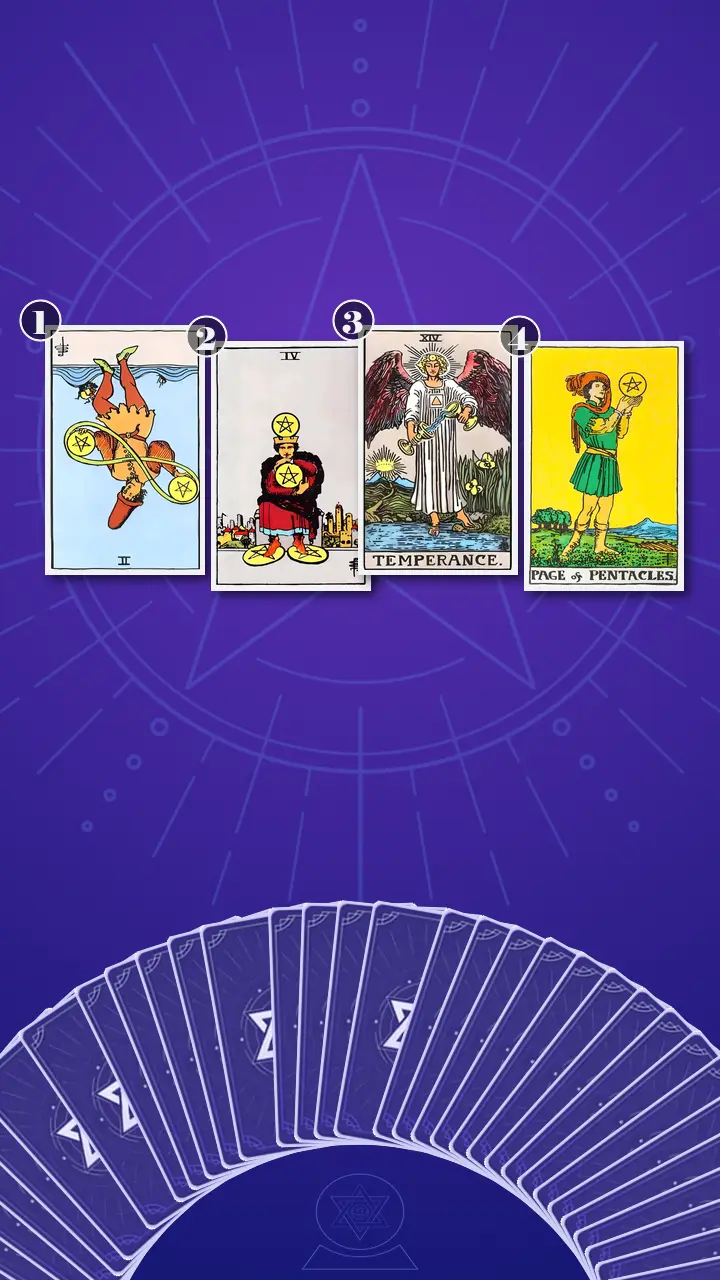
Reading the Map: Motion Without Direction
Position 1: The Loop That Calls Itself Helpfulness
Now the card I turned over was the one representing the visible doorway pattern itself: the urge to start one more chore precisely when leaving time had already arrived. It was the Two of Pentacles, reversed.
In everyday life, this card was almost painfully literal. Jordan was already physically in departure mode, but mentally she was still trying to hold four moving parts at once: the TTC timing, the mug in the sink, the state of the counter, and the fear of feeling scattered the second she stepped outside. The infinity loop around the pentacles felt exactly like the sentence that keeps a one-more-thing loop alive: I can still do this. I can still make it. This will take ten seconds. It has the same energy as having too many tabs open right as your phone battery drops to 5%.
Reversed, the Two of Pentacles shows overload and broken sequencing. This is motion without direction—too much practical energy, not enough clean commitment. Through my Execution Block Dismantling lens, I could hear the dissonant chord immediately: visible mess, countdown pressure, and the promise that one tiny task will create calm. That chord makes starting a chore feel easier than starting the exit, even though the exit is the thing that actually matters.
Jordan let out a quick laugh that had a sting in it. “That’s so accurate it’s rude,” she said. Her fingertips tapped the rim of her water glass once, then went still. That little bitter laugh was recognition arriving before relief.
Position 2: The Unsaved Tab You Refuse to Close
The next card I opened represented the deeper driver underneath the behavior, especially the control-based discomfort of leaving something unfinished. It was the Four of Pentacles, upright.
This is the card that says the mug is not just a mug. Under the late exit sits a control reflex: Jordan feels safer when the apartment, the bag, or the visible loose ends are pinned down before she crosses into the outside world. In modern terms, it’s like refusing to close a laptop because one tab still feels unsaved. The pentacle pressed to the chest shows the internal clutching. The coins under the feet show how staying grounded gets confused with staying clenched.
Energetically, this is rigid earth. Not supportive structure, but overholding. The real block isn’t the chore; it’s the discomfort of walking away while something remains unresolved. So she starts the tiny task, gets a few seconds of relief, and then pays for it with a rushed commute and less trust in her own timing. I said it softly so her body could hear it as much as her mind: “An unfinished mug is not an emergency.”
She didn’t answer right away. First her shoulders rose. Then her breath caught. Then she exhaled slowly and looked down at the card as if it had just translated a language she’d been blaming on “bad mornings.” “Okay,” she said. “So this isn’t random lateness.”
When Temperance Poured Between Two Cups
Position 3: The Handoff Your Body Has Been Skipping
When I turned the third card, the room changed. Even the low refrigerator hum from the kitchenette behind my reading table seemed to fade for a second. This was the card representing the inner shift that could loosen the loop, the antidote at the center of the spread. It was Temperance, upright.
I love Temperance for timing questions because it never lectures. It regulates. The image of water moving between two cups, with one foot on land and one in water, is the exact skill Jordan needed: moving between states without panicking and turning that discomfort into extra tasks. Whenever I see this card, I flash back to my sound-research years in the studio. A track can have beautiful instruments and still feel awful if the transition lurches. Jordan’s mornings felt the same to me. Through my Somatic Rhythm Mapping lens, her tight jaw, shallow breath, and reaching hands were not proof she needed more discipline. They were proof that her departure rhythm was going into arrhythmia right at the doorway, like trying to switch from home Wi‑Fi to mobile data without every app crashing.
She was caught in the exact thought trap this card addresses: coat on, bag on, streetcar time slipping, and somehow the mug in the sink feeling more urgent than her actual departure. The room of her attention got louder the second leaving became real.
You do not need to earn your exit by squeezing one more task into the doorway; pour your energy with intention, like Temperance, and leave while the day is still in balance.
I let the sentence sit. The radiator clicked once. Somewhere outside, a streetcar bell rang, faint and metallic, like the city itself agreeing on the beat.
Jordan’s reaction came in three small waves. First, a freeze: her fingers stopped halfway to the edge of the table, and her breath seemed to miss one count. Then came the replay: her gaze drifted past me, unfocused, as if she were watching a week of near-identical mornings spool back in fast cuts—mug, counter, tote, clock, shame. The feeling broke on the third wave. “But that means I’ve been treating leaving like a final exam,” she said, and there was a flash of irritation in it, the kind that usually hides grief. Her shoulders dropped. Her jaw loosened. She gave one shaky laugh and rubbed quickly at the corner of her eye. “I really thought the extra task was helping.”
“Of course you did,” I told her. “It gave you a quick hit of relief. That doesn’t make you foolish. It makes the strategy understandable.” Then I asked, “Now, with this new perspective, think back to last week. Was there a moment when this would have changed how you felt?”
She nodded almost immediately. “Wednesday. The mug. If I’d written ‘mug after work’ on a note and left, I still would’ve felt twitchy on the streetcar. But I wouldn’t have arrived already mad at myself.” I told her to test the insight instead of trying to perform it perfectly: for the next seven days, when the one-more-thing urge hit, she could write the task on a sticky note or phone note, place it by the door, and leave without doing it. If that felt too activating, she could scale it down to one harmless item or skip the day entirely. The point was to test the pattern, not force herself through distress. That was the real crossing here—from tense restlessness and control-through-busyness toward steadier calm and growing self-trust. The last five minutes are not spare minutes.
The Small System That Rebuilds Trust
Position 4: Practice, Not Punishment
The final card represented the grounded next step: the small repeatable practice that could turn insight into something she could actually use in real life. It was the Page of Pentacles, upright.
I was glad to see it. The Page of Pentacles never asks for a total personality overhaul. It asks for one concrete cue. In Jordan’s life, that meant a leave-now alarm, a sticky note by the door, or a tray for the loose-end items that usually hooked her—mail, receipts, charger, tote-bag chaos. It was streak energy for punctuality, not another Sunday-night reset fantasy or a Notion system abandoned by Thursday morning.
Energetically, this is grounded beginner’s earth. Not the overloaded earth of the reversed Two, and not the rigid earth of the Four, but practical focus. One thing. On purpose. Repeated. I told Jordan this card was inviting her to treat punctuality as a trainable skill instead of a referendum on competence. She smiled in that wary way people do when hope sounds suspiciously simple. “So I don’t need a better personality,” she said. “I need a better cue.” I smiled back. “Exactly. Self-trust grows from clean exits, not perfect rooms.”
From Insight to Action: The Clean Exit Ritual
When I stitched the spread together for her, the story became very clear. Two of Pentacles reversed showed the surface scramble: useful motion appearing at the exact wrong moment. Four of Pentacles showed the engine underneath: unfinishedness registering as a threat to control. Temperance introduced the corrective rhythm: leaving as a protected handoff between states, not a final test. Page of Pentacles brought it down to earth: one visible cue, repeated until the body trusts it. The blind spot was not “I’m bad at time management.” The blind spot was “if I feel discomfort, the task must be urgent.”
The transformation direction was simple and powerful: stop treating the final five minutes as bonus chore time, start treating departure as a boundary, and park unfinished tasks in plain sight for later. In my practice, I call the action version of this Frictionless Tempo Calibration. It’s a three-day micro-habit sequencing experiment designed to change the entry rhythm of leaving without triggering burnout.
- Day 1 — Leave-Now AlarmSet one alarm five minutes before your real departure time and label it “Leave-now is the task.” When it rings, do only three exit actions in the same order: keys, bag, door. No new chores, no tote-bag repack, no “one last text.”If five minutes feels too sharp, start with two. The voice that says “this will take ten seconds” is part of the pattern, not proof that the chore is urgent.
- Day 2 — The Park-It Note MethodKeep a sticky note pad, index card, or Apple Notes widget by the door. If a mug, mail stack, charger cord, or messy bag hooks you after the alarm, write one line—“mug after work” or “repack tote tonight”—and leave without doing it.If your brain insists you’ll forget, take a quick photo of the undone area. One line is enough; do not turn this into a full productivity system.
- Day 3 — The One-Mug ExperimentOn one commute morning this week, intentionally leave one harmless task visible—a mug unrinsed, a blanket unfolded, a pen on the counter. After you arrive, rate how scattered you feel from 1 to 10 and text yourself one sentence: “What did I fear would happen if I left it?”Keep the stakes small. This is about testing doorway procrastination and transition anxiety, not ignoring safety or urgent responsibilities.
I told her the goal was not to become the kind of person who never notices mess. The goal was to prove that she could leave without renegotiating every loose end in her head. In music terms, we were not asking her to play faster; we were changing the count-in so the whole track could enter cleanly. Leave-now is a task, not the gap between other tasks.

A Week Later: The Quiet Proof
A week later, Jordan messaged me from the streetcar: “Left one mug. Wrote it down. Caught the 8:33. Still thought about it for twenty seconds, then it passed.” I could hear the difference even through the screen. Less static. More room.
That was the proof I wanted for her—not a perfect morning, just a cleaner handoff. She bought coffee before work, then had one small flicker of doubt in line—what if the mug was still bothering her at home?—and smiled at the thought instead of obeying it.
This is what a real journey to clarity looks like from my chair. Not magic. Not moral purity. Just a person going from rushed and clenched to more measured and steady because she finally stopped using one more task to soothe the doorway.
When one hand is already on the doorknob but the rest of you is still scanning the room for one more thing to fix, the panic is rarely about the mug itself; it is the hit of walking away without proof that everything is under control.
If departure were allowed to be a clean handoff instead of a final test, what tiny thing might you let stay unfinished the next time you leave?
Every reading at AceTarot is a Journey to connect with inner wisdom and empower next step.
Learn more about our Journey to Clarity.