Caught in the Perfect-Time Trap and Learning to Use Fragmented Time

The 7:12 Perfect-Time Trap
When Alex (name changed for privacy) appeared on my screen, I recognized the pattern before I touched the deck. If you're a late-20s hybrid worker who keeps moving the start time from 7:00 to 7:30 to 8:00, then calling the whole night a wash by 9:10, you're usually not looking at a discipline crisis. You're looking at perfectionism procrastination in real clothes.
Alex was sitting at a dining table in a small apartment near Queen West, laptop half-open, Slack finally quiet. Somewhere just off-camera, a kettle clicked off. The fridge hummed steadily. Mint tea fogged the air in front of the webcam, and the blue light from the screen made the room look colder than it probably was. Alex's shoulders were slightly rounded forward, and their jaw was tight in that very specific way I know from years of watching people try to hold themselves together through uncertainty.
“Why do I wait for a perfect free hour,” they asked me, “and then lose the whole evening?”
They told me what that looked like in practice: 7:12 becomes 8:00, 8:00 becomes 8:37, then comes a quick check of messages, a better playlist, maybe one pass through Notion, maybe one productivity clip that somehow makes the night feel even smaller. By 9:10, they are googling things like deep work after work instead of touching the task itself. They wanted the evening to matter, but they refused to let an imperfect half hour count.
The frustration in the room had the texture of biting down on aluminum foil—sharp in the jaw, bright in the nerves, impossible to ignore, and completely useless as fuel.
I looked at them and said, “You did not lose the evening to laziness. You lost it to negotiations with perfection.” Then I softened my voice a little. “That’s workable. We’re not here to judge your night. We’re here to draw a map through the fog, so you can get your choice back.”

Choosing the Compass: A Four-Card Tarot Spread for Evening Paralysis
I asked Alex to let one long breath out and hold the question in mind exactly as they had asked it, without cleaning it up. Then I shuffled slowly—not as a mystical performance, but as a way to help both of us move from spiraling thought into focus.
For this session, I chose the Situation, Obstacle, Advice, Outcome · Context Edition, a lean four-card tarot spread for after-work perfectionism procrastination. This is how tarot works at its best for me: not as fortune-telling, but as a structured mirror. Alex’s surface problem sounded like time management, but the real issue was deeper—a hidden rule about what counts as valid effort, and a nervous system that only wanted to begin under pristine conditions.
I like this spread because it is the fewest cards that do the job. A larger spread would have added noise. This one gives me exactly what I need: the visible symptom loop, the block underneath it, the mindset shift that breaks the pattern, and the grounded rhythm that can replace it.
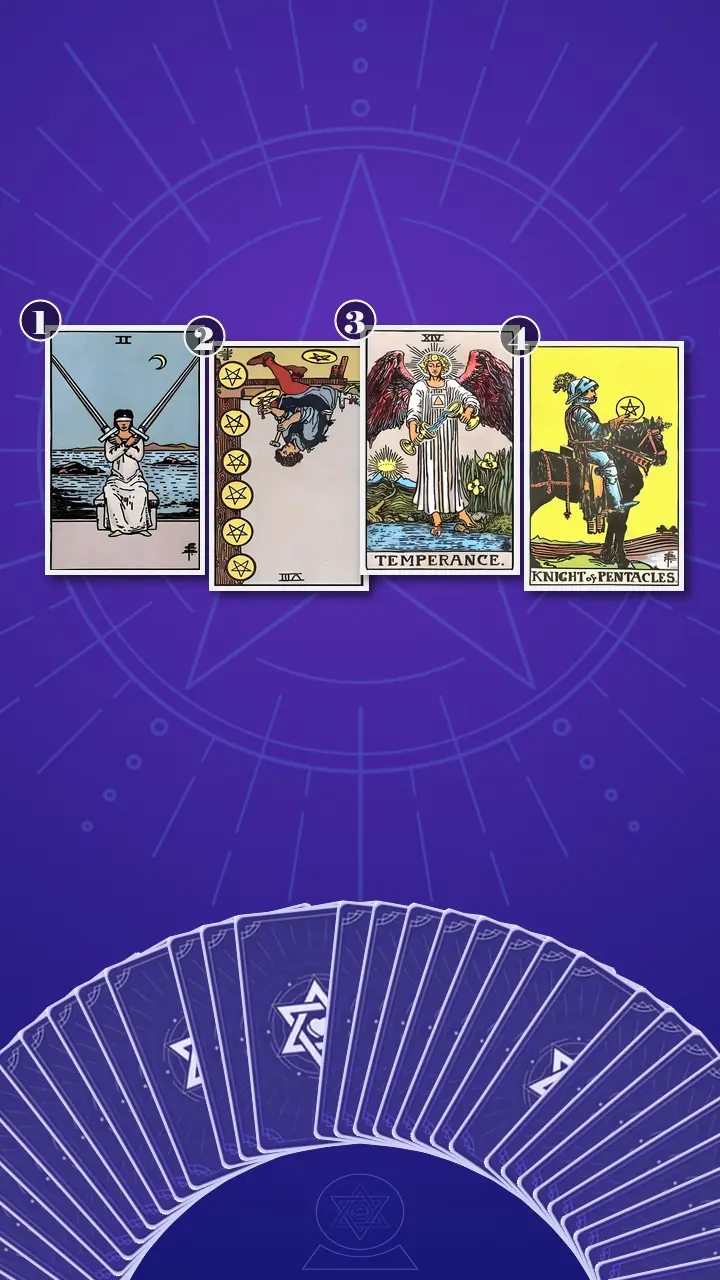
I told Alex what we were looking for as I laid the cards in a straight line from left to right. “The first card shows the stop-start loop you can already see. The second shows the fear or rule keeping it alive. The third is the hinge—the reframe that can actually loosen the grip. And the fourth won’t predict your future like a headline. It will show us what a healthier evening rhythm looks like in ordinary life.”
Reading the First Half of the Night
Position 1: The Pause That Looks Like Planning
I turned the card representing the present symptom loop—the stop-start behavior and the feeling that the evening is slipping away while action stays suspended.
Two of Swords, upright.
I could have translated it straight from Alex’s apartment. It was 7:12 PM after closing Slack, laptop open, checking whether the remaining 48 minutes were enough to make the task worth starting. A couple of harmless messages. A refill of water. A little mental rehearsal of the evening instead of entering it. It looks like decision-making from the outside, but it is really self-protection against the discomfort of a messy beginning.
In energetic terms, this is Air locked up tight. Thought isn’t helping movement here; it is replacing movement. The blindfold tells me uncertainty is being treated as unusable. The crossed swords over the chest show a body already defending itself before the first click, the first sentence, the first rep, the first form field. This is not laziness. It is a freeze response dressed up as being careful.
I asked, “In the last week, what exact time did you keep moving the start to next?”
Alex gave a short laugh, the kind that lands with a little sting. “Eight o’clock,” they said. “Then 8:30. Then 9:10 felt insulting.”
“Right,” I said. “And busy around the task is not the same as inside it.” Their fingers stopped on the mug. Their mouth twitched like they wanted to argue, but mostly because the card had gotten there first.
Position 2: When the Workbench Becomes a Stage
I turned the card representing the main block—the fear and perfectionistic standard that keeps imperfect time feeling unusable.
Eight of Pentacles, reversed.
This one landed with surgical precision. Here was Alex renaming a file, reordering a checklist in Notion, choosing the “right” playlist, reopening the same document, tidying one corner of the desk as if the task needed a cleaner launch bay before it could begin. It had exactly the energy of optimizing a second-brain dashboard and never dragging the actual task into Done.
Earth should be the element of practice, repetition, and useful effort. Reversed like this, Earth gets hijacked by quality control. The session has to look competent from minute one. The setup gets prettier. The work itself remains untouched. That is why the evening feels so full and so empty at the same time.
I asked Alex, “When you think, ‘There’s not enough time,’ what bad outcome are you quietly trying to avoid? Sloppy work? Feeling exposed? Proving you can’t follow through?”
They looked down. “Doing it badly in the first five minutes,” they said. “And then having to sit with that.”
“Exactly,” I said. “The polite sentence is, ‘I’ll start once the setup is cleaner.’ The truer sentence underneath it is, ‘...because if I start badly now, I have to feel it.’”
Alex laughed again, sharper this time, and then their chest visibly dropped. “I do exactly this with my desk and the doc title,” they said. “That’s... wow. Annoyingly accurate.”
“Good enough for tonight is a skill, not a cop-out,” I told them. “And I want to name one more trap here. If you try to solve this by building a military-grade evening routine with zero slack, it may feel amazing for two nights and then collapse into avoidance. That wouldn’t mean you failed. It would just mean the system became one more judge.”
When Temperance Poured Between Two Cups
When I turned the third card, the atmosphere changed. The steam above Alex’s tea had thinned into a pale ribbon. The fridge hum seemed farther away. Even through a screen, I could feel the reading reach its hinge—the place where explanation has to become relief.
Position 3: The Antidote in the Imperfect Hour
I turned the card representing the reframe—the mindset and regulation shift that could move the whole pattern forward.
Temperance, upright.
This is the card I wanted for them. Instead of waiting for 90 clean minutes, Temperance shows an evening becoming usable in pieces: 20 minutes on the admin form, 5 minutes to stretch or refill water, then 15 minutes back on the same task or its next small step. One foot on land, one in water. Real energy and ideal intention do not have to match perfectly before action is allowed. The whole point is blend, not purity.
I said it plainly: “The untouched hour is not the gold standard. It is often the fantasy that keeps the task untouched.”
This is where my old Wall Street brain always flashes in. Back on a trading desk, the expensive mistake wasn’t only a bad trade. Sometimes it was capital sitting idle while carrying costs quietly piled up off to the side. So when I see Temperance here, I run what I call a Time-Asset Valuation. Alex wasn’t only losing 58 minutes. They were paying hidden sunk costs in jaw tension, comparison fatigue, self-doubt, and tomorrow’s heavier task. The highest-ROI move was not a pristine, uninterrupted hour. It was converting dead waiting into live contact.
I looked at Alex and said, “You have seen this movie: 7:12 becomes 8:00, 8:00 becomes 8:37, the tea gets made, the list gets rewritten, the phone gets warm in your hand, and somehow the task still never gets touched.”
Stop worshipping the untouched hour and start blending the minutes you actually have, just as Temperance makes movement by pouring between cups.
Then I let the silence hold for a second before I added, “The evening is not disappearing because you lack discipline. It is disappearing because only a flawless hour earns your permission to begin.”
Alex’s reaction came in three clear waves. First, a physical freeze: their hand stopped halfway to the mug, and their breath clipped short. Then the realization moved inward: their eyes lost focus for a moment, like they were replaying a private montage of 7:12, 8:05, 8:37, one sock still on, the radiator ticking, Reels warm in their palm. Then the feeling broke the surface—not relief first, but resistance. “But if that’s true,” they said, voice suddenly sharper, “doesn’t that mean I’ve been making this worse?”
I answered immediately, because this is where people can turn an insight into self-attack if no one steadies the frame. “It means you learned a rule that promised control and charged you interest. That is not the same as being broken. We can renegotiate rules.”
I kept going, gently but directly. “Tonight, choose one task and write a one-line ‘good enough for tonight’ version before you do anything else. Then set a 10-minute timer and touch only the first visible step before checking the clock again. If that feels too activating, stop at 10, count it anyway, and leave the task open for tomorrow rather than turning the exercise into a punishment.”
Then I asked, “Now, with this lens, can you think of a moment last week when 17 honest minutes would actually have counted?”
Alex stared at the card, then nodded slowly. Their shoulders lowered a notch. The jaw unclenched. There was even that faint, strange dizziness that sometimes follows clarity—the moment a burden lifts and responsibility rushes into the newly empty space. “The insurance claim,” they said. “I could have filled line one. I didn’t need to make it a whole evening event.”
That was the turning point. Not a miracle. Not a personality transplant. Just the first real move from negotiating with the clock to entering the task, from clock-watching frustration and guilt to steadier self-trust. Readiness mode was loosening. Participation had entered the room.
Position 4: The Plain Rule That Beats Mood
I turned the final card representing the embodied rhythm—the way this insight could look in ordinary evenings if Alex actually lived it.
Knight of Pentacles, upright.
This card is wonderfully unglamorous. Over the next few weeks, it looks like the same chair, the same cue, the same one-task focus, the same rule: 20 minutes first, evaluation later. No dramatic productivity montage. No life-reset vlog. Just a calmer, sturdier pattern—closer to Duolingo streak energy than a total identity overhaul.
Energetically, this is healthy Earth at last. Not the reversed Eight’s workmanship theater, but grounded follow-through. The still horse matters to me here. It says progress does not need hype, adrenaline, or the perfect mood. It needs steadiness.
I asked, “What single default rule would make starting easier than negotiating tomorrow night?”
For the first time in the session, Alex answered without pausing. “Twenty minutes before I get to decide the night is ruined.”
I smiled. “That’s your Knight of Pentacles. Reliable beats intense. Repetition beats the fantasy of the perfect night.” Their face had changed by then—not euphoric, just calmer. The kind of calm that makes a person look a little more like themselves.
From Insight to Action: Your Next 48 Hours
Once all four cards were on the table, the story was clean. The Two of Swords showed the defended hover: the evening technically available, but emotionally unopened. The reversed Eight of Pentacles showed the hidden rule underneath it: if effort cannot look competent and uninterrupted from the first minute, it does not count. Temperance broke that all-or-nothing time logic by treating fragmented time as a real entry point. The Knight of Pentacles translated that insight into a low-drama routine. In other words, Alex’s blind spot was not a lack of hours. It was the belief that control had to come before contact. The direction of change was the exact opposite: first touch before verdict.
I gave Alex three next steps—small, testable, and deliberately boring enough to work on an ordinary Toronto weeknight.
- Good-Enough-for-Tonight Sentence Tonight, at the desk or on the couch where you usually stall, pick one task and write a one-sentence version of it in Notes or on a sticky note before opening any extra tabs. Example: “Fill line one of the expense claim” or “Draft the ugly first paragraph.” Give it 60 seconds, max. When your brain says it is too small to matter, answer it with the truth: small imperfect starts are a real unit of progress.
- 20-5-15 Blend Session Once this week, run one Temperance session: 20 minutes on the task, 5 minutes to stretch, eat, or refill water, then 15 minutes back on the same task or its smallest next step. Put the phone face-down or in another room before you begin. If 20 feels too exposed, shrink it to 7-3-7. The goal is contact, not heroic output.
- 48-Hour Energy Portfolio Restructuring For the next 48 hours, subtract one high-friction habit from your danger window between logging off and starting—usually Reels, desk-reset videos, or endless Notion tweaking—and reinvest that exact slice into one plain rule: 20 minutes first, evaluation later, in the same chair with the same cue. A phone alarm labeled “First touch, not final form” works well. Track starts, not outcomes, with one checkmark each night. If you miss one, restart the next night without backfilling guilt.
I also told Alex something I wish more perfectionists heard: actual rest is allowed. What I never want is fake resting—the kind where the body is on the couch but the nervous system is still litigating the task. That is what I call bandwidth bankruptcy, and it drains people twice. If a night really needs recovery, choose recovery on purpose. Do not make shame wear pajamas and call it rest.

A Week Later: Ownership, Not a Perfect Hour
Five days later, Alex sent me a message with a screenshot of three small checkmarks in their Notes app. “Did the good-enough sentence before touching Notion,” they wrote. “Twenty minutes on the insurance form, five to refill water, fifteen on reading. It felt almost offensively normal. But I didn’t lose the night.”
The next morning, their first thought was still, What if tonight goes sideways again? But this time they smiled, opened the form before Instagram, and let ten minutes count.
That is the journey to clarity I care about. Not becoming a different person in one inspired evening. Not proving worth through a flawless block of time. Just reclaiming the ability to start before certainty arrives. That is why I trust a situation-obstacle-advice-outcome tarot spread like this one: it does not hand your power to the cards. It hands your leverage back to you.
There is a very specific loneliness in sitting under apartment light with your laptop open, shoulders tight, wanting the night to matter and still feeling like you need a cleaner version of yourself before you can begin. If you recognize yourself there, I hope you remember what Alex learned: the night does not have to be pristine to be usable, and you do not have to earn your first step with perfection.
If tonight did not have to prove anything about you, what would your smallest honest first pour look like?
Every reading at AceTarot is a Journey to connect with inner wisdom and empower next step.
Learn more about our Journey to Clarity.