Feeling Stuck in a Stable Job: From Drafts to One Honest Ask

Feeling Stuck in a Stable Job, With Everything Still in Drafts
I often begin a reading by saying, “You can be competent at your job and still feel your life narrowing around it.” Jordan (name changed for privacy) looked down when I said it, as if the sentence had found a private tab she had forgotten to close.
At 8:52 p.m. on a Sunday in her Toronto apartment kitchen, she was refilling the dishwasher while scrolling through a saved career-pivot post. The blue phone light washed over the damp plates; detergent and warm metal hung in the air beneath the dishwasher’s steady hum. Her throat tightened when she imagined Monday morning, yet she told herself that opening one more advice thread was safer than admitting she wanted a different direction.
Jordan worked as a junior operations coordinator. She was reliable, capable, and quietly aware that her role offered little visible progression. After work, she moved between Notion dashboards, saved articles, familiar television, and half-written messages she never sent. She could explain her routine perfectly, but when I asked what she wanted next, she gave me the practical answer first.
“What am I holding back as I drift toward a dead-end life?” she asked. Then she added, “I keep waiting for a clear answer before I let myself move.”
I heard the contradiction beneath the question: she wanted to understand what she was withholding, but feared that naming a different desire would expose her as incapable of building a worthwhile life. The feeling did not sit in her like an abstract problem. It had the texture of a TTC loop: the scenery changed, the brakes squealed, the announcements came and went, but every route returned her to the same starting point.
“I know that loop,” I told her. My years in high-stakes finance had taught me how uncertainty can become physically heavy after dark, and my work now was to make uncertainty less isolating, not more frightening. “We do not need to force a life decision tonight. We can use the cards as an objective map of the pattern, then let you decide what deserves a small real-world test. Our journey is toward clarity, but you remain the person steering it.”

The Narrow Staircase into the Shadow
I invited Jordan to put her phone face down, take one slow breath, and hold the question without trying to improve it. I shuffled slowly, treating the movement as a transition into focused attention rather than a supernatural performance.
“I’m using The Shadow Spread,” I explained. “It is a four-card tarot self-exploration layout for understanding what is being held back. It follows the pattern from visible behavior, to the protective root beneath it, to an integrating resource, and finally to a small release practice.”
I explained this to Jordan and to anyone reading along because this is also how tarot works in a responsible consultation: the cards give us symbols and relationships to examine, not an irreversible prediction. This spread fits a directionless routine and emotional withholding more precisely than a broad Past-Present-Future line. It keeps our attention on the mechanism of feeling stuck: what Jordan does, what she is protecting, what quality can soften the pattern, and what action can create feedback.
The first position would show the Visible shadow, the behavior that revealed what she was holding back. The second would uncover the Root attachment, the fear or need for control sustaining the pattern. The third would be the Integrating resource, the quality that could turn a contained feeling into useful information. The fourth would point to a Release practice, a proportionate action rather than a dramatic announcement.
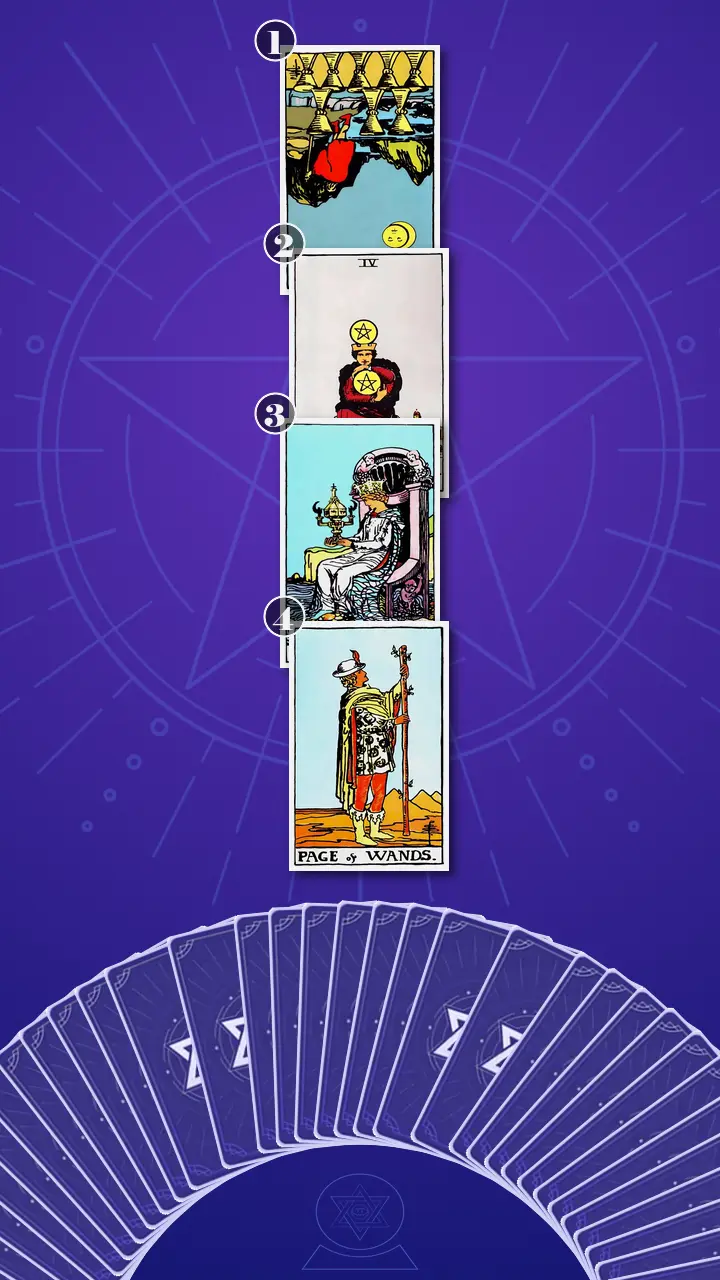
The Cups She Kept Turning From
The Visible Shadow: Eight of Cups, Reversed
“Now I’m turning over the card for the visible shadow: the behavior that shows what you are holding back, including the repeated postponement and return to the same routine.”
The card was the Eight of Cups, reversed.
In the Rider-Waite-Smith image, a figure walks away from eight stacked cups beneath a moonlit sky, but the reversed orientation interrupts the departure. The figure senses that the cups no longer provide enough meaning, yet the path remains contemplated rather than travelled. In Jordan’s life, this was the moment she knew her competent weekday routine felt emotionally empty, opened another advice thread, and turned away before the feeling became a conversation or a small experiment.
I connected the image to the 6:18 p.m. TTC Line 1 ride she had described. She would watch a former classmate announce a creative project on LinkedIn while fluorescent lights buzzed above her and the train brakes squealed into the station. She would type “good for you,” send it, and then feel her chest grow heavy as the thought arrived: I can see what feels empty, but I keep waiting before I let it count.
This reversed Water energy is blocked movement. It is not a command to quit her job or abandon stability. It shows a feeling that wants acknowledgment but keeps being translated into research, lists, and postponed drafts. The blockage maintains the dead-end sensation because Jordan receives no direct experience to challenge her assumptions. She keeps looking for evidence while avoiding the one kind of evidence that can only come from contact with a possible direction.
Jordan gave a short laugh with a bitter edge. “That’s too accurate. Almost cruel.”
I did not defend the card or ask her to agree with it. “Let’s keep the useful part and leave the cruelty out,” I said. “The card is describing a loop, not judging you for being in it. What feeling do you turn away from just before you call yourself confused?”
She looked at the card, then at the phone she had placed beside her. Her thumb rubbed the edge of the case. The image had not delivered an answer from outside her; it had made a familiar behavior visible enough for her to question.
“A plan is not the same thing as movement,” I said. “The first honest movement may be as small as letting one sentence exist outside your head.”
The Grip Around Stability
The Root Attachment: Four of Pentacles, Upright
“The next card is for the root attachment: the underlying fear and need for control that keep the emotional withholding in place.”
I turned over the Four of Pentacles, upright.
The figure in the Rider-Waite-Smith image presses one pentacle against the chest, pins two beneath the feet, and balances another above the head. I saw Jordan’s rent autopay, dependable salary, predictable calendar, and carefully maintained identity as the sensible one. The coins were not foolishness. They were real supports. But in this position, Earth had become so rigid that protection was starting to substitute for movement.
“You are not only holding back a feeling,” I told her. “You are holding the feeling against your chest while asking stability to prove that you are safe and worthwhile. That is why the word practical may be doing two jobs. It describes genuine responsibilities, and it protects you from the exposure of wanting something you cannot yet guarantee.”
Jordan’s shoulders lifted. “But I do have rent. I cannot just turn my life upside down because I feel restless.”
“I agree,” I said. “A responsible reading does not confuse emotional honesty with impulsive escape. The question is not whether stability is wrong. The question is whether you have made stability the price of remaining unspoken.”
First, her breath stopped halfway in, and her fingers hovered above the phone. Then her eyes lost focus as if she were replaying the many times she had said, “Everything is fine, just busy,” while deleting the longer message. Finally, her jaw loosened and a quiet exhale left her chest. She nodded once, with recognition and a little grief.
“I call it being realistic too,” she said.
“Staying practical can become a way of staying unspoken,” I replied. “That does not make practicality your enemy. It tells us where to separate a real constraint from a protective story about what your desire would supposedly prove.”
I thought of my years on a trading floor, where every position carried both a current value and a history of previous investment. A position could be familiar, expensive, and still deserve a fresh assessment. Sunk cost was information about the past, not a contract governing the future. I kept that thought brief; Jordan did not need a lecture. She needed permission to distinguish what she had built from what she still wanted to build.
When the Queen of Cups Asked Her to Listen
The Integrating Resource: Queen of Cups, Upright
The room became unusually quiet when I reached for the third card. Even the traffic outside seemed to recede, leaving the soft click of the radiator and the pale reflection of the kitchen light on the table.
“This is the integrating resource,” I said. “It shows the quality that can illuminate the shadow without demanding that you suppress the feeling or obey it impulsively.”
The card was the Queen of Cups, upright. Her ornate covered cup rested in both hands. Her throne stood beside moving water, and her gaze was calm, attentive, and unhurried. She did not fling the cup open. She did not turn away from it either.
I explained that the Queen of Cups offered Jordan a third way. She could let the sentence I want a life with more direction be privately true before converting it into a resignation, a public announcement, or a five-year plan. A feeling could be witnessed before it became a decision.
At this point I used my signature lens, Strategic Path Valuation. I do not use it to assign a financial return to an emotion. I use it to separate a direction’s possible long-term learning, fit, and scalability from the impossible demand to guarantee its success in advance. The Queen’s covered cup became the first piece of reliable data: not a verdict, not a forecast, but a signal worth holding steadily enough to investigate.
Jordan was still trying to make certainty arrive before movement. The Toronto kitchen was warm, her phone was still face down, and the draft message still existed. The old thought tightened around her throat: If I name it, I have to fix it. I waited until she looked directly at the covered cup.
You do not need to stay still until certainty arrives; name the feeling you have contained and let the Queen's covered cup guide one honest experiment.
The sentence remained between us. Jordan froze first: her inhale caught, her eyes widened slightly, and both hands closed around the edge of her sleeve. Then recognition moved through her face as though an old memory had begun playing without sound. I watched the tension travel from her brow to her shoulders, where it finally began to drain. Her eyes grew bright, but she did not look away.
Her fists opened one finger at a time. The first sound she made was not a triumphant laugh but a low, uncertain “Oh.” She pressed a palm to her sternum and breathed out with a small tremor. Relief arrived alongside a moment of dizziness: if she did not need to solve everything tonight, she was free to choose, and that freedom carried responsibility. The blank space after the insight felt vulnerable rather than magical. Nothing had been fixed. Something had stopped being hidden.
“A contained feeling can be information before it becomes a verdict,” I said. “Now, use this new perspective to remember whether there was a moment last week when seeing the feeling this way might have changed what you did next.”
Jordan stared at the card. “At lunch on Thursday, a friend asked what I wanted. I said I was figuring it out. Under that, I think I felt envious. And curious. Maybe sad that I have been acting like wanting more is embarrassing.”
“That is the shift,” I said. “You have moved one step from stagnant self-questioning toward compassionate self-honesty. The feeling is no longer proof that you are failing to build a worthwhile life. It is information you can carry while you learn.”
The Small Flame That Makes Direction Testable
The Release Practice: Page of Wands, Upright
“The last card is the release practice: the conscious next step through which the shadow can become usable energy.”
I turned over the Page of Wands, upright.
The Page held a sprouting wand at eye level, studying a living signal rather than pretending to have mastered it. The salamanders on the tunic suggested contact with an unfinished experience, not proof of permanent transformation. In Jordan’s week, this could be one exploratory message, one relevant event, or one hour spent testing a saved interest.
“This card does not promise a final calling,” I said. “It asks you to let curiosity produce evidence. The result is feedback, not a referendum on your worth. You do not need a five-year plan to run a one-hour experiment.”
Jordan picked up her phone, then set it down again. “What if I choose the wrong experiment?”
“Then you learn something proportionate,” I said. “The Page is allowed to be a beginner. Your first test is not a binding identity statement. It is simply a way to stop asking private analysis to do the work of direct experience.”
She wrote one phrase on a blank page: I am curious about work that lets me build and improve something visible. Her handwriting was small and uneven. For the first time that evening, the unfinished sentence did not look like evidence against her. It looked like a live signal.
From the Covered Cup to a Live Signal
When I placed the four cards in a line, the story became clear. The reversed Eight of Cups showed the first turn away: Jordan noticed emotional emptiness, then returned to the familiar schedule before the feeling could count. The Four of Pentacles revealed why: salary, rent, competence, and the identity of being sensible had become a tight protective structure. The Queen of Cups offered the bridge, allowing the contained desire to be witnessed without forcing a dramatic choice. The Page of Wands carried that honest feeling outward as a small test.
The blind spot was not simply that Jordan lacked direction. She had been treating uncertainty as evidence that no desire was real, while treating more research as evidence that she was moving. The deeper issue was fear of exposure: if she admitted she wanted another path, she might have to discover whether she could create a worthwhile life around it. The reading’s direction was therefore not leave immediately. It was to replace private analysis with one named feeling and one low-stakes conversation or experiment each week.
I used Sunk Cost Decoupling to make the distinction practical. Jordan could respect the time she had invested in operations, the skills she had gained, and the security her role currently provided without allowing those past investments to dictate every future possibility. The question was not, “Was the old path a mistake?” It was, “What can this path teach me while I gather honest evidence about the next one?”
Then I gave her my 5-Year Horizon Stress Test, adapted to protect the scale of the experiment. Within seventy-two hours, she would make a calculated Hold-or-Pivot micro-decision: hold the current job while testing one adjacent possibility, or pivot one hour toward a specific interest. She would not resign, announce a reinvention, or ask the cards to choose for her. She would create a small amount of contact with reality.
- Name the contained feelingOn Tuesday after work, Jordan would place her phone face down and spend two minutes writing, “Under I am stuck, I notice ___; what I may be longing for is ___.” She would add one body observation, such as a tight throat or heavy chest, without explaining it.Keep the note private and use an ordinary word such as flat, restless, envious, or curious. No interpretation is required; she could stop whenever the exercise felt too exposed.
- Give the feeling a safe witnessThis week, she would text one trusted person: “I have been keeping something about my direction private. I am not asking you to solve it; can I say it out loud for fifteen minutes?” She would share one honest sentence without announcing a resignation or asking the other person to decide for her.Choose someone who listens without taking over. If sending the message felt too vulnerable, Jordan could write it in Notes, send only the first sentence, or keep the conversation private.
- Run a one-hour direction experimentWithin seventy-two hours, she would apply the 5-Year Horizon Stress Test and choose one saved interest, local event, informational chat, short class, or small creative task. She would give it one contained hour, then record what held her attention, what drained it, and what she wanted to test next.Define success as contact with the experience, not proof that it is her calling. She could leave early, change her mind, or learn that the option had no energy.
I reminded Jordan that tarot could help her explore emotional withholding and feeling stuck because symbols can reveal relationships that ordinary self-talk keeps flattening. But the cards did not create her desire, and they could not own the consequence of acting on it. Their value was in helping her see the pattern clearly enough to make her own next move.

A Week Later, the First Card Moves
A week later, Jordan sent me a message: “I did the two-minute note, then asked Maya for fifteen minutes. I told her I am curious about process design, not that I have my life figured out. She mentioned a cross-team project, and I asked if I could observe one meeting.”
The change was small enough to miss from the outside. She had not solved her career, and she still had a stable job with no guaranteed promotion. But she had allowed one feeling to become a conversation and one conversation to become evidence.
That night, Jordan slept more deeply. In the morning, her first thought was still, What if I am wrong? She smiled at it, made coffee, and opened the message she had drafted. The clarity was real, but it was not complete. It was a little more room around her throat, a less crowded future, and the quiet knowledge that she could learn without staking her whole identity on the answer.
I think of that as the real Journey to Clarity: not a prediction that removes uncertainty, but a movement from private analysis and protective stagnation toward compassionate self-honesty, grounded experimentation, and self-trust built through lived feedback. Jordan remained the author of the direction. The Shadow Spread simply helped her notice where the next sentence was waiting.
If Sunday night leaves your throat tight and your chest heavy, it may feel safer to keep analyzing what you want than to say it aloud and risk discovering whether you can build a worthwhile life around it. Even noticing that protection is already a small departure from the old loop.
So if one named feeling could be information rather than a verdict, what small conversation or one-hour experiment would you feel quietly curious enough to imagine this week?