When Certainty Was the Test, One Real Attempt Changed the Question

Finding Clarity in the 10:18 p.m. Portal Spiral
I have sat with enough bright, tired twenty-somethings to know that if you're a mid-20s London office worker reopening the application portal after work, tweaking the top third of your CV, and calling it strategy when it's really readiness paralysis, this will feel uncomfortably familiar.
Maya (name changed for privacy) told me about 10:18 p.m. on a Wednesday in her rented Zone 2 flat: the laptop open to the application portal, the overhead bulb staining the kitchen table a tired yellow, one cold mouthful of tea beside the trackpad. She would rewrite the first line of her statement, click over to LinkedIn, read one post that began with "Excited to share...," then snap back to the draft with her chest pulled tight as drawstrings and her fingers skittering over the keys like they wanted both to hit submit and slam the screen shut.
"I don't want to miss the window," she told me. "But I also don't want to embarrass myself."
That was the whole knot. She wanted to apply this round, and she was frightened that applying before she felt perfectly ready would make her worth negotiable in public. Her self-doubt sat in her like wet wool wrapped around the ribs: heavy, itchy, and impossible to forget once it was there. Her current marketing job was stable enough to stay in, not alive enough to stop her imagining a different next chapter.
I nodded. "Then let's not treat this like a verdict," I said. "Let's make it a map. We are not here to force certainty. We are here to find clarity."

Choosing the Compass: A Decision Cross for Application Readiness
I asked her to put both feet on the floor and breathe once with the question in plain language: Should I apply this round, or am I rushing before I'm ready? Then I shuffled slowly. Not as theatre, and never as a demand for belief, but because a scattered mind often needs a physical pause before it can tell the truth.
I chose the Decision Cross · Context Edition, a tarot spread for application readiness and career timing that I use when the dilemma is not really about two external options, but about one desire and the story fear tells about timing. This is how tarot works best in my practice: not as fate, but as structure. The spread keeps the problem tight enough to be useful. It separates the present freeze from the pull to act, the pull to delay, the deeper truth above the spiral, and the grounded next step below it.
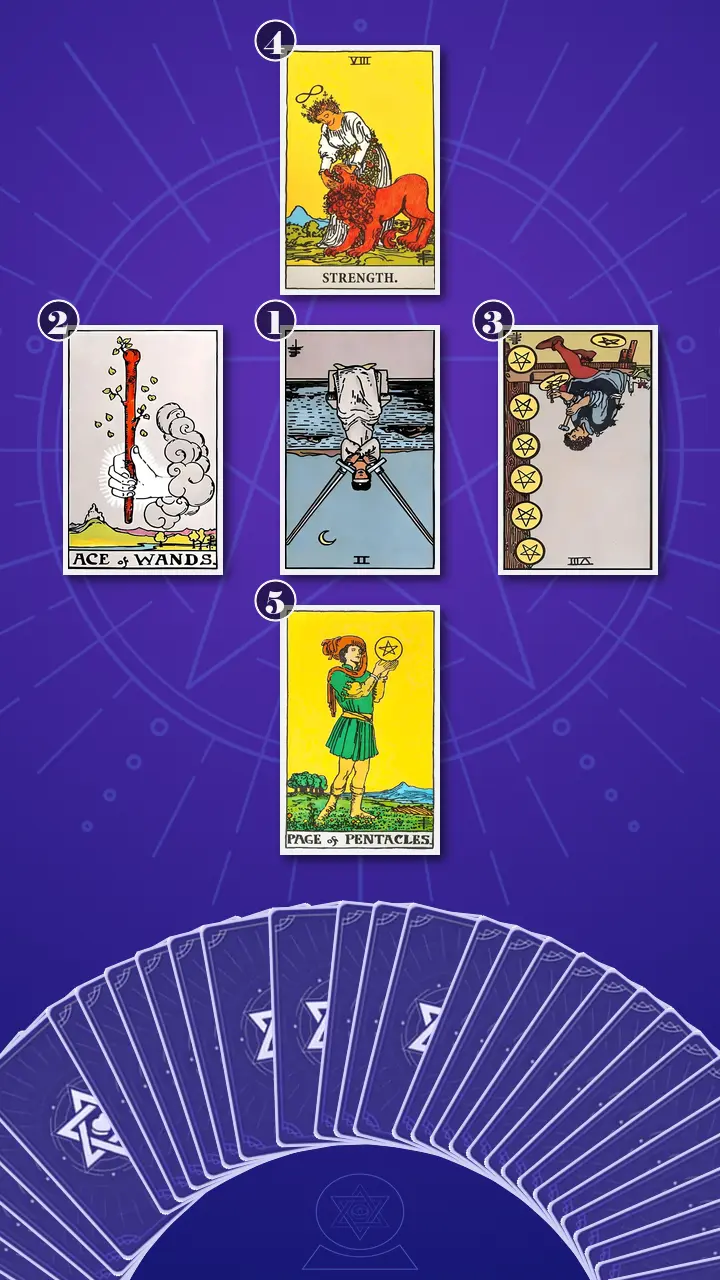
I told Maya that the center card would show the threshold where her stop-start behavior was most visible. The cards to the left and right would separate the honest wish to apply from the protective urge to wait. The card above would tell us what readiness actually means here. And the card below would translate the whole reading into one actionable next step.
The Tabs That Kept Calling Themselves Strategy
Position 1: The Loop That Protected Her From Being Seen
I turned over the card representing the current application threshold where overthinking and stop-start behavior were most visible. It was the Two of Swords, reversed.
In modern life, this card looks exactly like the browser-tab trinity Maya had already described: the application portal open, the notes app open, LinkedIn open, and no real movement happening between them. It is blocked Air leaking into agitation. She was not short on ambition. She was trying to make a real decision from inside a sealed loop where every sentence got pre-judged before it had the chance to become a full answer. It was like keeping the task in Notion's Planning column so long that the board looked productive while nothing actually moved.
The blindfold, the crossed swords over the chest, the still water under the moon—every symbol said the same thing to me. Analysis had become armor. The pause felt intelligent because it kept the attempt private. But private is not the same as clear. Fear is not proof you're early.
When I asked her where her body braced first, she touched the center of her sternum without thinking. Then she gave a short laugh, the kind with a little bitterness in it. "That is uncomfortably specific," she said. "I keep telling myself I'm being responsible."
"Of course you do," I said. "Calling it fear would sting. But the loop has a job. It protects you from being seen before you feel polished."
Position 2: The Spark She Kept Explaining Away
The next card was the one that reveals the genuine impulse behind applying this round, separate from panic or comparison. It was the Ace of Wands, upright.
This card is the quick bright jolt she feels when she reads the listing and, before the inner critic barges in, thinks, I could actually do this. That spark is not fake. It is not vanity. It is not just comparison fatigue dressed up as ambition. It is balanced Fire—clean, alive, directional. The hand emerging from the cloud and the sprouting wand told me there really was an opening here, and some part of her recognized it faster than her fear could drag her into job-title stalking and silent self-benchmarking.
I told her that London is especially cruel about timing because the city trains people to live by a social clock. One person's acceptance, promotion, or glossy "Excited to share..." post starts to feel like everybody else's deadline. In my work, I call the untangling of that pressure Social Clock Decoupling: taking your worth back from artificial milestones. What her peers posted was data about their path, not a ruling on hers.
Her face softened by a degree. "So wanting it isn't the problem?" she asked.
"No," I said. "Wanting it is the honest part."
Position 3: When Preparation Turned Into Proof-Building
The third card was the one that reveals what waiting until feeling ready is protecting, including the perfectionistic fear hidden inside caution. It was the Eight of Pentacles, reversed.
I could see her Sunday evening at once: CV open at 125 percent, shoulders up near her ears, swapping one verb for another while the rest of the application sat unfinished in the same harsh screen glow. This is Earth energy distorted into compulsive proof-building. Preparation stops serving quality and starts serving self-protection. Instead of using skill to support the application, she was using refinement to postpone the vulnerable moment when someone else might finally read what she had made.
The craftsman bent over one pentacle mirrored her perfectly—Google Doc named statement_final_v7, perhaps even CV_new_final_FINAL, lovingly reworked in private because privacy feels safer than feedback. I told her gently, "A private perfect draft can't answer a public question."
Her stomach seemed to drop before the rest of her did. She leaned back, let out a slow breath through her nose, and stared at the spread. "That's exactly what I've been doing," she said more quietly. "Working hard enough to feel virtuous. Not moving enough to risk anything."
By then the horizontal line of the spread was clear to me: frozen Air at the center, real Fire on one side, overcontrolled Earth on the other. Her ambition was not the problem. The container around it was.
When Strength Put a Hand on the Lion
Position 4: Readiness, Redefined
When I reached for the fourth card, the room altered in the small way good readings do. The radiator gave one last tick and went quiet. Rain brushed the window once and seemed to stand back. This was the card above the whole cross—the one that clarifies what readiness actually means in this case and challenges the fear that worth must be proven before action.
I turned it over. Strength, upright.
I saw her usual evening spiral as clearly as if it were happening in front of me again: the portal open, the CV half-tuned, the deadline suddenly close enough to count in days, LinkedIn whispering that everybody else had moved faster, her hands busy enough to feel productive without actually finishing anything. She had been using certainty as the test for readiness.
Readiness is not a locked gate you must force open. It is the calm hand of Strength, choosing steady contact with the lion instead of letting fear decide the timing.
I let the sentence sit between us.
For a second, Maya stopped moving entirely. Her thumb stayed suspended against the mug handle. Her eyes slipped past me and lost focus, as if she were replaying some late-night kitchen-table ritual in reverse. Then her jaw set before it softened. "But doesn't that mean I've been reading myself wrong this whole time?" she said, and anger came first, grief just underneath it. "Like I've been treating normal nerves as a stop sign."
"Not wrong," I said. "Protective. But yes—misread." After sixty-seven years of watching people confuse a trembling body with bad timing, I no longer trust fear when it tries to speak like a calendar. "In my Seasonal Energy Diagnostics, this is what it looks like when someone asks a spring action to arrive with autumn proof. An application is a seed-level move. You have been demanding harvest certainty before allowing yourself to plant."
I watched that land. Her eyes brightened, not dramatically, just enough to catch the yellow lamplight. Her shoulders dropped half an inch. One hand flattened against her thigh as if she were checking whether she was still in the room. She took a longer breath—shaky on the way in, steadier on the way out—and the release in her body came with that odd little lightheadedness people feel when a brace they have worn for months suddenly loosens. Clarity had arrived, but with it came a newer, more vulnerable feeling: responsibility. Once the path is visible, the choice is yours again.
"You can be shaky and still be serious," I told her. "You do not need the fear gone. You only need it not driving."
I asked her, "If you had held this view last Thursday, when you closed the portal again, what would have changed?"
She looked down at Strength and gave the smallest, strangest smile. "I think I'd have stayed in the tab," she said. "Maybe not calm. But not leaving."
That was the turning point. Not from fear to fearlessness, but from tight self-doubt to the first real muscle of self-trust. Readiness is built in the attempt, not proven in advance.
The Pentacle on the Desk
Position 5: The Beginner Who Actually Moves
The final card was the one that translates insight into one grounded next step that builds self-trust without demanding total certainty. It was the Page of Pentacles, upright.
I love this card in career readings because it takes all the grand drama out of them. In modern life, it is one checklist, one feedback ask, one submit window. Constructive Earth. Not proving, not performing—just attention on the next real task. The Page does not ask, "Am I already enough to deserve the mountain?" The Page asks, "What is the next line item?"
That mattered because Maya's blind spot was not lack of ability. It was treating the application like an identity referendum instead of a learning step. Submitting gives you data, not a verdict on your value.
When I said that, she gave a slow nod and finally uncrossed her ankles. It was such a small movement that most people would have missed it. I did not.
From Insight to Action: The Ready-Enough Submission
The Story the Cross Actually Told
When I looked at the full spread, the story was clean. At the center sat threshold freeze: Maya kept opening the application and closing it because the moment it started to feel public, her nervous system translated exposure into danger. To the left, the Ace of Wands showed that the desire to apply was genuine. To the right, the reversed Eight of Pentacles showed the defense: if she polished long enough, maybe she could avoid ever feeling underqualified in public. Above them, Strength corrected the false definition of readiness. Below them, the Page of Pentacles brought the answer back down to earth.
The cognitive blind spot was simple and sharp: she had been letting body fear define timing, and letting outcome impersonate worth. The transformation direction was equally clear: stop using certainty as the test for readiness, and use a bounded, values-led application attempt to build readiness through action. The spread did not tell her to rush. It told her to stop treating endless private preparation as wisdom.
Because the real blockage was compulsive proof-building, I folded in one of my own practices and turned it toward the spiral itself: The Winter Dormancy Ritual. For one week, the part of Maya that kept trying to become more qualified would go dormant. No new courses, no fresh certifications, no total CV identity overhaul. She was allowed only the tasks that moved this actual application forward.
The plan I gave her
- The 90-Second Strength Reset Before her next application session at her kitchen table, Maya was to put both feet on the floor, rest her hands on the desk instead of the keyboard, take three slow breaths, and name the feeling in one plain phrase: "scared of being seen too early," "worried I'll look underqualified," or whatever was true. Then she was to complete one real action within 90 seconds—answer one question, attach one document, or paste one final paragraph. If her body flooded, she could stop after the breathing and count that as the rep. The goal was regulation, not self-improvement theatre.
- The Two-Pass Proof Limit She was to choose one material this week—either her CV or one written response—and cap it at two full edit passes. After pass two, she had to send it to one trusted person, not a committee, with one specific question: "Does this sound clear and credible?" Put the edit cap somewhere visible. Feedback supports submission; it does not replace it.
- The One-Page Ready-Enough Window For the next seven days, she was to do nothing aimed at becoming "more qualified" for this round. Instead, in one note only, she would make three columns—Pros, Fears, Unknowns—circle only what could be acted on this week, choose one circled task, and set one actual submit window before closing the laptop. Dormancy is not laziness. It is how you stop feeding the loop that calls itself preparation.
These were not magic tricks. They were small structures designed to put the steering wheel back in her hands. That is the only kind of clarity I trust: the kind that leaves you more able to choose.

A Week Later: The Quiet Proof
A week later, a message from Maya lit up my phone while I was deadheading sweet peas by the back step. "Sent it last night," she wrote. "Heart went absolutely mental. Still sent it."
She had used the two-pass limit on her CV, asked one former manager one clean question, and given herself a Friday 7 p.m. submit window. She did not celebrate like the heroine of a productivity reel. She sat alone in a café near Holborn with a brownie she said was only okay, stared at her sent folder for three minutes, and then felt her shoulders drop.
The next morning, she told me, her first thought was still, What if I aimed too high? But this time she smiled at the thought instead of obeying it.
That is the Journey to Clarity I believe in. Not instant certainty. Not a guaranteed result. Just the quiet movement from self-doubt to self-trust, from perfectionistic delay to grounded follow-through, one real act at a time.
If tonight, as the deadline edges close, your own chest tightens and you feel caught between protecting your dignity and letting yourself be seen while you're still becoming, remember this: fear is not proof you're early.
If readiness were something you build by showing up instead of something you prove in private, what would your own smallest ready-enough step look like this week?
Every reading at AceTarot is a Journey to connect with inner wisdom and empower next step.
Learn more about our Journey to Clarity.