Live Location Boundary Guilt—and How to Separate Care From Access

The 6:18 Streetcar Freeze
If you’re a twenty-something city friend who can manage deadlines all day but still freeze on the TTC when someone casually says “add me on Find My,” I already know I am not looking at overreacting. I am looking at digital boundary guilt—the very modern kind that makes a small screen feel like a moral test.
That was the texture of it when Maya (name changed for privacy) sat across from me and told me about 6:18 p.m. on a Thursday, packed into a King streetcar heading east. Her tote was damp against her coat. The fluorescent lights buzzed overhead. The brakes gave that metal screech at the next stop while her phone ran hot in her palm. She read the text. She opened Settings. She locked her phone. She told herself she would answer later. What she wanted sounded simple: keep the friendship easy. What the request felt like was not simple at all: becoming a little moving dot on someone else’s map.
“I know it’s a small ask,” she said, looking down at the screen she had set faceup beside her tea, “but it does not feel small to me.” The feeling sat in her body like a thumbnail of ice behind the sternum—tight chest, jaw set, irritation she felt slightly guilty for even having. I told her, gently, that I was not here to decide whether she was nice enough or chill enough for the app era. I was here to sit with her in the scene for a moment, and then help her draw a map through the fog toward clarity.

Choosing the Compass: A Five-Card Relationship Spread for a Live Location Boundary
I asked her to take one slow breath before I shuffled. Not as theater, not as a mystical performance—just as a clean transition out of the spinning text-draft brain and into attention.
For this reading, I chose the Relationship Spread · Context Edition, a compact five-card relationship tarot spread I use when a friendship boundary question is bigger than the app feature itself. This is how tarot works best for me: not as a verdict from the sky, but as a way to separate the voices that get tangled together. I wanted the fewest cards that could fully cover the issue without diluting it—Maya, the friend, the dynamic between them, the healthiest boundary, and the next grounded step. In other words, I wanted card meanings in context, not generic hot takes.
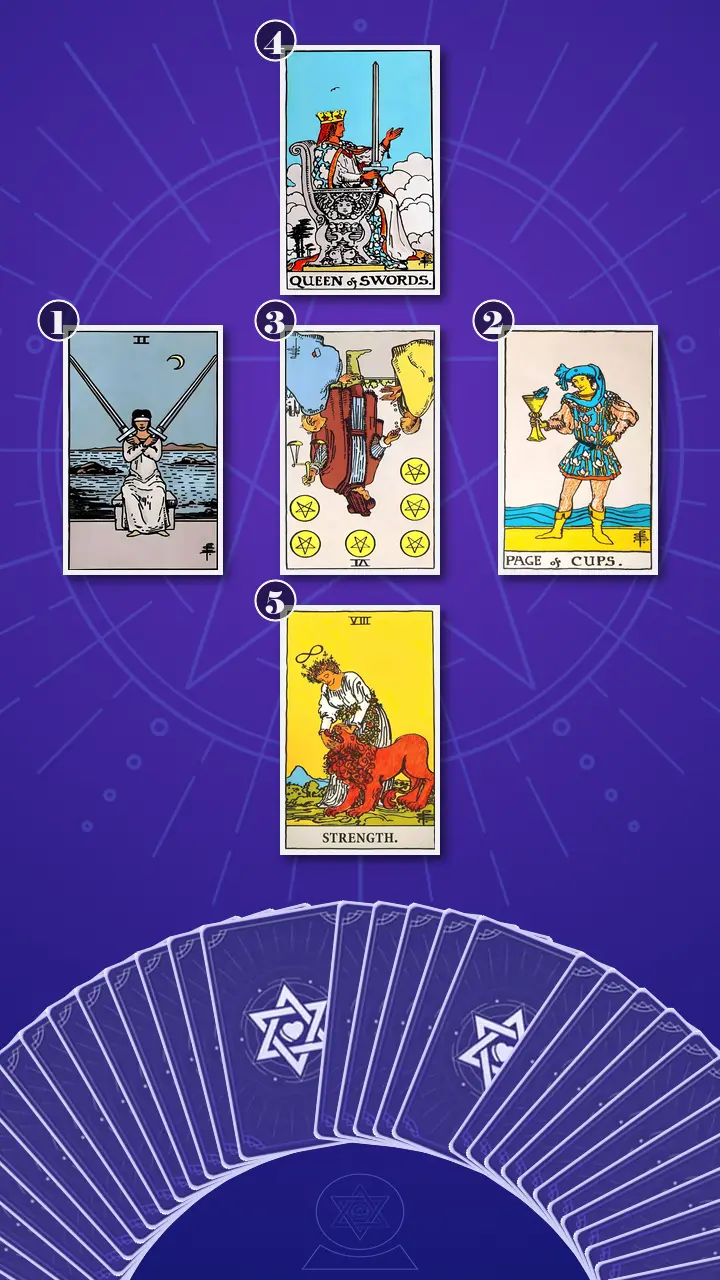
I laid the cards in a cross, with the center card as the visual anchor. The left card would show Maya’s immediate inner response to the Find My request. The center card would name the real imbalance under the polite wording. The top card would define the healthiest boundary, and the bottom card would show how to turn that insight into an actual text she could send tonight. It looked less like fate and more like a conversation map with a spine, which was exactly what she needed.
Reading the Map Before the Breakthrough
Position 1: The Freeze That Looks Like Politeness
Now I turned over the card representing Maya’s immediate inner response to the request and the part of privacy she was trying to protect. The card was the Two of Swords, upright.
I told her this was the exact image of her commute-home stall: the Find My screen open, thumb hovering between not sharing and sharing indefinitely, her body already leaning no while her social script kept insisting that the perfect wording would appear if she just waited long enough. In energy terms, this was contracted Air—thought looping so tightly it turns indecision into a shield. The blindfold on the figure did not mean ignorance to me here. It meant social self-blinding: trying not to know what her nervous system had already noticed. It’s probably not that deep, she keeps telling herself, so why am I bracing?
“A delayed yes you resent creates more weirdness than a clean no,” I said. She let out one short laugh that landed with more ache than humor. “Wow,” she said, rubbing her thumb over the edge of her phone case, “that’s accurate enough to feel a little rude.” I smiled and told her the card was not accusing her. It was simply showing that the freeze was not proof she was dramatic. It was proof that some part of her was already protecting a real line.
Position 2: The Soft Ask That Still Crosses a Line
Next came the card exploring what her friend might be bringing emotionally, or assuming, when asking for live location sharing. The card was the Page of Cups, upright.
I told Maya I did not read this as a villain card. I read it as soft, sincere, emotionally spontaneous Water—something like a playful “just share it so I know you got home safe <3” that arrives wrapped in care and casual closeness. The fish rising from the cup always makes me think of how quickly an unexpectedly intimate boundary issue can pop out of a message that sounds sweet on the surface. In other words, the tone may be gentle; the ask can still be too much.
That mattered, because it separated intent from fit. Her friend might be reaching for reassurance, convenience, closeness, or safety language without fully grasping the consent piece. Maya’s shoulders dropped a little when I said that. Not because the request suddenly worked for her, but because she no longer had to choose between calling her friend bad and calling herself unreasonable.
Position 3: When Care Starts Costing Too Much
Then I turned over the center card, the one revealing the current relational pattern where care, reassurance, and access start to blur into imbalance. It was the Six of Pentacles, reversed.
This was the hinge of the entire reading. I told her the modern translation was brutally simple: one person gets reassurance, and the other person pays in visibility. It is like an app permission accidentally set to Always when what you really meant was Only this once. Reversed Earth shows the real-world cost. Not imagined cost. Not symbolic cost. Actual cost—more exposure, more monitoring, more low-grade tension every time the phone vibrates and you picture your little dot being watched.
“Care is not the same thing as access,” I said, and the room went still in that particular way it does when a sentence finally names the thing under the thing. I have a lens I call Clique Power Dynamics, and it often shows up in hyper-connected friendships like this: the norm looks casual because the most accommodating person quietly absorbs the discomfort bill. Maya pressed her lips together and nodded. “I would never ask most people for that,” she said after a beat. Exactly. That was the scale in the card. The real question was no longer “How do I make this not awkward?” It was “In this friendship, where does keeping it easy start costing me more than it costs the other person?”
When the Queen of Swords Lifted Her Blade
Position 4: The Boundary That Restores the Friendship
When I turned over the top card, the room changed. A pale stripe of afternoon light caught the blade on the image as if the card had decided to underline itself. This was the position that defines the healthiest boundary by clarifying what is and is not available from Maya. The card was the Queen of Swords, upright.
By then, Maya was caught in the exact bind this card loves to cut through: the request looked tiny on the screen, and yet her whole body was acting like it had been handed a far bigger decision than everyone else’s tone seemed willing to admit. She was still trying to solve for two impossible goals at once—say no, and also make sure nobody could ever dislike the no.
Stop treating constant access as proof of care and let the Queen's upright sword do its work: one clear sentence can protect the friendship without handing over your privacy.
She went very still. First came the freeze: her breath paused, and the finger that had been tapping the side of her mug stopped midair. Then came the inward drop: her eyes lost focus for a second, like she was replaying every late-night kitchen draft, every fake tech excuse, every extra “lol” pasted over the truth. Then came the release: her shoulders lowered, her jaw unclenched with a tiny visible shift, and she exhaled hard enough to make the candle between us flicker. “But that means,” she said, and there was a flash of anger in it before the softness returned, “I’ve been acting like access is the price of being easy to keep around.”
I nodded. This is where I used one of my signature lenses, what I call Sidekick Syndrome Diagnosis. In a lot of close social ecosystems, especially app-heavy ones, someone quietly gets cast as the accommodating one, the planner, the therapist, the easy girl. The role keeps the group smooth until the person inside it needs something simple and human, like privacy. “You are not failing at friendship,” I told her. “You are resigning from a role that made your consent invisible.” The Queen’s sword and open hand showed the pairing perfectly: clarity without cruelty, warmth without overexposure. You can be warm without being map-visible.
Then I asked her, “Now, with that new lens, think back to last week—was there a moment when this would have made you feel different?” She laughed again, softer this time. “Sunday night in my kitchen,” she said. “I wrote three fake versions before the real sentence.” That was the shift I wanted her to feel. This was not just about one Find My request. It was the first clean move from guilt-driven stalling toward calm, consent-based clarity.
Position 5: The First 90 Seconds After Send
Finally, I turned over the card pointing to the next grounded communication step that would turn inner clarity into respectful action. It was Strength, upright.
I told her the card did not ask for force. It asked for regulated Fire—the courage to hold the boundary through the shaky part instead of collapsing out of it the second discomfort arrived. In practical terms, this was the first 90 seconds after hitting send: watching for typing dots, wanting to reopen the chat, feeling the urge to add a rescue paragraph she did not even believe. Strength is the moment the lion opens its mouth and you do not panic. You keep your hands gentle. You keep your spine.
As an artist, I have always thought lives feel a little like films stuck in post-production: people keep re-editing one honest line because they are terrified of the scene that comes after it. Strength told me Maya did not need a better script so much as a steadier body. “Trust lands softer when it’s chosen, not streamed,” I said. She gave me the smallest real nod of the session—the kind that says a next step has become imaginable.
From Insight to Action: The Warm No
When I stood back from the spread, the story was remarkably clean. The Two of Swords showed her polite overthinking loop. The Page of Cups showed that the friend’s ask may be soft in tone without being automatically suitable. The Six of Pentacles reversed exposed the actual problem: reassurance had started to get paid for with more privacy than Maya truly wanted to give. The Queen of Swords named the repair principle, and Strength showed how to embody it. Her blind spot was not that she lacked kindness. It was that she kept trying to earn permission for a boundary instead of naming a preference.
I told her the whole reading pointed in one direction: move from proving trust through constant access to defining trust through consent, context, and choice. In other words, this was a default-settings problem, not a character flaw. Her phone did not need to reflect group-chat autopilot. It needed to reflect her actual yes.
- Draft the Queen’s SentenceTonight, in Notes, write one honest line in 12 to 20 words: “I don’t share my live location, but I’m happy to text when I get home.” If you want warmth, add one warm phrase max before or after it—nothing longer.If you feel the urge to explain for five paragraphs, the boundary is probably already there. Write the long version first, then cut.
- Make the Care vs Access ListDraw two columns titled “care” and “access.” Under care, list only what you genuinely want to offer—text when home, a one-time pin for meetup logistics, a late-night ETA. Under access, list what you do not want as a default, like ongoing Find My or Snap Map visibility.Do not negotiate against yourself. One-time logistics is not the same thing as permanent visibility, and no alternative is required if none feels true.
- Use the Role Resignation ActIf the friend asks again, do the pivot cleanly: “I get why you asked. I just don’t do live location sharing.” Then place your phone face down for ten minutes, refill your water, and let the first wave of guilt pass without sending a rescue paragraph.This is how you step out of the endlessly accommodating role without picking a fight. Repeat the line; don’t rewrite your truth.
Those were her next steps—small, practical, and real. Not because tarot made the choice for her, but because the cards gave shape to what her body had been saying long before her drafts caught up.

A Week Later, the Quiet Proof
A week later, she sent me a message just before her commute: “Used the line. She was a little dry for a minute, then normal. I still wanted to over-explain, but I didn’t.” She added one more thing: she had turned off the gray-area location setting she used to leave half-on, half-justified, and then stared at the blank permissions screen for three silent beats before heading out the door.
That was the kind of finding clarity I trust most, and exactly what this five-card Relationship Spread · Context Edition is for. Not a cinematic life overhaul. Not a friendship magically purified by one perfect script. Just a woman hearing her own voice more clearly inside a relationship, and trusting it enough to let honesty do the work.
When a request sounds casual but your chest still tightens, the hardest part is rarely the app itself. It is the old fear that privacy might make you feel less easy to keep close. If you can notice that fear without obeying it, you are already no longer standing where the spiral started.
If trust in your friendships did not have to look like a little moving dot on someone else’s map, what level of contact would actually feel honest in your own voice?