Why Is No So Hard?

Explore the social pressure around refusing drinks, with related tarot cards and tarot reading insights for this specific bind.

Drinking Peer Pressure
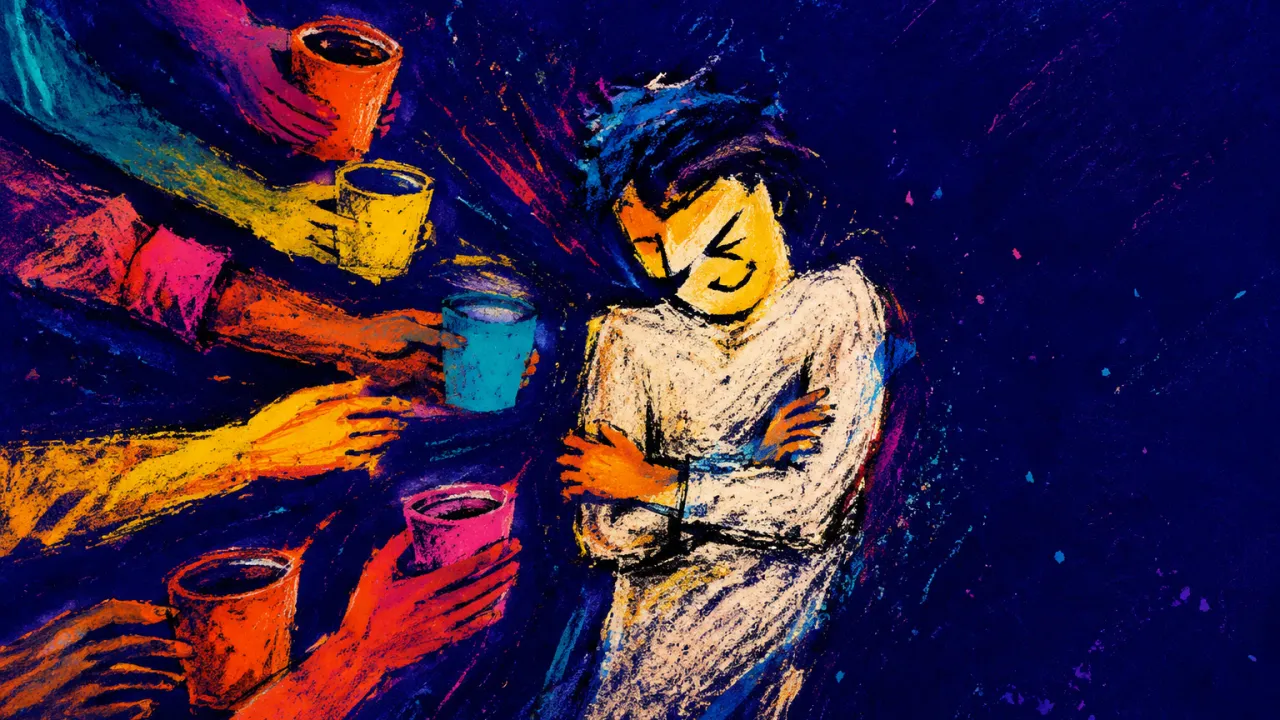
A solitary figure with folded arms as several hands offer cups into a shrinking circle of deep indigo space

What is this situation?

Drinking Peer Pressure — you step into a party, a bar, a pregame, a work happy hour, or a group trip, and before you have even settled in, someone is already asking what you are drinking. At first it sounds casual: “Come on, just one,” “Don’t be boring,” “We’re all doing shots,” “You can Uber,” “It’s not that deep.” The glass gets placed in your hand before you have clearly said yes, or your empty cup becomes a public object everyone feels allowed to comment on. The group dynamic turns alcohol into a test of whether you are fun, chill, loyal, spontaneous, or “one of us,” and the people pushing it may not see themselves as pushy because they are smiling while they do it. You might be at a birthday dinner where the next round is ordered for the table, a house party where someone keeps refilling cups without asking, a networking event where declining a drink makes the conversation tighten, or a friend group where choosing soda gets treated like an announcement. The pressure is rarely one huge confrontation; it is the repeated little moments where saying no makes the room notice you, where a joke lands a bit too sharply, where your shoulders tense because you know the next offer is coming. You start planning exits, holding the same drink for an hour, inventing reasons, or scanning for the one person who will not make it a thing. By the end of the night, the exhaustion is not from the socializing alone; it is from having to defend a simple boundary in a room that keeps turning it into a performance, much like the figure on the Four of Cups, arms folded while another cup is held out in front of them.

Why it's not you?

The problem is not that you are uptight, dramatic, or bad at being social; the problem is a group script that makes drinking feel like the price of belonging. Repeated offers, teasing, automatic refills, and public comments about your choice are forms of pressure, even when they are delivered with a laugh. That pressure belongs to the room, the routine, and the people pushing the cup, not to your character.

Drinking Peer Pressure in Tarot Cards

That tightness in your shoulders when another drink gets pushed toward you is part of the Drinking Peer Pressure setup, not a private overreaction. The pressure works as an environmental and structural dynamic: the room, the jokes, the rounds, and the fear of being singled out all move together. The cards below do not tell you what to do with the glass in your hand; they reflect the shape of the pressure around it. Here are the Tarot Cards that tend to mirror this kind of social bind.

The Hierophant
Reversed
The teacher on the throne, the paired followers, and the crossed keys depict beliefs being transmitted through a social institution. Reversed, the inherited rule loses its automatic authority: drinking no longer has to remain mentally coded as the price of being fun, mature, loyal, or socially competent. The blocked ritual makes the underlying growth task visible without blaming you for having absorbed the script. You can distinguish a group's repeated conditioning from your own values, which opens a cognitive path beyond the false equation of alcohol participation with legitimate belonging.
Temperance
Upright
The two cups, the controlled stream between them, and the angel's balanced footing show a physical system governed by measured transfer rather than group momentum. That image maps onto setting your own drinking pace, choosing a non-alcoholic option, or keeping a pre-decided limit while rounds and refills attempt to outsource that decision to the room. The open path behind the angel keeps moderation and abstention equally available as deliberate forms of physical self-management. You retain access to a stable nightlife structure when consumption, transport, sleep, and next-day capacity are treated as connected resources rather than sacrificed to a spontaneous group script.
The Devil
Upright
The chained figures, elevated authority, and visible but loose collars show how a belief can feel compulsory while remaining socially constructed. The growth problem is not simply the offered alcohol; it is the learned equation that says refusing the offer will make you boring, disloyal, or unworthy of the group. The open collars make that equation available for inspection without pretending the social cost is imaginary. You can recognise the pressure as a system of conditional approval and revise the assumption that belonging must require surrendering authorship over your own participation.
Three of Cups
Reversed
The linked trio, raised cups, and shared celebration show friendship expressed through a coordinated toast. Reversed, that coordination becomes conformity: friends use alcohol as shorthand for loyalty and interpret your different cup, slower pace, or refusal as stepping outside the bond. The inverted circle blocks effortless participation but clarifies what is being tested. You can see whether the friendship has room for different forms of presence or whether closeness is being measured through identical consumption.
Four of Cups
Upright
The seated figure's crossed arms, the three cups already on the ground, and the additional cup pushed into view depict a friend continuing an offer beyond its useful life. Within a close circle, the repetition carries relational weight because familiar people know your preference yet still treat it as negotiable. The solid tree supports a refusal that does not require withdrawal of affection. You can distinguish declining a drink from declining the friendship and observe whether your friends are willing to maintain that distinction too.
Eight of Cups
Upright
The carefully arranged cups, departing person, and uneven path show someone leaving a familiar emotional structure that no longer supports participation. With friends, that may mean stepping away from a specific plan, a recurring alcohol-centred routine, or a circle that keeps treating your limit as a loyalty problem. The cups remain standing, so departure does not erase the history or significance of the relationships. You can recognise that preserving yourself from repeated pressure may change the form of contact without requiring you to deny that the friendships once carried value.
Two of Swords
Upright
The blindfold, two crossed swords, and blocked moonlit shoreline present a decision defended against incoming influence. Drinking peer pressure creates this stalemate when accepting the cup appears to preserve social ease while refusing preserves the boundary but invites more attention. The swords remain in your hands, which means the decision has not actually transferred to the room. You can expose the artificial cost attached to no and distinguish uncertainty about the group's reaction from uncertainty about what you want to drink.
Seven of Swords
Upright
The figure carrying swords away, the backward glance, and the occupied camp in the distance create a scene of strategic movement under observation. That structure matches holding the same drink, disguising soda, inventing an excuse, or planning a quiet exit because direct refusal has repeatedly made the group intensify its attention. The open route makes tactical self-protection available, but the need for secrecy remains evidence about the environment. You can see that concealment is not proof your boundary is unreasonable; it reflects a social setting that has made straightforward participation unnecessarily costly.
Eight of Swords
Upright
The blindfold, loose bindings, and surrounding swords show attention narrowed by a ring of perceived consequences. After enough public comments about drinking, you may mentally reduce the available options to comply, invent a perfect excuse, or endure being judged, even though the physical scene still contains open ground. The distant shelter and incomplete sword enclosure keep the external structure visible without dismissing its psychological impact. You can separate the real social penalties from the additional scenarios generated by repeated anticipation, recovering a clearer map of what belongs to the room and what has remained in your mental cache.
Four of Wands
Reversed
The flowered canopy, four upright staves, and welcoming celebrants create a visible threshold into communal festivity. Reversed, that threshold becomes unstable: the party still looks cheerful, but hospitality is withdrawn when your refusal to drink makes the group question whether you are participating correctly. The inverted celebration distinguishes an event being open from it being genuinely inclusive. You may be physically invited while socially required to perform enthusiasm through alcohol, leaving the path into the room blocked by a condition that was never stated on the invitation.
Five of Wands
Upright
The five figures, crossing staves, and absence of a coordinating centre depict a group turning participation into noisy contest. Repeated drink offers can take on this structure when several people joke, argue, refill, or challenge your refusal at once, each treating your boundary as material for the group's performance. The open field means the conflict is visible enough to map rather than silently absorb. You can separate one person's offer from the cumulative force of a crowd, recognising that the exhaustion comes from having to answer a distributed group challenge rather than from failing to be relaxed.
Seven of Wands
Upright
The single defender, the cluster of advancing wands, and the unstable-looking footwear show a boundary being tested from within close range. In a friend group, repeated drink offers can make you defend not only what is in your cup but whether you are still loyal, fun, and willing to participate. The figure's higher ground preserves a position that does not require collective approval to exist. You can see that friendship becomes the contested territory when friends answer a clear refusal with negotiation, and that the repeated defence measures their respect for limits rather than your capacity for fun.
Nine of Wands
Upright
The head bandage, sideways gaze, and wall of wands depict attention held in reserve for the next intrusion. After repeated drinking pressure, the external event can continue internally as rehearsed excuses, predictions about who will comment, and constant checking of whether the room has noticed your cup. The intact boundary shows that this mental workload has an identifiable source and structure. You can separate anticipatory self-monitoring from your actual preference about alcohol, clearing space to see how much psychological bandwidth is being occupied by other people's refusal to accept a simple answer.

Drinking Peer Pressure in Tarot Card Reading Insights

Drinking Peer Pressure does not only show up at the bar; it shows up in readings when people bring in the awkward pressure of being offered something they do not want to accept. These Tarot Reading Insights come from sessions where the cards met that specific social tension.

Psychological Contexts Related to Drinking Peer Pressure