Asked To Sign For Them?

Explore the pressure around family cosigning, the tarot cards that mirror it, and readings where this obligation appears.

Family Cosigning Pressure
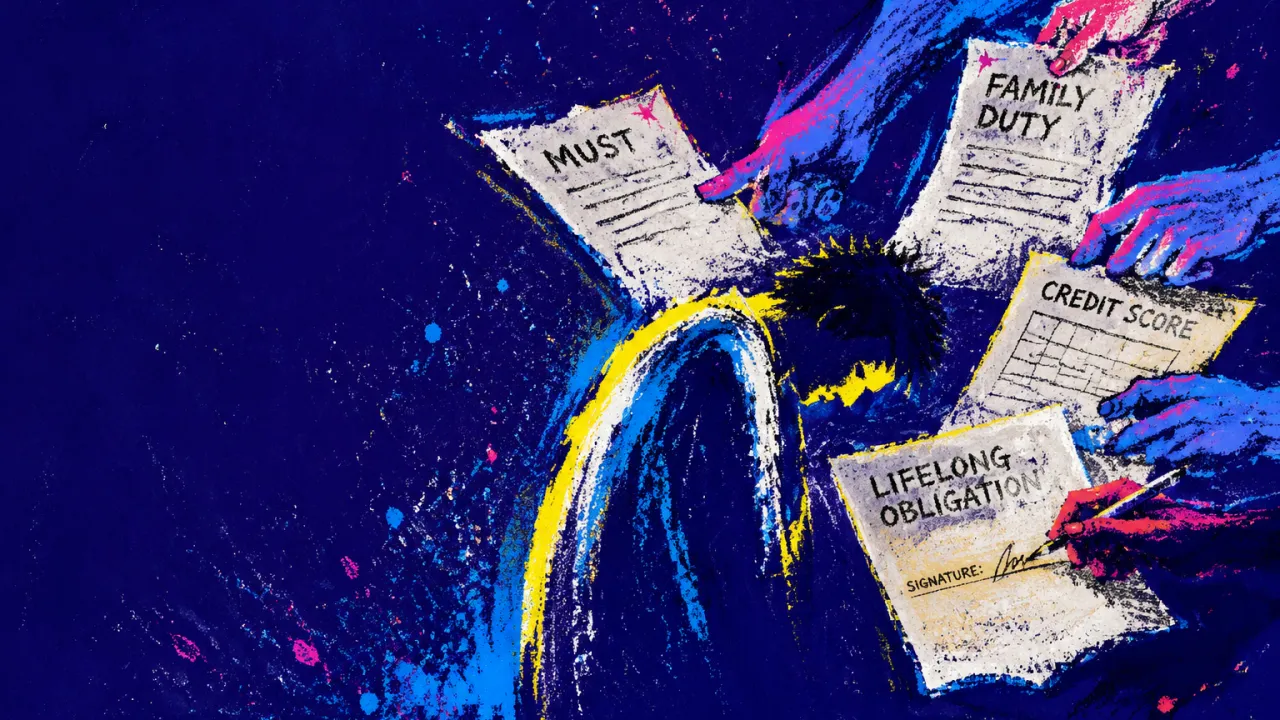
A solitary figure with tense shoulders as hands push contracts toward a pinned-down name in deep indigo space

What is this situation?

Family Cosigning Pressure — it starts with a call, a text, or a family group chat that looks ordinary at first: someone needs help getting approved for a car, an apartment, a personal loan, or a credit line, and your name is being presented as the missing piece. The request comes wrapped in urgency, history, and obligation: they remind you who helped you before, who raised you, who would be disappointed, who has no other option, and how quickly the paperwork needs to be signed. You may be sitting at your kitchen table after work, staring at a lender form or lease application while messages keep arriving, each one making the decision feel less like a financial boundary and more like a public loyalty test. If you ask basic questions about payments, timelines, debt, or risk, the conversation shifts from facts to character: suddenly you are being called cold, selfish, ungrateful, dramatic, or too obsessed with money. Other relatives may get pulled in to soften you up, compare you to someone more “helpful,” or frame your hesitation as proof that you have forgotten where you came from. The pressure keeps moving through ordinary spaces — your phone buzzing during lunch, a parent calling late at night, a sibling sending screenshots, a relative saying “just sign, we’ll handle it” as if your credit score, rental history, savings, and future options are small details. Your body learns the pattern: shoulders tightening when their name appears on the screen, chest pulling in when the conversation turns to paperwork, stomach dropping when love gets spoken in the same sentence as liability. By the time you are alone with the decision, the external demand has turned your name into a handle other people are trying to grab, much like the figure on the Ten of Wands, bent forward under a bundle that blocks the road ahead.

Why it's not you?

This is not selfishness, disloyalty, or a failure to care about your family. The pressure is coming from a setup where your financial name is being treated as a tool for someone else’s approval, and your hesitation is being turned into a character flaw. When a signature, credit file, or legal responsibility gets wrapped in family obligation, the problem is the pressure structure itself.

Family Cosigning Pressure in Tarot Cards

Family Cosigning Pressure is the kind of situation where a private financial boundary gets dragged into group chats, urgent calls, and family loyalty tests. The tightness in your chest when your phone lights up is tied to an environmental, structural dynamic: your name, credit, and future options are being treated as shared resources. The cards below do not decide for you or soften the paperwork into a family argument. Here are the Tarot Cards that tend to mirror the pressure pattern underneath this situation.

The Hierophant
Reversed
The raised hand, crossed keys, pillars, and kneeling acolytes present a complete system of authorised belief and expected obedience. Reversed, the inherited rule that family loyalty requires unrestricted financial access stops functioning as a sufficient decision framework. You are confronting a cognitive distinction between caring for relatives and surrendering independent consent to a binding contract. The inverted hierarchy reveals the growth threshold: family teachings about gratitude must be examined alongside the actual allocation of authority, benefit, and liability.
Justice
Reversed
The reversed scales, sword, and formal seat of judgement turn a family conversation into an image of accountability losing balance. The lender may hold You legally responsible even when relatives verbally insist that the debt will never become yours. Your factual questions are being treated as a moral trial because scrutiny threatens the family's preferred story of harmless help. The inverted legal structure reveals the mismatch between emotional assurances inside the family and enforceable responsibility outside it.
The Devil
Upright
The chained figures beneath the pedestal turn an external bond into a scene of internalised restriction. Repeated family claims that love requires signing can remain active in your mind after the calls stop, making factual hesitation feel like evidence that You are selfish or ungrateful. The loose collars matter because they distinguish internalised obligation from the absence of choice. You are carrying a pressure script that fuses belonging with financial compliance, and naming that fusion makes the source of the guilt more visible without reducing the real relationship stakes.
Six of Cups
Reversed
Six flower-filled cups surround a scene in which one child offers a cup to another inside a protected courtyard. Reversed, the remembered gift no longer remains freely in the past; it becomes a ledger used to claim that care received earlier must now be repaid through your credit. You can recognise genuine family support without accepting its conversion into open-ended liability. The inverted exchange reveals the structural shift from memory to leverage, where being raised, helped, or housed is cited as evidence that your present signature already belongs to the family.
Two of Pentacles
Reversed
The two pentacles turn inside an infinity loop while ships rise and fall on rough water behind the juggler. Reversed, that loop no longer reads as a sustainable rhythm; it resembles a household budget being asked to absorb a liability whose timing and amount remain controlled by someone else. You are not being offered a symbolic role when your name enters a credit agreement. The inverted juggling system exposes how missed payments, lender notices, and disrupted savings could enter your physical routine even if the family promises to handle everything privately.
Three of Pentacles
Reversed
An artisan stands on a bench while two other figures hold plans inside a formal stone building. Reversed, the shared plan loses collaborative integrity, mirroring a family cosigning arrangement in which your signature is required but your questions about payments, contingencies, and oversight are treated as interference. You are being asked to join a formal financial structure without receiving an equal role in designing or monitoring it. The inverted collaboration scene exposes responsibility without meaningful participation: your name is essential to approval, but your standards are excluded from the plan.
Six of Pentacles
Reversed
The standing giver, kneeling recipients, falling coins, and handheld scales depict help organised through unequal positions. Reversed, the scene mirrors a family exchange in which your credit enables access, the applicant controls repayment behaviour, and the family still claims that everyone is sharing the responsibility. You are being invited to perform generosity without receiving matching authority over the risk. The inverted resource structure exposes why hesitation attracts backlash: a boundary interrupts an arrangement that depends on calling unequal exposure mutual support.
Ten of Pentacles
Reversed
The multigenerational household, dogs, archway, and ten pentacles place family continuity inside a visible material estate. Reversed, the image shows the instability that appears when collective security depends on one member's credit while the wider family retains authority to define what loyalty requires. You are being asked to stabilise the family plan with an asset attached specifically to your identity and future options. The inverted legacy structure exposes how shared-family language can conceal unequal ownership of both risk and decision-making power.
Two of Swords
Upright
Blindfolded at the shoreline, the seated figure holds two swords in a rigid cross while water and a crescent moon remain behind her. The posture captures a binary decision held in suspension because neither option feels socially safe: signing creates liability, while refusing may trigger family backlash. The upright swords preserve two distinct positions, even though pressure is trying to collapse them into one acceptable answer. You are being denied a clean decision environment when requests for information produce more shame instead of more facts.
Five of Swords
Upright
A foreground figure gathers swords while two others retreat beneath a jagged sky, leaving a visible winner but no repaired relationship. The scene mirrors a family argument where insults, comparisons, and reputational pressure are used to force the paperwork through. You may be able to end the immediate conflict by signing, but that outcome would not make the process collaborative or the liability balanced. The upright conflict structure exposes a win-lose dynamic in which family peace is offered only after your financial boundary is surrendered.
Seven of Swords
Upright
A figure carries five swords away from a camp while looking back, leaving two swords standing behind. The divided load mirrors assurances such as "just sign, we'll handle it," where one party secures the benefit while crucial details and residual consequences remain with someone else. You are being asked to trust informal repayment promises in place of shared visibility and enforceable control. The upright evasion structure highlights the accountability gap between who can use the financed asset and whose credit may answer when the plan breaks down.
Eight of Swords
Upright
The blindfolded and bound figure stands among eight swords while the path beyond the enclosure remains difficult to perceive. The image mirrors a family pressure system that repeatedly claims there is no other solution until your legal ability to refuse feels socially unusable. The gaps between the swords reveal that the family's narrative is narrower than the actual option field. You are facing constraint produced by urgency, guilt, and coordinated messaging, not proof that your signature is objectively the only available resource.
Nine of Swords
Upright
Nine swords line the dark wall while a figure sits upright in bed with their face covered by both hands. The private night scene mirrors the after-hours replay of family calls, lender deadlines, possible default scenarios, and accusations that your hesitation proves a lack of care. The swords remain arranged outside the figure rather than becoming the figure, preserving the distinction between incoming pressure and identity. You are processing a real conflict with financial and relational consequences; the night-time mental load is evidence of unresolved external demands, not a verdict on your character.
Knight of Swords
Upright
An armoured rider charges forward with a raised sword while clouds and trees bend around the movement. The scene gives physical form to a family demand delivered as an emergency, where paperwork must supposedly be signed before questions can slow the advance. The road is open in the upright image, yet the pace leaves little room for proportionate assessment. You are dealing with an imposed tempo that privileges securing approval now while pushing credit exposure, repayment uncertainty, and future constraints outside the immediate frame.
Five of Wands
Upright
Five figures cross their wands in a crowded field with no shared line of movement or clearly coordinated task. The scene resembles a family group chat or call chain where several relatives add opinions, comparisons, and urgency without taking ownership of the legal liability under debate. You are surrounded by participation that increases noise without increasing accountability. The upright conflict structure reveals how collective involvement can make the cosigning request feel socially larger while leaving the actual financial risk concentrated in your name.
Seven of Wands
Upright
One figure stands on uneven high ground and holds a wand against six wands rising from below. The image directly mirrors a family pile-on in which multiple relatives call, text, compare, and challenge You while your position must be defended alone. The upright height gives visibility but not comfort; every incoming argument keeps the boundary under active contest. You are not creating the conflict simply by declining automatic access to your credit, because the conflict is being generated by a group system that refuses to recognise your decision as complete.
Eight of Wands
Upright
Eight wands travel diagonally across an open sky above a river and settled landscape, with no person visible to interrupt their speed. The image mirrors texts, calls, screenshots, and lender updates arriving in quick succession until the pace itself begins to shape the cosigning decision. The upright trajectory keeps communication moving, but velocity is not the same as informed readiness. You are being placed inside someone else's approval deadline, where rapid contact can crowd out the slower work of reading terms and considering future consequences.
Ten of Wands
Upright
The figure bends forward beneath ten wands while carrying the entire bundle alone toward the town. That unequal load-bearing mirrors a family system in which everyone can endorse the request, but your name is selected to carry the lender's enforceable risk. The upright image shows the burden moving because one person supplies the labour needed to keep it moving. You are being assigned the family rescuer role, and hesitation is attacked because it interrupts a plan built around your willingness to absorb responsibility.

Family Cosigning Pressure in Tarot Card Reading Insights

Family Cosigning Pressure can follow people into readings when the request sounds practical on the surface but carries family expectation underneath it. Other people have sat with cards while trying to separate a financial signature from a loyalty demand. Tarot Reading Insights from sessions where this pressure came into the spread.
Psychological Contexts Related to Family Cosigning Pressure