Arrive First, Plan Second: When After-Work Lists Stop Grading You

The 7:10 p.m. Notes App Spiral
When Jordan (name changed for privacy), a 28-year-old account coordinator in Toronto, joined me after work, I recognized a pattern I hear from young city professionals all the time: people who can juggle client requests all day and then go blank the second a 7 p.m. Notes app opens. Her agency tote was still by the door. The microwave hummed behind her. The overhead light in her west-end apartment was too white, and the blue of her phone spread across the kitchen counter like cold water. She peeled back the lid on reheated leftovers, opened a checklist called “Tonight,” and I watched her shoulders sink before she even read it out loud.
“I waste the whole night recovering from the pressure of trying not to waste the night,” she said.
She wanted her evenings to help her catch up. Her body wanted only to switch off. That contradiction sat on her like an invisible backpack of bricks: dishes, laundry, groceries, texts, tomorrow’s prep—all ordinary things, yet somehow they landed as one heavy block. By the time she saw six bullets on a screen, her limbs felt as if someone had quietly filled them with wet sand.
I nodded. “That makes sense to me,” I told her. “This is not laziness. It is overload in civilian clothes.” I use tarot as a mirror, not a verdict, and I told her that my job tonight was simple: to help her see why this after-work shutdown kept happening, and to help her leave with a kinder, clearer map of what her evenings could actually hold.

Choosing the Map for an After-Work Shutdown Loop
I asked her to put both feet on the floor and take one unforced breath before we did anything else. Not as a mystical performance—just as a way to let the nervous system catch up to the conversation. Then I shuffled slowly and asked her to hold only one question in mind: “What really happens to me between walking in the door and disappearing into the couch?”
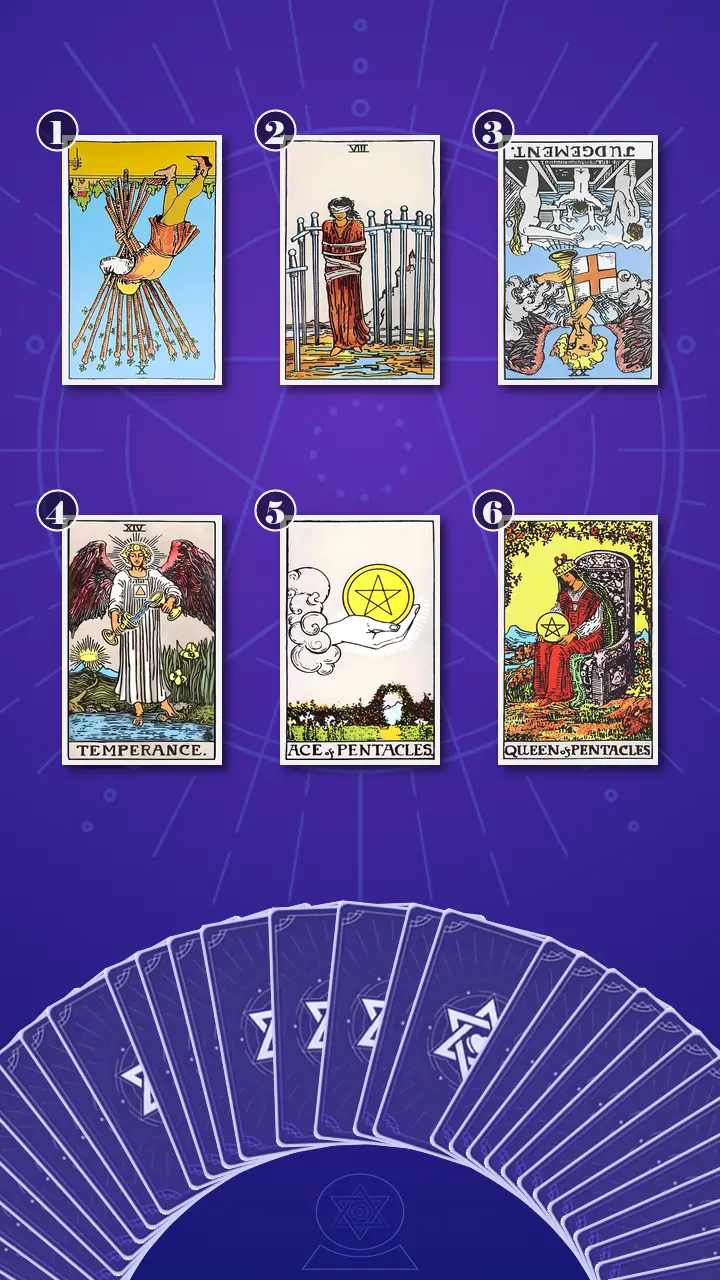
For her, I chose the Transformation Path Grid · Context Edition. When people ask me how tarot works for something as ordinary and frustrating as doomscrolling through an evening to-do list, this is the answer: I use a spread that separates the symptom, the mental trap, the root fear, and the practical lever that changes the cycle. Jordan did not need a vague mood reading. She needed a clean picture of a repeating loop—workday depletion, list pressure, shutdown, backlog, then more shame the next night.
I showed her the structure. The top row would diagnose the pattern: the visible after-work freeze, the immediate mental blockage, and the deeper fear underneath it. The bottom row would show the medicine: the regulating energy that interrupts the loop, the small grounded experiment, and the sustainable evening rhythm that becomes possible when the list stops acting like a verdict.
Reading the Diagnostic Band
Position 1: The Bundle at the Door
I turned over the card that showed the visible after-work shutdown pattern described in her question. It was the Ten of Wands, reversed.
I told her this was exactly the image of getting home already carrying the emotional residue of a workday spent answering other people’s asks, then opening an evening list and feeling all sequence disappear. Dishes, laundry, messages, groceries, tomorrow’s outfit—her mind no longer read them as separate tasks. It read them as one giant demand. In modern life, this card is a Notes app turning into a second Slack inbox in a different font. It has that Severance feeling, except the outie still brought the client inbox home.
In energy terms, this was excess pushed past capacity until it flipped into collapse. The problem was not that the tasks were impossible. The problem was that they landed on a body already overloaded, so the whole bundle looked heavier than it was. Jordan gave a short, almost offended laugh and shook her head. “That’s annoyingly accurate,” she said. “I don’t even choose not to start. I just... drop.”
Position 2: When Every Bullet Turns Bold
I turned the next card, the one revealing the immediate mental trap that activates the second the list is seen. It was the Eight of Swords, upright.
I asked her to notice what this card does so well: the feeling of being trapped by a system that is not fully sealed. This is what her evenings looked like in plain English. She would glance at Apple Notes and instantly assume every bullet point was urgent, equally loaded, and somehow a test of whether she was handling adulthood correctly. The trap felt closed, even though there was still room to choose one small next step. It was like Google Maps zoomed so far out that every route looked blocked, when in fact one street was still open.
“The hidden sentence,” I told her, “is not ‘there are tasks.’ It’s ‘if I only do one thing, I’m still behind.’” That is blockage energy: constricting air, pressure mistaken for reality. Her jaw tightened; I could see it even through the screen. Then came the sharp nod I had been expecting. “Yes,” she said. “If I only do dishes, the laundry is still there. If I only answer one message, I’m still behind. That’s the exact trap.”
Position 3: The Apartment as a Witness Stand
I turned the card uncovering the deeper fear underneath the freeze: Judgement, reversed.
This was the quiet root of the whole loop. Laundry, dishes, and unanswered texts were no longer neutral maintenance. They had become evidence. I told her that this card often appears when a person hears an ordinary reminder as an accusation. The list stops helping when it starts acting like a verdict. In Jordan’s small apartment, with the fridge humming and the hamper in view, the room itself had started to feel like a witness stand. The chore was not what hurt first. The meaning attached to it hurt first: If I were more together, this would not be hard.
That is a shame-based blockage, not a motivation failure. In older language I might call it the Inner Judge; in modern terms it is a Tuesday night to-do list turning into a personal performance review. Jordan went very still. Her fingers tightened around her mug, then loosened. “These are basic tasks,” she said quietly, “which is exactly why not doing them feels so embarrassing.” That was the moment the reading went from surface frustration to truth.
When Temperance Stood in the Doorway
Position 4: The Landing Strip
When I turned the fourth card, the air in the call changed. This was the card introducing the regulating energy that breaks the overload-to-freeze cycle, and it was the heart of the reading: Temperance, upright. After sixty-seven years of seasons, I have learned that the body keeps a truer clock than guilt does, and Temperance is one of the clearest reminders of that I know.
Before I explained the symbolism, I used one of the lenses I rely on most, what I call Somatic Fatigue Diagnosis. I asked Jordan not what she thought about the list, but what her body did in the first breath after she walked in the door. Her answer came fast: shoulders dropped, eyes glazed, jaw went slack, limbs felt heavy, and the couch started calling before dinner was even over. That told me more than any productivity app could. Her nervous system had not arrived home. She was trying to go straight from client deadlines to dishes, from Slack-brain to self-management, with no landing strip in between.
At 7:10 p.m., with the microwave humming and her bag still by the door, the Notes app was not landing like a helper. It was landing like the night had been assigned homework before she had even arrived.
Your evening does not shut down because you are weak. It shuts down when the list stops being a menu and starts demanding proof.
Your worth is not measured by how many boxes fit into one night; pour your energy between the cups with intention, and let balance, not guilt, decide what tonight can truly hold.
First, she froze. Even the hand that had been absently tapping her phone case stopped mid-motion. Then her gaze slipped past the camera, unfocused, as if she were replaying a row of identical Wednesdays: the tote by the door, the cold light on the counter, the tiny private sentence that said if you could not do it properly tonight, you should not start at all. When she looked back, her eyes were bright, but not soft. “So what,” she said, with a flare of resistance that made me like her even more, “I’m supposed to lower the bar?” I shook my head. “No,” I told her. “Lower the accusation. Keep the bar tied to reality.” The anger broke first, then the breath came—a long one, low in the chest, the kind that lets the shoulders unclench without permission. By then even the microwave had gone quiet, and the apartment behind her looked less like fluorescent evidence and more like a room again. There was relief in her exhale, and also that brief, dizzy feeling people get when the old rule stops making sense and a better one asks to be lived instead. I asked her to try the new question on last Tuesday: not What should I finish? but What can tonight realistically hold? She closed her eyes for a beat and nodded. “Honestly?” she said. “I probably would’ve done the dishes and stopped hating myself.”
That was the shift right there: from verdict-driven overwhelm and couch paralysis to the first fragile ounce of steadier self-respect. Not certainty. Not a perfect routine. Just more room inside the same evening.
Position 5: One Coin in the Hand
I turned the fifth card, the one translating the shift into a small, grounded after-work experiment. It was the Ace of Pentacles, upright.
I smiled when I saw it, because it answered the first card beautifully. The spread had begun with an unmanageable bundle. Now it offered one coin in one hand. I told Jordan this was the antidote to couch paralysis after work: Do not clear the night. Touch one real thing. One visible task, under fifteen minutes, physically finishable. Load the dishwasher. Lay out tomorrow’s clothes. Take out the recycling. Answer one practical email. This is balanced earth—an action small enough that the nervous system can trust it.
She exhaled, and some humor came back into her face. “So not the full reset routine from TikTok?” she asked. “Not unless TikTok is volunteering to do your laundry,” I said. That made her laugh for real.
Position 6: A Home That Stops Grading You
I turned the final card, the one showing the more sustainable rhythm available when the list stops acting like a verdict. It was the Queen of Pentacles, upright.
This is one of my favorite cards for modern burnout because she does not sell fantasy. She shows a home life built on enoughness. Dinner, a basic tidy, tomorrow prep, a text answered, lights lowered—that kind of thing. I told Jordan that the Queen of Pentacles was not asking her to become a perfectly optimized woman with a color-coded midweek reset. She was asking for a home that feels like a soft landing, not a quarterly review. In my own language, this is Organic Routine Restructuring: building the evening around the tired body that actually walks in the door, not the ideal self who lives in habit-tracker screenshots.
That is balanced earth: steady, warm, repeatable care. Jordan’s face softened when I said that. “I think I’ve been designing nights for a version of me who gets home with 70 percent battery,” she said. “Exactly,” I told her. “And the woman who walks in is on low power mode. That is not failure. That is information.”
From Verdict to Menu: Actionable Advice for the Next Three Evenings
Once all six cards were on the table, the story was clean. The top row showed how the loop formed: too much carried home, then a mental trap that said partial effort did not count, then an inner judge that turned ordinary chores into character evidence. The bottom row answered each point directly: regulate first, choose one grounded task, then build a home rhythm based on support instead of self-audit. In other words, why chores feel impossible after work is not a mystery of character. It is a system problem. Her body was meeting pressure, not just tasks.
I told Jordan the blind spot was this: she had been treating the emotional intensity of the list as proof that she needed more discipline, when it was actually proof that her evening container was too large and too moralized for the energy she had left. The transformation direction was simple and radical at once: shift from using the list as a measure of worth to using it as a menu of realistic options. An evening plan is a menu, not a moral test.You do not need a stricter night. You need a smaller container.
- Grounding Disconnect Protocol For the next three worknights, before Apple Notes comes out, spend 10 minutes arriving: change clothes, drink a glass of water by an open window, and let one full song play with no scrolling. If work is still buzzing, say out loud what you are setting down from the day. If 10 minutes sounds impossible, do 3. The goal is not to feel serene; it is to lower the nervous system one notch before the list appears.
- Two-Musts Menu When you do open the list, rewrite it under only four lines: 2 musts, 1 maybe, and not tonight. If a task starts sounding like an accusation, relabel it as Care, Maintenance, or Optional in plain language. Keep the wording neutral. “Laundry” works better than “finally do laundry like a functional adult.” You are lowering accusation, not pretending the task vanished.
- One Real Thing Reset Pick one visible task that can be finished in under 15 minutes—load the dishwasher, lay out tomorrow’s clothes, take out recycling, or answer one practical message—and do only that before deciding whether there is room for more. After it’s done, ask, “Do I genuinely have room for one more, or am I done?” Let done be a valid answer. The win is rebuilding trust, not stacking gold stars.

A Week Later, the Quiet Proof
A week later, Jordan sent me a photo of the sticky note she had put by her door: Arrive first. Plan second. Under it was a single text: “Did dishes, left laundry, went to bed anyway.” It was such a small sentence, and that was exactly why I loved it. The night had not become perfect. It had become humane.
When she wrote again two days later, she admitted the old thought still visited her in the morning—what if I slip again?—but this time she noticed it, smiled, and made tea instead of drafting a stricter life plan. That is how I know a reading has done its work. Tarot did not rescue her evening. It helped her stop treating her own tiredness like a character flaw and start listening for the steadier rhythm underneath it.
When ordinary evening stuff starts feeling like evidence instead of tasks, of course the body goes still before the mind can talk you out of it. If tonight were allowed to be a landing strip instead of a performance review, what would feel like one kind, realistic thing to pour into the first cup—and what can wait without becoming a verdict?
Every reading at AceTarot is a journey to connect with inner wisdom and empower your next step. The stories shared here are psychological mirrors, not private records—crafted to reflect universal emotional loops and help you find your own clarity. Learn more about our Journey to Clarity.
Author Profile