From Panic Cleaning Before Company to Ordinary Care for Yourself

The 6:11 p.m. Text: Why Cleaning Only Became Urgent When Someone Was Coming Over
If you have ever sat with a question like why do I only clean when someone is coming over, and you are the kind of late-20s hybrid worker who can keep a Figma file immaculate while your apartment quietly unravels around the edges, I know how specific that apartment shame can feel.
Alex (name changed for privacy) joined my session from her west-end Toronto rental and said, before I had even finished welcoming her, “The second someone texts that they might come by, I become a completely different person.” She was twenty-eight, a content designer at a tech company, polished in all the visible places of her life, and exhausted by the fact that her home only seemed to matter once it might be seen. “I know how to clean,” she told me. “I just can’t seem to do it for me.”
She gave me the scene with a timestamp. It was 6:11 p.m. on a Thursday. She was still in leggings from her work-from-home day. The radiator clicked. The kitchen air held that stale coffee and dish-soap mix that only appears when the day has gone too long. Blue laptop light caught two mugs by the sink, a package by the door, and the chair with clothes on it. “Five minutes earlier,” she said, “it was not ideal, but fine. Then my friend texted, and suddenly it felt disgusting.”
I could hear the deeper ache under the logistics. She wanted a home that felt calm and livable, but she was also scared of what the mess seemed to say if another person might see it. Shame, in her case, did not arrive like a dramatic breakdown. It sat in the room like a wet winter coat on her shoulders—heavy, cold at the collar, hard to ignore once she noticed the weight. “Needing a witness is not the same as not caring,” I told her. “Let’s see if we can draw a map through this, and find the kind of clarity that gives the choice back to you.”

Choosing the Ladder: How Tarot Maps Cleaning Under Pressure
I asked Alex to take one slow breath and hold the question exactly as it was: not how do I become perfect at home care, but why does care only switch on when judgment is possible. Then I shuffled slowly, not as theatre, but as a way to help the mind stop doom-scrolling its own arguments long enough to look at the pattern honestly.
For this reading, I used the Four-Layer Insight Ladder · Context Edition. This is how tarot works when I trust it most: not as fortune-telling, but as card meanings in context, a clean way to map a behavior back to the emotion and belief underneath it. I did not want a simple three-card spread here, because that would blur the visible symptom, the root fear, the turning point, and the practical next step into one vague answer. This four-card line is the smallest structure that lets me separate them without adding drama.
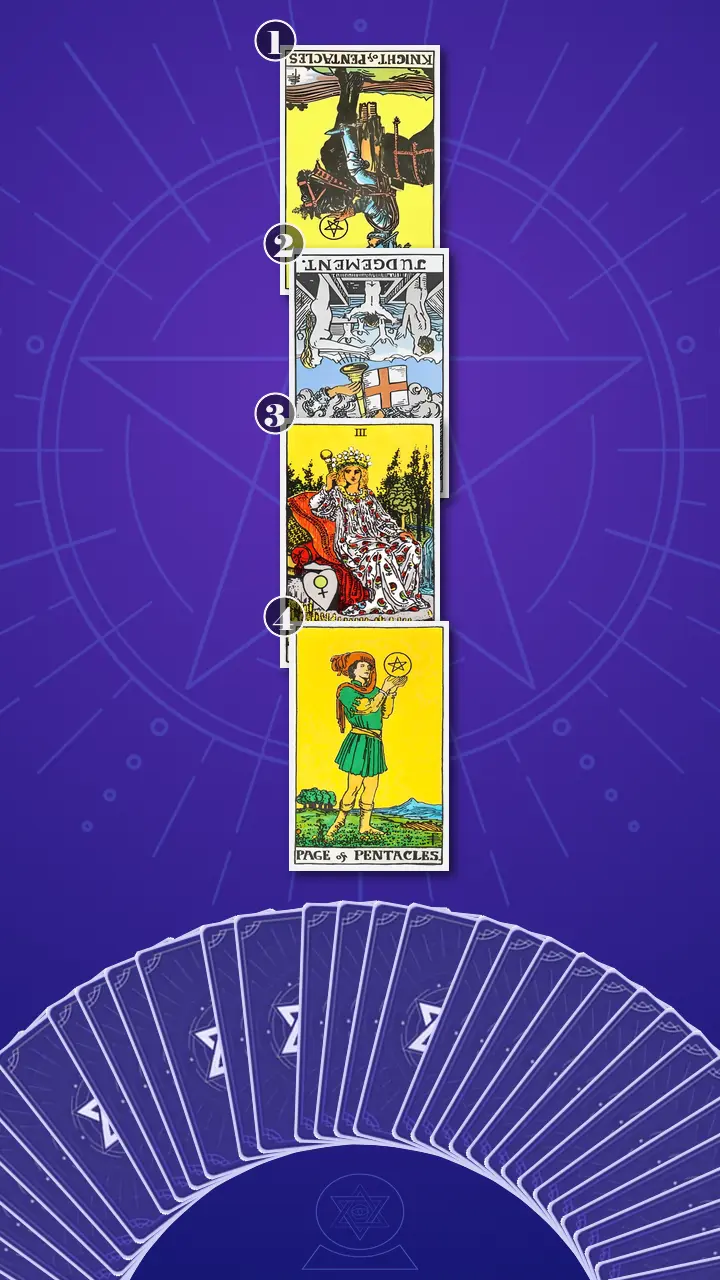
I told her what I was looking for as I laid the cards in a descending line. The first position would show the surface pattern: the stop-start rhythm, the cleaning under pressure, the guest-triggered sprint. The second would reveal the hidden driver: the inner verdict that wakes up the moment the apartment might become visible. The third would name the turning point, the exact energy shift that could soften the loop. And the fourth would ground it into something repeatable enough to survive ordinary weekdays.
From Courtroom to Garden
The Overdue Task in the Corner
I turned over the first card and named its role clearly. “Now the card representing the observable surface pattern from your daily life.” It was the Knight of Pentacles, reversed.
Reversed, this Knight is blocked earth energy: not absence of care, but stalled care. I told Alex I saw the exact work-from-home Tuesday she had already described to me—the two mugs, the mail pile, the chair of clothes sitting in her peripheral vision for hours while her brain kept saying, “I’ll do a proper reset later.” It reminded me of a Notion task dragged from today to tomorrow until it starts to feel bigger than it ever was.
“That’s why the burst right before company feels so weird,” I said. “You know how to clean. The skill is not missing. The motion is.” The unmoving horse in this card mattered to me. It showed deficiency in steady follow-through, not deficiency in worth. The value of a livable home was already there—the pentacle was in her hands, in a sense—but she was holding the idea of care instead of putting it into motion.
Alex gave a short laugh, half amused and half tired. “That’s rude,” she said. “Accurate, but rude.” Her fingers tapped once against her water glass and then went still. That tiny pause told me her defenses were loosening.
When the Room Becomes a Courtroom
I turned the second card. “Now the card representing the psychological root—the hidden fear or inner verdict keeping the pattern alive.” Judgement, reversed.
This was the heart of the shame system. I asked her to think about the last time someone might have seen her place as-is. She did not even need a full memory; her body found it before her words did. Her breath caught. Her jaw set. Her eyes slid off to one side as if replaying a Zoom square. Then it came out in a rush: “Wait, how bad is this? How long has that been there? Is this what other adults live like? If the super came in right now, what would he think?”
That is Judgement reversed in real life. The angel’s trumpet becomes the condo buzzer, the incoming text, the video-call window. The energy here is distorted fire: movement created by alarm. The sink is no longer just dishes. The laundry basket is no longer just laundry. Everything becomes evidence in a trial about whether you are lazy, behind, or failing at basic adulthood. “A messy counter is not a character reference,” I told her, because she needed that line exactly as cleanly as I could give it.
She let out one tight, disbelieving laugh, the kind with a chest drop inside it. For a second I had the familiar image I often get when I read patterns like this: not a mystical vision, just a quiet cosmic analogy. A planet does not become morally superior because it moves faster at one point in its orbit. It is still responding to forces. So is a nervous system. Alex was not broken; she had simply learned to mobilize under exposure.
“What if the problem is not that you care too little,” I asked her, “but that you only know how to move when judgment lights the fuse?” She looked straight back at the card then, and I could feel the room on both sides of the screen go quieter.
When The Empress Turned the Lights On
By the time I reached the third card, the reading had a hinge in it. Outside my window, the late light softened, and on Alex’s side of the call she reached back and clicked on a warm lamp. The room behind her stopped looking like evidence and started looking like a place someone actually lived in. “This,” I said, “is the central transformation card. The energy that changes the motive itself.”
The Empress was upright.
Before I said more, I named the exact moment she kept getting trapped in: the apartment feels survivable all day, then one “I might be nearby later” text lands, the room gets louder, and every mug, package, and sock suddenly develops a moral charge. She had been trying to solve that panic-cleaning before company with more discipline, when the real question was different: what kind of care is possible before shame arrives?
You do not need the trumpet of judgment to move; let The Empress turn your home from a stage for approval into a garden you tend because you live there.
I let the line sit for a beat, then I added, more softly, “The issue is not that you care too little. It is that shame has been doing the job of motivation. A home is not a performance review; your space does not need an audience to deserve care.”
Alex’s first reaction was not relief. It was resistance. Her whole body did a three-step tell I have learned to trust: first the freeze, shoulders lifted and breath held; then the mental replay, eyes unfocused as if she were rewatching a dozen guest-text emergencies at once; then the crack in the defense, a sharp exhale through her nose. “But if that’s true,” she said, almost irritated, “doesn’t that mean I’ve trained myself to need shame?”
“It means your system found a crude fuel source,” I said. “Not the only one. Just the one it learned first.” I asked her to try the question The Empress always brings me in home-care readings: “What would feel kinder tonight?” Not impressive. Not guest-ready. Kinder. Her face changed at that. The muscles around her mouth loosened. One shoulder dropped, then the other. There was even that brief, almost dizzy blankness that can happen after a real insight—the strange moment when a burden leaves and responsibility enters. I invited her to look back at the last week through this new lens. “If you had asked that on Tuesday,” I said, “would you have needed ninety frantic minutes, or would clearing the nightstand and taking the mugs to the sink have changed the feeling of the whole evening?” She nodded slowly. “That would have been enough,” she said, and there it was: the first move from panic cleaning for approval to calmer, audience-free care rooted in self-respect.
This is where I brought in one of my own favorite lenses: Rest Phase Legitimacy. I told her I do not believe in treating every low-energy day like a personal failure. Planets have low tides and high tides; human routines do too. The Empress does not ask for endless output. She asks whether your environment can support your body even when nobody is grading your effort.
The Tiny Habit That Rebuilds Trust
I turned the last card. “Now the card representing the grounded next step—the repeatable behavior that can start rebuilding self-trust in ordinary life.” It was the Page of Pentacles, upright.
This card always feels like a relief after all-or-nothing thinking. The Page does not demand a full apartment reset, a perfect storage system, or a CleanTok before-and-after montage. The Page studies one pentacle. One task. One anchor. One visible repeatable reset. In Alex’s life, that looked like a ten-minute evening reset after work, one load of laundry on Saturday morning, or carrying every mug from her desk to the sink before shutting her laptop.
Here I used another tool I return to often: Micro-Cycle Energy Mapping. I asked her, “When does your energy naturally dip, and when do you still have enough momentum for one small act?” She answered immediately. “Right before I fully clock out. If I sit on the couch first, it’s over.” That mattered. The Page of Pentacles loves honest data more than idealized plans. This was not about becoming the kind of woman who always has the perfect apartment. It was about treating maintenance like a beta test, not a final exam—more Duolingo streak than last-minute cram session.
“Start with the spot your body meets first,” I said. “That is how self-trust grows here.” She nodded in a different way this time: not the big emotional nod of revelation, but the smaller one that means a person can actually imagine doing the thing.
Finding Clarity in One Lamp, One Song, One Surface
When I stitched the spread together for her, the story was clean. First came the Knight of Pentacles reversed: the frozen routine, the TTC-streetcar-between-stops feeling of everyday maintenance that never quite leaves the station. Then Judgement reversed showed why: the apartment had become a courtroom, so movement only arrived when a witness seemed possible. The Empress opened the hinge by changing the reason for care, and the Page of Pentacles turned that new motive into something usable. The whole reading moved from image management to self-nurture, from being seen to being supported, from shame fuel to steadier self-trust.
I told Alex the blind spot was not laziness. It was the belief that the space only really mattered when someone else could see it. Once that belief runs the show, of course chores get postponed; there is no outside witness yet. The transformation direction was simple, but not easy: move from cleaning to prevent judgment to maintaining the space in small ways because your own comfort counts as a valid reason.
When I gave her practical next steps, she looked at me and said, “Okay, but on a low-energy day I can barely get myself to answer texts. Five minutes can still feel weirdly impossible.” I appreciated the honesty. “Then we lower the bar until it becomes real,” I said. “That is not cheating. That is design. Low tide is not failure.”
- Body Landing SpotTonight, pick one place your body will meet first—your bedside table, bathroom sink, or your side of the couch—and spend five minutes making only that area 10% easier on your nervous system. Turn on one warm lamp, put on one song, or open the blinds before you start.If your brain tries to escalate this into a full clean, stop when the timer ends. If five minutes feels like too much, do two. Small counts, even when nobody sees it.
- The Lunar Routine SyncFor one week, match the task to your actual energy tide. On each work-from-home weekday, right before you shut your laptop, carry every mug and dish from your desk area to the sink and mark it in Notes as your future-me landing pad.This is an experiment, not homework. Miss a day and resume at the next cue; do not restart the week or make up for it with a punishment clean.
- One-Minute Courtroom InterruptionThe next time you get an “I might stop by” text, stand still for sixty seconds before cleaning and name three things you want to reset for your comfort, not their opinion. Then do one for-you task first: clear the sink, empty the trash, or fold the blanket you actually use.If saying it out loud feels cringe, text yourself one sentence: “I am making tonight easier, not proving anything.” That pause is enough to interrupt the old script.
Those steps were intentionally unglamorous. No full overhaul. No shame-powered redemption arc. Just actionable advice built to survive real life in a small city rental, on an ordinary weekday, in a body that does not feel the same every day.

A Week Later: The Quiet Proof
A week later, Alex sent me a message after a workday: “I did the mug-to-sink thing before closing my laptop, then cleared my nightstand after my shower. Nobody was coming over. It felt bizarrely emotional.” That was the point. The first evidence of change is usually small and almost embarrassingly ordinary.
She slept through the night after clearing the nightstand, but woke with the old thought—What if I slide back? This time she smiled, carried the breakfast mug to the sink, and let that count.
When I thought back on her reading, I felt grateful for the precision of this Four-Layer Insight Ladder tarot spread for self-worth patterns in home care. It had not told her who she was. It had shown her what had been driving the loop, and then handed the steering wheel back. She did not need more pressure. She needed a gentler engine, and proof that her own comfort was reason enough.
When your place only feels worth tending once someone else might see it, even a pile of mugs can land in your chest like proof that you are failing at basic adulthood.
If your comfort counted just as much as anyone else’s opinion, what is one corner of your space you would want to make 10% kinder tonight?
Every reading at AceTarot is a Journey to connect with inner wisdom and empower next step.
Learn more about our Journey to Clarity.