From Verdicts to Flow: The Half-Worn Clothes Chair Reset

The Chair That Spoke Before Coffee
If you’re a hybrid twenty-something whose bedroom also has to function as a work setup, and the first thing you clock before opening Slack is the half-worn clothes chair, I want to say this plainly: that is usually decision fatigue, not laziness.
When Maya (name changed for privacy) came to me, she described her room so vividly I could almost hear it. At 8:43 p.m. on a Wednesday in her small Toronto rental, she would drop her tote by the door, sit on the edge of the bed, peel off her jeans and knit top, and glance at the desk chair beside a laptop still glowing with Figma tabs. The radiator hissed. A streetcar bell floated up from outside. Her phone screen felt warm in her hand. She wanted the room to exhale with her, but instead one tiny clothing decision became three more she did not want to make.
“It is not dirty, but it is not put away either,” she said. Then, quieter: “Why does one chair make me feel like I am losing at adulthood?” I had heard versions of that question before, including the midnight-search-engine version of it: how to store half-worn clothes in a small bedroom, clean enough to rewear or dirty enough to wash. Underneath it, I could hear the real contradiction. She wanted a calm, functional, adult-feeling room, but she did not want one more loaded verdict about whether yesterday’s hoodie belonged in the hamper, the closet, or nowhere at all. The overwhelm sat on her like twenty browser tabs open in the body—nothing individually catastrophic, but all of it humming at once in her jaw and shoulders.
I told her, gently, “The chair is not the crime scene. It is where postponed decisions become visible.” Then I asked her to take one slow breath with me. “Let’s make a map of this fog,” I said, “and find the kind of clarity that still works on a tired Tuesday night.”

Choosing the Ladder, Not the Lecture
I asked Maya to breathe in, breathe out, and keep the question simple: why does the chair keep taking over? Then I shuffled slowly, not to perform mystery, but to give her nervous system a bridge from self-criticism into observation.
I chose the Four-Layer Insight Ladder · Context Edition. For a question like this, the structure matters. This was not a grand fate question, and it was not really a yes-or-no cleaning question either. It was a compact feedback loop: fatigue led to postponement, postponement became visible clutter, clutter created shame, and shame made the next decision harder. A Celtic Cross would have buried that clean pattern under too much detail, while a decision spread would have over-focused on options instead of the loop itself. This is how tarot works best for repetitive room clutter and routines in my practice: it names the symptom, the hidden mechanism, the key shift, and the next embodied step without overdramatizing the issue.
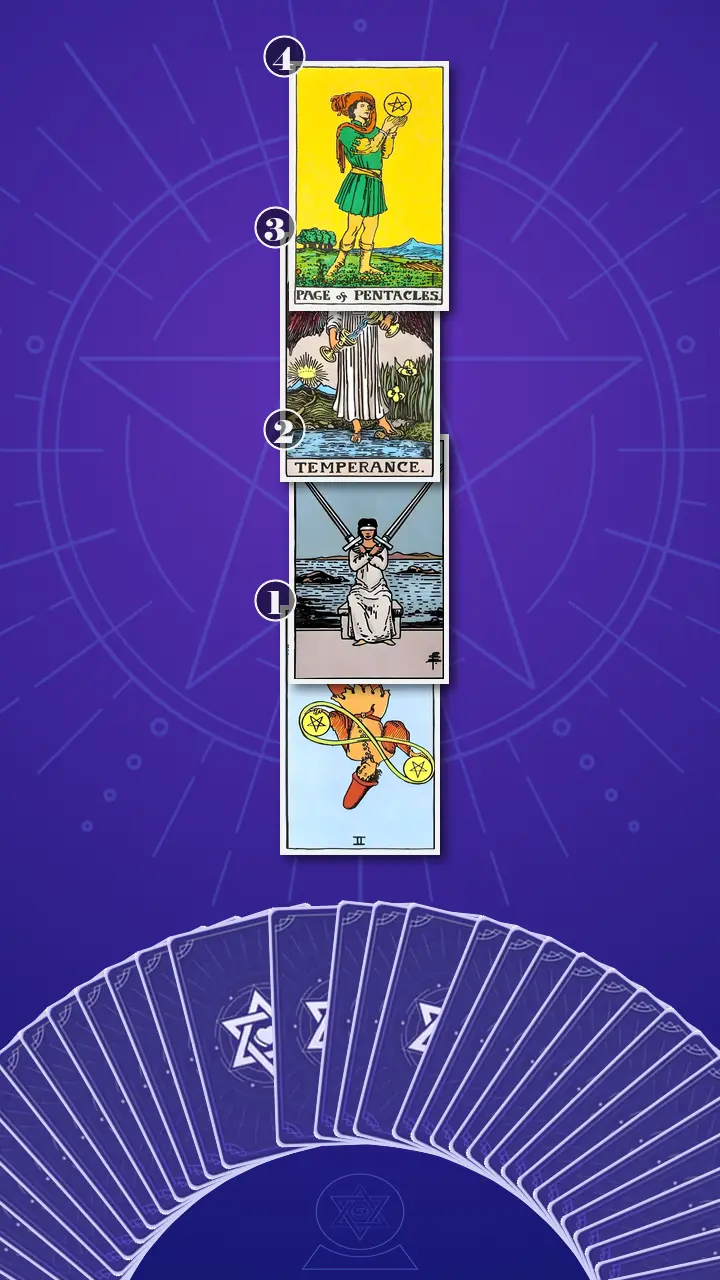
I laid the four cards in a vertical line like a small staircase out of the corner she felt trapped in. The first card would show the visible symptom. The second would reveal the hidden stall point. The third—the catalyst and key card—would name the transformation. The fourth would offer actionable advice and next steps for this week, not some fantasy version of a perfect future self.
Reading the Map of the Catch-All Chair
When the Room Wears the Backlog
I turned the first card and named the position before the card itself. This was the layer that shows the visible symptom: how the half-worn clothes chair becomes a backlog of postponed micro-decisions and steals usable space.
The card was Two of Pentacles, reversed.
I told her this card always makes me think of daily life when the juggling stops being dynamic and starts spilling. In the exact scenario she had already described to me, the chair had become the extra pair of hands her routine did not have: jeans over the back, bra on the armrest, knit top on the seat, then the same hoodie pulled from the middle two days later because nothing had ever fully resolved. It had the same energy as keeping too many browser tabs open for tiny tasks until the tab bar itself becomes the stressor.
In energy terms, I read this as overload tipping into blockage. The earth element here should help with ordinary management, but reversed it loses rhythm. “This isn’t a sign that you can’t run your life,” I told her. “It’s a sign that tired evenings keep knocking one small practical loop out of alignment, and the room starts wearing your backlog on its surface.” She gave a short laugh with a little sting in it and said, “That is annoyingly accurate.” Her fingers tapped once against her mug, then went still.
The Five-Second Hoodie Freeze
Then I turned the card representing the hidden stall point: the threshold decision between rewearing, washing, or putting away that keeps items in limbo.
The card was Two of Swords, upright.
I felt the reading sharpen. I asked her to remember the last time she held a half-worn item and froze. She said, immediately, “A hoodie.” I nodded, because that was exactly this card. I described the scene back to her: standing in socks between the bed and the hamper, holding the fabric for five extra seconds, jaw tight, shoulders high. Not dirty enough. Not clean enough. I don’t want to think about this right now. Then the chair absorbs the stalemate.
“This is blockage,” I said. “Not clutter volume. Not lack of discipline. Blockage.” The blindfold and crossed swords showed me a mind trying to protect itself by reducing a nuanced call into a harsh binary. I translated it into her language: “It’s like an interface that only gives you two buttons when what you actually need is save as draft.”
She pressed her lips together and gave me that tight, almost embarrassed nod I know so well. “Yes,” she said. “That exact stupid moment.” I told her there was nothing stupid about it. Half-worn clothes create clutter in the gap between categories, and that gap had been carrying far more emotional weight than a hoodie ever should.
I also noted something I never ignore: the first two cards were both Twos. Clean or dirty. Now or later. Practical or emotional. The chair kept growing in the gap between twos, not because Maya lacked discipline in some global sense, but because her system kept forcing every in-between thing into a split that real life almost never obeys.
When Temperance Poured Between Two Cups
When I turned the third card, the whole reading seemed to inhale. Even through the screen, I saw the room behind her go still; the laptop light was still there, but it stopped feeling like background and started feeling like witness. This was the card that names the core transformation: the middle path that turns rigid sorting into a more flexible, sustainable flow.
The card was Temperance, upright.
I told her the image mattered as much as the keyword. One foot on land. One foot in water. Water moving steadily between two cups. Not frozen. Not dumped. Not judged. In the life she had already shown me, this looked like one rewear hook or basket for in-between clothes, plus a weekly reset rule, so transition stopped feeling like failure and started functioning like part of the system. It was less dramatic closet overhaul, more giving the room an in-progress lane so everything no longer had to be either done or failed.
This was balance returning, but not the brittle kind. It was moderation as movement. Whenever I see Temperance, I think of orbital transfer windows more than tidy-home advice. That is my own inner shorthand. In my practice, I call this Rest Phase Legitimacy: the understanding that low-energy phases are not moral defects but natural parts of an orbit. After years of reading for burnt-out people, I have learned that so much shame comes from asking a low-tide version of ourselves to perform high-tide precision. Planets do not apologize for moving through dimmer stretches of their path. A room system that only works for your best-energy self is not wisdom; it is bad design.
So I slowed down and set the moment carefully. “After a long hybrid day,” I said, “you drop your tote by the door, sit on the bed, and hold yesterday’s knit top for three extra seconds while the desk chair waits beside you. The room is quiet, but the decision suddenly feels absurdly loud.”
As I said the word “transition,” another streetcar bell rose faintly through her window, and I smiled at the accidental accuracy. Temperance often feels like transit to me: not the destination, not nowhere, just the transfer point that keeps movement possible.
This chair is not proof that you are hopelessly messy; it is a cue to choose a middle path, and Temperance's pouring cups remind you that some things need a transition, not a verdict.
I let that sit between us for a beat. Then I added, softly but clearly, “Tired you does not need a verdict. Tired you needs a category.”
Her reaction came in three waves. First her breath caught and her hand stopped halfway to brushing her hair back, as if her body had paused before her mind could. Then her eyes slipped past me for a second, unfocused, replaying some private Thursday-night scene in that narrow gap between bed and chair. Then the tension left her shoulders so suddenly I could actually see the drop on screen—followed by a small frown, almost like dizziness after stepping off a moving walkway. “But… doesn’t that mean I’ve been making this harder than it needed to be?” she asked, and there was a flash of resistance in it, almost irritation.
“Yes,” I said, “but not because you failed. Because the system kept turning ordinary clothes into pass-fail judgments.” I asked her to look back at the last week through this new lens. She laughed once, more gently this time. “If I’d had a middle category on Thursday,” she said, “I would’ve put the hoodie there in two seconds and gone to bed.” That was the shift right there: not from messy to perfect, but from annoyed overwhelm and low-level self-criticism to the first real glimpse of a calmer, more trustworthy routine.
The Tiny Prototype That Brings Grounded Energy Back
Then I turned the card representing the grounded next step: the small practical system that can restore movement and reduce friction this week.
The card was Page of Pentacles, upright.
I smiled when I saw it, because Maya works in product design, and this card speaks fluent prototype. In the world of her room, it looked like placing the hamper within arm’s reach of the bed, adding one hook near where she changes, and doing a 60-second nightly sort only for the clothes she wore that day. Not a personality overhaul. Not a dramatic Sunday reset. Just a tiny v1 that can survive real conditions.
In energy terms, this was grounded balance returning to earth. The Page studies what works in practice. He doesn’t audition for adulthood; he tests, observes, adjusts. I told her, “I want you to borrow this line: I am testing a setup, not auditioning for adulthood.” She looked off toward the actual chair in her room, then back at me with the first real half-smile of the session. The room hadn’t changed yet, but her relationship to it already had.
From Verdicts to Flow: The Chair-to-Flow Reset
When I stepped back and looked at the reading as a whole, the logic was clean. The reversed Two of Pentacles showed unstable earth: daily management slipping out of rhythm until the room wore the backlog on its surface. The Two of Swords hardened into defended air: a frozen threshold decision. Temperance blended water and fire back into movement. The Page of Pentacles brought us home to earth again through one humble, repeatable habit. That entire arc answered the clothes chair problem without moralizing it. It was not about whether she was secretly bad at adulthood. It was about domestic limbo clutter caused by decision fatigue around half-worn clothes.
The blind spot, I told her, was thinking she needed better storage or more discipline first. What she actually needed was to stop treating every in-between item as evidence. Once that shifted, the transformation direction was simple: from verdicts to flow, from a perfect reset fantasy to one clear next place. And in my own mind, I was back in that cosmic metaphor I trust so much—because relief rarely arrives like a meteor. More often it arrives when a system finally starts matching the energy season you are actually in.
When I suggested a five-minute setup, she shook her head immediately. “Honestly? I don’t have five minutes on office nights.” I appreciated that, because real obstacles are where good advice either survives or falls apart. “Then we won’t build a system for five-minute Maya,” I told her. “We’ll build it for sixty-second Maya. Low friction beats perfect reset.”
This is where I brought in my Micro-Cycle Energy Mapping and folded it into my Lunar Routine Sync. I asked her which nights were reliably low-tide—usually hybrid office days and late Figma nights—and which one evening had just a little more room. Once we mapped that honestly, the solution stopped sounding like a lifestyle makeover and started sounding like a real-world routine.
- Give in-between clothes one real orbit.By midweek, choose exactly one rewear spot near where you change clothes: one wall hook, one basket, or one shelf section. Tonight, sort only the clothes you wore today into three homes—hamper, hanger, or rewear spot—and stop there.Keep the rewear zone intentionally small, three to five pieces max, so it stays transitional instead of turning into a second clothes chair.
- Run a 60-second chair intercept.On work nights, set a 60-second timer the moment you change clothes and handle only what is in your hands right then. If a guest, date, or video call is coming, clear only the chair seat and floor into those same three homes—no panic hiding, no full-room spiral.If timers annoy you, make it three items instead. Missing one night does not mean the system failed; it means you’re testing a habit under real conditions.
- Try the seven-day Lunar Routine Sync.For one week, notice your low-energy and higher-energy evenings. On low-tide nights, do only the day’s three-home sort. On your chosen reset night—Sunday or Friday—anything still in the rewear spot gets washed or rehung. Judge the setup by whether the chair becomes usable again, not by whether you felt perfectly organized.If you feel yourself reaching for a dramatic closet purge, stop after three items. If a room system only works for your best-energy self, it needs redesign, not more shame.
That was the actionable advice the spread had been pointing toward all along: not a prettier guilt cycle, but a middle category, a rewear spot, and a simple reset rule. That is how finding clarity becomes practical.

A Week Later, the Chair Was a Chair Again
A week later, Maya sent me a photo in pale morning light. The chair had her work tote on it again. A single cardigan hung on a hook by the desk. “Still had the urge to pile everything there last night,” she wrote, “and my first thought this morning was still, what if I’m doing it wrong? But then I just moved the hoodie to the rewear hook and made coffee.” It was such a small sentence, and it told me everything. The room was not perfect. It was simply less loud.
I loved that message because it showed what tarot does at its best. It does not magically wash the clothes or save you from being human. It helps you see the real bottleneck clearly enough that your next move becomes smaller, kinder, and more yours. That was the real Journey to Clarity here, and it was exactly what this Four-Layer Insight Ladder tarot spread for the half-worn clothes chair loop had offered: a map from visible clutter to the hidden decision point, and then back into a calm, low-friction room routine.
When a tired evening turns one hoodie into a tiny character test, no wonder your shoulders rise the second you see the chair again. If tonight you are caught between what your space should look like and what your tired self can actually decide, the fact that you can name that tug means you are already no longer standing at the very start.
If one half-worn thing in your room could have its own little orbit this week instead of becoming another verdict, what tiny rule would make that feel lighter?
Every reading at AceTarot is a Journey to connect with inner wisdom and empower next step.
Learn more about our Journey to Clarity.