Slack Beside the Suitcase: Reading Post-Trip Whiplash as Feedback

The Suitcase, the Slack Ping, and Post-Travel Identity Whiplash
When Jordan (name changed for privacy) sat down across from me, I knew the pattern before she finished the question. She was 29, a content strategist at a hybrid tech company in Toronto, and the morning after landing she had opened Slack, watched Monday’s calendar fill up, and then googled why she suddenly had career pivot anxiety instead of answering email. In other words, the post-trip reinvention urge had shown up right on time.
As she described that first morning home, I could see the scene almost frame by frame: 7:12 a.m. in a downtown condo kitchen, the kettle clicking off, Gmail and Slack loading on her laptop beside an unopened suitcase, the room still smelling faintly of laundry detergent and airport air. The screen light felt harsh. Her jaw tightened. Her chest buzzed. One look at her calendar, and the walls seemed to move two inches closer.
“I get home and suddenly my whole life feels off by two sizes,” she told me. “Why do I only feel like myself when I’m somewhere else? I know I sound dramatic, but the urge feels real every single time.” Once she said it plainly, the contradiction underneath everything became clean: she wanted a life that felt expansive and alive, and she was afraid that staying with routine meant getting trapped inside a smaller future.
I could feel her restlessness in my own body just listening. It wasn’t abstract. It felt like a phone left vibrating on a wooden table inside the rib cage—small enough to fit in one hand, loud enough to take over the whole room. It was not that the trip had solved her life; it was that coming home had made her usual life feel two sizes smaller. And still, I told her gently, not every urge to escape is a call to explode your life.
“That doesn’t sound dramatic to me,” I said. “It sounds specific. So let’s not treat the feeling like a verdict yet. Let’s make a map for the fog and see what it’s actually trying to tell you.”

Choosing the Compass: A Four-Layer Insight Ladder for the Re-Entry Spiral
I asked her to put both feet on the floor and take one slow breath before I shuffled. I never use that moment as theater. I use it as a reset. It gives the nervous system one beat to settle, which is often the difference between reacting to a feeling and actually hearing it.
For this reading, I chose a four-card spread I call the Four-Layer Insight Ladder · Context Edition. When someone asks a question like, “Why do I want to change my life after every trip?” I do not want a dramatic prediction. I want clean structure. This is a tarot spread for recurring inner patterns, not a fortune-telling stunt. It gives me the minimum number of positions needed to separate the visible symptom from the deeper root, the key inner reframe, and the grounded next step.
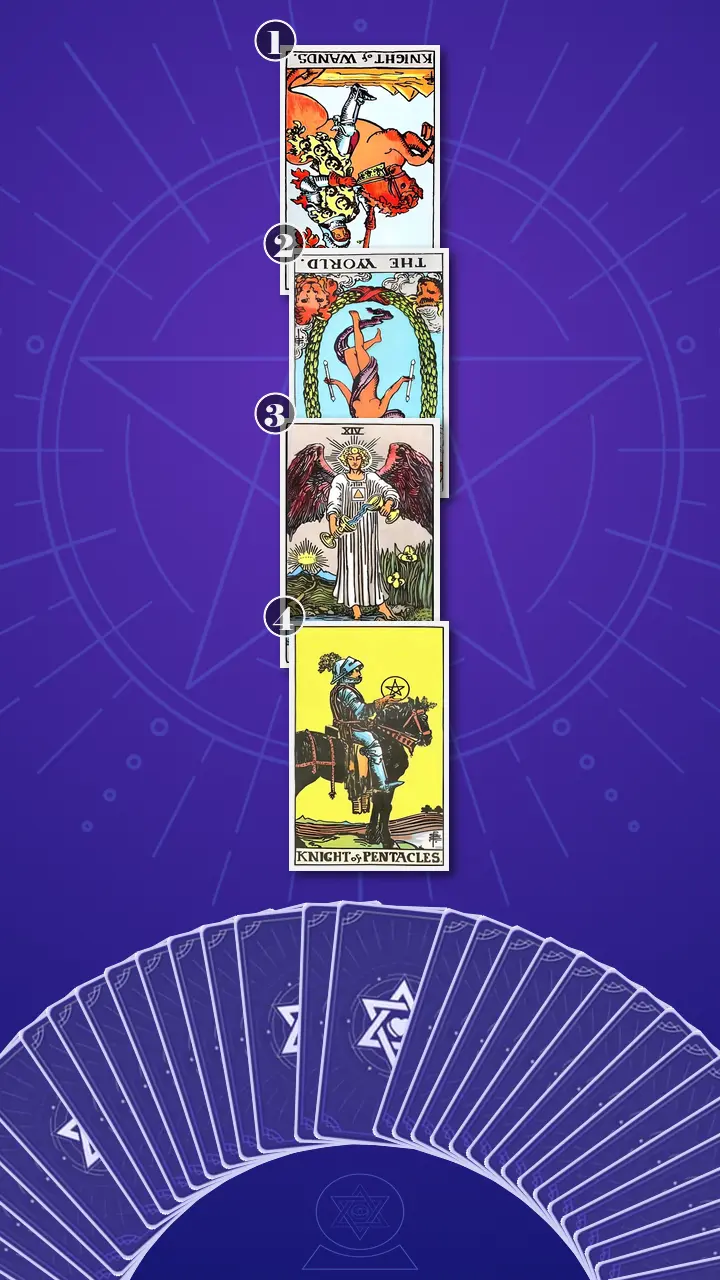
I laid the cards in a vertical line, like steps going downward. The first card would show the immediate post-trip urge to change everything. The second would reveal what travel temporarily restores and why returning home hits that deeper fear of contraction. The third—our bridge card—would show the integrating truth that could reconnect travel-self and home-self without an all-or-nothing reset. The fourth would point to one sustainable change that could carry the lesson into an ordinary Tuesday.
Reading the Inner Staircase
Position 1: The Flare That Feels Like Clarity
Now the card I turned over for the immediate post-trip reinvention impulse—the observable urge to change everything at once after returning home—was Knight of Wands, reversed.
The image was almost too accurate. Within hours of landing, Jordan was toggling between LinkedIn, apartment tabs, a budget spreadsheet, and a new routine in Apple Notes before her suitcase was even open. The urge was real, but it was running hot and fast. This card showed fire in a blocked, excessive state: too much momentum, not enough container. Movement felt safer than sitting still long enough to ask what exactly the trip had woken up.
The rearing horse on the card gave me the whole nervous-system story. Her body was still traveling even though her plane had landed. It had the same energy as the late-night “should I just move abroad?” TikTok spiral that feels wildly convincing until regular life re-enters the chat. Years ago, on a trading floor, I learned that the loudest spike at the opening bell was not always direction; often, it was just volatility. Seeing this card, my mind flashed right back to that lesson. Heat, yes. Durable signal, not yet.
“So this isn’t me being fake?” she asked.
“No,” I said. “It’s you being activated. There’s a difference.” Then I gave her the sentence I wanted her to keep: Contrast is loud. It is not always the truth.
She let out one short laugh that had a bitter edge to it and rubbed her thumb along the rim of her mug. “Wow,” she said. “That’s so accurate it’s almost rude.” The laugh mattered. I could feel the shame loosen just enough for us to keep going.
Position 2: The Self That Suddenly No Longer Fits
The next card I turned over represented what travel temporarily restores and why returning home activates a deeper fear of contraction, stagnation, or lost agency. It was The World, reversed.
This was the major blockage in the spread, and I told her so. Jordan was not simply bored with home. She was struggling to fit the more curious, embodied, wide-open version of herself back into a life organized around screens, meetings, commute rhythms, and familiar walls. In real life, this is the half-unpacked-suitcase moment: sitting on the floor, looking at a photo where you seem lit from the inside, and thinking, Maybe nothing is technically wrong, but everything suddenly fits wrong.
The World reversed showed blockage in integration. The trip had expanded her sense of self, but home still had the settings of the older version. The laurel wreath on the card looked to me like a container, and that became the real question: did her daily life currently have enough space, rhythm, and emotional bandwidth to hold the fuller self that showed up while she was away? If the answer was no, then of course re-entry felt emotionally false. It had a little bit of Severance energy to it—travel-self and inbox-self acting like two versions of the same person who had never been allowed to sync across devices.
“This is why the first card feels so urgent,” I told her. “You’ve been mistaking an integration gap for proof that your life is fundamentally wrong. That misunderstanding hurts, but it is not the same thing as a dead end.”
She went very still. First her fingers stopped moving. Then her gaze drifted off the table, as if she were replaying a Tuesday night with the suitcase still open beside her. When she finally looked back at me, her voice had dropped. “Yes,” she said. “Home isn’t bad. It just feels too small when I get back.”
“Exactly,” I said. “And that’s why not every urge to escape is a call to explode your life. Sometimes it’s the clearest sign that the bigger version of you has not been given a place to live on weekdays yet.”
When Temperance Poured Between Two Cups
Position 3: The Bridge Between Travel-Self and Home-Self
When I flipped the third card—the one that shows the integrating truth that can bridge travel-self and home-self without an all-or-nothing reset—the room changed. On the table between us sat her water glass and my tea cup, and for a second they mirrored the card before I had fully named it. Temperance, upright.
Jordan had been describing the exact state this card addresses: home for less than 24 hours, still half in departure mode, standing in socks beside an unpacked suitcase, half-scrolling trip photos and half-pricing out a different life. In that state, the urge can feel so convincing that it passes for truth.
Stop treating home and freedom as opposing worlds, and let Temperance's pouring cups show you that the real work is blending what felt alive on the road into the life you already live.
I let the sentence sit there. Outside my window, a streetcar bell rang once and disappeared. Jordan’s reaction came in layers. First, a physical freeze: her hand stopped halfway to her mug, breath caught just under the collarbone. Then came the cognitive seep: her eyes lost focus, not blank exactly, but distant, as if her mind had gone back through baggage claim, the condo kitchen, the visa tabs, the whole loop. Then the emotional release arrived: her shoulders dropped all at once, and a shaky exhale left her like air finally leaving a room with a stuck window.
“But if I do that,” she said, and now there was resistance in her voice, a quick flash of anger protecting something softer underneath, “doesn’t that mean I’ve been reading this wrong every time? Like I turned it into some huge sign when it wasn’t?”
“Not wrong,” I said. “Over-scaled. The feeling was accurate. The verdict was too large.”
This is where I used one of the frameworks I carry from my old life. On Wall Street, I learned to separate signal from strike timing. I call it Strike Timing Calibration: a feeling can contain real information and still be the wrong moment for decisive action. Temperance told me Jordan’s real thesis was not, ‘I need a new life by Tuesday.’ Her real thesis was, ‘I need more novelty, movement, beauty, and direct experience inside the life I already have.’ That is a very different trade.
“You do not need a new identity by Tuesday,” I told her. “You need a better container for what lit up. What if this feeling is data, not destiny?”
I watched that question land. The defensiveness left her face first. Then came the slightly disorienting part that often follows relief—the brief dizziness of realizing the answer is smaller, truer, and now partly yours to build. So I kept it practical. “Look back at last Monday,” I said. “Before the apartment tabs, before the job boards, before the Notes app rescue mission. Was there a moment when the real ache wasn’t ‘I need a different life,’ but something more specific? Something this new lens would have named correctly?”
She nodded slowly. “Yeah,” she said. “Walking. Slower mornings. And not feeling like every hour already belonged to a screen.”
I could feel the energy shift from speed to precision. Ten dramatic plans had collapsed into three honest ingredients. That was the hinge. Not from confusion to total certainty, but from restless post-trip reinvention panic to the first clean inch of steadier self-trust. Post-trip reinvention is not always proof your life is wrong. Often, it is the clearest feedback you have about what your life is missing.
Position 4: The Still Horse and the Calendar Test
The final card I turned over represented one sustainable change that could carry the trip’s lesson into ordinary routine. It was Knight of Pentacles, upright.
I loved this as the landing point because it answered the first card perfectly. The same life-force was here, but at a different pace. The Knight of Wands reversed wanted manifesto energy: new life plan, new city, new bio, six tabs open by midnight. The Knight of Pentacles wanted repeatable proof. In modern life, this is the difference between a dramatic life list and a recurring calendar block that actually survives Thursday.
This card showed earth in balance. No adrenaline spike. No fantasy-scale reset. Just one concrete shift that could survive contact with her real week: protecting one evening for local exploration, blocking one no-meeting work hour, or taking one lunch break outside without her phone. The still horse and the cultivated fields said the same thing in different language: Jordan did not need less desire. She needed a container for desire.
“So the goal isn’t to recreate the trip,” she said, more to herself than to me.
“Exactly,” I said. “The goal is not to recreate the trip. It is to translate the aliveness.”
She nodded this time without flinching. Her breathing had slowed. Her legs had stopped bouncing. And I gave her the line I wanted to anchor the last card: Desire becomes trustworthy when it can survive a calendar.
From Insight to Action: The Strategic Holding Pattern
Once all four cards were on the table, the story was clean. First came blocked fire: the post-trip reinvention urge that made job boards, budget sheets, relocation tabs, and Apple Notes life plans feel like relief. Underneath it sat the real ache: not that her life was secretly ruined, but that the version of herself who felt expanded on the trip did not yet have enough room at home. Temperance turned the whole reading by correcting the false binary. The choice was never ‘stay trapped’ or ‘blow it up.’ The choice was whether she would keep using travel as proof that home was wrong, or start using travel as feedback about what qualities home needed more of. The Knight of Pentacles finished the argument by insisting on a form that real life could actually hold.
I named the blind spot directly. “You’ve been treating contrast like a verdict and planning like proof,” I told her. “That’s why the first 48 hours feel so dramatic. Strategy has been protecting you from specificity.” Her transformation direction was just as clear: move from using travel as evidence against her life to using it as information about what her life is missing.
I also gave her the lens I use before any major pivot: a Resource Readiness Assessment. Do your internal assets actually match the scale and timing of the move you’re imagining? Jordan had real assets—self-awareness, flexibility, enough stability to experiment, and now a clear sense of what travel had awakened. What she did not yet have was evidence that a total overhaul matched the specific need. The missing piece was design, not detonation.
Jordan looked at her calendar on her phone and gave me the practical objection I was hoping for. “Okay,” she said, “but I do not have room for some ideal reinvention ritual. My weeks are already packed.”
“Good,” I said. “Then we won’t build an ideal ritual. We’ll build something that can survive your actual week.” I call this The Strategic Holding Pattern. In my old world, holding was never passive. It was how you stopped adrenaline from making expensive decisions and used the waiting period to prepare the next high-ROI move. Here, it becomes a tactical micro-plan for the re-entry period: less anxious stagnation, more grounded resource preparation.
These were the next steps I gave her:
- Build a 48-Hour Landing BufferAfter your next trip, give yourself a hard rule for the first 48 hours at home: no job applications, no relocation research, no major purchases, and no announcing big life changes to friends. If an idea feels important, park it in one plain note and revisit it on day three.If 48 hours feels impossible, start with 24. This is not suppression; it is a delay between feeling and action so the signal can cool without disappearing.
- Make a 10 Percent Translation NoteOpen one ugly note on your phone with two headers: ‘What the trip gave me’ and ‘How home could hold 10% of that this week.’ List no more than three qualities—walking, slower mornings, anonymity, beauty, less screen time, spontaneity—and choose one to test in real life this week.If you start turning the note into a perfect system, stop at one sentence: ‘What I actually miss is ___.’ Short is safer here than smart.
- Choose One Calendar-Tested ChangeFor the next two weeks, put one recurring shift directly into Google Calendar: one 30-minute neighborhood walk after work with no podcast, one no-meeting hour, or one evening for local exploration with zero errands attached. At the end of each week, ask only: ‘Did this make home feel 5% more like mine?’Lower the bar until it fits your real schedule. Fifteen minutes counts. Missing once does not mean the experiment failed; it means you live in the real world.
That was the most practical answer I could give to the question people type into Google at 12:14 a.m.: why do I want to change my life after every trip? Not by arguing with the feeling, and not by obeying it at fantasy scale, but by letting one quality from the trip cross the border into ordinary life. That is how you stop making dramatic life plans after a trip and start integrating travel energy into everyday life. It is also exactly what this Four-Layer Insight Ladder tarot spread was built to do: turn a chaotic urge into actionable advice and clear next steps.

A Week Later: The Quiet Proof
A week later, Jordan sent me a message. “Did the buffer. No job boards. No apartment tabs. I wrote three words instead: walking, slowness, anonymity. Then I blocked Thursday after work for a phone-free wander through the Annex. It didn’t solve my life. But I didn’t feel like I had to flee it.”
That was the proof I wanted for her. Not a cinematic reinvention. Not a main-character montage of blowing everything up. Just a woman who had stopped asking one flat re-entry moment to serve as a verdict on her whole future. She had moved one inch from overclocked reaction toward grounded authorship, and that inch mattered.
The next morning still brought a small old thought with it—What if I’m settling?—but this time she noticed it, smiled, and made tea before opening Slack. Clear, but still human. Steadier, not finished.
When I think about that reading now, I do not remember it as a prediction. I remember it as a reclaiming. The cards did not hand Jordan a new city, a new identity, or a perfect answer. They helped her win her narrative back by showing her where the signal ended and the spiral began.
I know that when you unlock your door after a trip and the room suddenly feels two sizes smaller, it makes sense that your chest starts bargaining for a different life before your suitcase is even open.
If I leave you with one question from this reading, it’s this: if the urge is feedback instead of a verdict, what one quality from the trip would you want to give a small seat at your kitchen table this week?
Every reading at AceTarot is a journey to connect with inner wisdom and empower your next step. The stories shared here are psychological mirrors, not private records—crafted to reflect universal emotional loops and help you find your own clarity. Learn more about our Journey to Clarity.
Author Profile