Birthday Week Feels Like a Performance Review—and How to Exit It
Finding Clarity in the 11:43 p.m. Birthday Audit
When Taylor (name changed for privacy) sat down across from me, I recognized the pattern immediately: if one casual question about turning 29 can turn a normal Tuesday night into six tabs on career pivots, rent math, and whether you should move, that is not drama. It is birthday milestone panic under a social clock.
She was twenty-nine, living in Toronto, working a hybrid content strategy job that looked stable from the outside and unfinished from the inside. By the week before her birthday, her life would start to feel less like a life and more like a dashboard. At 11:43 p.m. she would be upright in bed with LinkedIn open beside a salary calculator, a Notes list called 29 reset, and a half-serious article about moving cities. The fridge hummed in the dark kitchen. The screen light went hard and blue against her face. Her phone ran hot in her palm from flipping between Instagram Stories and budgeting tabs.
“I know this is dramatic,” she said, trying to smile and not quite landing it, “but I need a plan before my birthday.”
What I heard underneath that sentence was the real contradiction: she wanted to feel in control of her future, and she was afraid that another birthday would prove she was falling behind. Her panic had the texture of trying to reroute your whole life in Google Maps while the app kept shouting new directions. Tight chest. Shallow breath. Jaw locked so long it almost became posture. Panic-planning feels like control because it is louder than uncertainty.
I leaned in a little and kept my voice gentle. “You are not here because you are failing,” I told her. “You are here because the date turns the volume up on a fear. Let’s make a map for it. We are not here to prove your life tonight. We are here to find clarity.”
Choosing the Compass: The Situation-Obstacle-Advice-Outcome Spread
I asked Taylor to put both feet on the floor and take one slow breath before she touched the deck. Then I shuffled. I always treat that opening moment as a practical threshold, not a mystical performance. It helps the mind stop sprinting long enough to notice what it is actually reacting to.
I told her I was using a Situation-Obstacle-Advice-Outcome spread. When people ask me how tarot works for a birthday anxiety spiral, this is one of the cleanest layouts I know. It is compact enough to hold the full pattern without feeding it. We get the visible symptom, the hidden blocker, the restoring energy, and the grounded next step. Tarot card meanings only become useful when they are read in context, and this spread gives context without adding more noise to an already overloaded system.
The first card would show the midnight life audit itself. The second would reveal the deeper verdict underneath it. The third card, the hinge of the entire reading, would show what could restore alignment. The fourth would bring everything back down to earth, into an actual calendar, an actual budget, an actual week.
Reading the Map of the Birthday Anxiety Spiral
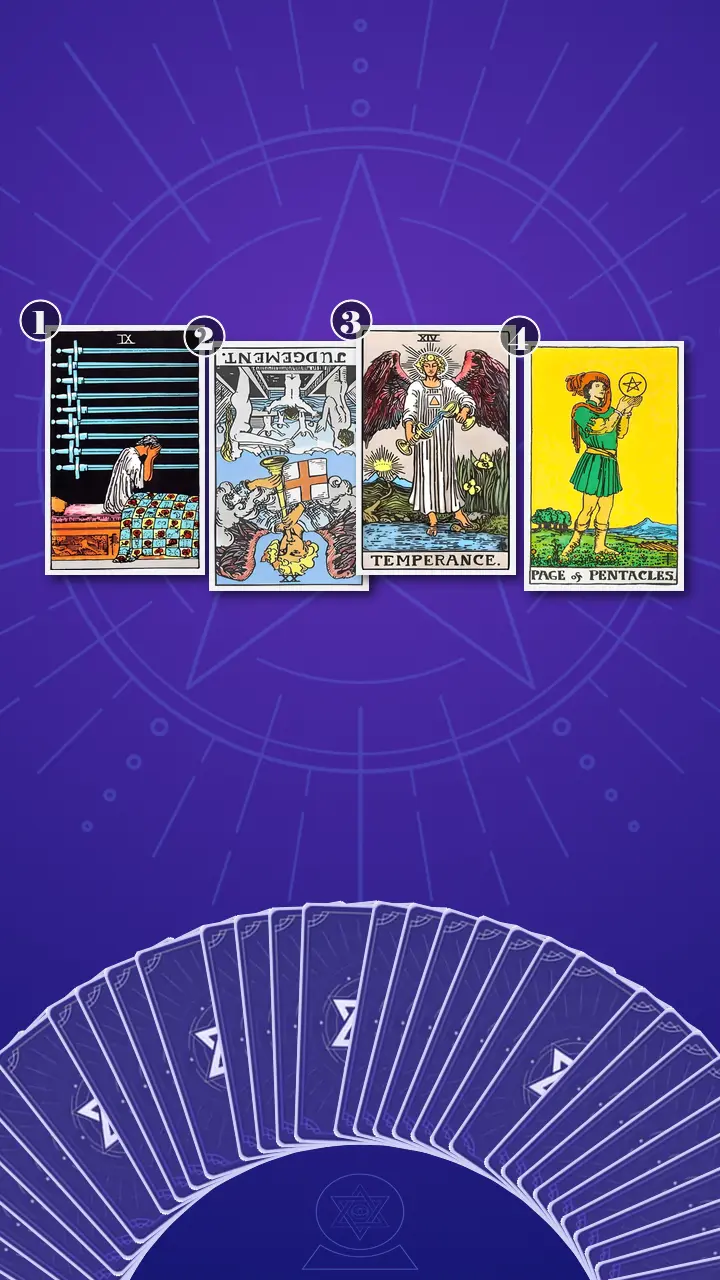
Position 1: Nine of Swords and the Midnight War Room
The first card I turned over was the one showing the birthday-week symptom cluster: late-night panic-planning, comparison, and mental overwhelm. It was the Nine of Swords, upright.
I told Taylor that this card is what happens when the body is in bed but the mind is in a war room. In real life, it looks exactly like the week before your birthday when Chrome is open to LinkedIn, a savings calculator, and articles about moving cities, while your Notes app fills with urgent life fixes. Nothing external has changed enough to justify the level of alarm. The date has simply become symbolic, and suddenly the whole future feels like something that must be solved before sleep.
Upright, the Nine of Swords is excess. Too much air. Too much thought. Too much projection. I pointed to the figure sitting straight up beneath the swords and said, “This is the moment your nervous system starts acting like the future is on fire, even though you are physically safe in your own apartment.”
She let out a short laugh with a bitter edge to it. “That is so accurate it is almost rude.”
I smiled. “Good. That means we are not guessing.” Her fingers eased off the paper cup by a fraction. Then came a slow exhale. Naming the spiral without shaming it is often the first moment a person starts to come back into the room.
Position 2: Judgement Reversed and the Courtroom in Her Head
The second card I turned over represented the deeper blocker beneath the panic: the fear that age will expose a lack of control or worth. It was Judgement, reversed.
I told her this card answered the question beneath the question. Why do birthdays hit harder than random Thursdays? Because what begins as reflection turns into prosecution. In real life, this looks like old photos, old journals, classmates’ job titles, engagement posts, salary comparisons, and the quiet feeling of being graded by timelines you never agreed to. The birthday stops being a checkpoint and becomes a sentencing hearing where you have to prove you used time correctly. It is like a personal Spotify Wrapped narrated by your harshest inner critic.
Reversed, Judgement is blocked renewal. The fire is still there, but instead of rising into clarity, it folds inward and becomes self-sentencing. Instead of hearing a call toward honest change, you hear an internal alarm saying your life is late. “A birthday can be a checkpoint without becoming a verdict,” I said, and let the sentence settle between us.
Her reaction came in three quiet beats. First, stillness: even her breath seemed to stop for a second. Then recognition: her eyes lost focus, as if she were replaying every birthday text and every LinkedIn promotion post she had ever entered into evidence. Then release: her shoulders dropped the smallest amount, and she said, very quietly, “I do turn birthdays into a performance review.”
That was the real blockage. Not a lack of ambition. Not a lack of options. An inner tribunal. The card was not issuing a sentence. It was exposing the courtroom so she could stop mistaking it for truth.
When Temperance Slowed the Whole Room
Position 3: Temperance, the Two-Cup Check-In, and Better Timing
When I reached for the third card, the atmosphere changed. The traffic noise outside seemed to thin out. Even the lamp light felt steadier. This was the hinge card, the one identifying the shift that could replace deadline thinking with paced integration. It was Temperance, upright.
I gave her the first layer plainly. Temperance is not dramatic reinvention. It is one notebook, one timer, two honest questions, and a pace slow enough for feeling and planning to share the same room. I told her I think of it as a two-cup check-in: one cup holds what you feel, the other holds what is practical, and the point is not to let either one flood the table. It is the opposite of staying up all night trying to manufacture a new identity.
Seeing that patient movement between the cups, I had a flash from my old Wall Street life. On the trading desk, the most expensive moves were rarely the slow ones. They were the under-resourced ones made just to relieve discomfort. So I used the framework I rely on when people are on the edge of forcing a pivot: my Resource Readiness Assessment. “Temperance is asking a very unglamorous but powerful question,” I told her. “Do your internal resources — your sleep, your attention, your money, your emotional bandwidth — actually match the speed of the decision you are trying to force? Because if they do not, that is not clarity. That is bad strike timing. On the desk, we called that strike timing calibration: knowing the difference between a true moment to act and an impulse to act because waiting feels unbearable.”
When it is 11:43 p.m., your Notes app is full, your tabs are multiplying, and your chest is tight because the birthday suddenly feels bigger than the actual day, it is easy to think the answer is a more intense plan.
Your age is not a fire alarm; let Temperance's two cups teach you to replace frantic life audits with measured mixing and one workable next step.
She did not soften immediately. First came resistance. Her jaw tensed again, and a quick spark of frustration crossed her face. “But if I stop pushing,” she said, “won’t I just drift?”
I kept my voice steady. “No. Drifting is unconscious. This is deliberate pacing. Panic is a fire alarm, not a project manager.”
Then the reaction moved through her in layers. Her hands, which had been locked together so tightly the knuckles had gone pale, loosened one finger at a time. Her gaze dropped from me to the card and then somewhere beyond it, into the memory of a recent Sunday when she had built a beautiful birthday reset in Notion and abandoned it by Monday. The skin around her eyes flushed pink. She took one breath, then a deeper one, and with that second inhale her upper body seemed to remember the chair could hold it. Relief was there, yes, but not the clean movie version. There was also a flicker of vulnerability, the slight dizziness that comes when you set down a burden you have been using as structure. If urgency was not going to run the meeting anymore, then she would have to hear something quieter. I asked her, “Now, with this lens, think about last week. Was there a moment when slowing down would have told you more than opening another tab?” She gave a smaller, truer laugh. “Sunday. Coffee shop. I did not need a new life plan. I needed to admit I felt behind.”
That was the shift in plain language: not from failure to success, but from panic-driven self-verdicts to steadier self-trust around age and timing. The future gets clearer when it stops being cross-examined.
Position 4: Page of Pentacles and the One-Pentacle Month
The final card I turned over represented the grounded next step, the way this reading could end in practice rather than another abstract life overhaul. It was the Page of Pentacles, upright.
I told Taylor this card is what happens after the panic settles. The future stops looking like one giant verdict and starts looking like one small experiment: one savings transfer, one informational coffee, one course module, one recurring Sunday check-in. The page is not trying to appear fully figured out. The page is willing to learn.
Upright, this is balanced earth. Steady. Trackable. Teachable. Not ten imagined futures, one tended thing. “One grounded step tells the truth faster than ten emergency plans,” I said. “This card wants one tab called next step, and it wants the rest closed.”
She nodded without the earlier flinch. “That I can actually do.” And there it was: less performance, more contact with reality.
The Checkpoint, Not Verdict Method
When I laid the spread back out in a line, the story was clean. The Nine of Swords showed the symptom: birthday-week overthinking that turns an ordinary night into a private emergency. Judgement reversed showed the hidden mechanism: she was not just planning, she was trying to outrun a verdict about her worth. Temperance showed the reorientation: slower pace, better regulation, clearer signal. The Page of Pentacles showed the embodiment: one experiment she could actually tend. The elemental flow was almost textbook in the best way — air overload, blocked fire, careful mixing, then earth. The whole reading moved from courtroom to workshop.
The blind spot was subtle but expensive. Taylor had been treating intensity as evidence of seriousness. If the plan felt punishing enough, strict enough, or exhausting enough, part of her assumed it must be real. But intensity is not the same thing as truth. That is how panic borrows the costume of direction. The transformation here was simpler and stronger: move from using age as a deadline for worth to using it as information for one realistic next step.
She looked at me and made a face. “Twenty minutes feels almost insultingly small.”
“Exactly,” I said. “Small is the medicine. I want boring enough to be repeatable.”
I gave her a practical framework I call the Strategic Holding Pattern. On a trading desk, the waiting period is not wasted if you use it to reduce friction and prepare resources. Around birthdays, it can work the same way. Instead of letting the countdown hijack your nervous system, you turn the waiting period into a high-ROI reset that protects your attention.
- Single-Tab Birthday ReviewThis week, sit at a table — not in bed — with one blank page, your phone on Do Not Disturb, and a timer for 8 to 20 minutes. Answer only two prompts: ‘What actually grew this year?’ and ‘What is one area I want to nourish next?’If 20 minutes feels like too much, do 8. When the timer ends, stop. No LinkedIn, no salary calculators, no old-photo deep dive.
- The Strategic Holding PatternFrom the day before to the day after your birthday, log out of LinkedIn and move Instagram off your home screen. Keep a small note titled Not for Tonight for giant topics like moving cities, quitting your job, redesigning your whole routine, comparing net worth, or deciding your five-year identity.This boundary is temporary, not avoidant. If full logout is unrealistic, mute the accounts or apps that trigger the most scorekeeping.
- One-Pentacle MonthChoose one one-month experiment that fits your real life: one savings auto-transfer every Friday, one coffee chat with someone in content strategy, or one course lesson every Sunday. Put the first tiny step on your calendar within the next seven days.Track completion, not meaning. Ask ‘Did I do the step?’ not ‘Did this instantly prove who I am?’
I reminded her that none of this was designed to fix her life in a weekend. It was designed to stop the birthday anxiety spiral from hijacking her long enough for something honest to surface.

A Week Later, the Tabs Were Fewer
Six days later, Taylor sent me a photo of a single sheet of paper on her kitchen table. There was a tea ring in one corner, two columns in black pen, and a calendar alert beneath it that read Maya coffee next Thursday. Her message said, “Woke up with the usual what if I’m behind thought. But I did not open six tabs. I made tea and kept the one appointment.”
That is the kind of proof I trust. Not a dramatic reinvention. Not a birthday reset routine built for a fictional version of yourself. Just the quiet evidence that a person has started to belong to her own timing again.
This is what I value most about a Situation-Obstacle-Advice-Outcome spread for birthday milestone anxiety: it does not hand your power to the cards. It gives your pattern a shape, lowers the noise, and helps you choose your next step on purpose.
When the birthday gets close and your chest tightens, the panic is rarely just about the number — it is the ache of wanting your life to feel legible before the clock can judge it.
If that ache is familiar, remember this: noticing the courtroom is already the beginning of leaving it. If you let this birthday be information instead of a verdict, what is the one pentacle — the one small thing — you already know you want to tend next?
Every reading at AceTarot is a Journey to connect with inner wisdom and empower next step.
Learn more about our Journey to Clarity.