A Sunday Carryover Spiral—and the Sentence That Kept the Plan Alive
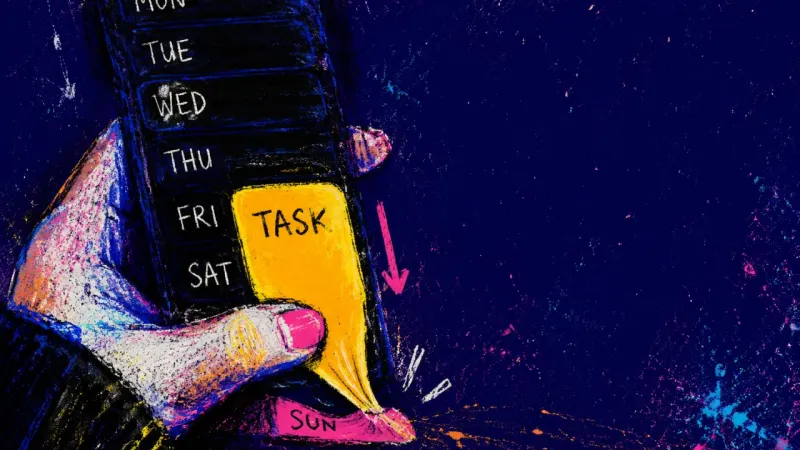
The 9:18 p.m. Carryover Spiral
When Alex (name changed for privacy) sat down across from me, I recognized a pattern I see all the time in late-20s city workers: people who can manage moving deadlines for everyone else, then short-circuit the second their own Tuesday plan gets bumped.
Alex told me about 9:18 p.m. on a Sunday in their small Toronto apartment kitchen. Their laptop was open beside a half-dry dish rack. The radiator kept clicking. Google Calendar threw blue light across the counter while they dragged color-coded blocks into place for the week. Then they saw three carryover tasks from last week. Their hand stopped on the trackpad. Their stomach dropped so fast it was like a trapdoor had opened beneath the whole week. “The task itself isn’t even huge,” they said. “It’s the fact that it missed its slot that suddenly makes it feel unreal.”
Alex was twenty-eight, an operations coordinator, the reliable one. The person who could keep everyone else’s shifting timelines moving without drama. But when a workout, an application, a text, or a boring piece of life admin slipped off its original date, they quietly stopped treating it like a living plan. They still wanted the goal. That was the painful contradiction sitting right there between us: wanting to keep plans alive after setbacks, and at the same time fearing that once the timing slips, the chance is gone.
“I know I could just reschedule it,” they said, rubbing one thumb over the edge of their phone. “But my brain acts like it expired.”
I nodded. I know that feeling more intimately than I like to admit. Years ago, on Wall Street, I learned how quickly uncertainty can put a private weight on the chest at night. “That isn’t laziness,” I told them. “That’s an all-or-nothing timing spiral. And it’s common in people who are competent enough to mistake self-punishment for standards. Let’s make a map of it. I want to see where the delay becomes a verdict, and where we can get your clarity back.”

Choosing the Map: Finding Clarity with a Four-Card Spread
I asked Alex to take one slow breath and hold the exact moment in mind when a task gets moved and everything inside them drops. Then I shuffled. For me, that part is not performance and it is not mysticism for its own sake. It is a focusing device. Tarot works best, in my experience, as a structured mirror: a way of organizing what the nervous system already knows but has not yet translated into language.
For this session, I chose a spread called Situation-Obstacle-Advice-Outcome · Context Edition. I picked it because Alex was not asking for a whole-life audit. They were asking a tight, honest question: why do delayed tasks suddenly feel pointless, and why does rescheduling feel embarrassing instead of practical? This four-card spread is ideal for that kind of loop. It tracks the symptom, the belief underneath it, the antidote, and the next grounded step. It keeps the reading centered on self-awareness and choice, not prediction.
I explained the structure simply. The first card would show the visible shutdown pattern: what Alex actually does in the first few minutes after timing changes. The second would reveal the deeper blocker, especially the belief that a delay means the window has closed or that the self has failed. The third card would show the medicine, the inner quality that loosens all-or-nothing timing. The fourth would bring it down to earth: how re-entry becomes behavior.
In other words, I told them, we were not here to ask whether the trip was cancelled. We were here to see where the route got misread as doom.
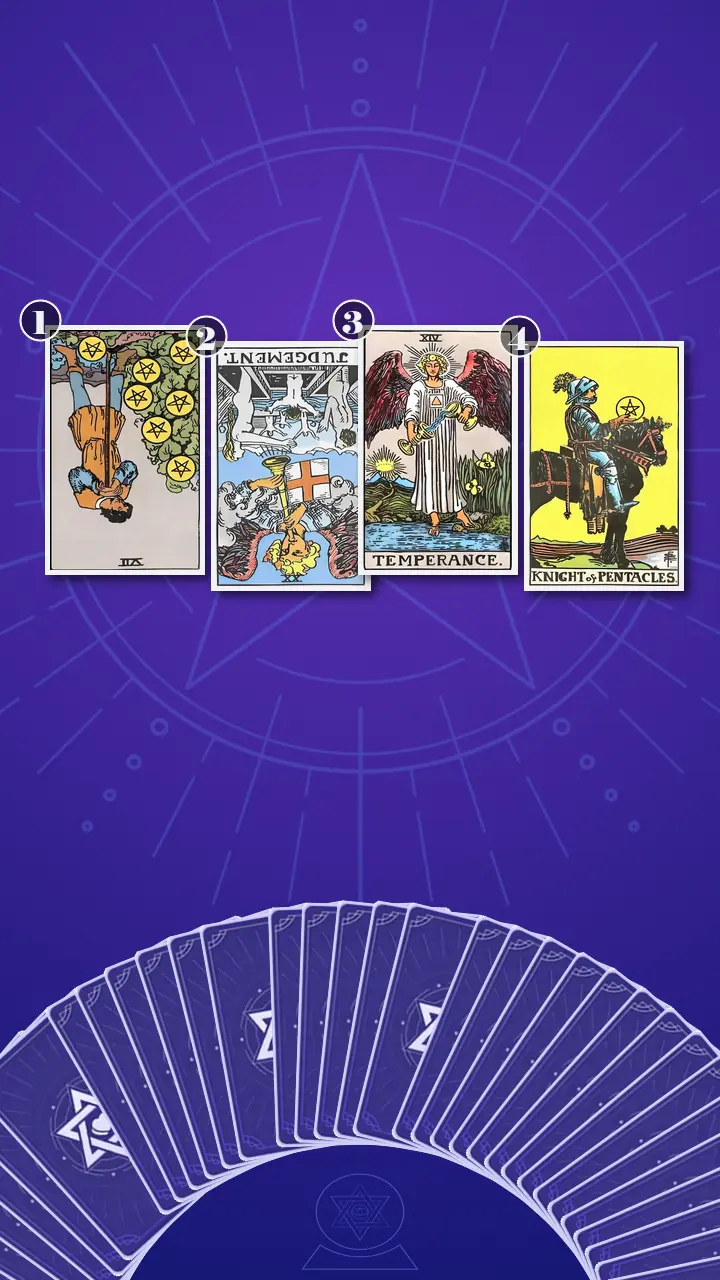
Reading the Problem Cluster
Position 1: The Task That Feels Expired
I turned over the first card and said, “Now I’m looking at the position that presents the concrete shutdown pattern that appears when a plan is delayed or moved.”
The card was Seven of Pentacles, reversed.
I felt the accuracy of it almost immediately. “This is the Google Calendar drag-and-stare card,” I said. “It’s the moment you move a workout to Friday, or leave an application draft open in another tab, and then spend more energy studying the fact that the timing changed than touching the task itself.”
I showed Alex the image of the figure leaning on the staff, staring at what has already grown. “That posture matters,” I told them. “This isn’t a card of not caring. It’s a card of evaluation becoming paralysis. The energy here is blocked earth. Progress exists, but the delay makes that progress feel invalid. Like missing a streak and instantly acting as if the habit itself got deleted.”
Alex let out a short laugh that had a little salt in it. Their shoulders lifted, held, then dropped a fraction. “Wow,” they said. “That’s accurate enough to be annoying.”
“Yes,” I said, smiling. “Because the problem isn’t the task size. It’s that the moved date starts contaminating the task. You’re not asking, ‘Can I still do this?’ You’re asking, ‘Does it still count now that it’s late?’ And while your brain is running that review, you flip to Gmail, tidy your inbox, answer two low-stakes emails, maybe reorganize a Notes folder. The phone feels warm in your hand, your limbs go heavy, and the plan goes untouched.”
I watched them nod. It was the quick, involuntary kind—the kind that says a memory has already landed. Same-frequency recognition. No theory yet. Just the truth of the pattern.
Position 2: When a Delay Turns Into a Verdict
I turned over the second card. “This position reveals the deeper blocker behind the pattern, especially the belief that a delay means the window has closed or the self has failed.”
The card was Judgement, reversed.
“Here’s where the scheduling issue becomes a self-story,” I said. “A delayed workout, message, application, or errand stops being logistics and turns into an inner announcement: ‘You had your chance. Now you’re behind.’”
I pointed to the trumpet, the rising figures, the gray distance. “In the Rider-Waite-Smith deck, this card is about awakening and answering a call. Reversed, that energy gets distorted. It becomes a verdict machine. The energy is not balanced accountability. It’s excess judgment and blocked self-trust. A notification badge starts sounding like a moral accusation. One moved task feels weirdly like a performance review.”
I had a small flash of the trading floor then—bright screens, sleep-deprived brilliance, and smart people privately destroyed by one missed entry because they turned timing noise into identity. I never forgot that lesson: markets can punish a decision, but only our own minds turn it into a sentence about who we are. I looked back at Alex. “Busy is sometimes just shame in a tidy outfit,” I said. “Inbox zero can feel safer than reopening the thing you actually care about.”
Their jaw tightened. Then they looked away from the cards for a second, toward the window. “That’s the part I hate,” they said quietly. “It’s never just, ‘This moved.’ It’s like my whole brain goes, ‘Well, now it’s embarrassing.’”
“Exactly,” I said. “Judgement reversed is the private sentencing of the delay. And once that starts, of course you don’t reschedule. You don’t negotiate with something you think already disqualified you.”
I let the silence sit for a beat, then softened my voice. “A delayed plan is not a dead plan. But I can see why your system forgets that in the moment.”
When Temperance Poured Between Two Cups
Position 3: The Antidote in Real Time
When I turned the third card, the room changed a little. The city noise outside seemed to flatten into the background, and even Alex’s hands went still. “This,” I said, “is the position that shows the key antidote to all-or-nothing timing and the inner quality that can loosen the ‘too late’ narrative.”
The card was Temperance, upright.
“This is the hinge,” I told them. “Not because it promises a perfect fix, but because it changes the meaning of everything before it.” I pointed to the water moving between the two cups, the foot on land, the foot in water, the path leading onward. “Temperance does not ask whether the original timeline can be rescued in pure form. It asks what version of the plan still fits the week you actually have. The route changed, not the destination.”
This is where my old strategic training naturally enters the room. I have a name for this in my own work: Strike Timing Calibration. On a trading desk, the right move after slippage is not panic-chasing the original price and it is not walking away from the whole position. It is recalibrating your next clean entry based on current conditions and available resources. Temperance speaks the same language. Not emotional overcorrection. Not collapse. Measured flexibility with a clear return point.
“So,” I said, “it’s late Sunday, your week is mapped out, and one carryover task is sitting there like a stain on the whole plan. You still care about it. What hurts is how fast the moved date starts feeling like a verdict instead of a detail.”
The Sentence That Shifted the Room
The missed date is not the truth. Blend the old plan with today’s reality, and let Temperance turn delay into continuity.
Alex froze in three distinct waves. First, their breath caught and their fingers hovered over the edge of the table as if the sentence had interrupted an old reflex. Then their eyes lost focus for a second, not from confusion but from replay—the Sunday kitchen, the TTC ride home, the half-finished draft sitting open all week. Then came the release, but not cleanly. Their mouth tightened before it softened. Their voice came out a little sharper than before. “But doesn’t that mean,” they said, “I’ve been making it way worse than it needed to be?”
“It means your nervous system learned to read slippage as danger,” I said. “That’s not the same as being foolish. It’s a pattern. Patterns can be updated.”
Something in their shoulders unclenched then, slowly, like a knot losing its argument. They exhaled through their nose and looked back down at Temperance. There was relief in their face, but also that slightly dizzy feeling people get when the burden they’ve been carrying turns out not to be law. “The timestamp changed,” I said. “The goal didn’t disappear.”
I asked, “Using that lens, can you think of a moment last week when this would have changed how you felt?”
Alex gave a small, almost disbelieving laugh. “Tuesday,” they said. “On the TTC. I moved a workout and then decided the week was basically off. I could’ve just changed it to a twelve-minute walk.”
“Exactly,” I said. “That is the shift. Not from chaos to perfection. From delay-as-verdict shame to adaptive self-trust. From treating a delayed train like proof the whole trip is cancelled, to understanding it’s still your trip.”
Position 4: The Knight Who Comes Back Quietly
I turned over the final card. “This position translates the shift into a practical re-entry move that rebuilds momentum after disruption.”
The card was Knight of Pentacles, upright.
“This is not comeback montage energy,” I said. “This is the same Thursday evening hour, the same pinned tab, the same low-drama return.” I pointed to the still horse and the worked field. “The Knight holds one pentacle steadily forward. That means one concrete task. Not a life overhaul. Not catching up on everything at once. Just contact.”
The energy here is balanced earth: grounded, repeatable, deliberately unglamorous. “Momentum comes back through contact, not drama,” I told Alex. “This card is the opposite of waiting to feel fully caught up before you begin. It says, ‘I don’t need to be caught up to show up.’”
Alex nodded more slowly this time. No wince. No defensiveness. Just a practical click settling into place. “So the point,” they said, “isn’t fixing the whole week. It’s making it easier to come back next time.”
“Exactly,” I said. “Temperance gets you out of the courtroom. The Knight gets you back into the field.”
From Verdict to Re-Entry: Actionable Next Steps
When I laid the whole line of cards back out for Alex, the story was clean. Seven of Pentacles reversed showed the visible freeze: the task gets moved, and attention locks onto the missed timing instead of the next step. Judgement reversed showed why the freeze feels so heavy: the delay becomes a private sentence about worth, control, or embarrassment. Temperance changed the architecture entirely by reframing delay as information, not disqualification. And the Knight of Pentacles grounded that insight in behavior: one repeatable return, done without theatrics.
So the blind spot was not poor discipline. It was the meaning Alex was attaching to interruption. They were treating a reroute like cancellation, a status change like identity exposure. The transformation direction was equally clear: move from treating delay as disqualification to treating it as a cue to revise the plan and take the next visible step. You do not need a clean restart to make honest progress.
Because Alex lives in calendars, deadlines, and shifting operational demands, I wanted the advice to respect real life instead of floating above it. I gave them three specific actions.
- Rename the ideal task into the current-version taskTonight, open one delayed item in Google Calendar or Notes and rename it based on what actually fits now: ‘Workout’ becomes ‘12-minute walk + stretch,’ or ‘Application’ becomes ‘draft intro paragraph.’ Then give it a 15- to 20-minute slot within the next 72 hours.If resistance spikes, stop after the rename and new slot. That still counts. You are updating the route, not auditioning for worthiness.
- Use status-update thinkingThe next time your stomach drops after a delay, pause before opening email or social apps. Write the exact sentence your brain delivers—something like ‘I blew it’ or ‘Now it doesn’t count’—and rewrite it as if you were sending a coworker a neutral update: ‘This moved. New next step is Friday at 6 p.m.’ This takes about two minutes.If neutral language feels fake, just remove the harshest word and stop there. The goal is less punishment, not forced positivity.
- Build a Strategic Holding PatternFor the next two weeks, choose one recurring Re-Entry Hour attached to an existing routine—Thursday after your commute, Saturday morning with coffee, whatever is real. Define success as contact with the task, not finishing it. And set a backup version in advance: if the full block gets bumped, do 15 minutes within the next 48 hours instead of deleting it.Keep the entry friction low on purpose: pin the doc, leave the gym clothes visible, write the next line at the top of the page. A holding pattern is not stagnation; it is tactical preparation that keeps the goal alive.

A Week Later: Ownership, Not Certainty
A week later, Alex sent me a screenshot from their phone just after work. A calendar block sat there at 7:15 p.m., renamed from the vague, accusing ‘Application’ to the much smaller ‘Draft intro paragraph.’ Under it they had typed: ‘Did 18 minutes at a café after the TTC ride home. Felt awkward for the first three minutes. Then it just felt like work.’
The next morning, the old thought still showed up—what if I slip again?—but they smiled, opened the pinned tab, and worked for fifteen minutes anyway.
That was the whole Journey to Clarity, as far as I was concerned. Not a perfect life hack. Not a magical cure for rescheduling shame. Just a quieter and more powerful shift: Alex stopped treating delay as a verdict and started treating it as information. This Situation-Obstacle-Advice-Outcome · Context Edition spread did not take control away from them. It handed it back.
If you’re feeling that same drop in your stomach when a date moves and your chest goes tight, I want to say this as clearly as I can: the pain usually isn’t the calendar itself. It’s the fear that this small slip says something final about whether you can trust yourself.
So if you stopped trying to recover the perfect timeline and simply worked with the week you actually have, what tiny current-version step would I see you place back on the map?
Every reading at AceTarot is a Journey to connect with inner wisdom and empower next step.
Learn more about our Journey to Clarity.