Fresh-Start Perfectionism—and Starting Before the Date Feels Clean

When the 1st Starts Glowing Like Permission
If you’re the kind of late-20s city professional who can keep a campaign calendar moving and still rename a Notion page “Reset” instead of doing the ten-minute task, especially in the last few days of the month, I know that pattern well. When Jordan (name changed for privacy), a 28-year-old hybrid marketing coordinator from Toronto, sat across from me, she didn’t tell me she was lazy or unmotivated. She said, “I keep asking myself whether I really need the 1st, or whether I’m hiding in fresh-start perfectionism.”
I could see the whole Tuesday-night scene in the way she told it: 8:47 p.m., condo kitchen table, leftovers going cold beside her laptop, Google Calendar open in one tab, Notion in another, a half-finished campaign doc sitting there like eye contact she didn’t want to make. The overhead light was too bright, the laptop fan kept up its mosquito hum, and her phone was still warm from scrolling those polished reset reels that make change look clean and effortless.
Her shoulders were halfway to her ears. Her hands kept doing that stop-start hover people do when they want movement and protection at the same time. The feeling around her wasn’t simple fear; it was more like trying to step into cold lake water with one foot while the rest of your body negotiates from the dock. She wanted the 1st to feel like a real reset, and she was just as afraid that a messy start tonight would expose something she didn’t want confirmed.
I told her softly, “That makes sense. Planning can soothe you without moving you. We’re not here to shame the stall. We’re here to find clarity inside it, and then give your body one honest way forward.”

Choosing the Compass: The Decision Cross for Real Rest or Avoidance
I asked her to take one slower breath and notice what her shoulders did when she imagined starting tonight instead of on the 1st. Then I shuffled slowly, not as theater, but as a way to let the noise settle enough for the real question to come into focus.
For this reading, I used the Decision Cross · Context Edition. I like this spread when a question looks binary on the surface—do I need a reset, or am I avoiding the start—but is actually hiding a deeper mechanism underneath. This is how tarot works at its best: not by handing out cosmic permission slips, but by showing the structure of the pattern in context.
I told her the center card would show the current symptom loop. The left card would clarify what a true reset would actually need to provide. The right card would reveal what the idea of a messy start was bringing up in her. The card above the center would expose the hidden belief making the whole question so emotionally loaded, and the card below would point to the integrating move—the wisest next step once the false binary collapsed.
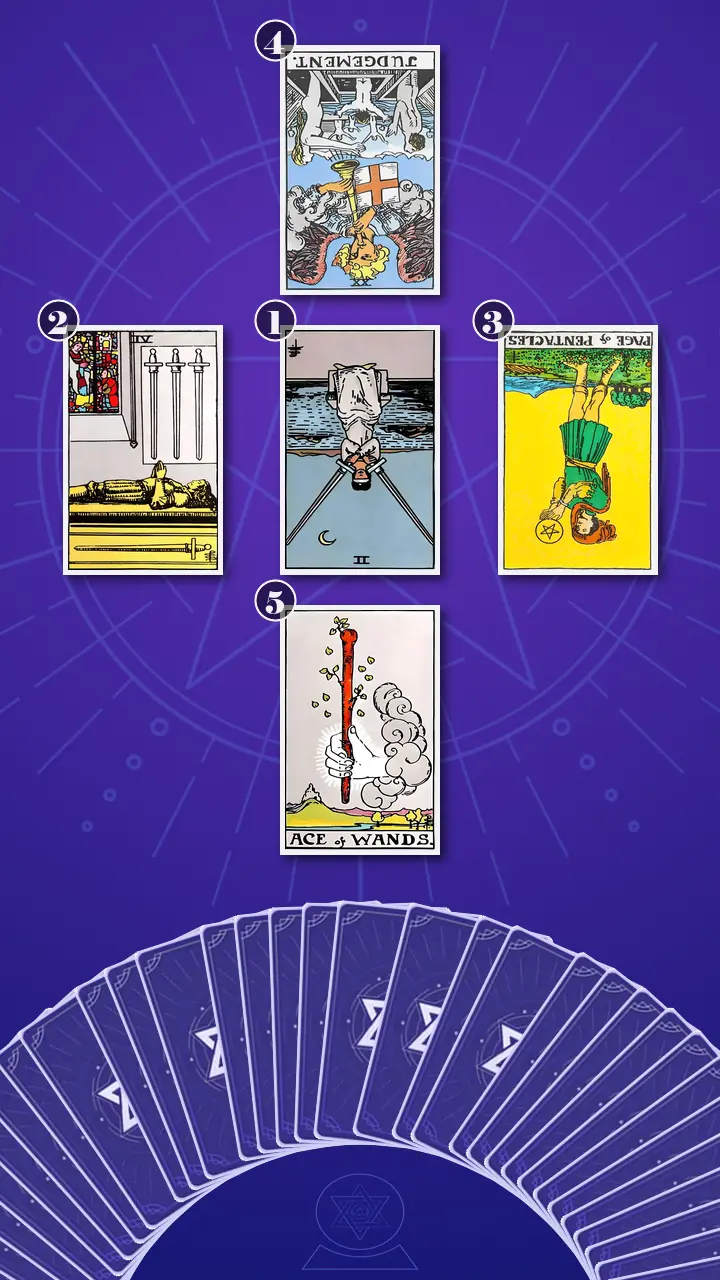
Reading the Map of Fresh-Start Perfectionism
At the Center: Two of Swords Reversed
I turned over the first card and said, “Now we’re looking at the position that shows the current symptom pattern: how the start date becomes a mental standoff instead of a first move.” The card was Two of Swords, reversed.
I didn’t have to stretch to translate it. This looked exactly like Jordan sitting down after work intending to begin, then bouncing between her calendar, Notion setup, and saved advice instead of touching the real task. Not inactive—just trapped in a loop where rechecking felt safer than contact. It was like having twelve tabs open about the task and none of them being the task, like standing at Union Station reading departure boards without boarding a train.
In reversed form, this card showed Air energy in excess and leakage: too much analysis, too many internal arguments, not enough embodied contact. The blindfold became calendar logic without task contact. The crossed swords became every polished reason tonight was not quite the right moment. I told her, “This is what planner-shaped avoidance looks like. You said you were starting. What you actually started was the setup.”
Her reaction came fast in three beats: first her breath caught, then her thumb stopped moving against the rim of her mug, then she gave a short laugh with that unmistakable sting in it. “That’s… rude,” she said, smiling without really smiling. “Also, yes. That is literally me every end of month.”
I smiled back. “Only because it’s precise. And precision helps. Planning can soothe you without moving you.”
On the Left Arm: Four of Swords Upright
I moved to the next position. “This one clarifies what a true reset would actually need to provide if rest is real rather than a cover for delay.” The card was Four of Swords, upright.
Whenever I see this card in a question like this, I use what I call Macro-Cycle Phase Identification. Before I tell someone to push harder, I want to locate whether they’re in a genuine low tide or just using the language of recovery to protect themselves from beginner discomfort. Four of Swords told me there was real saturation here. End-of-month brain fry. Slack aftertaste. Too many tabs, too much input, not enough blank space.
I told her, “Part of you does need rest—but not the aesthetic kind, not the version with a new playlist, a fresh tracker, three habit videos, and a prettier plan. Real rest here looks more like airplane mode, a quiet room, tea by the window, no self-improvement content performing wellness for the algorithm.”
This card carried balanced, contained Air. Not avoidance. Not hustle. A bounded pause with an end point. In my mind, it looked like a winter sky before dawn: still, not dead; paused, not broken. Jordan’s shoulders lowered a fraction. Even the muscles around her mouth softened. That told me the card had differentiated her accurately instead of accusing her.
On the Right Arm: Page of Pentacles Reversed
I turned the third card. “This position reveals what the idea of a messy start brings up in you—the beginner discomfort and self-judgment you’re trying to avoid.” The card was Page of Pentacles, reversed.
I could feel the truth of it instantly. This was the Saturday-morning coffee-shop version of the pattern: comparing habit apps, watching YouTube reviews, rewriting the starter checklist, choosing the perfect shoes, the perfect template, the perfect first week. It was the part of her that wanted portfolio-ready output before draft-one energy had even been allowed. Like buying the beginner kit but refusing the first ugly rep.
Reversed, the Page showed blocked Earth—potential standing still in fertile ground because the first clumsy repetition felt too exposing. I told her, “You’re not actually asking for discipline before you begin. You’re asking to feel like someone who has already practiced before you let yourself practice. That’s why the middle of the month feels so hard. It doesn’t protect you from being a beginner.”
She looked down at the card and rubbed her palm over her jeans, once, twice. “I know I could do it in ten minutes,” she said. “I just want to do it properly.”
“Exactly,” I said. “And that sentence is doing a lot of emotional labor for the fear underneath it.”
Above the Cross: Judgement Reversed
I turned the card above the center. “This one uncovers the deeper belief and core fear that make the reset-versus-start question feel so loaded.” It was Judgement, reversed.
This is the card that changes the room, because it stops the conversation from being about scheduling. In Jordan’s life, it looked like missing one day and feeling the whole story escalate by the next evening from ‘I skipped Tuesday’ to ‘See? I knew I wouldn’t stick to this.’ The fridge buzzing in a quiet kitchen. Jaw tight. Chest gone hollow. Waiting for next month suddenly feeling safer than restarting midweek where the evidence would be messier and more honest.
Judgement reversed is blocked awakening. The inner call gets heard as evaluation rather than invitation. I asked her, “If you began tonight and it went unevenly, what is the worst conclusion your mind is afraid to draw about you by tomorrow morning?”
She didn’t answer immediately. I watched the sequence move through her face: a small freeze, then her eyes drifting slightly out of focus as if she were replaying past restarts, then a slow swallow. “That I’m organized in theory,” she said finally, “but not actually the kind of person who follows through.”
I nodded. “There it is. A missed day is an interruption, not a verdict. But your nervous system has been treating each imperfect return like a full personality audit.” Outside my window, a streetcar bell rang and faded, and the sound landed in the silence like a clean line through fog. I’ve guided enough people through these cycles to know this is often the hidden ache: not fear of effort, but fear of what effort might reveal before it becomes elegant.
When the Ace of Wands Lit the Air
Below the Cross: Ace of Wands Upright
When I reached the final card, the room went noticeably still. Even Jordan stopped touching her mug. “This,” I told her, “is the integrating guidance—the practical inner shift that dissolves the false binary and turns insight into one immediate first action.” The card was Ace of Wands, upright.
I always slow down for this kind of card. The hand emerging from the cloud, the living wand already sprouting, the distant castle not yet reached—it is pure initiated movement. Before I interpreted it, I used my other lens, Systemic Friction Auditing. I stripped the stall down to two categories: real friction and symbolic friction. Real friction was the tired brain, the saturated end-of-month nervous system, the hybrid-work spillage that turns evenings into digital soup. Symbolic friction was the belief that a cleaner date could certify her before the task ever touched her hands. Ace of Wands doesn’t deny the first kind. It simply refuses to obey the second.
I looked at her and gave the setup exactly where she lived: that end-of-month evening when the Notion page looks cleaner than your energy does, and your shoulders are tight because starting tonight feels somehow riskier than promising yourself the 1st.
Stop waiting for a cleaner calendar to bless you, and let the Ace of Wands be the lit match that proves one imperfect move is already the reset.
I let the sentence sit. Then I added, gently and clearly, “The first imperfect action is the reset.”
Her reaction arrived in layers. First, she went utterly still—breath paused, fingers suspended above the table as if her body had hit a quiet freeze. Then her gaze unfocused, not away from me but through me, the way people look when they’ve just watched three months of their own behavior line up all at once. Then came the release, though not neatly: her shoulders dropped, she exhaled from somewhere deeper than the lungs, and right behind the relief there was a flicker of resistance. “But if that’s true,” she said, with a small burst of irritation, “then I’ve been waiting for a date to give me permission.”
“Yes,” I said. “And that doesn’t make you foolish. It makes you human under pressure. When control feels shaky, the mind reaches for symbols. Monday. The 1st. A new notebook. A cleaner app. But a cleaner date can’t do the part only contact can do.”
I asked her, “Now, with this new lens, think about last week. Was there a moment when one tiny live action would have changed the whole emotional weather?”
She laughed again, but this time the edge had softened. “Wednesday,” she said. “I could have just opened the doc and written the first three lines. That would have been enough.”
That was the real crossing. Not from lazy to disciplined. From future-dated self-negotiation to grounded self-trust built through imperfect action. I could see it land in her body—the strange little dizziness that comes when a burden lifts and responsibility returns with it. Clearer, yes. Also more real.
From Insight to Action: The Living Reset
When I threaded the whole spread back together for her, the story was clean. Two of Swords reversed showed the symptom: a start date turned into a mental standoff. Four of Swords showed that some of her exhaustion was real and needed honest, low-input recovery. Page of Pentacles reversed revealed the beginner stage she didn’t want witnessed, even by herself. Judgement reversed named the deepest charge: every imperfect restart had been treated like evidence about identity. And Ace of Wands answered all of it with one truth—movement before elegance.
The blind spot was not a lack of discipline. It was the belief that self-trust had to be earned in advance by choosing a cleaner date, rather than built in real time by making contact with the task. That was the shift the reading kept pointing toward: from calendar control to embodied momentum, from self-verdict to self-trust. So I gave her my Orbital Sync Protocol for the next 72 hours—not mystical, just practical. Its job is to stop forced action from impersonating progress, while also stopping endless planning from impersonating rest.
- Boundary-First Rest Window In the next 72 hours, choose one 20-minute window after work and label it “actual rest,” not “prep.” Keep Notion, email, and planning apps closed. Lie on the sofa without your phone, take a short walk without a podcast, or sit by the window with tea. At the end, write one sentence only: “After resting, the next live action is ___.” If 20 minutes feels irritating or too long, make it 8. No trackers, no system redesign, no little “while I’m here” admin add-ons.
- The Five-Minute Live Version Before you open any planner, tracker, or reset page, do a five-minute live version of the real task today. Open the document and write the first three lines. Send the email opener. Do one set. Start the timer. Choose the version that looks almost unimpressive on purpose. If your mind says five minutes doesn’t count, that’s the old gatekeeper talking. Stop when the timer ends. Start before your mind turns it into a ceremony.
- The Twenty-Four-Hour Return If you miss a day this week, return within the next 24 hours using the same note, same document, same messy thread. Keep a tiny friction log with only three headings: time, what happened, what helped me restart. Do not rename the plan, buy a cleaner tracker, or wait for Monday. A missed day is an interruption, not a verdict.

A Week Later, the Quiet Proof
A week later, Jordan sent me a message at 9:11 p.m.: “Did the five-minute version on Thursday. It was literally just the subject line, three bullets, and a timer. It felt almost insultingly small. Also… it worked.” The part I loved most came after that: “I missed Saturday, came back Sunday on the same page, and didn’t rename anything.”
That is the kind of change I trust. Not a cinematic reinvention. Not a perfect streak. Just a woman in Toronto, tired after work, opening the real document before her mind turned it into a ceremony. Clear but still human: she slept a full night, then woke with the brief thought, “What if I drop it again?”—and this time she smiled, opened the same page, and continued.
When I think back on that reading, I don’t remember a miracle. I remember gravity returning to the body. The Decision Cross · Context Edition helped her sort real rest from avoidance, but the cards did not take the step for her. She did. That is always the point of a journey to clarity: not outsourcing power, but reclaiming it from the calendar, the streak, the symbol, the imagined perfect beginning.
Sometimes the tightness in your chest isn’t because you don’t care enough; it’s because an imperfect first step feels dangerously close to proof that you’re not as in control as you want to be. If that’s where you are tonight, I hope you can hear this without shame: noticing the pattern already means you’re no longer fully trapped inside it.
So if today didn’t have to look clean to count, what tiny live action would you let be the lit match?
Every reading at AceTarot is a Journey to connect with inner wisdom and empower next step.
Learn more about our Journey to Clarity.