Downplaying Your Hobbies in New Groups: One Real Detail, No Disclaimer

The Queen West Answer That Wasn't True
If you're an early-career city person who can present cleanly in a meeting but suddenly forget how to describe yourself at a friend-of-a-friend dinner, I know this pattern well.
Alex (name changed for privacy), a 25-year-old junior product designer in Toronto, sat across from me with one knee bouncing under the chair and told me about 7:18 p.m. on a Saturday on Queen West: menus still open, glasses clinking, chili oil and citrus in the air, somebody asking the table for a weekend highlight. Two hours earlier, she had been excited about the climb she finally sent and the roll of film she developed after. In the actual moment, she smiled, pressed her tongue to the roof of her mouth, and heard herself say, 'I don't really do anything that interesting.'
Her throat had stayed tight all the way home. Her body, she said, felt like it had swallowed a coat hanger: shoulders slightly raised, stomach on alert, jaw careful. It was self-consciousness, yes, but more specific than that—like carrying your personality in airplane mode while everyone else seemed to be broadcasting in full signal.
'I can tell a story about myself that sounds normal,' she told me, 'or I can tell the real one.'
I nodded. 'That is exactly the kind of pattern tarot is good at clarifying. Not because the cards decide who you are, but because they show where your energy starts editing you before the room ever does. Let's make a map for the fog.'

Choosing the Compass: a Five-Card Cross for Group Chat Anxiety and New-Group Belonging
I asked Alex to take one slow breath, feel both feet on the floor, and hold the question in plain language: why do I downplay my hobbies when I'm trying to fit into a new group? Then I shuffled slowly enough for the question to stop sounding like a complaint and start sounding like data.
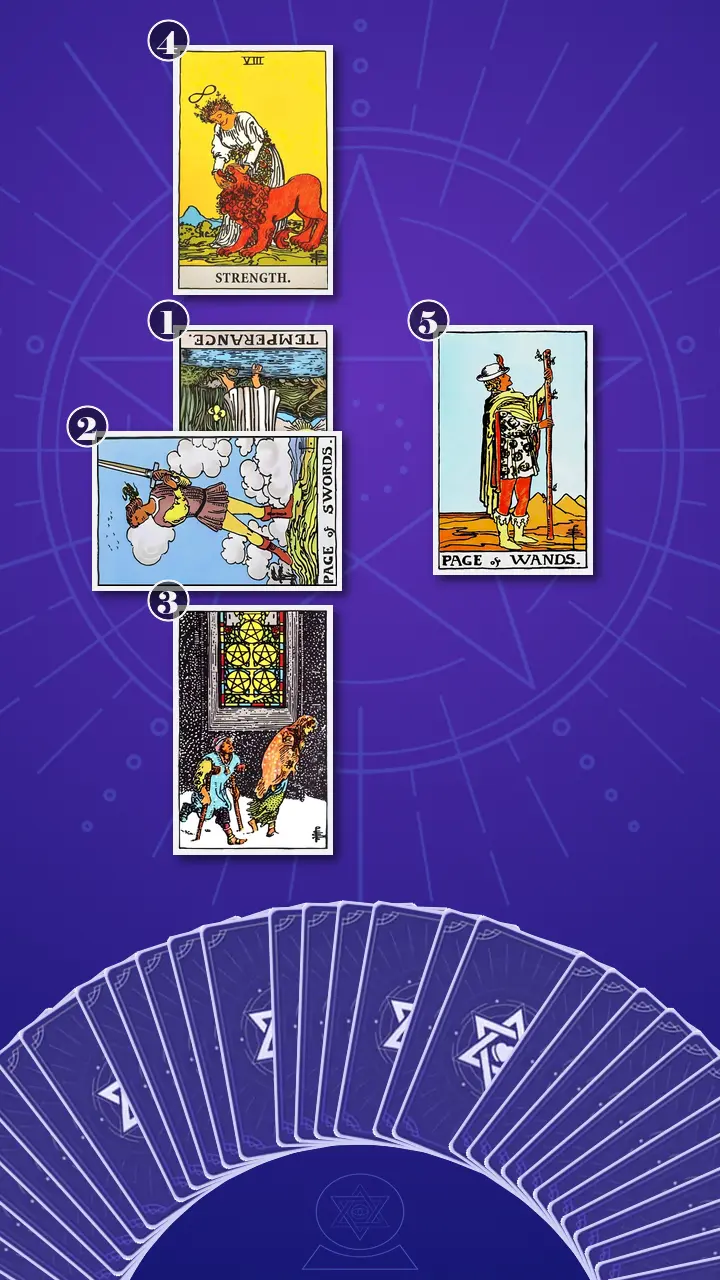
For this session, I used a Five-Card Cross · Context Edition. This is how tarot works best in my practice: card meanings in context, not vague fortune-cookie symbolism. Her issue was not a sprawling life audit. It was a tight, repeating social pattern. So I chose the fewest cards that still covered the problem clearly: the visible symptom, the live trigger, the deeper root fear, the corrective resource, and the next practical step.
I told her what I tell readers every time: the center card would show the pattern as it appears now. The crossing card would expose what hijacks her natural expression in real time. The lower card would take us under the behavior, into the belonging wound. The upper card would show the resource she could consciously use. And the card to the right would not predict her future; it would translate insight into next steps.
Where the Flavor Gets Lost
Position 1: the visible self-editing strategy
Now I turned over the card representing the visible self-editing strategy from the diagnosis, especially the habit of watering down hobbies in new-group settings.
Temperance, reversed.
I always pay attention to the two cups on Temperance. In this card, they looked like the acceptable version of Alex and the real version of Alex, with too much liquid passing between them. I told her this was the exact social moment she had described at that Queen West dinner: a vivid weekend flattened into something beige. Sunday climbing and developing film became 'nothing much.' Not a lie. Just so overmixed it stopped tasting like her. Like adding so much water to cold brew that it no longer tastes like coffee at all.
'Say the normal version,' I said softly, naming the inner script I could feel in the card. 'Keep it light. Don't make this a whole thing.'
Reversed, Temperance showed excess adaptation and blocked authenticity at the same time. Her social intelligence was real, but it was being used to dilute instead of connect. Self-censorship can get you included. It rarely gets you recognized.
Alex let out one short laugh that had no amusement in it. 'Wow,' she said, looking down at the card. 'That's rude in the most accurate way.' Her fingers pinched the edge of her sleeve, then loosened.
Position 2: the immediate social trigger and mental tension
Next I revealed the card for the immediate social trigger and mental tension that kicks in when she tries to fit into a new group.
Page of Swords, reversed.
This was the live surveillance system. I told her that when this energy gets blocked, curiosity turns into monitoring. In real life, it looks like editing a message three times in a new group chat, scrolling someone's Instagram highlights before brunch, or running live QA on every sentence while everyone else seems to be just talking. Too much? Too niche? Say it cleaner. Say it safer.
The Page of Swords is all wind and alertness, but reversed it becomes hypervigilance. Distorted Air. Instead of letting a hobby arrive naturally, she hears herself through a focus group before her own voice even gets a turn. The problem is not that she lacks a personality. It is that social threat detection keeps grabbing the mic.
I saw her jaw set the way people do when a pattern becomes embarrassingly visible. 'That office kitchen version is me,' she said. 'I literally delete the part that sounds like an actual person.'
Position 3: the deeper fear under the behavior
Then I turned over the card for the deeper fear beneath the behavior, the belonging wound and scarcity story holding the whole structure up.
Five of Pentacles, upright.
The room went quieter for me when this card appeared. In my old Wall Street life, I learned that markets make otherwise rational people behave strangely the moment scarcity enters the picture. I have come to see social scarcity do the exact same thing. Five of Pentacles does not say her hobbies are the problem. It says her body has learned to treat belonging like a resource that could be withdrawn.
I traced the image with a finger: the cold street, the bent bodies, the warm stained-glass window glowing nearby. 'This,' I told her, 'is what it feels like when the table is warm but your body acts like one wrong detail could leave you outside it.'
That is why the self-editing feels logical. If some part of you assumes friendship is a guest list you could get bumped from at any moment, then of course you start mirroring the room. Of course you choose the safest possible version of yourself. Belonging built on sameness is expensive.
Alex went very still. First her breath paused. Then her eyes lost focus for half a beat, as if she was replaying a patio dinner frame by frame. When she finally exhaled, it came out slower than before. 'I never think of it as fear of exclusion,' she said. 'But yes. That's exactly what it is. Quiet exclusion.'
When Strength Put Her Hand on the Lion
Position 4: the core resource that changes the pattern
When I reached for the fourth card, the air in the room changed in that unmistakable way it does when a reading stops diagnosing and starts offering an antidote. Outside my window, a streetcar bell rang once and then dropped back into the city noise below.
This position identifies the core resource and transformational quality needed to interrupt the pattern and support a different social stance.
Strength, upright.
I felt my own shoulders drop when I saw it. This card was not asking Alex to become louder, cooler, or more magnetic. It was asking for regulated visibility. The gentle hand on the lion is the opposite of performance. It is what happens when fear is still present, but it is no longer driving the conversation.
I told her that in real life this looked almost absurdly small: saying, 'I've been climbing a lot lately, and I was developing film on Sunday,' and then not rushing to cover it with humor, apology, or a Fleabag-style smoke bomb of self-deprecation. The goal is not to say more. It's to stop erasing what was already true.
This is also where I used a lens from my own practice that I call Network ROI Analytics. I do not bring it in to make people cynical; I bring it in to make the cost visible. If the cost of entry to a group is constant self-dilution, the return is usually polite access, not recognition. A room that only welcomes the beige version of you is offering low-return belonging. Strength asks a cleaner question: are you protecting yourself from rejection, or pre-rejecting yourself so the room never gets a vote?
You know that moment when the room asks for an easy little fact about you, and your body reacts like the wrong answer could quietly cost you warmth, even though two hours earlier your hobby felt joyful and natural?
You do not need to water yourself down to be welcomed; meet the lion of social fear with a steady hand and let one real passion stay visible.
I let the sentence sit between us.
Alex's reaction came in layers. First, a freeze: her hand stopped halfway to her mug. Then the thought landed deeper; her gaze slid past me, unfocused, as if she were suddenly back in that Monday team chat, seeing the deleted sentence about the film lab. Then the emotion showed itself, not as relief at first, but as resistance. Her mouth tightened. 'But if I stop doing that,' she said, voice thinner now, 'doesn't that mean I've basically been excluding myself first?'
'Partly, yes,' I said, keeping my tone steady. 'Not because you're weak. Because you built a smart safety strategy and kept using it after the danger became less certain. Strength doesn't shame that strategy. It just stops letting it run the room.'
Something in her face softened at that. Her shoulders lowered a full inch. She took a deeper breath, then another, and there was that almost dizzy beat I know well—the little internal sway that can come after a heavy truth finally lands and a person realizes they now have more responsibility, not less. I asked her, 'Using this new lens, was there a moment last week when this would have changed how you felt?'
She nodded before she answered. 'The office kitchen. I typed the part about the photo lab, deleted it, and then hated the whole message. If I'd just left it in, maybe nothing dramatic would have happened. But at least I would've been in the chat.'
That was the hinge of the reading for me: not from introvert to extrovert, but from guarded approval management to steadier self-trust in being seen. From watering herself down to holding herself steady.
Position 5: the first honest spark
Finally, I turned over the card that translates insight into a concrete relational experiment: how to show more authentic interest and let connection form from resonance rather than self-erasure.
Page of Wands, upright.
I smiled when I saw it. This was not a demand for a personality rollout. It was a signal flare. In modern life, this card is the simple group-chat message, the real dinner answer, the one live spark: 'Anyone here ever shoot film?' or 'I've been climbing a lot lately—any gym recs?' Offer one real detail. Let resonance do the sorting.
Where Page of Swords reversed had her studying the room from the doorway, Page of Wands asked her to enter it. The energy here is balanced Fire: curiosity, not performance; initiative, not oversharing. The point is not to be broadly palatable. The point is to be specifically recognizable to the people who can actually meet you there.
Alex gave me the first real smile of the session. Small, skeptical, but real. 'That feels weirdly less terrifying than trying to seem universally chill,' she said.
From Polite Access to Real Recognition
When I laid the whole spread back out for her, the story was clean. Temperance reversed showed the symptom: editing yourself to fit in until your answer loses flavor. Page of Swords reversed showed the trigger: social surveillance replacing spontaneity. Five of Pentacles showed the root: a scarcity story that says visible difference could cost you warmth. Strength placed the remedy above that wound: steadiness instead of self-erasure. And Page of Wands opened the right side of the spread like a door: one honest spark, shared lightly, so connection can grow from resonance rather than approval management.
The blind spot was not 'I need better small talk.' It was this: Alex had been treating better editing as the path to belonging, when all it was really buying her was a technically successful but emotionally thin connection. She was trying to solve quiet exclusion by participating in a softer version of it. The transformation direction was clear—move from matching the room before showing yourself to selective honesty: one real detail, no disclaimer, and enough steadiness to let the room respond.
I gave her actionable advice, not because tarot replaces real life, but because clarity is only useful when it changes what you do next. That is the real value of a Five-Card Cross · Context Edition tarot spread for belonging-driven self-editing in new social groups: it turns emotional static into next steps.
- The One True Detail NoteBefore your next dinner, work social, or after-work hang, put one line in your phone: 'One true detail, no disclaimer.' When someone asks what you're into, answer with one hobby and one concrete fact—something like 'I've been climbing a lot lately, and I was developing film on Sunday'—then stop.If your throat tightens, keep the sentence shorter instead of safer. One honest line is enough; you do not owe anyone a full personality reveal to be honest.
- Retire One Dilution Phrase for Seven DaysPick one phrase you use to minimize yourself—'I don't really do much,' 'nothing interesting,' or 'I'm not serious about it'—and remove it for one week in every chat, intro, or casual hangout.Do not replace it with a performance. Replace it with a plain factual sentence. The goal is not rebranding. It is reducing dilution.
- Send the Spark, Then Track the ReturnThis week, send one low-stakes spark message in a group chat or to a new circle: a climbing question, a film-lab recommendation request, a class you're taking, a real interest you're actually spending time on. Then notice who responds with curiosity, follow-up, or shared specificity.This is where my Social Divestment Plan begins quietly. If a circle only engages when you flatten yourself, stay cordial but stop overinvesting there. Reallocate your energy toward the people and spaces that respond to the honest version.
Those were her next steps. Small. Measurable. Human. Not 'be more confident.' Not 'just be yourself.' Just enough structure to take her personality off airplane mode without turning honesty into a performance review.

A Week Later, the Signal Stayed On
A little over a week later, Alex messaged me. She had sent a note in a team chat: 'Anyone know a good place to develop film in the east end? I got back into shooting on weekends.' Two coworkers replied. One had a lab rec. Another said she climbed at the same gym Alex had mentioned once and had been meaning to ask about it. Nothing cinematic happened. No instant soul-friend montage. But the conversation got warmer, and more importantly, it got real.
She told me the strangest part was the two seconds after sending it. Her coffee went cold while she stared at the typing bubbles, and the first thought in her head was still, What if that was weird? Then she laughed at herself a little, because this time the sentence had already left the room intact.
That is what I call a real Journey to Clarity. Not certainty. Not social perfection. Just the first solid proof that belonging becomes more trustworthy when you stop negotiating against yourself before anyone else has spoken.
If tonight you recognize that specific loneliness—being technically included while your throat stays tight because the version of you they met was the edited draft—please know that noticing it is already a form of return. You are no longer only managing the room; you are beginning to see yourself inside it.
So the next time the lion of social fear lifts its head at the table, what is one real detail you might let stay in the room for two whole seconds?
Every reading at AceTarot is a journey to connect with inner wisdom and empower your next step. The stories shared here are psychological mirrors, not private records—crafted to reflect universal emotional loops and help you find your own clarity. Learn more about our Journey to Clarity.