From Discord Lurking to Kinder Visibility: Belonging in Small Replies

The 8:47 p.m. Discord Spiral
If you are an early-career city person who can handle Figma feedback at work but still freeze in a Discord #introductions channel after dinner, this is probably your Discord lurking loop.
When Alex (name changed for privacy) sat across from me, they gave a small, exhausted laugh and said, “It is weird that I joined to make friends and somehow turned it into homework.”
As they spoke, I could see the whole frame as clearly as a film still: 8:47 p.m. in a small west-end Toronto apartment, Discord split-screened beside a half-watched YouTube video essay, radiator hissing, laptop fan humming, leftover takeout hanging sweet and salty in the room. They open a movie channel, read the last thirty messages to study the vibe, type a lowercase reply so it sounds casual, delete “lol” twice, and promise themself tomorrow will feel more natural.
That is the contradiction at the center of this kind of online social paralysis in Discord servers: wanting to make friends, and fearing the visibility, awkwardness, or possible silence that come with speaking first. Alex did not want to become the center of attention. They just wanted it to feel normal to exist in the chat.
The feeling sat in their body like a tiny job interview clipped to the throat. Every breath went shallow. Every word looked overlit. Their hands hovered over the keyboard the way people hover at a cold lake’s edge—wanting in, already bracing.
I nodded and said, “That makes sense. You did not fail at friendship - you turned it into a tone audit. Let’s make a map of the loop together, not so the cards can dictate your life, but so you can see where your power still is and find some real clarity inside it.”

Choosing the Map: The Shadow Spread for Discord Lurking
I asked Alex to put both feet on the floor and take one slightly longer exhale than inhale. Then I shuffled slowly. For me, this part is never about theatrics. It is a transition point: a way to help a busy, over-alert mind move from spiraling to observing.
For this reading, I chose The Shadow Spread. When people ask me how tarot works in situations like Discord first-message anxiety, my answer is simple: tarot works best as a pattern map, not a verdict machine. The real issue here is not Discord itself. It is the inner loop that turns social hope into self-monitoring.
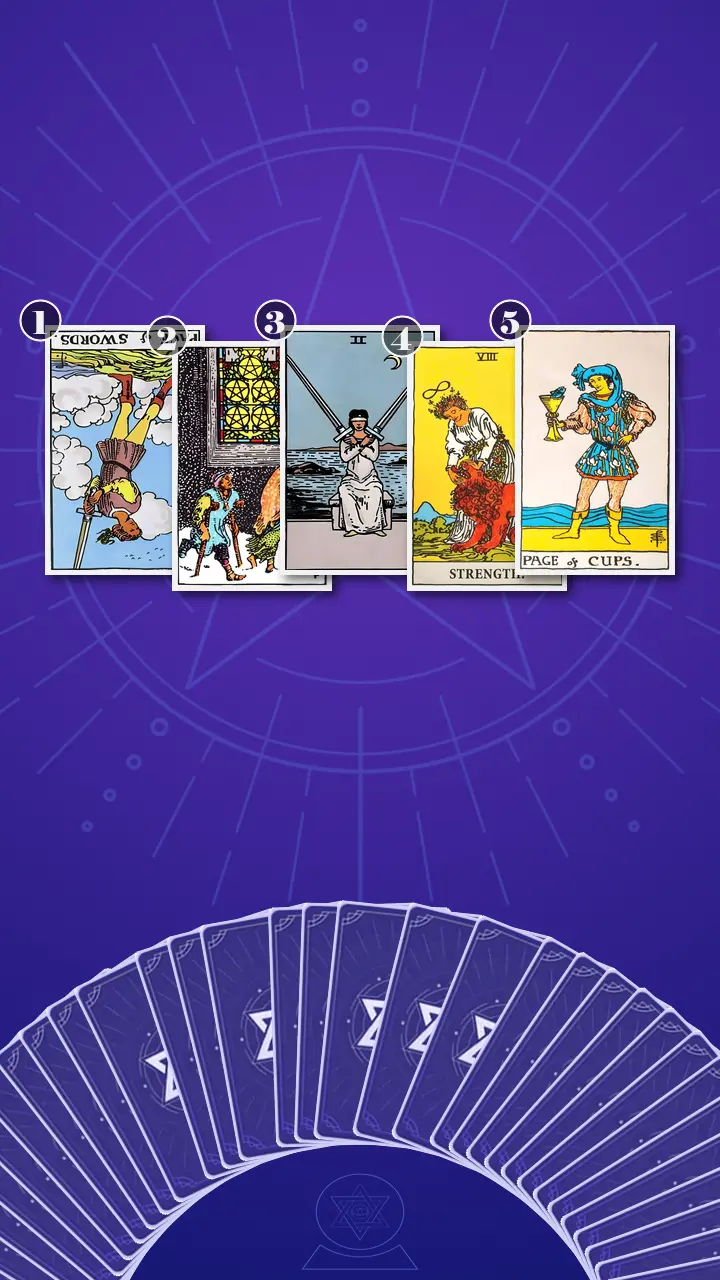
This five-card spread is especially useful because it follows a clean line. The first card shows the surface symptom: what the lurking loop looks like in real time. The second goes underneath that silence to the belonging wound that makes visibility feel so expensive. The third reveals the protective strategy that keeps the whole pattern frozen. The fourth is the key reframe—the medicine. The fifth shows the embodied next step: one lived action that can move this from theory into practice.
In other words, the spread would let me walk with Alex from doorway to dialogue: from typing and deleting, to the fear beneath it, to the exact moment their nervous system could learn that being seen does not have to equal being judged.
Reading the Cold Air
Position 1: The Loop That Calls Itself Research
I turned over the first card. “Now we’re looking at the position of the surface symptom: how the lurking pattern shows up in real time through monitoring, drafting, deleting, and staying silent.”
Page of Swords, reversed.
I told Alex this card was almost painfully exact. In lived terms, it looked like this: after work, they open three Discord servers from their laptop, study the latest threads like they are reverse-engineering the social UX, type one casual reply, edit it until it feels suspiciously overdesigned, and delete it before anyone can see it. The Page is curious, quick, mentally sharp. Reversed, that sharpness becomes excess Air turned inward—curiosity converting into surveillance, like doing QA on your own personality before you are allowed to hit send.
The image on the card mattered too: the windy sky, the sideways defensive stance, the sword held ready. Casual chat starts to feel less like exploration and more like something to defend against. I asked, “At what point does observation stop being preparation and start becoming a hiding place?”
Alex let out a short laugh, the kind with a little sting in it, and rubbed their forehead. “Okay,” they said, “that’s accurate enough to be rude.” Their shoulders lifted, then dropped a fraction. There it was: instant self-recognition.
Position 2: The Lit Window and the Old Story
I turned over the second card. “This one represents the hidden fear: the belonging wound underneath the silence and why visibility feels emotionally expensive.”
Five of Pentacles, upright.
I always find this card tender in a brutal way. On the surface, Discord lurking can look like a communication problem. Underneath, this card says it is often a belonging problem. A lively server can feel like standing outside a warm room and watching everyone else laugh through the window. One delayed reply, one unread message, one inside joke you do not catch fast enough—and suddenly your body reacts as if the light inside just dimmed on purpose.
This is Earth in a deprived state: not actual exclusion, necessarily, but a deficiency in felt safety and welcome. The mind takes one neutral silence and translates it into a full story: There it is. Proof I do not fit here. I told Alex gently, “A lot of lurking is not disinterest. It is interest under pressure.” Then I asked whether they were reacting to the server in front of them, or to an older story about being on the outside of warmth.
Alex went quiet. Their fingers, which had been worrying the sleeve of their hoodie, stilled completely. I watched their chest sink on the inhale before they looked back at the card and gave a tiny nod. That was the deeper ache landing.
Position 3: The Pause That Became Armor
I turned to the center card. “This position shows the protective strategy: the internal stalemate that keeps you safe by keeping you unreadable and uncommitted.”
Two of Swords, upright.
This was the lock in the mechanism. In modern life, it looks like the message box staying open while you check active dots, reread the last joke for tone, and tell yourself you are still deciding when to enter. But the pause is no longer neutral. It has become the strategy. The blindfold on the card is the refusal to gather new evidence by actually posting. The crossed swords over the chest are emotional arms folded over the part that wants connection.
Energetically, this is pure blockage. Desire and fear are frozen at the same time. Total safety from awkwardness; total distance from being known. I heard myself say the sentence as soon as the card landed: “Silence feels protective until it starts posing as proof.”
For one brief second, I had a private artist’s flash of memory: an old short film I once kept re-editing because an unreleased cut can never be criticized. The trouble, of course, is that it also never reaches anyone. This card felt exactly like that.
I asked Alex, “When you stay in ‘maybe later,’ what feeling are you actually avoiding?” They exhaled long through their nose and stared at the crossed blades. “The moment after,” they said. “The part where I would have to find out what happened.”
When Strength Put a Hand on the Lion
Position 4: Kind Visibility Instead of Perfect Control
When I reached for the fourth card, the room changed in that subtle way good readings sometimes do. The radiator had gone quiet. Even the street noise outside seemed to flatten for a beat. This was the bridge card, the one the whole spread had been walking toward.
“This card represents the key reframe,” I said. “The inner quality that can interrupt shame and make imperfect participation feel survivable.”
Strength, upright.
In real life, this card begins the shift when Alex notices the tight throat and restless hands, does not shame them, and sends one honest message anyway. Confidence here is not being chill. It is balance—warm Fire regulating cold Air. It is staying kind and steady enough under the social spotlight to let a normal human sentence go through.
At 8:47 p.m., Discord is open beside a half-watched video, and you are editing a harmless sentence as if it could decide your entire social life. Your throat tightens. Your hands hover. One blinking cursor gets louder than the room.
You do not need a perfect social script before you speak; let Strength place a calm hand on the lion of self-consciousness and send one honest message.
I let that sit between us for a moment. Then I added, more softly, “Belonging is not the reward for a flawless entrance; it starts to grow when you survive being seen kindly, one imperfect post at a time.”
This is where I brought in one of the lenses I use most in my work, something I call Typecasting Analysis. I told Alex, “Right now, you’ve been cast in your own social life as the Watcher—the person who understands the vibe, reads the room beautifully, notices everything, but only enters once it would no longer feel risky. Sometimes a group quietly reinforces that role. More often, fear writes it first and you keep performing it because at least the script is familiar. Strength is not asking you to become louder, cooler, or instantly witty. It is asking you to stop obeying a character arc that keeps you visible enough to watch and invisible enough to never connect.”
Alex’s reaction came in three waves. First, their breath caught halfway, and their hand froze around the mug beside them. Then their gaze drifted out of focus, like they were replaying every half-written intro, every movie-thread reply deleted at the last second, every night they had kept the app open like a tab-shaped alibi. Then the release: their jaw unclenched, their shoulders fell, and a shaky little laugh came out with the exhale.
But it was not pure relief. They looked back at me with a flash of resistance and said, “But if I send it and nobody answers, how is that not proof?”
I shook my head gently. “It is not proof. It is data, and often very incomplete data. A server is not a jury. People are at work, in transit, distracted, mid-thread, half here. Your nervous system has been treating a chat delay like a verdict on your whole social worth. Strength asks for a different move: not forcing yourself past fear, but keeping one calm hand on it so fear no longer gets final cut.”
Then I gave them the first practice rep right there, the one this card wanted: one server, one thread with fewer than twenty unread messages, both feet on the floor, one longer exhale than inhale, one line sent within two minutes, no more than one reread, and then five minutes away from the app. “If your body gives you a hard no,” I said, “save the sentence in Notes and stop there. This is an invitation, not a dare.”
I asked, “With this new angle, can you think of a moment last week when you would have felt different?” Alex nodded almost immediately. “Yeah,” they said. “There was a film thread. I had a normal question. I turned it into a cover letter.”
That was the true pivot. Not from fear to fearlessness, but from self-conscious lurking and tone-auditing to kinder visibility and steady participation.
The First Ripple in the Chat
Position 5: A Tender Messenger, Not a Perfect Entrance
I turned over the final card. “This one is the embodied next step: how to practice friendship through one small, low-stakes bid for connection this week.”
Page of Cups, upright.
I loved seeing this here. After all that cold Air and frozen control, Water finally moved. In modern terms, this is not a polished introduction. It is one small bid for connection: replying in a game thread, asking a simple question in a movie channel, reacting and then adding five words, or dropping a meme that actually fits the room. The cup offered forward in the card is small on purpose. The fish popping out of it reminds me that connection often starts through something slightly odd, light, or imperfect—not through a TED Talk, more like meme energy with a pulse.
This is balanced energy again: beginner-friendly, sincere, emotionally alive. The goal is not to impress the server. The goal is to become a familiar, real presence inside it. Belonging is usually built in replies, not perfect entrances.
Alex smiled for the first time without folding inward afterward. “So I don’t have to do the full intro arc,” they said. “I can just… be a person in a thread?”
“Exactly,” I said. “Your first message does not have to explain your whole existence.”
From Tone Audit to Presence
When I looked across all five cards together, the story was clean. Alex enters the room wanting connection. The Page of Swords reversed turns that wish into hyper-monitoring, like trying to join a party by studying the group chat transcript instead of walking through the door. The Five of Pentacles reveals why it feels so intense: one small silence gets wired to an older fear of being outside the warmth. The Two of Swords shows the coping pattern that keeps the pain alive—delay, indecision, the message box open as armor. Then Strength changes the genre entirely. It replaces control with kindness, and that softer courage opens the way for the Page of Cups: one small, human signal sent into the water.
The blind spot was not that Alex lacked social instinct. It was that they kept assuming more analysis would produce enough certainty to make connection safe. But endless tone-reading does not create belonging. It only keeps the role of “observer” in place. The transformation direction was clear: move from waiting for the perfect first message to making small, low-stakes, repeatable contributions that let familiarity build over time.
So I gave Alex three next steps—practical, small, and fully theirs to choose from:
- Body-Before-Message ResetBefore opening Discord, put both feet on the floor, take one slightly longer exhale than inhale, and choose one server only instead of touring every option first.If your mind says this is too small to count, that usually means it is finally small enough to repeat.
- Thread-First FriendshipSkip the formal intro for now. Enter through one niche channel—films, gaming, design, music, pets—and send one opinion, one question, or one “same” within two minutes, with no more than one reread.Small reads as natural online. You do not owe the server a mini personal brand statement.
- The Recasting ExerciseAt your next visit to the server where you usually play the silent observer, deliberately break character with one light, human contribution: an emoji plus five words, a meme that fits, or a simple “wait, which one are people recommending rn?” Then close the app for five minutes.This is not about becoming extroverted. It is about reclaiming authorship from the old role and proving to your body that visibility can be survived.
I reminded Alex that the point was not to feel ready first. The point was to practice kind visibility reps until the app stopped feeling like a stage and started feeling like a place.

A Week Later, the Quiet Proof
A few days later, Alex sent me a screenshot from a film thread. Their message was almost endearingly ordinary: “okay wait, which one are people recommending rn?” Underneath it were three replies, one recommendation, and a side conversation already starting. Their caption to me was even better: “My throat still did the thing. I sent it anyway.”
That was the proof I cared about. Not a total personality rewrite. Not a magical end to all awkwardness. Just one real movement from hiding to kind visibility. The next morning, they told me, their first thought was still, what if that sounded weird?—but this time they smiled, made coffee, and opened Discord instead of staging a trial in their head.
That is what this Shadow Spread tarot reading for Discord lurking and online friendship anxiety gave them: not certainty, but ownership. A way to stop handing their belonging over to one blinking cursor. A way to treat friendship as a practice instead of a performance review.
If tonight you are sitting with your shoulders tight and your half-written message glowing on the screen, trying to avoid one awkward silence that feels way too much like proof, please remember this: noticing the loop is already the first soft break in it.
So when the cursor starts blinking like a tiny alarm again, what is the smallest message, reaction, or question you could let past the lion of self-consciousness and into the chat?
Every reading at AceTarot is a journey to connect with inner wisdom and empower your next step. The stories shared here are psychological mirrors, not private records—crafted to reflect universal emotional loops and help you find your own clarity. Learn more about our Journey to Clarity.