Performing at Work Happy Hours: Trading Polish for Connection

The 6:12 p.m. Pub Door and the Cost of Performing Around Coworkers
When Jordan (name changed for privacy) sat down with me, she did not start with office politics or team dynamics. She looked at the mug between her hands and said, "I can do the job. I just never know who I'm supposed to be after 6 p.m."
I knew the pattern immediately. If after-work drinks feel less like downtime and more like a stealth performance review, that is not you being bad at people. That is professional mask burnout. It is a very particular kind of work happy hour anxiety, the kind that shows up after the deadline is done, when the only task left is apparently to be effortlessly likable.
She described 6:12 p.m. on a Thursday outside a City pub near Liverpool Street: half-turned toward the door, pretending to answer a text that had never arrived, rain and cigarette smoke in the air, glasses knocking together from inside, her phone warm in her palm. Her jaw was already tight. Her shoulders had climbed a few inches toward her ears. She was sorting, in real time, which parts of her day were safe to mention, which opinions needed sanding down, and whether ordering wine looked too exposed while a pint looked too try-hard.
What she wanted was simple enough: to belong, to seem easy to work with, to not make casual work socials feel so loaded. What made it exhausting was the other side of the contradiction: a fear that if she stopped performing, someone would quietly decide she was awkward, off-brand, or not quite the right fit.
The self-consciousness in her body sounded like a blazer lined with wire: neat from the outside, faintly painful the entire time it was on. It reminded me of that Severance split so many young professionals joke about now—the competent work self functioning perfectly in daylight, then buffering the second the room turns casual.
I leaned in and said, "If every casual conversation feels like an audition, no wonder you're tired. We don't need to force you to be more extroverted tonight. We need to make a map of what your system thinks it's protecting you from, and then find the part of you that can stay in the room without turning into internal PR."

Choosing the Compass: The Shadow Spread for Work Happy Hour Anxiety
I asked Jordan to take one slow breath with both feet on the floor while I shuffled. I always treat that moment as a threshold, not a performance of mysticism. It helps the nervous system catch up to the question. It gives the mind somewhere to set its bag down.
For her reading, I chose a five-card spread called The Shadow Spread. I use it when a question looks social on the surface but is really about the fear underneath the behavior. This was not a prediction reading and it was not a "how to win the room" strategy session. It was inner excavation: visible mask, buried wound, defensive pattern, corrective energy, then one grounded experiment she could actually try this week.
I explained the structure simply. The first card would show the social persona that appears the second the room goes casual. The second would reveal the belonging fear hiding underneath that polished version of her. The third, sitting at the center, would expose the protective lock that keeps the cycle going. Then the fourth card—our hinge—would show the antidote, the inner quality that restores self-trust. The last card would translate all of that into something usable at the next happy hour, not in some fantasy version of her life, but at an actual pub, with actual coworkers, in actual London, this week.
That is why The Shadow Spread works so well for questions like, "Why do I feel fake around coworkers?" It does not flatter the mask and it does not shame it either. It simply shows the chain clearly enough that you can stop calling a survival strategy your personality.
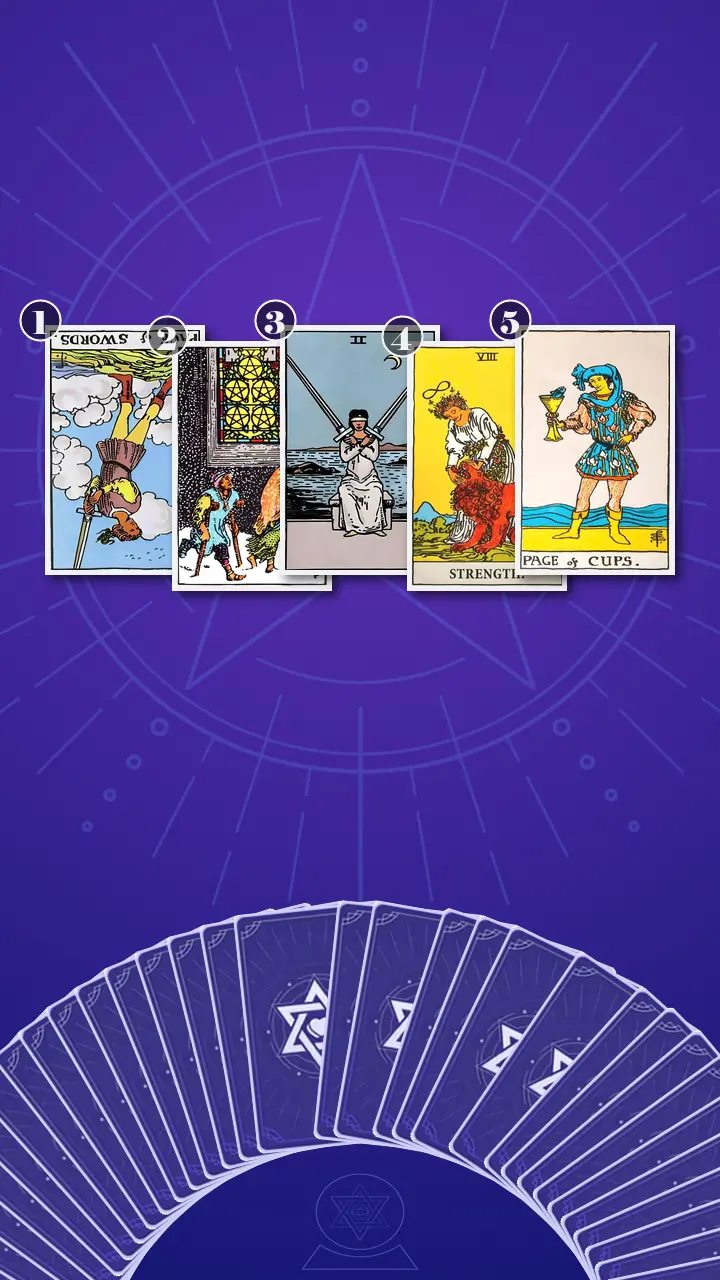
Reading the Cold Air: The First Three Cards
Position 1: Page of Swords Reversed — The Draft-Version Persona
I turned over the first card. "This position presents the visible social mask," I said. "And here we have the Page of Swords, reversed."
The image fit her almost too perfectly. This is the card of alertness gone brittle, of mental agility turned into self-surveillance. In Jordan's life, it looked exactly like arriving at the pub already mentally drafting herself: checking her face, her voice level, her drink choice, her opening line, as if casual conversation needed a compliance check before it could go live. It had the same vibe as typing and deleting in Slack three times before hitting send, except now the draft was her whole personality.
I pointed to the Page's raised sword and sideways stance. "This is excess Air," I told her. "Too much scanning, too much editing, too much trying to stay one sentence ahead of possible judgment. You're not entering the room from presence. You're entering it pre-defended."
Jordan gave a short laugh that had more sting in it than humour. "That's accurate enough to be rude," she said.
I smiled, because sometimes the first card lands that way. "Yes," I said gently. "And it also means you're not imagining it. There's a real pattern here. You speak like every sentence has to pass an internal approval workflow before it goes live. Be warm, but not too real. Be likable, but not memorable in the wrong way."
She winced, then nodded. Her fingers rubbed the edge of her sleeve without seeming to realize it. That was the first soft click of recognition.
Position 2: Five of Pentacles — The Fear of Being Outside the Circle
I turned over the second card. "This position reveals the buried insecurity underneath the performance, specifically the fear of exclusion and not fitting in professionally." The Five of Pentacles sat between us.
There it was: the cold street, the lit window, the feeling of being near warmth without trusting that it includes you. I told her this card often appears when ordinary ambiguity gets translated into rejection. In her case, it looked like walking into the pub, seeing three coworkers already laughing at the bar, and instantly feeling her stomach brace as if the room had already decided who belonged more naturally.
"This isn't just about small talk," I said. "This is the card that asks what you think would happen if you relaxed a little. Your nervous system is treating casual contact like proof-of-belonging."
She went quiet. Outside, a bus hissed through wet pavement. Inside my reading room, the late light shifted against the window and left a pale band across the table like a doorway she was not sure she could step through yet.
After a moment, she said, "I think if I got too comfortable, they'd decide something about me. That I'm a bit much. Or a bit off. Or just... not the kind of person people naturally gravitate to here."
I nodded. "That is Five of Pentacles. Feeling physically present while emotionally outside the warmth. Sometimes the loneliest place is being included while still heavily edited."
Her jaw set, then loosened just slightly. I could see the card had found the older wound beneath the newer habit.
Position 3: Two of Swords — The Safe-Neutral Character
I turned the center card and felt the spread lock into place. "This position identifies the defensive strategy that keeps the cycle going, especially your guarded neutrality and emotional armoring. The Two of Swords."
The blindfold. The crossed blades over the chest. The still water behind the figure. It was an exact portrait of what Jordan did next once the belonging fear got activated: she went neutral. She softened every opinion, trimmed every story, asked questions so nobody had to ask her back, and kept her real reactions behind glass. Like privacy settings so strict nobody could actually reach the real version of her, including people who probably could have handled it.
"This is blockage," I said. "Not bad boundaries. Blockage. Protection has hardened into armor. You are not only afraid of being judged; you are also withholding so much access that connection has very little material to work with."
I felt one of my old artist thoughts flicker through me then—the one that comes when I watch a scene go flat because the actor is so focused on hitting the mark that they never actually inhabit the line. I have seen this exact thing in rehearsal rooms. I have seen it in friendships. And I have seen it at sticky corner tables all over London where people are trying to look low-maintenance while privately gripping the moment to death.
So I gave her the clearest sentence I had: "You're not bad at socializing; you're over-managing safety."
She inhaled and held it. Her eyes dropped to the blindfold on the card. "I ask questions," she said quietly. "A lot. It's how I don't have to say much."
"Exactly," I said. "The mask looks socially competent. The cost is that you leave feeling unknown, then you replay the night on the Tube and call the loneliness professionalism."
When Strength Spoke: Steadiness Over Polish
Position 4: Strength — The Antidote in the Body
By the time I reached the fourth card, the room had changed. The earlier cards had all carried a coldness to them—wind, stone, snow, moonlit stillness. When I turned this one over, the atmosphere warmed almost immediately. "This position names the key antidote," I said. "The inner quality that can interrupt the performance loop and restore self-trust. And your card is Strength."
I let her look at it for a moment: the woman, the lion, the calm touch instead of force. Then I named the setup as plainly as I could. "You've probably had that moment outside the pub where your body is already braced before anyone has said anything wrong, and by the Jubilee line home you're still auditing whether you landed correctly."
Not every pause means danger; let Strength replace performance with grounded presence, the way a calm hand steadies the lion instead of forcing it into disguise.
Jordan's reaction arrived in three beats. First, the freeze: her breath stopped halfway in, and her thumb hung still against the side of her mug. Then the cognitive slipstream: her focus went past me, eyes unfixed, as if she were replaying a dozen doorways, a dozen drink orders, a dozen moments where she had mistaken silence for risk. Then came the feeling underneath it—an exhale from somewhere deeper than the chest, followed by a small drop in the shoulders that looked almost like surprise.
But it did not come out as instant relief. It came out as resistance. "But if that's true," she said, her voice sharper now, "doesn't that mean I've been doing all this for nothing?"
"Not for nothing," I said. "For safety. There's a difference. And this is where I use something I call Typecasting Analysis. Somewhere along the way, your work environment cast you as a very specific character—the easy one, the polished one, the low-friction one, the person who is always pleasant and never socially inconvenient. At first that role probably helped. It made you readable. It made you safe. But now you're auditioning to keep a part that has become too small for your real range."
I tapped the Strength card lightly. "This card is not asking you to become louder, cooler, more magnetic, or weirdly fearless. It's asking for a steadier nervous system. Less crowd analytics in your head, more contact with your own body. On a moving Tube carriage, balance doesn't come from tensing at every sway. It comes from feeling your footing. Same here. You don't need a better mask; you need a steadier way to stay with yourself when the room gets fuzzy."
Her eyes shone at the edges then—not dramatic, just suddenly more alive. She nodded once, slowly. I could feel the reading cross its real threshold in that moment: from self-conscious social performance and post-event overanalysis toward something steadier, warmer, and more selective. Not perfect ease. Not instant authenticity. Just the beginning of embodied self-trust.
I asked her, "With this new lens, think back to last week. Was there a moment that might have felt different if you hadn't treated every pause as evidence?"
She gave a half-laugh, softer this time. "Ordering a drink," she said. "I changed my mind twice because I didn't want it to say something about me. Which sounds ridiculous out loud."
"It sounds human," I said. "And very fixable."
Position 5: Page of Cups — One Small Sincere Move
I turned over the final card. "This position translates the insight into a realistic next step you can practice in an actual work-social setting this week. The Page of Cups, upright."
I love this card in endings like this. It does not demand a personality transplant. It asks for one small, sincere bid for contact. In Jordan's life, that meant one actual preference, one genuinely curious question, one laugh she did not immediately correct, one sentence that sounded like a person rather than a brand. Not oversharing. Not confessional energy. Just one line she didn't run through legal first.
"This is balanced Water," I told her. "Beginner energy. Human energy. The fish in the cup is the unscripted thing you normally edit out because it feels slightly exposing, even though that is often where connection starts."
For the first time all evening, she smiled without checking my face right after. "Okay," she said. "I can do one honest sentence."
From Insight to Action: The Recasting Exercise
Once all five cards were on the table, the story was clean. The Shadow Spread had moved exactly as it was meant to: surface mask, buried wound, central defense, corrective truth, lived experiment. First came the Page of Swords reversed, where casual conversation became live quality control. Under that sat the Five of Pentacles, the old fear of being outside the circle. At the center, the Two of Swords showed the cost of coping through guarded neutrality. Then Strength arrived and changed the whole film: not by telling Jordan to perform confidence better, but by teaching her to soothe the part of herself that had mistaken every social wobble for danger. The Page of Cups closed the sequence by replacing polish with contact.
The cognitive blind spot was simple and brutal: she had been trying to solve a belonging wound with sharper impression management. But think harder, reveal less, feel lonelier is a loop, not a strategy. The transformation direction was equally clear: shift from managing every impression to tolerating small moments of realness. Professional doesn't have to mean pre-edited.
I gave her three next steps, all small enough to survive a real Thursday night.
- Shoulders-Down Check-InBefore the next work happy hour, stand outside the venue or in the loo for 60 seconds. Put both feet on the floor, exhale longer than you inhale three times, and drop your shoulders once on purpose. If you answer someone after that, let your exhale finish first.If a full minute feels like too much, do one shoulder drop and one long exhale. The goal is not to be impressive. It is to be less braced.
- The Recasting ExerciseAt the next gathering, intentionally break the old social character once. Retire one line from the role of "easy, polished, no-friction Jordan" and replace it with one real but low-stakes detail: a genuine preference, a slightly human comment, or a question you actually care about. For example: "I always need ten minutes alone after client calls," or "I never get the hype around spicy margaritas."Keep it at 5 percent more human, not fully exposed. This is not a command to overshare. It is a creative proof that you can stay warm without disappearing into a role.
- Five-Minute Replay CapOn the commute home, set a five-minute timer. In your Notes app, write one line only: "One moment I was slightly unedited and nothing bad happened was..." When the timer ends, switch to music, a podcast, or a message to a trusted friend. If you want to leave the event earlier, use a warm exit line: "I'm going to head off—early one tomorrow—but this was lovely."Your brain may call endless replay responsible. That is the old control loop talking. Self-trust grows when the audit ends on purpose.

A Week Later: The Quiet Proof of Finding Clarity
A week later, Jordan sent me a message just after nine. "Did the shoulder drop in the loo," it read. "Stayed for one drink. Said I hate spicy margaritas. Asked someone what they'd been into lately that wasn't work or productivity-coded. I still felt the spike, but it passed faster. And I didn't spend the whole Tube ride home doing a forensic review."
That was the proof I wanted for her. Not a cinematic reinvention. Not a miraculous work-bestie montage. Just one small scene played differently. She had not become a different person. She had become less tightly directed by fear.
She told me the next morning she still woke with the old thought—what if I was awkward?—knocking once at the door. This time, she smiled, made coffee, and didn't invite it in.
That is what a Journey to Clarity often looks like. The cards do not hand you a new personality. They show you the script, the wound, the reflex, the opening. The Shadow Spread named her professional mask burnout clearly enough that she could stop calling it "just how I am" and start practicing something better: steadiness over polish, small moments of realness, and the kind of self-trust that lets connection be built instead of perfectly controlled.
There is a very specific kind of loneliness in standing inside the circle with a smile on your face and tension in your jaw, still afraid that one unedited sentence could cost you belonging.
If you didn't have to nail the vibe at the next work drink, what might one 5 percent more natural moment look like for you?
Every reading at AceTarot is a Journey to connect with inner wisdom and empower next step.
Learn more about our Journey to Clarity.