Waiting for the 1st: How a Wednesday Start Began Rebuilding Self-Trust

The 11:38 p.m. Drag to the First, a Clean-Slate Procrastination Ritual
If I’m reading for a 20-something office worker in London who can hit deadlines for everyone else but keeps pushing her own real start to the 1st after another Sunday Scaries spiral, I already know I’m looking at a very specific form of clean-slate procrastination.
Maya (name changed for privacy) came to me with the kind of polished exhaustion that often hides in plain sight. She worked near Liverpool Street, handled campaign deadlines all day, and looked fully functional from the outside. But when she described the last night of the month, the real texture of the problem came into focus: 11:38 p.m. in a small South London flat, laptop half on a pillow, Google Calendar open, mint tea gone cold, radiator clicking in little metal snaps, blue light washing the duvet while she dragged a reminder from tomorrow to the 1st. Her shoulders went rigid. Her stomach dropped. Then came the tiny hit of relief that always arrived the second she postponed.
‘I always have a reason to wait one more week,’ she told me. ‘If I can’t start it properly, I’d rather not start at all.’
I knew that feeling. On Wall Street, uncertainty rarely arrived as drama; more often it arrived as a body braced for impact at midnight, still trying to negotiate with tomorrow. Maya’s frustration wasn’t abstract. It was like sitting at a starting line holding a clipboard so tightly your knuckles ache, pouring all your energy into designing the clean beginning instead of tolerating the messy first step. I told her gently, ‘A cleaner date is not the same thing as a real start. Planning can feel safer than contact. Let’s map the fog and find the leverage point inside it.’

Choosing the Four-Layer Insight Ladder Instead of Another Reset
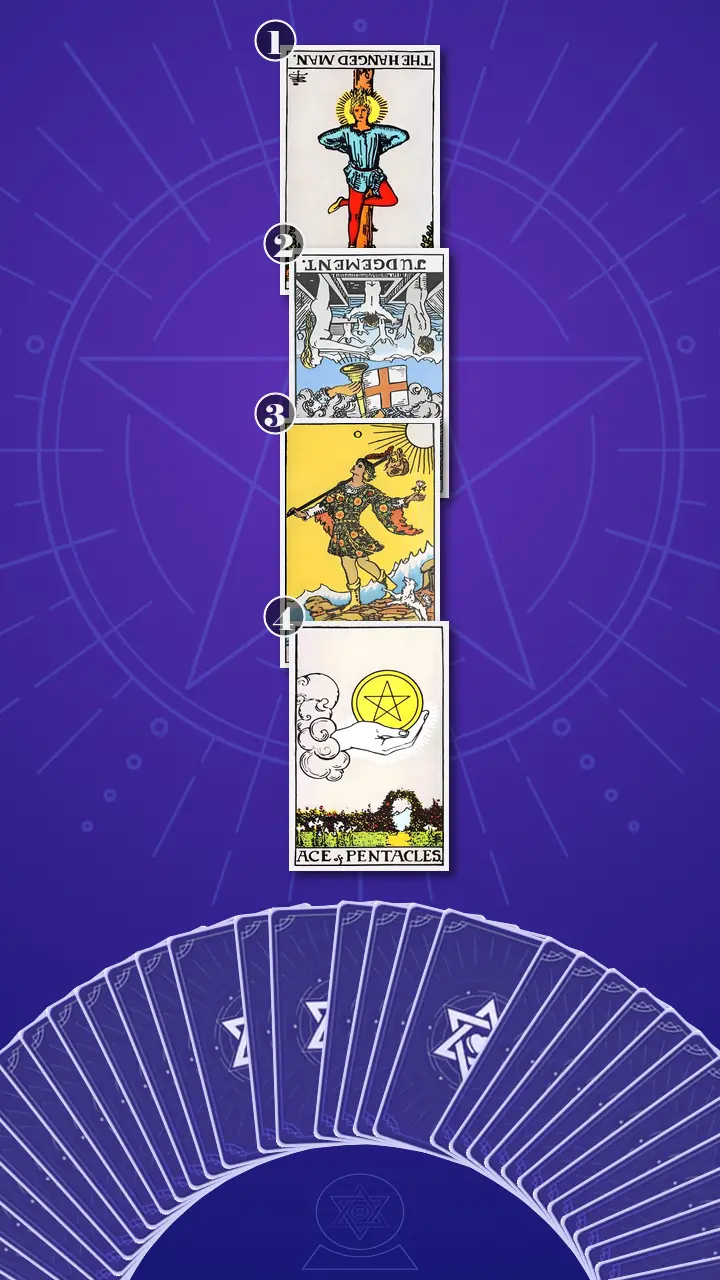
I asked Maya to take one slow breath and hold the real question in mind, not the idealized one: how do I stop pushing every start date to next month? Then I shuffled slowly and laid four cards in a vertical line between us, a ladder rather than a fan, so the eye could travel from visible behaviour down into the hidden mechanism and then back up into action.
I used the Four-Layer Insight Ladder · Context Edition because this wasn’t a Past-Present-Future problem. It was a repeating system. The closer the date got, the more pressure rose. The more pressure rose, the more she moved the date. The more she moved the date, the more self-doubt accumulated. A larger spread would have blurred the leverage point. This one stayed clean: symptom, root, pivot, action. That’s how tarot works at its best for procrastination and self-trust—it doesn’t predict a cleaner month; it shows where the loop is feeding itself.
I told her what each rung was there to reveal. The first card would name the surface symptom: the actual ritual of waiting for the 1st. The second would expose the root mechanism: the fear and belief that made delay feel safer than beginning. The third, the transformational pivot, would show the insight capable of breaking the monthly reset loop. The fourth would ground that insight in one countable, embodied next step she could practice this week.
The Start-Line Paralysis Hiding in the Planner Tab
Position 1: The Planner Tab That Pretends to Be Progress
I turned the first card and named its role out loud: this card represented the surface symptom, the concrete pattern she had asked me about—the pushing forward of the start date and the freeze that appeared the moment action became immediate. It was The Hanged Man, reversed.
In real life, this card looked exactly like her last few nights of the month: bed, laptop, Notes or Notion or Google Calendar open, reminder dragged forward, tracker renamed, and the reschedule itself mistaken for progress. The tied foot in the card mirrored a self-created hold. The glowing halo showed something even more frustrating: she could already see the pattern clearly. Awareness was present. Movement was withheld. It had the same energy as keeping a workout class in the cart and calling that the workout, or living in a Google Doc named Final_v7 with no first paragraph in it.
Reversed, the energy here was blocked and slightly over-controlled. Waiting had stopped being reflection and become a strategy for not feeling exposed. I asked her, ‘When was the last time you moved a reminder instead of doing ten minutes of the actual thing?’ She gave a short laugh with no real light in it. ‘Last night,’ she said. Her thumb kept rubbing the edge of her phone case, fast and repetitive. She knew I had landed on the exact private ritual.
I also warned her about the overcorrection hidden in this card. Once frustration peaked, she was likely to prove seriousness by creating an overly strict routine, a dramatic restart, a set of daily rules that would become something else to rebel against by Thursday. The Hanged Man reversed was not asking for a better plan. It was asking where pause had quietly become self-postponement.
Position 2: The Inner Performance Review
I turned the second card and named its job: this one represented the root mechanism, the core fear and inner belief that made delay feel safer than beginning. It was Judgement, reversed.
This is the card people often misunderstand. In Maya’s life, it wasn’t about doom. It was about every new routine turning into a private performance review. The angel’s trumpet, reversed here, stopped sounding like renewal and started sounding like an alarm. The rising figures became all the old attempts she mentally resurrected the second a new start date approached. The open coffins were the old shame she feared waking back up. A missed day was never just a missed day; it became evidence in a case about whether she could direct her own life.
I asked her the most important question in the whole lower half of the spread: ‘When the date gets close, what is the exact sentence your mind uses to make waiting sound responsible?’ She looked down at her desk. ‘If I mess this up again,’ she said slowly, ‘it means I just can’t manage myself properly.’ Her jaw locked on the last word. There it was—the real blockage. Not laziness. Excess verdict.
When I see Judgement reversed, my mind flashes not to thunderclouds but to the old performance-review grids from my Wall Street years. People think pressure comes from the market. Often it comes from an internal scorecard that turns one wobble into identity. Maya was doing the same thing to a random Wednesday evening. I told her, ‘If every beginning feels like a character test, of course your nervous system tries to avoid the exam.’ She winced, then let out a long exhale that seemed to empty her chest by degrees. ‘Every start really does feel like a test,’ she said.
When The Fool Put One Foot Down
Position 3: The Card That Refused the Ceremony
When I turned the third card, the radiator in her flat clicked off and the silence on the call changed shape. I told her this was the transformational pivot—the card that directly challenged the monthly clean-slate loop. It was The Fool, upright.
I asked her to picture the last night of the month again: laptop on the duvet, tea gone cold, cursor hovering over the habit tracker while she dragged the date forward for what felt like the hundredth time. She was caught in the same question that had been governing everything: ‘Can I become the sort of person who does this properly?’ That question sounds responsible. In practice, it keeps a person hovering over the plan instead of putting one foot down.
Stop worshipping the perfect start line; take the Fool's small step at the cliff edge and let movement teach you what planning cannot.
I let that sit for a beat, then added the sentence I most wanted her to keep: the first step is data, not a verdict.
For a second, Maya froze. First came the physical stop: her breath stalled halfway in, and her fingers hung motionless above the mug by her laptop. Then came the cognitive ripple—her eyes went slightly out of focus, as if she were replaying every Tube ride home, every renamed Notes page called this time for real, every Sunday evening spent watching monthly reset videos while her actual life remained untouched. Then came the emotional break in the surface. ‘But doesn’t that mean I’ve been making the start date way too important?’ she asked, and there was a flash of anger in it, the kind that shows up when an insight is accurate enough to sting.
‘Yes,’ I said. ‘But that doesn’t mean you were foolish. It means you built a system to protect yourself from another internal verdict, and now the system is overcharging you.’ This was the moment I used what I call a Resource Readiness Assessment, a habit from my old life in finance. I separate the assets a person actually has from the fantasy asset they keep demanding. Maya already had usable assets: ten minutes, a laptop, a course tab, shoes by the door, one paragraph, one free evening pocket, one body capable of a short walk. The thing she kept insisting she needed first—a calmer, cleaner, more disciplined future version of herself—was not a resource. It was a mirage. If anyone ever asks me what The Fool tarot meaning for starting over looks like in ordinary life, this is it: not a new-year montage, but a minimum viable first step on a random Wednesday. Her shoulders dropped a fraction, then more. The release almost seemed to unsteady her. Clarity can do that. I asked, ‘Now, with this new lens, think about last week. Was there a moment when one ugly seven-minute start would have changed the whole emotional weather?’
She nodded slowly. ‘Wednesday. I got home, sat on the floor with my bag still on, and spent twenty minutes rewriting the plan instead of opening the course.’ That was the hinge right there—from shame-loaded start-line paralysis to ordinary-day momentum and cautious self-trust. Not certainty. Contact.
The Seed That Counts This Week
Position 4: One Small Thing in Actual Soil
I turned to the final card and named its role: this one represented the embodied next step, how to practice the shift this week in a small, concrete, repeatable way. It was the Ace of Pentacles, upright.
After three Major Arcana cards, this felt wonderfully grounded. The hand offering the coin, the garden path, the flowering arch—none of it was asking for a dramatic reinvention. It was asking for one seed in actual soil. In Maya’s world, that meant one lesson opened, one paragraph drafted, one short workout completed, one budgeting session logged, one email started, one pair of trainers already by the door. Not a whole new lifestyle. One countable unit. In energy terms, this was balance: The Fool’s spark settling into earth.
I told her, ‘One calendar block that happened beats a beautiful month view that didn’t.’ She looked from the card to the tab bar on her screen and gave me the first almost-smile of the reading. ‘I could do one course lesson tonight if I stop pretending I need the whole weekly schedule first,’ she said. Exactly. Ace of Pentacles is where insight stops performing and starts touching real life.
No New System Until the Task Has Touched Real Life
Once all four cards were on the table, the story became very clear. The Hanged Man reversed showed the visible ritual of self-postponement: living in the planning tab instead of pressing play. Judgement reversed showed the hidden cost: every new beginning had become an inner performance review, so postponing delivered short-term relief from exposure. The Fool broke that spell by changing the governing question from ‘What does this say about me?’ to ‘What can I learn by moving?’ And the Ace of Pentacles translated that shift into behaviour, because momentum grows from touching reality, not fantasizing about a better month.
The blind spot was not lack of intelligence or effort. It was mistaking relief for readiness. Moving the date calmed her nervous system for a moment, so it felt responsible. But the relief came from escaping the test, not from being more prepared for it. The transformation direction was simple and hard in the best way: stop treating the 1st like a personality transplant. Start treating the first step as a tiny experiment you can begin before you feel transformed.
She frowned at that and gave me one practical objection, which I appreciated. ‘But some nights I genuinely don’t have a clean ten minutes without turning it into a whole thing.’
‘Then we lower the bar again,’ I told her. ‘I’m not interested in theatrical discipline. I’m interested in high-ROI contact. A tactic only fails when it’s sized for fantasy instead of the real conditions on the ground.’ Because the last week of the month was her danger window, I gave her my Strategic Holding Pattern—a tactical micro-plan for the waiting period, so anxious stagnation would stop masquerading as preparation.
My Strategic Holding Pattern for the last week of the month
- Ordinary-Day Start Tonight, before opening Notion, Google Calendar, Apple Notes, or any habit tracker, pick the one goal you keep promoting to next month and do a 5- to 10-minute version in the exact place you usually avoid it—at your desk after work, on the bedroom floor, or on the sofa before you scroll. Say, ‘This is a trial run, not a new identity.’ If your shoulders climb or your stomach drops, cut it to two minutes and still count it.
- Verdict-to-Data Switch Write down one missed start date you still cringe about and finish the sentence ‘What actually got in the way was…’ Then delete one rule that makes the start feel heavier than it needs to be—something like ‘it has to be daily’ or ‘I need the full routine for it to count.’ Keep it factual and short. No self-lecture. The first step is data, not a verdict.
- Single-Seed Practice Set one physical cue for the next two sessions this week—shoes by the door, document pinned to the top bar, class tab already open, book on your pillow—and track completions only with one tick mark for each finished micro-session. No new system until the task has touched real life. Paper beats a fancy app this week if the app tries to become a second project.
I wasn’t asking her to become someone new by Monday. I was asking her to stop loading symbolic dates with imaginary rescue power. The Four-Layer Insight Ladder had done its job: symptom to root, root to pivot, pivot to action. What happened next belonged to her choices, not to the cards.

A Week Later, the Quiet Proof
A week later, at 8:41 p.m. on the Victoria line, Maya sent me a message while the brakes screamed into the platform. ‘Did seven minutes of the course before I let myself open the planner,’ it said. ‘Not glamorous. But I did it on a Wednesday.’
That was the proof I wanted for her. Not a perfect streak. Not a cinematic transformation. Just one honest interruption of the old monthly reset loop. She had moved from private performance review to feedback, from future fantasy to grounded momentum. That is how self-trust actually starts to grow—quietly, through evidence.
The next morning, she told me, the first thought in her head was still, ‘What if I slip again?’ Then she laughed, put her shoes by the door, and went to work. Clearer, yes. Still human, also yes.
If tonight you’re carrying that same tight-shouldered exhaustion—half in your life, half in a planner tab, waiting for the 1st to rescue you—please remember this: there is a special kind of exhaustion in sitting on the edge of your own life with tight shoulders and a sinking stomach, because starting today feels risky but waiting another month feels like disappearing. But the moment you notice the loop, you are no longer fully inside it.
So before the calendar changes, what would your honest Ordinary Day Start be—the seven-minute timer, the one rough paragraph, the shoes by the door, or one tiny action that lets reality answer back?
Every reading at AceTarot is a journey to connect with inner wisdom and empower your next step. The stories shared here are psychological mirrors, not private records—crafted to reflect universal emotional loops and help you find your own clarity. Learn more about our Journey to Clarity.