When Holiday Loneliness Feels Like Dating Readiness: Let It Settle

Finding Clarity in the 11:43 p.m. Scroll
When Taylor (name changed for privacy) sat across from me, I named the pattern before she had to dress it up as overthinking. If you have ever downloaded a dating app on a Sunday night, matched with a few people for reassurance, and left every message unanswered by Monday morning, I know how easily that can feel like random confusion when it is actually holiday loneliness and dating app burnout arriving in the same outfit.
She described one scene so precisely I could almost hear it: 11:43 p.m. on a Sunday in her small downtown Toronto apartment, one lamp on, radiator hissing, half a bowl of takeout cooling on the coffee table, a Netflix intro looping while Hinge stayed open in her hand. The phone glass was warm in her palm. The room had that end-of-weekend silence that makes every little sound feel too close. Her shoulders curled forward, her thumb kept moving, and by morning she would almost always ghost the very matches she had wanted the night before.
Her question came out in one breath: was she ready to date again, or just lonely because it was the holiday season? She said she did not want to use another person as pain relief. She also admitted that after enough couple-heavy Instagram Stories, a quiet ride home, or one family text asking for dating updates, the apartment could feel less like home and more like evidence. Loneliness, in the way she described it, was not dramatic. It was like standing in a room after the music cuts out and hearing your own pulse too loudly in the speakers.
I told her gently that she was not flaky, and she was not behind. She was moving from noise into quiet, and the quiet was where the question got loud. Then I said what I say whenever someone asks me for finding clarity in a moment like this: let us not force a verdict too early. Let us make a map.

Choosing the Compass: The Decision Cross
I asked her to put both feet on the floor and take one slow breath before I shuffled. Nothing theatrical, nothing designed to impress. I use that pause the same way I use silence in music research: not for mystique, but so the real signal can separate itself from the static.
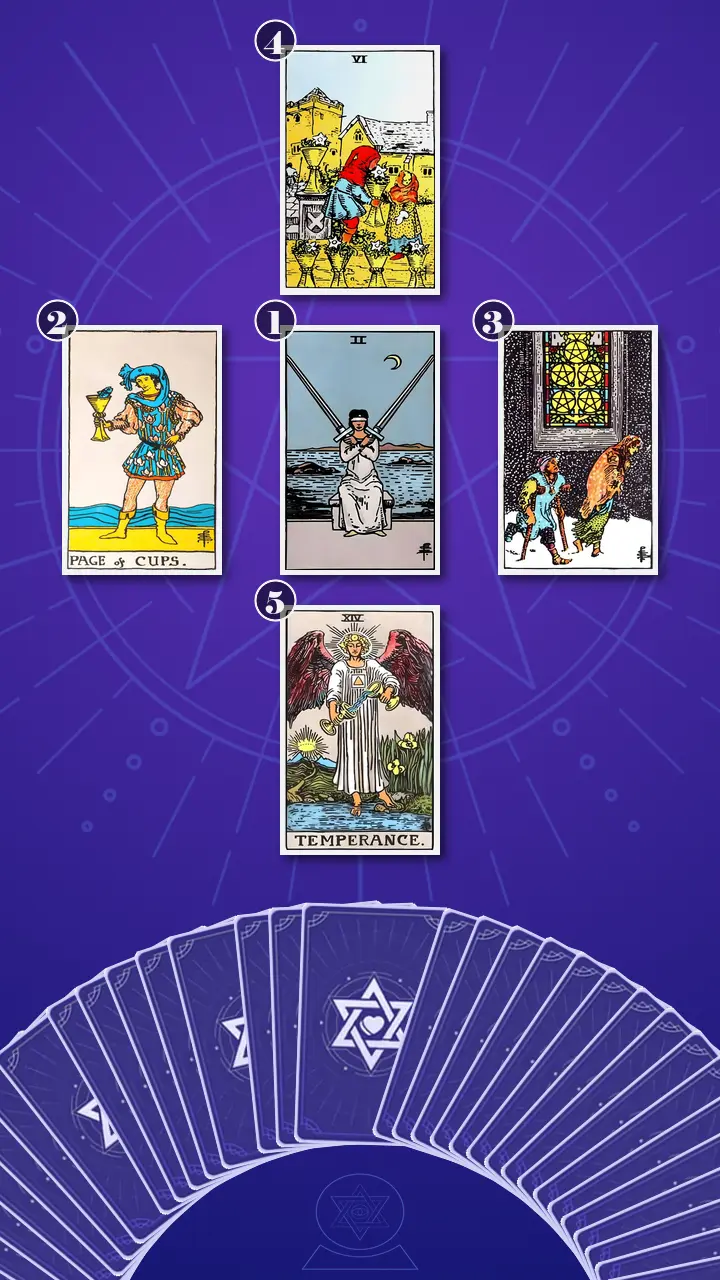
For her question, I chose a Decision Cross tarot spread. When someone is caught between two competing explanations inside the same emotional moment, this spread is one of the cleanest tools I know. It lets me look at the present stalemate, the part that may genuinely be ready for connection, the part that is reacting to holiday-triggered loneliness, the deeper emotional root underneath both, and the most grounded next step.
I explained the structure as I laid the cards down. The center would show the current symptom cluster: the indecision, the late-night app opening, the emotional freeze around the question of readiness. The left card would show what truly supports dating again. The right card would show what supports the competing pull of seasonal loneliness and reassurance seeking. The card above would reframe the whole question by naming the deeper truth beneath it. The card below would offer guidance. In a case like this, the spread works like a winter road sign at a crossroads: not telling you who you must become, but showing which lane you are actually in.
Reading the Split Signal
Position 1: The Loop That Calls Itself Being Careful
I turned over the center card and named its job first. This position shows the current symptom cluster from the diagnosis: the indecision, app-opening, and emotional freezing around the question of whether she was ready or just lonely. The card was the Two of Swords, upright.
I told her this card looked exactly like the version of her sitting on the couch with Hinge open, rereading one match’s message, trying to decide what the app meant about her emotional state instead of replying and learning something real. The blindfold in the card was not ignorance. It was the insistence on emotional certainty before contact. The crossed swords over the chest were intellect used like body armor. It was the dating version of keeping twelve browser tabs open so you never have to hit send on the one email that would make things real.
In energy terms, this was blocked air. Too much thought, not enough lived data. She had been calling it caution, but the card showed me something more precise: safety had started masquerading as clarity. I said it plainly. December ache is not the same thing as dating readiness. And still, staying in the question forever would not answer it either.
I asked her what she was protecting by staying undecided. Her peace. Her hope. Or the fear of repeating an old disappointment. She gave one short laugh that landed with more bitterness than humor and said, That is annoyingly accurate. Then her fingers went to the edge of her sleeve, rubbing the fabric back and forth the way people do when a truth has found the seam.
Position 2: The Soft Signal of Real Openness
I moved to the left side of the cross. This position reveals what genuinely points toward dating readiness: emotional openness, curiosity, and capacity for low-pressure connection. The card was the Page of Cups, upright.
I told her that in real life, this card did not look like a dramatic comeback season or some TikTok-ready declaration that she was fully healed. It looked smaller than that, and healthier. It looked like imagining one simple coffee date in daylight and feeling interested rather than desperate. No fantasy montage. No need to secure a plus-one for the season. Just the quiet thought, this could be nice.
Here the water element was balanced and alive. Not flooded. Not shut down. The Page of Cups is emotional openness in beginner mode, which is exactly what healthy dating readiness often feels like. Awkward, light, a little tender, and not trying to turn one interaction into a referendum on your worth. I asked her to picture one short date under an hour, with someone she already found mildly interesting. Did her body feel lighter, tighter, or simply relieved?
She looked away from the cards and toward the window for a second. The city light caught on the glass beside her, softening her face. Then she nodded once. Not excited, she said. Just curious. That mattered. I told her it mattered a lot.
Position 3: The Cold Street Outside the Window
I turned to the right side. This position reveals what points toward seasonal loneliness or reactive dating: the belonging ache, the comparison trigger, and the urge for quick reassurance. The card was the Five of Pentacles, upright.
This card did not need much translating. I could feel it as soon as I saw the image. It was the cold walk home after a holiday event, the couple photos already up on Stories, the overhead apartment light suddenly feeling harsh, the hollow drop in the chest before the coat is even off. I told her the app in that moment was not functioning like connection. It was functioning like a space heater. Her fingers reached for the phone before her brain even had a theory.
In energy terms, this was earth under strain: scarcity, exclusion, the body-level ache of feeling outside the warmth. The glowing church window in the card became visible closeness all around her, on social media, in plus-one dinners, in harmless family questions that suddenly did not feel harmless. I told her loneliness can be real without being a deadline. The card was not shaming the ache. It was showing how fast the ache could become a story that said everyone else has somewhere warm to land and I do not.
Her jaw tightened exactly the way it had when she first sat down. She did not interrupt me. She just pressed her lips together and nodded with that tiny, unwilling recognition people have when they are being seen in the place they least wanted photographed.
Position 4: The Season She Was Actually Missing
I lifted the card above the center. This position uncovers the deeper psychological layer beneath both options, especially the nostalgia and belonging themes that make the question harder to read clearly. The card was the Six of Cups, upright.
I felt the room soften before I even finished the sentence. I told her this card rarely means only I miss a person. More often, especially at this time of year, it means I miss softness, ritual, familiarity, shared atmosphere. It is the holiday playlist that changes the emotional weather in the kitchen. It is the gift-wrap aisle. The extra voice in the room. The feeling of being witnessed in ordinary winter life. More Nancy Meyers holiday atmosphere than ex-specific longing.
In energy terms, this was water shaped by memory. Not false, not silly, not less valid because it was seasonal. But it was memory-colored water, which meant it could tint the whole question. I asked her what she missed most this time of year that was not exactly a person. She went still for a beat, then said, I miss the feeling of someone else existing in the day with me. Groceries. Tea. Someone seeing the boring parts.
That was the hidden lens. She was not only asking whether she wanted new intimacy. She was also standing outside a warmly lit house and assuming any open door would feel like home. I told her that wanting warmth is human. The trick was not to make a stranger responsible for manufacturing it on command.
When Temperance Poured Between Two Cups
Position 5: The Bridge, Not the Verdict
By the time I reached the final card, even the room seemed to lower its volume. The radiator had gone quiet. Headlights moved across the wall in a slow wash of winter light. I turned over the guidance card and found Temperance, upright, exactly where I wanted the reading to land.
The Tempo Misalignment Audit
This position offers the grounded next step that supports the whole transformation: moving from binary pressure into paced, self-aware experimentation. Temperance is balance, pacing, and emotional integration, but I never read it as bland moderation. With my own work, I read it through rhythm. This is where my Tempo Misalignment Audit always clicks into place. Her problem was not that her heart had no answer. Her internal rhythm was out of sync. After a loud office dinner or a busy workday, her nervous system dropped into a quiet apartment too fast, her executive brain started sprinting for certainty, and the app became a metronome for belonging panic. She was pushing against a wall because her emotional BPM and her daily capacity were not on the same beat.
I gave her the setup as carefully as I could. I said that moment when she got home from a holiday dinner, kicked off her boots, and reached for the app before her bag even hit the chair felt like a dating answer. But most of the time, it was only a spike.
Stop treating this as a forced yes-or-no verdict, and start letting connection unfold at a human pace, like Temperance pouring one cup into another.
I let that sit between us for a second, and then I translated the card even more directly. Readiness is not the absence of loneliness. It is the ability to meet someone without making them responsible for fixing it.
She reacted in three small waves. First, there was a physical freeze: her breathing paused and her thumb stopped against the rim of her mug. Then came the cognitive drop-through: her eyes lost focus, not dramatically, but like she was replaying every Line 1 commute where the city felt festive and she felt newly separate from it. Then the emotion finally moved. Her shoulders lowered. Her mouth pulled sideways. And instead of pure relief, what showed up first was resistance. She said, So I do not get a clean answer tonight?
I told her no, and that was not a punishment. It was freedom. I asked her to open a note on her phone and split it into two lines: I want warmth. I want this person. Then I asked her to put three words under each. She stared down at the screen while a streetcar bell rang faintly outside, as if the city itself wanted in on the timing. Finally she said, Under the first one I have cozy, chosen, witnessed. Under the second one... maybe kind, maybe interesting. Then she laughed, softer this time. I asked her to look back at last week with that new lens. Was there a moment this would have changed how she felt? She nodded immediately. After the holiday dinner, she said. I did not want that guy. I wanted not to feel outside the warmth.
That was the crossing point of the whole reading. Not from single to partnered. Not from lonely to cured. From belonging panic and second-guessing to measured self-trust and steady openness. Temperance was not telling her to delete the app forever or force herself back out there. It was telling her to use the Hinge pause button like a dimmer switch instead of living in delete-and-redownload extremes.
The Two-Cups Pace: Actionable Advice for the Next Few Days
Once all five cards were on the table, the story was clean. The Two of Swords showed why she stayed stuck: she kept trying to think her way into certainty before experience was allowed to give her new information. The Page of Cups showed that some genuine openness was still alive in her, but it was quiet and easily drowned out. The Five of Pentacles showed how quickly a lonely evening could turn into a scarcity story about belonging. The Six of Cups revealed the hidden amplifier: she was missing ritual, softness, and a witness to the season as much as she was missing romance. And Temperance gave the reframe. The issue was not whether dating was good or bad right now. The issue was tempo.
I told her the blind spot was this: she had been treating intensity as truth. Every December spike felt like a verdict on her whole dating future. But a spike is not a destiny. The transformation direction was much simpler and much kinder than that. Instead of using dating to soothe the discomfort of the season, she needed to test whether connection still felt right after the holiday trigger settled.
I gave her a framework I use often, and because it matched Temperance so perfectly, I named it out loud: The Syncopation Reset. It is a three-day tempo adjustment experiment. Not a life overhaul. Not a moral test. Just smaller, more harmonious beats that restore momentum without forcing it.
- Day 1: The After-the-Spike CheckFor one week, I asked her not to open a dating app within 30 minutes of getting home from a holiday event, office dinner, or family call. Instead, she would open a phone note called After the Spike and write three words for what she was actually feeling before deciding whether to swipe.Even ten minutes counts. If energy is low, the minimum version is one line: what am I trying to soothe right now?
- Day 2: A Non-Romantic Softness RitualI asked her to create one cheap, real source of warmth that did not depend on a match replying: flowers from the corner shop, pasta and a candle, a seasonal movie with her phone in another room, or a tea walk with one trusted friend. If the urge to text an ex hit, she was to ask whether she missed that person or simply missed having a witness to the season.If it feels fake, keep it smaller. The goal is not to manufacture a Hallmark life. It is to give the nervous system one honest place to land.
- Day 3: The Curiosity-Not-Relief TestIf one match still felt genuinely interesting the next day, I wanted her to suggest one low-stakes plan this week: coffee, a short walk, one drink, under 60 minutes. Before sending the message, she would ask herself whether she wanted to know this person or whether she wanted tonight to hurt less. Then she would do a 24-hour check-in after the date instead of deciding instantly what it meant.A coffee date is data, not destiny. Wanting warmth is human. Making a stranger responsible for it is the part to watch.
Those were her next steps. Small enough to do. Honest enough to teach her something. Practical enough to give her back agency. I reminded her that she did not have to solve winter in one swipe.

A Week Later: The Quiet Proof
A week later, she sent me a message just before lunch. She had come home from a plus-one-heavy dinner, felt the usual drop in her chest, and this time did not open the app. She wrote her three words. She made pasta, lit a candle, sent a voice note to a friend, and left her phone on the counter. The next afternoon, when the emotional weather had changed, she messaged one match and suggested a 45-minute coffee. She added one line that told me everything I needed to know: I was still nervous in the morning, but it felt like nerves, not emergency.
That is the part I love most about a journey to clarity. The proof is rarely cinematic. It is usually quieter than that. One less compulsive swipe. One more honest pause. One choice made from grounded curiosity instead of panic. That was the real gift of this Decision Cross tarot spread for relationship readiness versus seasonal loneliness: not a prediction about whether dating would work, but a way to separate loneliness, nostalgia, and interest so her next move belonged to her again.
When the city is glowing and your place goes quiet, that ache in your chest can make any open door look like home, even when what you are really craving is warmth, not just a person.
If you stopped asking December to decide your whole dating future, what tiny, honest two-cups experiment with connection would still feel true to you after the loneliness wave settles?
Every reading at AceTarot is a Journey to connect with inner wisdom and empower next step.
Learn more about our Journey to Clarity.