Geographic Reset Fantasy: When "I Need Out" Is Really "I Need Relief"

The Sunday-Night Buzz Behind Geographic Reset Fantasy
I could hear the real question before I laid down a single card. Jordan (name changed for privacy) sat across from me in that particular late-20s way I know well from Toronto clients: coat still half on, phone still warm in her palm, face composed, nervous system nowhere near composed. She told me her lease was up in a few months, and lately one flat workweek was enough to send her straight into Rentals.ca tabs, moving vlogs, cost-of-living calculators, and the old Sunday Scaries spiral.
She described one night so precisely I could almost smell it with her: 6:41 p.m. on a Sunday, grey light pooling across her tiny kitchen counter, soy-sauce takeout going lukewarm beside the sink, a streetcar bell outside, a lease-renewal email glowing on her screen. Her shoulders climbed toward her ears. Her stomach dropped. Instead of answering a friend’s text asking if she wanted to grab a drink, she opened a video called moving to Chicago alone at 29 and felt, for ten minutes, like motion might save her.
When she finally looked at me, she said, “I don’t know if I want a fresh start or just an exit.” Then, quieter: “What if I move and find out I was the thing I was trying to leave?”
Restlessness sat on her like an airport departures board flickering in a dark room: all possible destinations, no actual boarding call. Her chest, she said, kept buzzing high and tight, while the idea of staying still hit her with that awful elevator-drop feeling in the stomach. What she was describing had a name I use often now: geographic reset fantasy that masks emotional numbness and avoidance in daily life.
I leaned in and answered her gently. “The urge to move can be real and still be carrying avoidance. Those two things can absolutely exist in the same body at once.” I let that land before I continued. “So I’m not here to hand you a life verdict tonight. I’m here to sit with you inside the fog and help us draw a map through it.”

Choosing the Compass: A Five-Card Cross for Relocation Clarity
I asked Jordan to take one slow breath with her feet on the floor and hold the question simply, without trying to solve it: Am I craving a move, or am I trying to outrun my current life? Then I shuffled slowly. I always treat this moment as a focusing device, not a performance of mystery. Tarot works best, in my experience, when it gives a nervous system somewhere honest to look.
For a question like hers, I chose a Five-Card Cross tarot spread for move-or-stay discernment. When people ask me for the best tarot spread to know if they should move to a new city, I rarely use a yes-or-no layout. A clean yes or no is seductive, but it flattens the very thing that needs care. This spread is small enough to stay clear and classic, yet spacious enough to separate the surface relocation urge from the escape impulse tangled inside it.
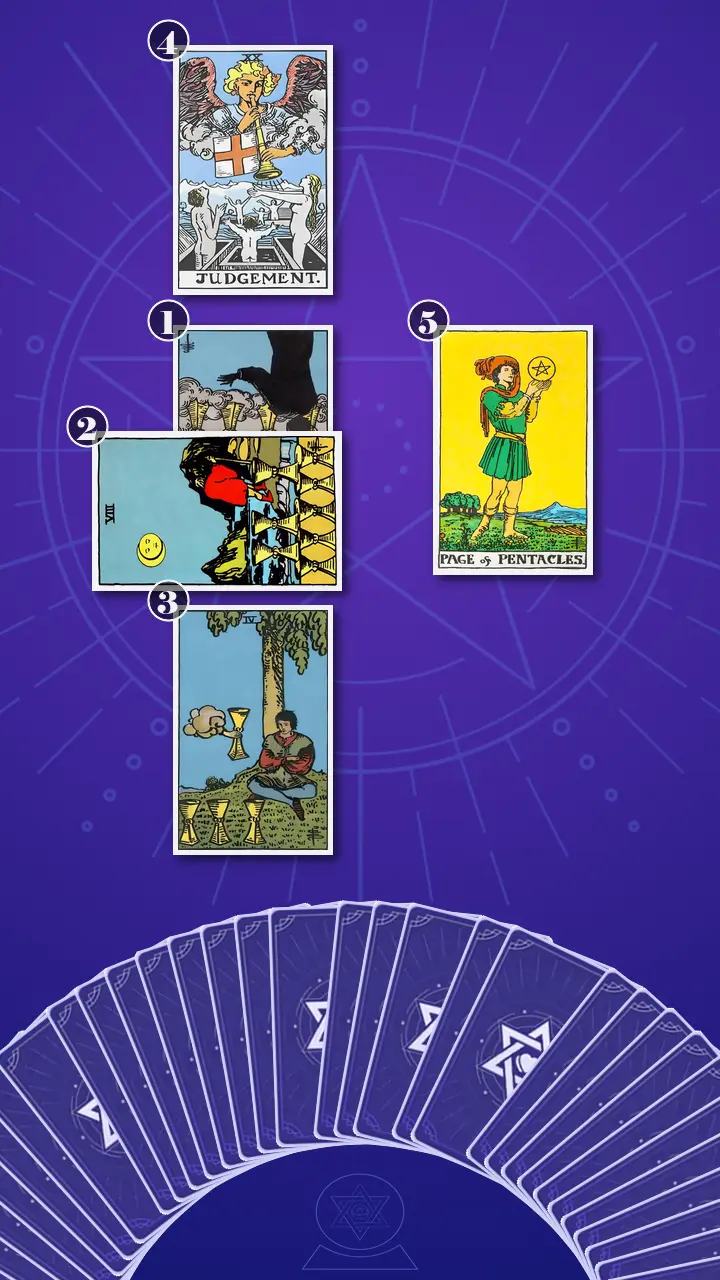
I explained the shape as I placed the positions. The center card would show the live issue: the late-night tabs, the fresh-start fantasy, the feeling stuck underneath the research. The crossing card would reveal what was complicating it: the part of leaving that might really be emotional distance. The card below would uncover the root, what had gone underfed long before any city name got attached to the problem. The card above would show the wake-up point, the higher perspective. And the final card to the right would give us not prediction, but a practical next step.
That is one of the reasons I trust this spread so much for questions like how to know if moving is avoidance. It does not ask, Should you go? It asks, What are you asking a new place to carry for you, and what changes if you get honest first?
Reading the Crossed Current
Position 1: The Tabs That Feel Like Progress
I turned over the first card. “Now we’re looking at the position that shows the visible symptom — the restless move fantasy, the scrolling, the overload of imagined new lives.” The card was the Seven of Cups, reversed.
I smiled a little, because this one was painfully exact. “This is the streaming-menu version of reinvention,” I told her. “Slack open. Half-finished content deck. Rentals.ca. A Montreal neighborhood thread. A cost-of-living calculator. Maybe a TikTok about a soft reset in New York. It feels like research. But really, possibility is multiplying faster than trust.”
In energy terms, I read this as excess in imagination and deficiency in grounded selection. Too many futures, none embodied. The cloud-borne cups in the card always remind me of browser tabs — each one floating just far enough away to stay seductive. Reversed, the card stops being dreamy and becomes flooded. Forty minutes of choosing, zero minutes of moving. Or, more painfully, zero minutes of contacting the life already on your desk.
Jordan gave a short laugh that had a bitter edge to it. It was not agreement so much as being caught. “That’s kind of rude,” she said. “Because that is exactly how it feels. Productive. And then suddenly it’s 4:10 and I haven’t sent the email.” Her fingers tapped once against her mug, then went still.
Position 2: The Exit Plan That Creates Distance
I touched the second card where it crossed the first. “This position reveals what in the move impulse is acting as a blocking pattern — the part that wants distance without processing why the current life feels unbearable.” I flipped it over: Eight of Cups, reversed.
“This,” I said, “is Friday-night spreadsheeting after a dead week. One tab for airfare. One tab for a moving budget. One tab for someone else’s relocation post. And inside your head, the rhythm goes: I just need out. No, I need a plan. No, I need relief.”
The energy here was not clean departure. It was blockage. Incomplete leaving. Motion used as emotional distance. The card showed me that part of Jordan’s urge to move might be true, but it was tangled with something unprocessed — loneliness, flatness, grief, misalignment — and because it had not been named, leaving kept turning into a fantasy loop instead of a decision. I told her plainly, “Research is not clarity if it keeps you from contact with your actual life.”
She winced before she nodded. First her breath paused. Then her eyes drifted away from the cards as if replaying a familiar night. Then the exhale came, long and tired. “Right,” she said. “Because the boxes wouldn’t fix the lonely part.”
Position 3: Life on Mute in a City Full of Options
I turned to the lower card. “This position uncovers the deeper root below the symptom — what feels emotionally underfed or deadened in the current life and makes escape feel magnetic.” The card waiting there was the Four of Cups, upright.
I felt the whole spread sharpen. “This is the Sunday scene,” I told her. “Group chat pings with an invite. The fridge hums. Coffee’s gone cold. Laundry is half-folded. Nothing is dramatically wrong. But your life reaches you like muted audio, so you stare at the text, feel weirdly blank, and open another video about starting over somewhere else.”
The energy of the Four of Cups is not drama. It is deficiency. Emotional withdrawal. A kind of inner dimming that can make a perfectly functional city feel like the entire problem. The offered cup in the image is what you can’t receive right now — not because it is worthless, but because you have been moving through your own life on low battery for too long. I told her it was very Severance-coded, but in a personal way: everything technically works, yet you cannot feel yourself inside it.
Jordan’s expression changed more quietly this time. Her throat moved before any words did. Her gaze went past me, past the window, somewhere inward. “Nothing is even that wrong,” she said at last. “That’s the part that makes me feel crazy.”
“You’re not crazy,” I said. “You’re underfed.”
When Judgement Sounded Like a Push Notification
Position 4: The Card That Asked a Harder Question
By the time I reached the fourth card, the room had gone unusually still. Even the small radiator by the wall, which had been clicking all evening, paused between knocks. I have learned to trust those tiny environmental conspiracies. They often happen right before the card that changes the whole sentence. “This position points to the key transformation,” I said. “What in the urge is a true wake-up call, and what inner reckoning needs to happen regardless of address.” I turned over Judgement, upright.
As an artist, I think in scenes and arcs as naturally as I think in card meanings. So when I see Judgement after three Cups like these, I use what I call Macro-Narrative Arc Auditing. I ask: is this person standing in a dead end, a false climax, or the messy middle of a transition montage? Judgement told me instantly that Jordan was not at a dead end and not at a glamorous finale where one skyline saves everything. She was at the wake-up scene. The internal push notification. The beat where the story stops asking, Which city?, and starts asking, What part of your life has been waiting for permission to live again?
I let the setup become specific. “It’s Sunday around 6:40,” I said. “The lease email is there. The takeout is going cold. You’ve got one tab for rent, one for flights, one for moving alone at 29. Your stomach drops at the thought of another unchanged week, and the panic makes escape look like a plan.”
A new city is not your resurrection plan; answer the trumpet of what feels unlived now, and let any move follow that truth instead of replacing it.
I didn’t rush the silence after that. First, Jordan went completely still, the kind of stillness that is really a freeze. Her hand hovered over her phone but did not touch it. Then I watched the meaning seep in: her eyes unfocused, jaw tightening for one second as if some old internal argument had been reopened, then her brows pulled together. When she finally spoke, it was not relief first. It was resistance.
“But then what does that mean?” she said, sharper now. “That I’ve just been romanticizing this whole thing? That I’ve been wrong?”
“No,” I said. “It means the move question has been doing honest work. It got loud because something real needed air.” I felt the shape of the next beat and named it for what it was — Turning Point Catalysis. “This is not the story exposing you as foolish. This is the inciting incident. The part where the fantasy stops being your escape hatch and starts becoming your clue.”
I leaned closer. “A new zip code can’t carry an unnamed life. So let me ask you this with the card open between us: if you stop asking where to go for one day and ask what in your life feels unlived, what answer makes your stomach flip because it feels true?”
She inhaled, but it snagged halfway up. Then came the second stage of the reaction — the mind replaying its own evidence. “My work,” she said slowly. “Not because it’s terrible. But because I keep acting like I’m still becoming someone I already know I’m not trying to become.” Her fingers loosened. Her shoulders dropped a full inch. Then came that third stage, the soft emotional release that sounds almost like surprise at your own honesty. “And my weekends,” she added. “I keep waiting for a better version of me to start having a real life.”
I asked her to look back at the last week through this new lens. Would the reading have changed anything in a specific moment? She gave a tiny, almost dazed laugh. “I probably would’ve answered my friend,” she said. “Or at least admitted I was lonely before I opened the Chicago videos.” That was the shift, right there in the chair: from panic-driven escape planning to grounded self-trust, not completed, but begun.
Position 5: The One-Pentacle Experiment
I turned over the final card on the right. “This position grounds the reading into an experiment — the most practical next step for testing truth without forcing an all-or-nothing decision.” The card was the Page of Pentacles, upright.
I felt the elemental change immediately. After all that water — fantasy, incompletion, numbness — here was earth. “This is the grounded beginner,” I told her. “Not the dramatic rebrand. The beta test. One clean spreadsheet. One savings bucket. One day in a different neighborhood. One changed routine. One fact gathered in reality instead of fifty collected in fantasy.”
The Page’s steady gaze on a single pentacle is the exact antidote to the scattered Cups. In energy language, this card restores balance through containment. It does not ask Jordan to know whether she is staying or going forever. It asks her to build evidence. To learn what is true in her body, schedule, budget, and attention. “You do not need a life verdict tonight,” I said. “You need one honest data point.”
Something in her posture settled when she heard that. Not certainty. Better than certainty, honestly. Permission to begin small. She turned her phone face-down on the table for the first time since she’d arrived.
From Fantasy Tabs to One Honest Data Point
When I looked at the full spread, the story was clean. At the center sat option overload pretending to be progress. Crossing it was relocation used as emotional distance. Underneath both was the real ache: a life that had gone emotionally flat enough to make movement feel like salvation. Then Judgement broke the spell. Not with prediction, but with sober self-contact. And the Page of Pentacles gave the exit lane: one grounded act that could turn longing into evidence.
I told Jordan her cognitive blind spot was not stupidity or indecision. It was outsourcing renewal to geography. She had been asking a future city to perform a task that belonged to her own naming process first. The transformation direction of the reading was clear: use the move question as a mirror rather than a getaway hatch. Whether she stayed or went, she needed to start naming what felt dead in the current life before asking a new city to fix it.
Because she was visibly calmer now, I gave her a concrete framework. “We’re not drafting a verdict,” I said. “We’re doing a Director’s Cut.” I use this often when someone has let fantasy take over the editing room. The goal is to reclaim authorship, not to force a plot twist.
The Director’s Cut Reframe and the One-Pentacle Experiment
- Mirror Before MapBefore you open any listing site this week, open Notes and write two headers: What feels dead in my life right now is… and What I want more alive, wherever I live, is…. Add one honest bullet under each, then finish with a one-line logline for your next six months.If writing feels intense, do a 60-second voice note instead. One true sentence counts.
- Evidence, Not FantasySet a 20-minute timer for relocation research and keep one document called Evidence, not fantasy. You are only allowed three facts: likely rent range, income implication, and which feeling you hope that city would solve. If you can, move even $25 into a separate mobility fund or aliveness fund.If 20 minutes feels long, make it 8. The point is containment, not perfection.
- One Local Beta TestBefore this week ends, test one thing locally that matches the energy you say you want: work from a different neighborhood, book one Sunday plan before Friday, go to a class alone, or replace one takeout night with a walk and grocery run.Do not ask this experiment to prove stay or go. Let it give you one data point about what your life responds to.

A Week Later: Ownership, Not Certainty
A week later, Jordan messaged me. Not a dramatic announcement. Not a screenshot of a signed lease in another city. Just this: “I muted move content for three days, wrote the dead/alive list, moved $50 into an aliveness fund, and booked a Sunday museum hour with a friend. I still looked at Montreal apartments after that, but it felt different. Less like rescue. More like information.”
That was the proof I wanted for her. Not that she had solved her life in seven days, but that she had interrupted the loop. She had taken the Five-Card Cross for relocation questions exactly where it was meant to go: out of fantasy, into contact. She slept through the night after doing the Notes exercise, she told me, though the first thought the next morning was still, What if I’m wrong? This time, she laughed, made coffee, and left her phone face-down for another ten minutes.
That is what a real journey to clarity usually looks like when I witness it. Not fireworks. Not perfect certainty. Just a woman getting her own pen back. The cards did not command Jordan to stay or go. They helped her separate escape impulse from actual change, which is often the moment self-trust begins.
Sometimes the hardest part is not deciding whether to stay or go. It is sitting in your Sunday-night apartment with your chest buzzing and admitting you are afraid nothing changes unless you blow up your whole life. A lot of people are not trying to leave a city; they are trying to leave a version of themselves that no longer fits.
If you treated this move urge like a clue instead of an escape hatch, what is one small part of your life you would want to make more alive before any boxes get packed?
Every reading at AceTarot is a Journey to connect with inner wisdom and empower next step.
Learn more about our Journey to Clarity.