From Doom Pile Shame to Grounded Self-Trust Through Fair Rules

The 4:56 p.m. Doom Pile: Perfectionist Clutter Paralysis Before a Zoom
If you’re a late-20s hybrid worker in Toronto who can build a content strategy deck but still panic-clear the dining table five minutes before a Zoom, this might be your version of perfectionist clutter paralysis.
When Jordan (name changed for privacy) sat across from me, they didn’t start with a dramatic story. They just said, “I can make big work decisions, so why do old receipts and random cables wreck me?” and I could feel the whole Thursday scene assemble itself between us: 4:56 p.m., Slack pinging, grey winter light flattening the apartment into one tired color, a laptop open on one end of the table, the rough handle of a canvas tote biting into their palm while unopened mail, a notebook stack, two shopping bags, and loose chargers got swept out of camera range.
In a small Toronto apartment, one crowded surface had started making the whole place feel mentally noisy. It wasn’t that the pile was huge. It was that every object arrived carrying three extra decisions and one quiet accusation. Jordan described their shoulders climbing toward their ears, their stomach tightening, that instant urge to step away and do literally anything else. They wanted a calm, usable space; at the same time, they were dreading the discomfort and finality of deciding what stayed and what went. The feeling sounded to me like carrying a bag of unresolved push notifications from room to room.
I told them gently, “This isn’t laziness. It’s too much meaning packed into too many tiny decisions.” Their face softened in that way people’s faces do when they feel accurately seen instead of judged. “So no,” I said, “this isn’t a referendum on whether you can adult correctly. We’re going to map the loop. And from there, we’re going to find some clarity.”

Choosing the Compass: A Situation-Obstacle-Advice-Outcome Spread
I asked Jordan to put both feet on the floor, let their shoulders drop once, and hold the question in plain language: Why do I keep moving the same clutter pile instead of sorting it? Then I shuffled slowly and laid four cards in a straight line between us. I always like this part because it works less like a magic trick and more like a mental threshold; it helps the nervous system move from spinning to observing.
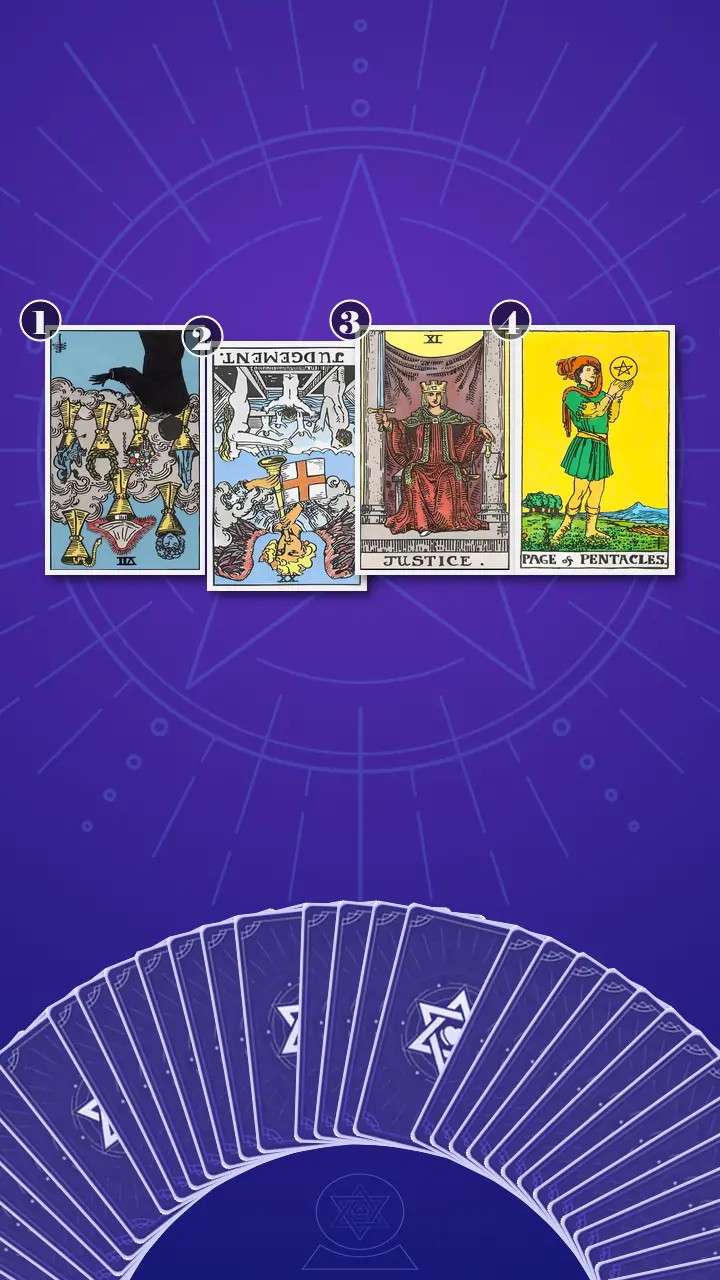
I chose a Situation-Obstacle-Advice-Outcome spread because this kind of doom pile loop does not need more inputs. It needs a clean chain. What is the visible behavior? What hidden pressure keeps it alive? What perspective shift interrupts it? And what grounded next step can be tried this week? For anyone who has ever wondered how tarot works in a practical problem like decluttering anxiety or decision fatigue at home, this is often the answer: a focused spread can show symptom, obstacle, reframe, and next step without overcomplicating the issue.
I told Jordan what I would be watching for as I turned the cards. The first card would show the visible symptom: the repeated pile-moving ritual itself. The second would reveal the deeper block, where sorting starts to feel strangely personal. The third would be the hinge of the whole reading, the card that could restore fair discernment. The last would ground everything into one practical experiment—small enough for a real week, not a fantasy weekend.
Reading the Left Side of the Hallway
The Card of Too Many Maybe’s
I turned over the card representing the visible symptom: the repeated pile-moving behavior and the overwhelmed state it temporarily masks.
Seven of Cups, reversed.
I nodded as soon as I saw it. “This is the pile becoming a mental menu,” I said. In real life, it looks exactly like the pre-video-call moment Jordan had described: one envelope becomes maybe-tax-paper, maybe-return-receipt, maybe-important-later; one charger becomes maybe-I-need-that-for-travel; one notebook becomes maybe-I’ll finally use it properly next week. It is like opening one browser tab for a simple task and ending up with nineteen tabs, a saved-for-later cart, and no idea which one is playing audio. The pile may only cover one corner of the table, but mentally it hangs over the whole apartment.
Because the card was reversed, I read the energy as blocked and over-saturated. Not laziness. Not indifference. Freeze. Too many imagined futures attached to too many tiny objects. Moving the pile creates short-term visual relief, but it doesn’t resolve the decision fatigue underneath. It just drags the same open tab from desk to chair to floor to tote.
Jordan let out a quick laugh and then winced at their own laugh. Their thumb kept rubbing the rim of their mug. “Wow,” they said. “That’s so accurate it’s kind of rude.” I smiled, because that little bitter laugh is often the first sign that recognition has broken the spell.
When Sorting Turns Into a Courtroom
I turned to the second card, the one showing the deeper block: the self-evaluating fear, regret, or inner pressure that turns sorting into an emotionally loaded task.
Judgement, reversed.
“There it is,” I said, more softly now. “You’re not just sorting objects anymore; you’re sorting what they seem to say about you.” I described how this card shows up in a real apartment: an expired coupon stops being paper and becomes proof of carelessness; an unread notebook becomes proof of wasted potential; a duplicate charger becomes proof you spent money badly; a missed return label becomes proof you let something basic slide. Less home organization, more your Notes app staging an intervention with every unfinished intention you’ve ever saved.
A small pile can feel huge when every item is carrying regret, future possibility, or self-judgment. That is Judgement reversed. In healthy form, Judgement is honest review and release. Reversed, it becomes self-prosecution. Sorting stops being about objects and starts feeling like a surprise performance review. No wonder the body wants to leave the room. No wonder the tote bag starts looking merciful.
Jordan’s reaction came in three clear beats. First, their breath paused. Then their eyes lost focus for a second, as if I could almost see the Sunday-morning scene replaying behind them: lukewarm coffee, an upbeat cleaning playlist, an old receipt, then an unread notebook. Then came the release—a long exhale from deep in the chest. “Yeah,” they said quietly. “I touch one thing and suddenly I’m not deciding about an object. I’m deciding whether I’m... together.”
I let that sit. Outside, a streetcar bell rang faintly through the window. Inside, the card had already named the real obstacle more clearly than any storage bin ever could.
When Justice Picked Up the Sword
The Hinge Card
By the time I reached the third card, the room had gone very still. Even the radiator seemed to hush itself. I turned over the position that identifies the key reframe—the one that challenges the fear of loss or wrong decisions and restores fair, workable discernment.
Justice, upright.
I always notice the posture first: the straight back, the balanced scales, the sword held cleanly upright. When I saw it, I had one of those private flashes that come from doing this work for years. I thought of planetary orbits—not because life is fated, but because stable movement needs structure. Even planets do not travel by mood. They move because there is an intelligible path. Justice was asking Jordan for that kind of path.
“This,” I told them, “is the antidote.” Justice is what happens when a task stops running on vibes and starts running on criteria—the way a content approval rubric saves you from debating every headline from scratch. Not What does this say about me? but What is this for? Does it belong here? Does it earn a home? Before, every object asks for a feeling. After, every object meets the same standard. If anyone asks me for the Justice tarot meaning in decluttering and decision-making, this is it: fair criteria, clear boundaries, and accountability without self-attack.
This was also the moment I brought in one of my own tools: Micro-Cycle Energy Mapping. Justice does not only ask for fair decisions; it asks for fair conditions. If you keep trying to sort during your cognitive low tide—4:56 p.m. after Slack, or late Sunday when shame is already humming in the background—you are asking a tired nervous system to behave like a courtroom. Of course it reaches for the tote. Fair discernment gets easier when you stop demanding peak clarity from yourself at the exact hour your energy naturally dips. That isn’t indulgence. It’s accuracy.
Use a Rule, Not a Mood
You know that moment when you touch the same tote on a Sunday morning and your whole body reacts before you’ve made a single decision—shoulders up, stomach tight, brain already bargaining with itself? I told Jordan that this was the setup, not the verdict. The pile keeps coming back because you keep asking a self-worth question where an object question would do.
“This pile is not proof that you failed; weigh each item by a clear standard and let Justice’s sword make one clean cut at a time.”
I stopped talking and let the sentence ring out. Jordan went completely still. First their fingers froze above the table, suspended as if they had forgotten what came next. Then their gaze shifted away from me and unfocused for a second—the unmistakable look of someone replaying the same memory with a new subtitle under it. Then the feeling broke open: their jaw unclenched, their shoulders dropped, and they let out a breath that sounded half relieved, half stunned.
What came next wasn’t easy serenity. It was more honest than that. Their eyes got shiny, and they frowned. “But... doesn’t that mean I’ve been turning this into way more than it is?” There was a flicker of resistance in it, almost anger, the kind that shows up when clarity reveals how much extra weight you’ve been carrying.
“Not because you’re dramatic,” I said. “Because you’ve been overloaded. There’s a difference. Judgement reversed made every receipt feel like testimony. Justice says we do not need testimony. We need a filter.”
I asked them, “If you’d had that filter last Thursday, right before the Zoom, what would have changed?” Jordan looked back at the cards and answered almost immediately. “I would’ve stopped asking whether I was the kind of person who lets mail pile up. I probably just would’ve said: admin folder, recycle, or actual home.”
That was the shift. Not from mess to perfect order. From shame-heavy overwhelm to grounded self-trust through clear criteria. When that happens, the nervous system no longer has to defend itself from the pile. It only has to make one fair choice.
The Card That Lands in Earth
Then I turned over the final card, the one that grounds the reframe into a small, practical experiment that can be tried this week without demanding perfection.
Page of Pentacles, upright.
I smiled because the spread had moved exactly the way I wanted it to: from murky emotional overload into clean thinking, and now into something touchable. The Page of Pentacles is a beginner, and I mean that kindly. This card does not care about a total apartment reset, an Apartment Therapy fantasy, or a Sunday reset TikTok montage with matching bins. It cares about one bounded unit of attention. One pentacle. One category. One timer.
In real life, this looked like Jordan choosing receipts or unopened mail—not the whole doom pile, not the whole apartment, not a sudden small-space rebrand. Ten minutes. One category only. One visible landing spot. More beta test than life overhaul. The energy here is balanced and grounded, the opposite of the overreach that says, “If I start, I should probably do the whole thing properly.”
Jordan gave a smaller, steadier nod. “That I can picture,” they said. “Not the full reset. The receipts, maybe.”
“Exactly,” I said. “Clear enough still counts.”
From Self-Prosecution to Fair Discernment
When I looked across the full line of cards, the story was clean. The Seven of Cups reversed showed the visible loop: too many micro-decisions, too many imagined futures, not enough internal structure, so the same clutter pile gets moved instead of sorted. Judgement reversed showed why the loop feels so emotionally loud: the task is no longer about paper, cables, beauty samples, or half-used products. It has fused with identity, competence, waste, and regret. Justice changed the meaning of the entire reading by replacing self-attack with criteria. The Page of Pentacles showed how that insight becomes real—through one modest, repeatable action, not a heroic purge.
The blind spot was not lack of discipline. It was this: Jordan had been trying to solve a rule problem with mood, and a shame problem with more pressure. They were also assuming every low-energy phase was proof of failure. In my practice, I call that Rest Phase Legitimacy—the reminder that an unproductive phase is not a moral defect but part of the orbit. Some days are not built for sorting emotionally loaded objects. Knowing that can keep a low-energy day from becoming another layer of self-judgment.
The direction of change was equally clear. This Situation-Obstacle-Advice-Outcome spread was asking Jordan to stop waiting until they felt fully ready, fully certain, or somehow worthy enough to sort. Instead: one small, imperfect decision at a time, made by a clear rule. Rule-first decluttering. Justice before storage.
- The Justice Sticky NoteTonight or tomorrow, at the dining table, write only three rules on a sticky note: “use this week,” “legally or admin necessary,” and “has a real home.” Set out three landing spots before touching the pile: a recycle or trash bag, a keep-at-home container, and a small admin folder. Decide only 10 to 15 items in one pass.If your brain says this is too simple to count, that is the sign you’re doing it right. Keep the rule short enough to use while tired, and cap any “review later” pouch at five items.
- The Object, Not Verdict ScriptBefore each emotionally loaded item, say quietly, “This is a decision about an object, not a verdict on me.” If one item opens a full self-critique spiral, skip it and move to a neutral category like receipts, flyers, or empty packaging. End the session after five emotionally loaded decisions.Whisper it, type it into Apple Notes, or keep it on your phone screen. If your body gets hot, shaky, or tight, scale down. That is not failure; it is useful data.
- The Lunar Routine SyncFor one week, track your natural energy tide. Mark one daily window when your brain feels clearest and one when it reliably dips. Do your 10-minute single-category sort—receipts, cables, unopened mail, beauty samples—only in the clearer window. On low-tide days, your entire task is just to carry one filled bag out or place one admin folder in its permanent spot.This experiment is about syncing effort to energy, not proving discipline. Low-output days are part of the rhythm, not evidence that you can’t do it.

A Week Later: The Quiet Proof
Five days later, Jordan sent me a photo. Not of a magazine-ready apartment. Not of a full reset. Just a narrow, honest strip of dining table visible again, a labeled admin folder standing upright, and one grocery bag tied shut by the door. The message underneath read, “Did receipts only. Ten minutes. I stopped when the timer ended.”
What I loved most was what the photo did not try to prove. The spare chair still had a scarf on it. One corner of the table still held a mug and headphones. The apartment looked lived in, not transformed for content. But the old catch-all tote was gone, and so was the story that every sorting session had to become a verdict on whether they were a competent adult.
The next morning, Jordan told me they woke with the brief familiar thought—what if I threw out something I needed?—and then, for the first time, they caught themselves and smiled. Clear, but still a little tender. That is often how real change arrives.
I ended the reading by reminding them that this Situation-Obstacle-Advice-Outcome spread had not cleaned the table. They had. The cards simply helped us see the symptom, the obstacle, the reframe, and the next step clearly enough that action stopped feeling like punishment. That, to me, is the real Journey to Clarity: not certainty, but ownership.
When a small pile makes your chest go tight, it is often not because the task is big. It is because every receipt, cable, and half-used notebook has started feeling like a test of whether you can trust yourself to choose well.
If you stopped waiting for the perfect tide, what is one tiny category you might let Justice’s sticky note decide for you this week?
Every reading at AceTarot is a Journey to connect with inner wisdom and empower next step.
Learn more about our Journey to Clarity.