Overthinking Where to Stand in Group Photos—and Staying Present
The 8:47 Rooftop Freeze
If you're a late-twenties London professional who can lead a client call without blinking but goes oddly quiet the second someone at brunch or agency drinks says, 'Photo,' I know how specific—and how lonely—that can feel. Emma (name changed for privacy) sat across from me and gave the kind of half-laugh people use when they already expect to be embarrassed by their own question. 'I think I've basically been googling some version of why do I overthink where I stand in group photos even with friends,' she said.
She told me about a Thursday rooftop in Shoreditch. The bass was thudding up through the decking, cold air kept catching her bare arms, and the sharp smell of lime and perfume hung above the table while a phone threw white light across everyone's faces. She had been fine until the camera came out. Then came the tiny sequence: step left, step right, smooth the dress, ask, 'Is this spot okay?' hold the smile half a beat too late.
'I never know if standing in the middle looks confident or embarrassing,' she said. 'Everyone else seems to just know where to go.' What I heard underneath was the real split: she wanted to belong naturally in the group, and she was terrified of being visibly out of place inside it. Her self-consciousness was not abstract; it sat on her like wet tailoring—shoulders up by her ears, breath caught high in the chest, every muscle trying to disappear without actually leaving.
I nodded and told her the truth I wish more people heard sooner: this is not vanity. It is belonging fear in a very modern costume. 'The frame is not a ranking chart,' I said softly. 'And today, let's draw a map through the fog so you can stop treating one small photo like it gets to grade your place in the room.'
Choosing the Compass: A 4-Card Tarot Spread for Group Photo Anxiety
I asked Emma to take one slow breath and hold the question in its real form—not 'How do I look better in photos?' but 'Why does a simple photo moment make my body act like belonging is on the line?' Then I shuffled slowly, not as theatre, but as a way of helping the mind stop sprinting long enough for the deeper pattern to speak.
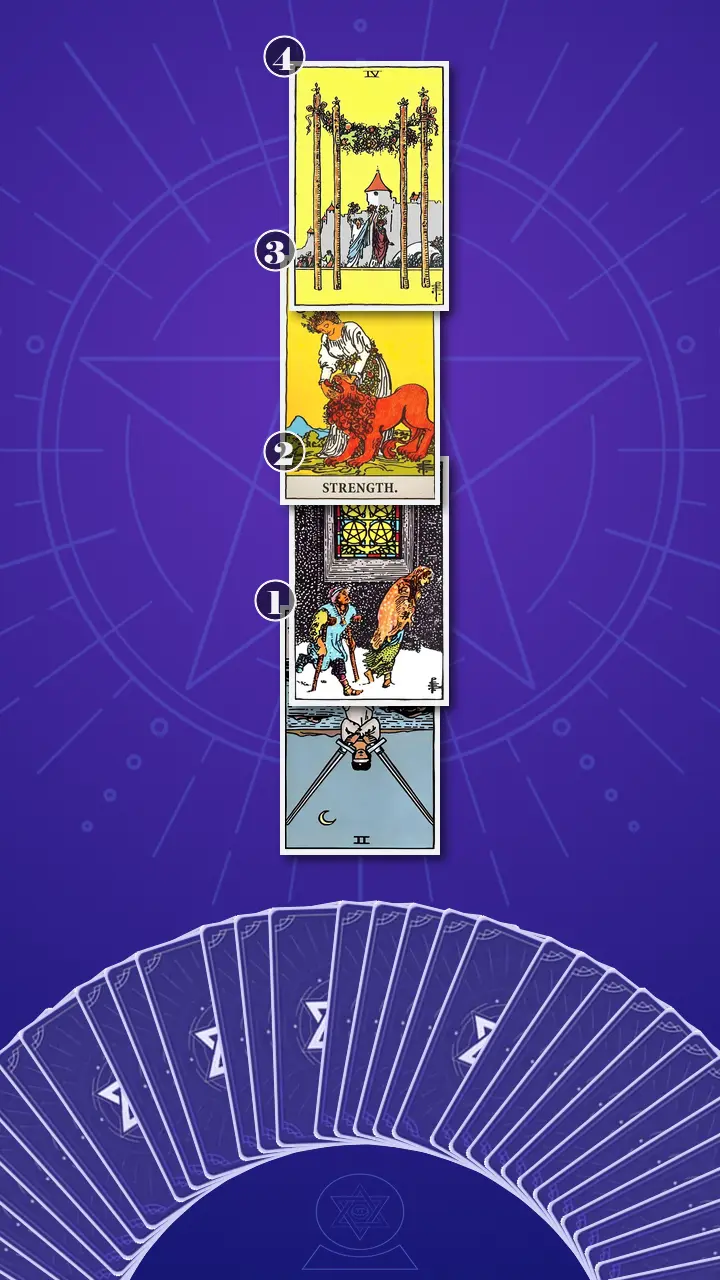
For her reading, I used my Four-Layer Insight Ladder · Context Edition. It is a simple four-card tarot spread I reach for when a small social moment is clearly carrying a bigger emotional charge. In cases like this, I do not need a sprawling spread. I need a tight ladder: the visible symptom, the root fear, the turning point, and the practical way that new insight can live in ordinary life. That is how tarot works best here—not by predicting where Emma should stand, but by showing what standing in the 'wrong' place has come to mean inside her.
I told her what I would be tracking as I laid the cards upward in a clean line. The first card would show the concrete camera-up moment: the hovering, the scanning, the hesitation. The second would expose the belonging fear underneath it. The third—our hinge card—would show the antidote, the inner shift from reading the room for worth to trusting embodied presence. The fourth would answer the only question that really matters after insight: what do you do at the next brunch, birthday dinner, or work social when the phone actually comes out again?
Reading the Ladder: Why the Camera Changes Everything
Position 1: The Left-Right Shuffle
I turned over the first card. 'This is the position that presents the concrete camera-up moment from the diagnosis: the overthinking, scanning, and hesitation around where to stand.' The card was the Two of Swords, reversed.
I have learned, both on trading floors and across tarot tables, that the body often tells the truth before the story catches up. Here, the blindfold and crossed swords over the chest gave me Emma's whole pattern in one image. This was exactly the dinner-or-work-social moment when the phone comes up, she does that tiny left-right shuffle near the edge of the group, smooths her clothes, checks where the most camera-easy person has gone, and somehow feels less certain with every extra second.
Reversed, the card showed stalled Air overflowing into visible overthinking. Too much mental analysis, not enough grounded choice. Like a cursor hovering over two buttons while everyone else has already clicked, Emma was trying to think her way to certainty in a moment that only really asked for one small embodied move. The longer she delayed, the more loaded standing still felt. Group photo anxiety was not arriving after the fact; it was beginning in that three-second gap before she picked a place.
Her reaction came in three small beats. First, her fingers stopped around the paper cup she had been holding. Then her eyes drifted past the cards, as if she were replaying half a dozen birthday dinners at once. Then she gave a short laugh with a wince in it. 'That is painfully specific,' she said. 'Like... a bit rude, actually.' I smiled. 'Good,' I said. 'Specific is useful. It means we are not dealing with some vague flaw. We are looking at a pattern.'
Position 2: The Outsider Script in the Tagged Photo
I turned over the second card. 'This is the position that exposes the core belonging fear from the psychological mechanics: what standing in the wrong place emotionally seems to prove.' It was the Five of Pentacles, upright.
This is where the reading dropped below manners and into meaning. I asked Emma to picture the commute home: Central line, fluorescent buzz overhead, tote strap cutting into the shoulder, phone warm in the palm while tagged photos finally load. In the image on the card, warmth glows through stained glass while two figures move through the cold outside it. In modern life, that becomes a completely ordinary group shot turning into evidence. She sees herself slightly off to one side and the body reacts first—jaw tight, chest hollow, stomach gone cold—before the mind builds the case file: everyone else fit naturally, and I looked inserted.
That is deprived Earth: not drama, not vanity, but scarcity. The fear is not really, 'What if I pick an awkward spot?' The fear is, 'What if the awkward spot proves I was never fully inside the group?' This was the outsider script. The frame is not a ranking chart, but her nervous system had been reading it like a LinkedIn org chart of closeness.
My old Wall Street brain clicked in here. I have a diagnostic lens I call Toxic Hierarchy Filtration, and it is useful whenever a neutral situation gets mistaken for a status test. I told Emma, 'Your mind is filtering a casual photo as if it were a room full of subtle power plays. But most of the hierarchy you are reacting to in that moment is imagined, not because your feelings are fake, but because the data set is terrible. A camera angle is weak evidence. A body bracing for exclusion will still try to trade on it.'
She went very still. Her inhale caught; then her gaze unfocused, like she was back on a Tube carriage looking at a photo she already hated. When she exhaled, it came out long and low. 'That,' she said quietly, 'is the part no one says out loud. It was just a photo, so why does my body feel like I failed something?' 'Exactly,' I said. 'Because this is belonging versus exclusion, not aesthetics versus confidence.'
When Strength Taught Her Presence Over Positioning
Position 3: The Gentle Hand That Changes the Story
When I turned the third card, the room seemed to settle with it. Even the rain at the window had softened to a thin tap instead of a rush. 'This,' I told her, 'is the heart of the reading. It points to the key shift: moving from reading the room for worth to trusting embodied presence.' The card was Strength, upright.
On the surface, Emma's problem looked like indecision. Underneath, it was a threat response. In my head, I flashed for a second to the old trading desk version of me watching brilliant adults mistake every flicker on a screen for a verdict on their value. Same mechanism, different costume. Emma had been trying to solve a body alarm with better surveillance. Strength does not do that. Strength softens the alarm first.
She was still stuck in the thought-loop I hear so often in readings like this: If I do not decode the perfect spot, I could expose myself. If I choose too fast, I will look try-hard. If I choose too slowly, I will look unwanted. Her shoulders had crept upward again without her noticing.
Stop treating the frame like a verdict; with Strength's gentle hand on the lion, calm the inner alarm first and let your place come from presence rather than performance.
The sentence sat between us for a beat. Then I added, more quietly, 'The photo does not get to decide whether you belong. It only captures where you were standing while you already did.'
I watched the insight land in layers. First came the freeze: her mouth parted slightly and even her blinking paused. Then came the cognitive shift—I could see it in the way her focus went soft, not absent but internal, as if some old scene were being replayed with new subtitles. Then the release arrived. Her shoulders dropped an inch. One hand, which had been gripping her sleeve, let go. She drew in a deeper breath than any she had taken since sitting down, and then laughed once under it, not because it was funny, but because the relief had a bit of dizziness in it. That happens sometimes when clarity enters where constant self-monitoring used to live; the nervous system suddenly has more space than it knows what to do with.
'But if that is true,' she said, and now there was a flicker of resistance in it, 'does that mean I have been getting this wrong the whole time?' I shook my head. 'No. It means you have been protecting yourself with the only strategy your body trusted. We are not calling old protection stupid. We are updating it.'
I leaned in slightly. 'Now, with this new lens, think back to last week. Was there a moment when this would have changed how it felt?' She nodded almost immediately. 'At my friend's birthday,' she said. 'If I had just picked one spot and breathed, I think the whole thing would have passed faster.' Exactly. That was the crossing point—from treating the frame like a silent ranking chart to experiencing the photo as a shared memory. Not instant confidence. Just the first real move from self-conscious tightening toward grounded participation.
I translated Strength into the most practical terms possible. Crossed arms, held breath, eyes scanning: that was the old operating system. Feet planted, jaw unclenched, one full breath, one chosen place: that was the update. You choose. The world does not stop. The moment carries on. Choose once. Breathe once. Let the moment keep moving.
Position 4: Back to the Table, Back to the Night
I turned over the final card. 'This position shows how the new state is lived in real social moments: choosing participation over perfect placement.' It was the Four of Wands, upright.
I loved seeing it here. After all the contraction of the first two cards, this one opened the room back up. The garlanded threshold, the lifted flowers, the sense of welcome—this was not about performing belonging. It was about stepping into a social space that was already holding her. In modern terms, it looked like this: the shutter clicks, and instead of instantly auditing the preview, Emma turns back to the table, catches the next joke, hears the toast, notices the candle smoke, the clatter of cutlery, the actual life still happening.
This was balanced Fire: warm, communal, alive. The photo becomes a camera-roll souvenir, not a performance review. Where you stand can be practical without being personal. You were invited into the memory, not asked to audition for it.
Emma looked at the card and gave the kind of small nod people give when their body recognizes home before their mind fully does. 'That feels normal,' she said. 'Exactly,' I replied. 'That is the point. Healing is often less dramatic than the spiral that came before it.'
The Stand, Breathe, Stay Reset
When I zoomed out, the story the cards told was clean. First came the visible coping pattern: Emma froze and hovered because the camera-up moment felt unusually high stakes. Under that sat the real engine: a belonging wound that turned neutral placement into supposed proof of exclusion. Strength interrupted the whole mechanism by offering not fake confidence, but compassionate self-possession—enough steadiness to stop crowd-sourcing worth from the room. And Four of Wands showed the destination: the same social life, the same photos, but a different internal contract with visibility.
The cognitive blind spot was simple and brutal: she had been treating a logistics question as an identity question. Where should I stand? had quietly become What does my place say about my value? The transformation direction was equally simple: move from decoding the perfect spot to making one grounded choice and trusting that presence matters more than positioning.
I told her I wanted her next steps to be tiny, repeatable, and boring in the best way. Grand promises are useless here. What works is practice.
- The 3-Second Spot ChoiceAt the next casual photo—brunch, birthday dinner, wedding, or work social—pick a spot within three seconds instead of waiting for the perfect one. Once you choose, keep both feet there for one full inhale and exhale before you adjust.If embarrassment spikes the second you stop over-correcting, count that as old pattern recognition, not proof you chose badly. The goal is not confidence. It is one steady breath.
- The Stand. Breathe. Stay. NoteBefore you leave for an event this week, put a private note on your phone that says, 'Stand. Breathe. Stay.' Read it once in the cab, on the Tube, or in the bathroom mirror so your brain has a rule ready before the phone appears.Do not underestimate a simple cue. Your overthinking is already overstaffed; the reminder works precisely because it is brief.
- The Preview-Pause DivestmentAfter the next group photo, stay in the conversation for at least thirty seconds before looking at any preview. If photos land later in WhatsApp or tagged posts, wait until you are home or regulated before opening them. Save one picture because it captures the night, not because your placement looked strategically safe.This is my Social Divestment Plan in miniature: stop investing emotional capital in low-return data like preview angles and frame geometry. Delay is enough. You do not need perfection.
Emma frowned at the first step. 'Three seconds sounds fast when my brain is already spiraling,' she said. That was fair. So I made it smaller. 'Then your only job is the breath,' I told her. 'Even an edge spot counts if you chose it on purpose. We are building tolerance for one visible decision, not trying to turn you into the most camera-relaxed person in London by next Thursday.'
A Week Later, the Quiet Proof
A week later, I got a message from Emma after agency drinks. 'Phone came out,' it read. 'I nearly did the step-left step-right thing. Then I remembered: stand, breathe, stay. I picked a spot next to my friend, dropped my shoulders, and stayed there for one breath. Nobody reacted. The moment just... kept going.' A second message followed a minute later: 'I still wanted to zoom in on the photo on the Central line home, so I waited until I got in. It was weirdly less loaded by then.'
That is how finding clarity usually looks in real life. Not a personality transplant. Not permanent certainty. Just one ordinary moment no longer hijacked by an old equation. Emma had not solved belonging once and for all; she had simply stopped asking the frame to do a job it was never qualified to do. This is exactly the kind of finding clarity I built the Four-Layer Insight Ladder · Context Edition for: not to predict your place, but to hand your place back to you.
When everyone else seems to slide into place in one smooth move, it can feel strangely exposing to stand there with tight shoulders and a held breath, trying not to let one small position confirm the fear that you were never fully inside the group. If you can name that as belonging anxiety instead of some silly personal flaw, you are already less trapped inside it.
So the next time a phone rises and your inner ranking chart tries to wake up, where might you let yourself stand simply to stay with the people you are already with?
Every reading at AceTarot is a journey to connect with inner wisdom and empower your next step. The stories shared here are psychological mirrors, not private records—crafted to reflect universal emotional loops and help you find your own clarity. Learn more about our Journey to Clarity.
Author Profile