When 'Home Safe?' Feels Like Surveillance: Checking the Actual Request

Finding Clarity in the 11:14 p.m. Streetcar Glow
When Jordan (name changed for privacy), a 28-year-old UX designer from Toronto, sat across from me in the corner booth of my café, I heard myself say the thing I say when a seemingly tiny text is carrying a much older charge: if you’re a late-20s city professional who can write perfect Slack messages all day but still freeze when a date texts ‘home safe?’, this is usually less about texting etiquette and more about hyper-independence in dating.
She nodded before I even finished. Then she described 11:14 p.m. on a Friday: the back corner of a nearly empty TTC streetcar heading west, fluorescent lights buzzing overhead, her own tired face thrown back by the window, her phone hot in her palm. She opened the message, typed ‘Yep’, deleted it, let the screen go dark, reopened it, and felt her jaw lock while her shoulders crept up toward her ears. On paper it looked caring; in her body it landed like a demand.
‘I know it’s a sweet text,’ she said, staring into the foam. ‘So why do I instantly feel cornered?’ What she wanted was closeness. What she feared was that closeness came with admin, reporting, and a quiet little invoice for future access. Her defensiveness had the feeling of a lobby door deadbolting from the inside before she had even checked who was knocking. I told her gently, ‘That makes sense. Your body can hear “report back” inside a text that only says “home safe?”. Let’s make a map of that old rule, and then find the kind of reply that keeps your space without forcing you to go cold.’

Choosing the Compass: The Shadow Spread
I asked her to put both hands around the cup, take one slow breath, and hold the exact question in mind: ‘When they text “home safe?”, what old rule am I reacting to?’ Then I shuffled slowly, not because I needed theatre, but because the body often needs a beat of structure before the mind will stop doom-scrolling meaning.
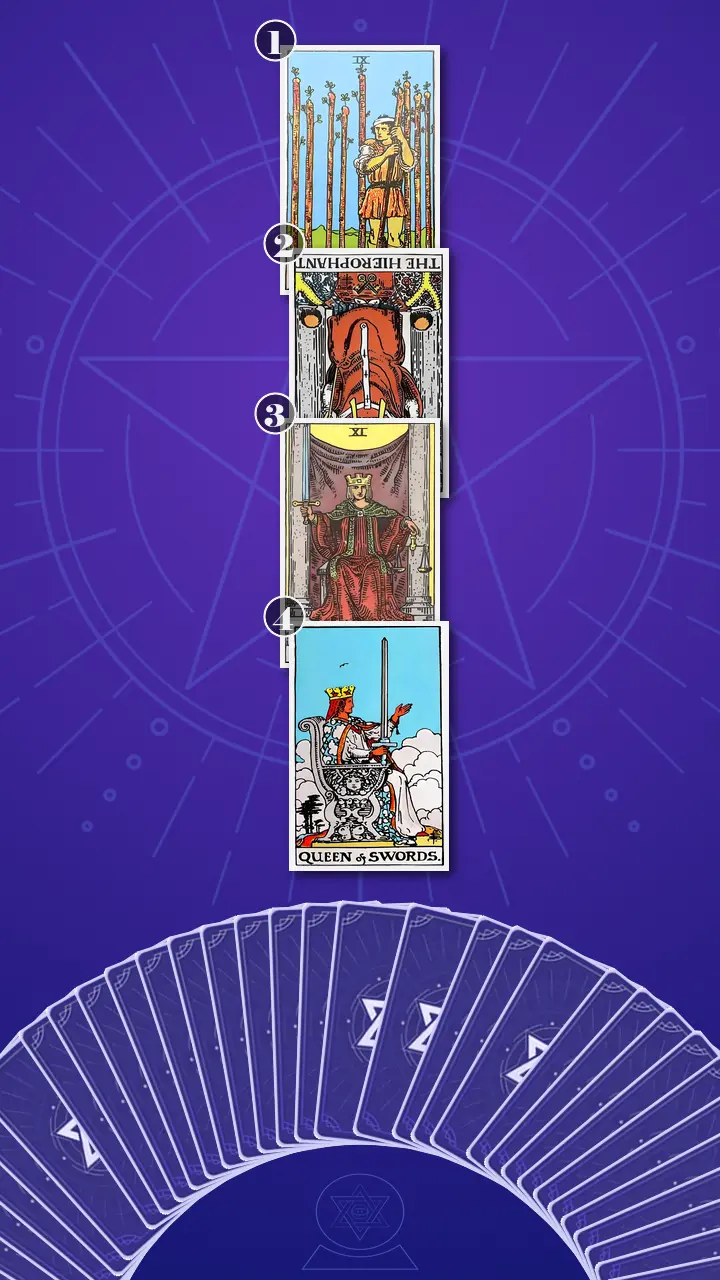
For this kind of relationship trigger, I use The Shadow Spread. It’s a compact four-card spread, and that matters. The question here isn’t whether the other person is secretly good or bad. It’s why one ordinary check-in text can feel controlling, why care feels like pressure, and what helps us tell the difference between present-day concern and past-day authority. A bigger spread would blur the signal. This one moves in a clean line: the visible trigger, the hidden rule beneath it, the corrective truth, and the response that can actually be lived.
I laid the cards in a narrow vertical ladder down the wooden table between us. The first card would show the immediate bracing response. The second would name the shadow belief about closeness, obedience, and reporting in. The third—the key card—would tell us where discernment interrupts the old pattern. The fourth would show how to reply from choice instead of reflexive defensiveness.
The Fence That Rose Before the Question
Position 1: The Body That Answers Before the Mind
When I turned over the first card, I said, ‘Now we’re looking at the position that presents the immediate bracing behavior—the moment a caring text is experienced as a threat to your boundary.’ The card was the Nine of Wands, upright.
I pointed to the bandaged forehead, the tight grip, the fence of wands behind the figure. ‘This is exactly the streetcar moment you described,’ I told her. ‘A decent date. A simple check-in. And suddenly your whole system acts like it needs to defend access to your evening before you’ve even decided what the text means.’ In modern life, this card is like a spam filter that got so aggressive it started flagging legit emails from people you actually want to hear from.
Nine of Wands is fire, but not expressive fire. Here it’s defensive fire—energy contracted into vigilance. Not confirmed danger. The expectation of danger. That matters. The card didn’t tell me she was weak; it told me her nervous system had learned to stand one step ahead of the next demand. So when that home safe text lands, the body braces first, and the mind races in afterward to justify the brace.
Jordan gave a short laugh that had a little bitterness in it. ‘That’s accurate enough to be rude,’ she said. Her fingers paused on the rim of the cup, then tapped once, twice, like she was checking whether she still agreed with being seen. I nodded. ‘I’m not reading pathology here,’ I said. ‘I’m reading protection. The question is whether the protection still fits the moment.’
Position 2: The Invisible Attendance Policy
I turned the second card and named the position first. ‘This one reveals the hidden rule underneath the trigger—the old script about closeness, obedience, and reporting in.’ The card was The Hierophant, reversed.
Reversed Hierophant is one of the clearest signs of inherited rules that no longer fit but still run in the background. I showed her the blessing hand, the pillars, the kneeling followers. ‘This is not really about one text,’ I said. ‘This is the part of you that hears a harmless push notification through the voice of an old rulebook. Care gets translated into compliance. Availability becomes proof that you’re good, easy, legible, manageable.’
I could see her jaw tense again, so I translated it into the language of her actual life. ‘It’s the feeling that a sweet message came with an invisible compliance checklist. Like the internet handed you one more green-flag dating script—text back fast, be warm, prove you’re easy to reach—and your body rejected the whole template on contact. Not because you don’t want closeness, but because closeness got tangled up with obedience somewhere along the line. So the inner monologue becomes: if I answer too warmly, am I signing up for more than this text?’
That is reversed-Hierophant energy as blockage. The rule is stale, but it still has force. Then the overcorrection kicks in: a joke, a dry ‘all good,’ a delayed reply, notifications off, phone face down in the tote. Silence can feel like autonomy for five minutes and distance for five days. Jordan winced, looked away toward the rain-striped window, and then nodded once. ‘Yes,’ she said softly. ‘Tiny things feel weirdly like an attendance policy. That’s the part I never know how to explain without sounding dramatic.’
When Justice Set the Cup on the Scale
Position 3: Reading the Contract, Not the Panic
The room changed when I flipped the third card. Maybe it was only that the grinder behind the bar had finally gone quiet, or maybe it was the way Jordan stopped moving altogether. Either way, the air thinned. ‘This,’ I said, ‘is the position that identifies the key reframe—the truth that separates present reality from past authority.’ The card was Justice, upright.
Justice is discernment, proportion, and facts before projection. I showed her the scales before I mentioned the sword. ‘For you, this card isn’t asking whether you should trust every text,’ I said. ‘It’s asking whether you can reality-check the actual request before your history writes the whole plot.’ For a UX designer, it’s the moment you stop building around a bug from the last project and check the actual user requirement in front of you.
Then I brought in the language I know best. After twenty years of rinsing demitasse cups before sunrise, I’ve learned something about what stays in the bottom and what belongs to the fresh pour. In my café, I call this Conflict Sedimentation. Old grounds can cloud a new espresso if you keep swirling the cup. Justice was telling her not to stir yesterday’s residue into tonight’s message. ‘What was written’ is the fresh pour. ‘What I heard’ is the settled sediment. If you confuse the two, every sip tastes like the old verdict.
This is not a summons to prove you are manageable; put the text on Justice’s scales, cut away the old verdict with its sword, and answer from the facts.
For a second, Jordan didn’t relax at all. First came the freeze: her breath caught halfway in, and her thumb stayed suspended against the cardboard sleeve of her cup. Then the thought landed; her eyes went slightly unfocused, not blank, but busy, as if a hallway scene was replaying in the back of them—the keys in one hand, the lit screen in the other, the whole moment loaded before the words had even finished appearing. Then came the emotion, though not the easy kind first. She let out one sharp little laugh and said, ‘So what, I’ve been arguing with an invisible HR policy?’ There was heat in it. A flicker of anger. A little grief too.
‘Not arguing with nothing,’ I told her. ‘Arguing with something old that still knows your routes.’ I slid my notepad toward her and drew two lines: What was written and What I heard. ‘Look at the gap,’ I said. ‘That gap is where choice comes back.’ Her shoulders dropped a fraction. Then more. Her jaw unclenched so gradually I only noticed because I had been watching it all session. She blinked hard, breathed out through her nose, and for a second the clarity seemed to make her slightly dizzy—the way setting down a heavy tote can leave your arm feeling strange because you didn’t realize how much it was carrying. I asked, ‘Now, with this new lens, was there a moment last week when this would have changed how you felt?’ She nodded immediately. ‘The second text,’ she said. ‘If I’d done this, I would’ve seen that nothing in it actually asked for access. I added that part.’
That was the real pivot: not from caution to blind openness, but from bracing defensiveness and subtext panic to discernment. A warm reply is not a lifetime subscription to access. This card marked the first honest step toward self-trusting closeness—being able to receive care, decline it, or clarify it without disappearing inside the old rule.
Position 4: The Sentence That Keeps the Door Yours
I turned the final card. ‘This position translates insight into a lived response—how to answer with boundaries and choice rather than reflexive defensiveness.’ The card was the Queen of Swords, upright.
I love her in this spot because she holds the whole lesson in one image: sword raised, left hand open. Boundary plus receptivity. Clarity plus warmth. I told Jordan, ‘This is not you becoming softer than you feel, and it’s not you becoming colder than you are. It’s you sounding like yourself without using delay or sarcasm as your only privacy tools.’
In modern life, the Queen of Swords looks a lot like a clean out-of-office line instead of ghosting the inbox. She acknowledges the message, names the pace, and keeps the night her own. So I gave Jordan an example that matched the card exactly: ‘Made it home, thanks for checking. I’m logging off now—talk tomorrow.’ Brief. Honest. Chosen.
That is balanced air energy. Not excess sharpness. Not deficiency of boundaries. A precise middle: the open hand says, I can receive the care; the sword says, I still decide the terms of my availability. Jordan looked back down at the Queen and gave me the first expression of the night that wasn’t armored. Not full relief. More like relief mixed with curiosity. ‘That actually sounds… possible,’ she said. ‘Like I don’t have to vanish to keep the evening mine.’
From Old Verdicts to a Warm Boundary Text
By then, the whole story of the spread was clear to me. The Nine of Wands showed the body-level brace: the fence goes up before the meaning is even settled. The Hierophant reversed named the hidden rule under it: care gets mistaken for compliance, and a small check-in text starts sounding like a system of access. Justice interrupted the fusion by asking for a fact-then-meaning check. The Queen of Swords turned that insight into adult authorship: not obedience, not rebellion, but a clear sentence.
The blind spot wasn’t that Jordan lacked boundaries. It was that she had been using delay to protect a boundary she hadn’t yet named. She kept treating interpretation as evidence. And because this spread carried so much fire, earth, and air but no water, one more truth surfaced: the part of her that actually likes being cared for has been getting skipped. Feeling gets translated into analysis so fast that longing barely gets a vote.
Jordan looked up at me and said, ‘Okay, but what if I don’t have twenty seconds for a whole process when I’m in the elevator and already annoyed?’ I smiled. ‘Then don’t do the full cappuccino version,’ I said. ‘Do the espresso shot. One breath. One fact. Then choose.’ After that, I gave her the smallest actions I trusted.
- The Two-Column Justice PauseWhen the next check-in text lands, open your Notes app before replying and make a fast split list: ‘What was written’ / ‘What I heard.’ Use one real message, keep each side to one line, and then decide whether the text is asking for information, offering care, or actually pushing for more contact.If you’re activated, do the tiniest version possible: one breath and one question—what is literally being asked? The point is interruption, not elegance.
- Save a Warm Boundary ReplyPut two templates in your phone this week so you’re not drafting from scratch while braced: ‘Made it home, thanks for checking.’ and ‘Home safe. I’m heading offline now—talk tomorrow.’ Use one with a date, partner, or friend exactly once and notice what happens in your body after you send it.Keep it in your own voice. Short is enough. You do not owe a full rundown of your evening, location, or future availability.
- Name the Split Before It HardensOnce this week, after a caring follow-up message, say quietly to yourself, ‘Part of me liked that, and part of me tensed up.’ If you can, unclench your jaw or put a hand on your chest while you say it.If that feels cringe, fine. Keep it to one sentence. The goal is not to force softness; it’s to stop flattening the whole moment into defensiveness only.
I told her one last thing before we stood up: clarity protects your space better than punishment does. That is the Queen of Swords lesson in plain clothes. The more directly she named pace, the less she would need strategic delay as emotional infrastructure.

A Week Later: The Quiet Proof
Four days later, before my morning rush, Jordan sent me a screenshot. She had used the line almost verbatim: ‘Made it home, thanks for checking. I’m heading offline now—talk tomorrow.’ Under it she wrote, ‘Chest still buzzed for a minute. But I didn’t disappear.’ That was enough for me. Clear, but still tender. Firm, with just a little aftershock.
When I think about why I trust The Shadow Spread with questions like why a ‘home safe?’ text can feel controlling, it’s because the cards rarely shame the defense. They show me where it came from, what it protected, and how to update it without betraying the part that still wants closeness. This isn’t proof you don’t want closeness. It’s proof an old rule still reaches your nervous system faster than your thoughts do.
Sometimes the loneliest version of this is wanting to be held in mind while your body still tightens like you’re about to be managed. If the next check-in lands and I invite you to place it on Justice’s scales as information first instead of a verdict, what kind of reply would actually sound like you—warm enough to be real, clear enough to keep your space?
Every reading at AceTarot is designed to connect you with your inner wisdom and empower your next step.
Learn more about our Journey to Clarity.