From Late-Night Tabs to a Real Plan: Moving With Them or Staying Put

The 10:58 p.m. Two-City Spiral
You keep telling people you’re being “practical,” but it’s really 1:00 AM and you’re redoing the same pros/cons spreadsheet while your chest feels tight and you can’t sleep.
Taylor said it like she was confessing a weird habit she didn’t want to have. She was 28, a product designer in Toronto, the kind of person who can map a user journey in Miro with color-coded calm—yet right now her life was stuck at a relationship career crossroads that refused to behave like a clean flowchart.
When she sat down across from me, I could almost see the scene she described: 10:58 PM on a Sunday in her downtown condo, laptop glow turning the room into a colder version of itself. The heater clicking on and off. Her phone warm from being in her hand too long. A Notion/Apple Notes page titled “Move?” open like an open wound, while PadMapper and job boards in two cities fought for space on her screen.
“My partner got an out-of-town job offer,” she said. “Short deadline. And I’m… stuck. Do I move with them or stay?”
Then her voice dropped, smaller but sharper: “I don’t want love to cost me my life.”
Uncertainty wasn’t an idea in her body—it was a tight band around her chest, like she’d swallowed a too-small sports bra made of electricity. Her legs wanted to sprint while her brain demanded more spreadsheets.
I leaned in, keeping my tone steady and human. “You’re not ‘bad at decisions.’ You’re trying to feel safe in a choice that changes your whole scaffolding. Let’s make this less like a verdict and more like a map—something that can actually lead you to clarity.”

Choosing the Compass: The Decision Cross Spread
I asked Taylor to take one slow breath—not as a mystical ritual, just a nervous-system handoff from spiraling to focusing. While she held the question—move with them or stay—I shuffled slowly, the way I used to on long transoceanic nights when travelers came to me on cruise decks with their own “two boarding passes” moments.
“Today I’m going to use a classic spread called the Decision Cross,” I told her, and—because I always speak to the reader in the room as much as the client—I’ll tell you why it works, too.
This is how tarot works when it’s practical: it doesn’t pretend to predict one fixed outcome. Instead, it reveals the energies and trade-offs already present—what each path genuinely gives and costs—so you can make a values-led choice. The Decision Cross is built exactly for relocation decision paralysis in a relationship: love vs self-preservation.
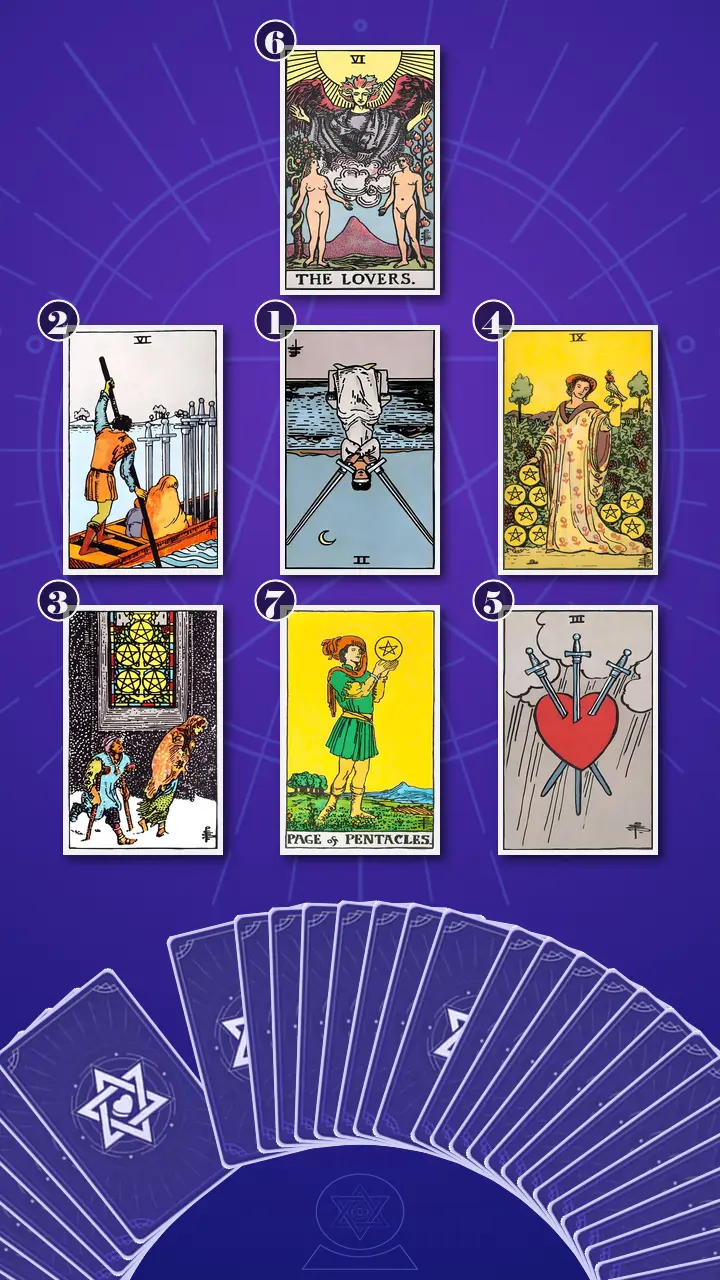
Card 1 will name the present decision trap—what keeps you stuck day-to-day. Cards 2 and 3 look at moving (gain and cost). Cards 4 and 5 look at staying (gain and cost). Card 6 is the deeper need—your “north star.” And Card 7 is the grounding next step, so we end with actionable advice, not vibes.
Reading the Map: Card Meanings in Context
Position 1: The present decision trap
“Now flipped over,” I said, “is the card that represents the present decision trap: what you are doing that keeps you stuck and what the choice currently feels like day-to-day.”
Two of Swords, reversed.
“This is the ‘draft mode’ card,” I told her. “Two cities open in your browser, two versions of your future running like competing apps. You keep the partner conversation vague—‘we’ll figure it out’—while privately doing marathon research sessions because data feels safer than saying, out loud, what you need.”
Reversed, the energy isn’t balanced neutrality. It’s a blockage: a blindfold that’s starting to cut off circulation. The crossed swords over the heart are self-protection—until the protection becomes the block. You’re protecting your heart by not choosing—until the protection becomes the block.
Taylor let out a short laugh that had a bitter edge. “That’s… way too accurate. Like, almost rude.” She looked down at her hands, then back up at me. “I keep looking for a sign that doesn’t exist.”
“That laugh makes sense,” I said gently. “Indecision can look like control from the outside. Inside, it feels like your nervous system paying the RAM cost.”
Position 2: Moving with them — what you gain
“Now we’re looking at moving with them: what you gain—the real support, growth, or relief available in that path.”
Six of Swords, upright.
“Moving could feel like finally exhaling,” I said. “No more long-distance ambiguity, no more calendar Tetris for visits. It’s packing and getting on a train or a flight together and feeling the relationship stop stretching across a map.”
The Six of Swords is movement toward calmer water—a kind of relief that comes from committing to a direction. But it’s not a magical reset. “Those swords standing in the boat?” I tapped the card lightly. “They travel. Your career worries, money fears, identity questions—they come with you unless you plan how to carry them as a team.”
Taylor’s shoulders dropped a fraction, like her body recognized the idea of forward motion. Her eyes, though, stayed cautious—design-brain already imagining edge cases.
Position 3: Moving with them — what it costs
“This next card is moving with them: what it costs—the trade-offs and pressure points.”
Five of Pentacles, upright.
“This is the ‘outside looking in’ phase,” I said. “You arrive, and your partner has the validated opportunity, the new network, the daily structure—while you’re rebuilding from scratch.”
In energy terms, it’s not doom. It’s vulnerability: financial strain, community loss, the temptation to pre-shrink your needs so you don’t feel like a burden. “The fear isn’t just money,” I added. “It’s belonging.”
And because I’m a Jungian psychologist, I can’t ignore the symbolism of that glowing stained-glass window. I felt my own “Venice reflex” kick in—my old habit of reading light through glass as a psyche projector.
“Here’s something I call Stained Glass Decoding,” I told her. “That warm window can become an archetype in your mind: ‘The Safe Place I’m Not Allowed In.’ When you picture moving, you might be projecting that your partner’s new job becomes the warm window, and you become the one limping outside in the cold. The card isn’t saying that will happen. It’s revealing the image your subconscious keeps rehearsing.”
Taylor’s mouth tightened, then softened. She nodded once, slow. “I do that,” she admitted. “I start thinking, ‘I’ll be fine, I don’t need much,’ and it feels… like I’m making myself smaller to be easier.”
Position 4: Staying — what you gain
“Now we look at the other road: staying: what you gain—what stabilizes or strengthens you if you remain where you are.”
Nine of Pentacles, upright.
The energy in the room changed right away—less screen-glow, more sunlight-through-curtains. “Staying protects the life you’ve already cultivated,” I said. “Your hybrid-work rhythm. The coffee shop where you can actually work on your portfolio. The couple of steady friends that make Toronto feel like it belongs to you.”
This card is earned autonomy. It’s not ‘choosing fear’ by default—it’s choosing stability and identity you’ve built with your own hands. Staying isn’t nothing; it’s a life with roots.
Taylor’s breath deepened. She stared at the card like it was evidence she’d forgotten she had. “I keep acting like if I don’t move, I’m… failing some relationship test,” she said.
“That’s the trap,” I replied. “This card reminds you: you’re not starting from zero.”
Position 5: Staying — what it costs
“Now,” I said, “the honest part: staying: what it costs—the emotional price and the truths you’d have to face.”
Three of Swords, upright.
“This is emotional weather,” I told her. “Not drama. Weather. Missing them. Empty weekends. The sharp moments where distance turns into doubt.”
The energy here isn’t a failure; it’s a predictable condition. “If you stayed,” I continued, “you’d need structure—communication cadence, visit plans, what you do when one of you gets flooded—so pain doesn’t quietly become resentment.”
Taylor swallowed. Her gaze went unfocused for a second, like she was watching a Friday evening memory replay: her phone buzzing with ‘They need an answer soon,’ her stomach dropping, and her brain fleeing into lease math to avoid feeling the ache.
“I hate that I can’t spreadsheet this,” she whispered.
“You can’t spreadsheet longing,” I said. “But you can plan for it like weather.”
When The Lovers Lit the Bridge
Position 6: The deeper need/value
I paused before turning the next card. The room got quiet in that particular way it does when someone is finally about to hear the thing they already half-know. “We’re flipping the deeper need/value: what must be honored so either decision becomes self-respecting rather than fear-driven,” I said.
The Lovers, upright.
“This isn’t the ‘romance decides for you’ card,” I told her. “This is the conscious choice card. Your deeper need isn’t a correct city. It’s an agreement that keeps you connected to your own goals while staying connected to them.”
Her eyes narrowed—not in disagreement, but in resistance. I watched her body do a three-beat reaction chain: 1) a brief freeze—breath caught, shoulders lifting; 2) a cognitive flicker—eyes darting like she was scanning for a loophole; 3) a flash of emotion—a sharp exhale that sounded almost like anger.
“But if I have to name needs,” she said, voice suddenly hot, “doesn’t that mean I’m making this harder? Like—what if I sound high-maintenance? What if this is just me being difficult?”
I didn’t rush to soothe her. I stayed with the truth of the moment. “That reaction makes sense,” I said. “Because up until now, the ‘easy’ strategy has been vagueness. But vagueness doesn’t protect you. It only delays the part where your needs show up anyway—usually as resentment.”
Stop waiting for perfect certainty, start choosing through shared values—like The Lovers, let the decision be a conscious commitment rather than a silent sacrifice.
I let the sentence hang in the air like a bell tone, clean and unavoidable.
Setup: This was that Sunday-night moment: Taylor holding her phone, staring at the “Move?” note, refreshing listings like the next scroll would finally hand her certainty—because if she could just find the perfect answer, she wouldn’t have to risk asking for what she needed.
Reinforcement: Her face changed in layers. First, her eyes widened—just a millimeter—like the word sacrifice had landed somewhere physical. Her jaw worked once, unclenching and then catching again. Her hands, which had been folded tight in her lap, opened as if she’d realized she’d been gripping something invisible all session. She blinked fast, not quite crying, but close enough that the moisture made the room feel more real.
When she spoke, her voice wasn’t angry anymore. It was quieter—more exposed. “I keep trying to make it so no one’s the villain,” she said. “But I think I’ve been making me the villain for… needing stability.”
“Exactly,” I replied. “Love isn’t proved by self-erasure. It’s proved by agreements you can both live inside.”
I leaned forward slightly. “Now, use this new lens and replay last week. Was there a moment you went vague to be ‘easy’—and your body got tight anyway?”
Taylor nodded immediately, eyes down. “Tuesday. I drafted a Slack to my manager about remote flexibility, rewrote it five times, and sent the most watered-down version. Because if I asked clearly, I’d have to face the answer.”
“That’s The Lovers’ work,” I said. “Not romance—alignment. From tight uncertainty to a hard, honest naming of needs. That’s the first step toward finding clarity.”
And here’s where my Venetian mind went, as it always does, to bridges.
“I have a framework I call Bridge-Corridor Theory,” I told her. “In Venice, two places can be close, but if there’s no bridge, you still can’t get there. In relationships, love is not the bridge. Love is the desire to cross. The bridge is the explicit agreement. And the corridor is the conversation that gets you onto it—clear entry points, clear exits.”
“Right now,” I continued, “you and your partner have two islands: their opportunity and your stability. You’ve been standing at the edge, staring at the water, trying to think your way into teleportation. The Lovers says: build a bridge. Out loud. With terms.”
One Focused Next Step Beats Ten Anxious Tabs
Position 7: The grounding next step
“Now we flip the grounding next step: a concrete move you can take within a week to turn insight into clarity and agency,” I said.
Page of Pentacles, upright.
“This is the difference between research as hiding and research as a tool,” I told her. “The Page isn’t frantic. She’s focused. She converts a messy brainstorm into one doable ticket with a clear next action.”
In energy terms, it’s stabilization. Not certainty. Not forever. A plan you can stand on long enough to breathe. “One focused next step beats ten anxious tabs,” I said, and I watched Taylor’s mouth twitch into the tiniest smile—relief showing up as irony.
From Insight to Action: A Plan With Terms
I stitched the whole spread together for her in plain language, the way I would for any client who’s deep in decision fatigue.
“Here’s the story I’m seeing,” I said. “You’re stuck in Two of Swords reversed: trying to stay neutral by staying undecided, using logistics to avoid naming needs. Moving does offer Six of Swords relief—forward motion, daily closeness—but it triggers Five of Pentacles vulnerability unless you build real support so you don’t shrink yourself. Staying offers Nine of Pentacles stability—you’ve built something in Toronto—but it carries Three of Swords weather, the predictable ache of distance that needs structure. And The Lovers is the bridge: clarity doesn’t arrive as a sign; it’s built when you name your values out loud.”
“Your cognitive blind spot,” I added, “is treating this as if there’s one correct choice you must discover before you’re allowed to act. That’s why you keep reopening the same tabs. The transformation direction is different: shift from eliminating regret to choosing based on clearly named values and negotiated needs—with a practical trial plan. This becomes a committed experiment, not a permanent identity verdict.”
Then I offered next steps—small, specific, and designed to protect both love and self-respect.
- Three Non‑Negotiables NoteOpen one note (max 6 lines total). Write exactly three sentences in this format: “I need ___ by ___ so I can feel secure.” Example: “I need a decision date by Sunday,” “I need a job plan with a 4‑week time cap,” “I need a community anchor within 30 days if I move.”Set a 10‑minute timer. When it ends, stop. No optimizing. If you feel the urge to keep researching, close the laptop as the boundary.
- The “Move/Stay: needs + terms” Calendar InviteSchedule one 30‑minute conversation with your partner (send a real calendar invite). Title it exactly: “Move/Stay: needs + terms.” Paste your three non‑negotiables into the invite description so you don’t have to manufacture courage in the moment.If 30 minutes feels intense, do 20. If it gets heated, agree on a pause phrase in advance: “Let’s take 10 and come back.” Pausing is allowed.
- Gondola Balance Check (Load Distribution)On one page, draw two columns: “If I move” and “If I stay.” Under each, write (1) one career-protection step you control this week (two 45‑minute portfolio blocks, or one coffee chat), (2) one money anchor (your monthly safety floor number), and (3) one community anchor (weekly class / coworking day / running club). This is your gondola: distribute weight so the relationship isn’t carrying everything on one side.Keep it boring and real. Community is infrastructure—like transit. If you don’t plan it, you still pay for it emotionally.
And because Taylor was afraid of sounding “difficult,” I gave her a communication structure from my own home region—something precise enough to use even when your throat tightens.
“If you freeze mid-conversation,” I said, “use what I call the Lace Communication Method, like Burano lacemaking: small stitches, clear pattern. One sentence each: Value (‘I care about us and I want to do this without resentment’), Need (‘I need X by Y’), Term (‘If X isn’t possible, here’s the adjustment we try’).”

A Week Later: Ownership, Not Certainty
Six days after our session, I got a message from Taylor—just a screenshot, the kind clients send when they don’t want to jinx progress with too many words.
It was a calendar invite: “Move/Stay: needs + terms.” In the description: three short lines. No apology language. No essay. And underneath, a note: “Also blocked two 45-min portfolio sessions this week. Did the 10-minute timer thing. Closed the laptop.”
Her follow-up text was almost reluctant in its honesty: “I still woke up and thought, ‘What if I choose wrong?’ But my chest didn’t clamp down the way it’s been. It was more like… okay. I have terms. I can work with this.”
That’s the journey I trust—moving from spiraling to grounded steps, from trying to eliminate regret to making a committed experiment with clear agreements. Not perfect certainty. Ownership.
When you’re staring at two futures, refreshing tabs and rewriting messages, it’s not that you don’t love them—it’s that you’re terrified love could cost you your safety, your belonging, and the version of you you worked hard to build.
If you stopped trying to eliminate regret and treated this as a committed experiment with clear terms, what’s the smallest need you’d be willing to say out loud first?
Every reading at AceTarot is a Journey to connect with inner wisdom and empower next step.
Learn more about our Journey to Clarity.