The 8:47 p.m. “I Love You” Text—From Freeze to One Clean Sentence

Finding Clarity in the 8:47 p.m. Lock Screen
If you’ve ever seen “I love you” pop up on your lock screen and felt your stomach drop—like your phone just turned into a verdict—then you already know this isn’t just about texting etiquette. It’s about safety.
Taylor (name changed for privacy) slid into the chair across from me in my studio space in Brooklyn, still wearing the day like a tight collar. They’re a product designer—someone who can ship a feature fast, take hard feedback, keep a Slack thread moving. But when love shows up in iMessage, their body reacts like it’s about to be audited.
They described the moment with the kind of precision you can only have when you’ve replayed it a hundred times: 8:47 PM on a Tuesday, on the L train heading back to Brooklyn. Fluorescent lights flickering. AirPods leaking a tinny hi-hat. Their phone warm in their palm. Then: I love you. Their shoulders crept up like they were trying to protect their neck. Their chest tightened and their throat narrowed, that pill-stuck feeling, plus a quick jolt low in the stomach—bracing for impact before they even unlocked the screen.
“I want to say it back,” they said, eyes on the table like the wood grain might offer an answer. “But it feels like signing something I didn’t read.”
I watched their thumb hover over an invisible screen in the air—the muscle memory of type, delete, retype. That familiar loop where you workshop one sentence like it’s going to be graded by a panel of judges who already don’t like you.
“You’re not overthinking love,” I told them gently. “You’re negotiating safety.”
And the apprehension in their body—tight chest, tight throat—wasn’t abstract. It was specific, mechanical, almost like a subway turnstile that won’t open unless you swipe the perfect MetroCard at the perfect angle. “Let’s make a map,” I said. “Not to force a reply. To find clarity about what past pattern is shaping your reflex—so your next text can be a choice, not an old alarm system.”

Choosing the Compass: A Five-Card Cross for Texting Anxiety
I asked Taylor to take one slow inhale and one longer exhale—nothing mystical, just a way to let the nervous system catch up to the room. Then I shuffled, the soft snap of cards like a metronome against the distant city hum.
“Today we’ll use a spread I call the Five-Card Cross · Context Edition,” I said. “It’s simple on purpose: situation, obstacle, root, advice, integration.”
To you, reading this: this structure works especially well for the question After they text ‘I love you,’ what past pattern shapes my reply? because it’s a clean cause-and-effect loop. A specific trigger hits (the text). A reflex activates (freeze, deflect, delay). And underneath, there’s usually an older template running the show. This spread doesn’t try to predict what the other person will do; it maps what you do—so you can change it.
“Card 1,” I told Taylor, “will show what your reply is doing in real time—the first 30 seconds. Card 2 crosses it: what clamps down and blocks an honest message. Card 3 goes underneath: the past pattern that loads the moment with extra weight. Card 4 is your pivot—the self-leadership move. And Card 5 shows the integrated style you can practice for steadier love communication.”
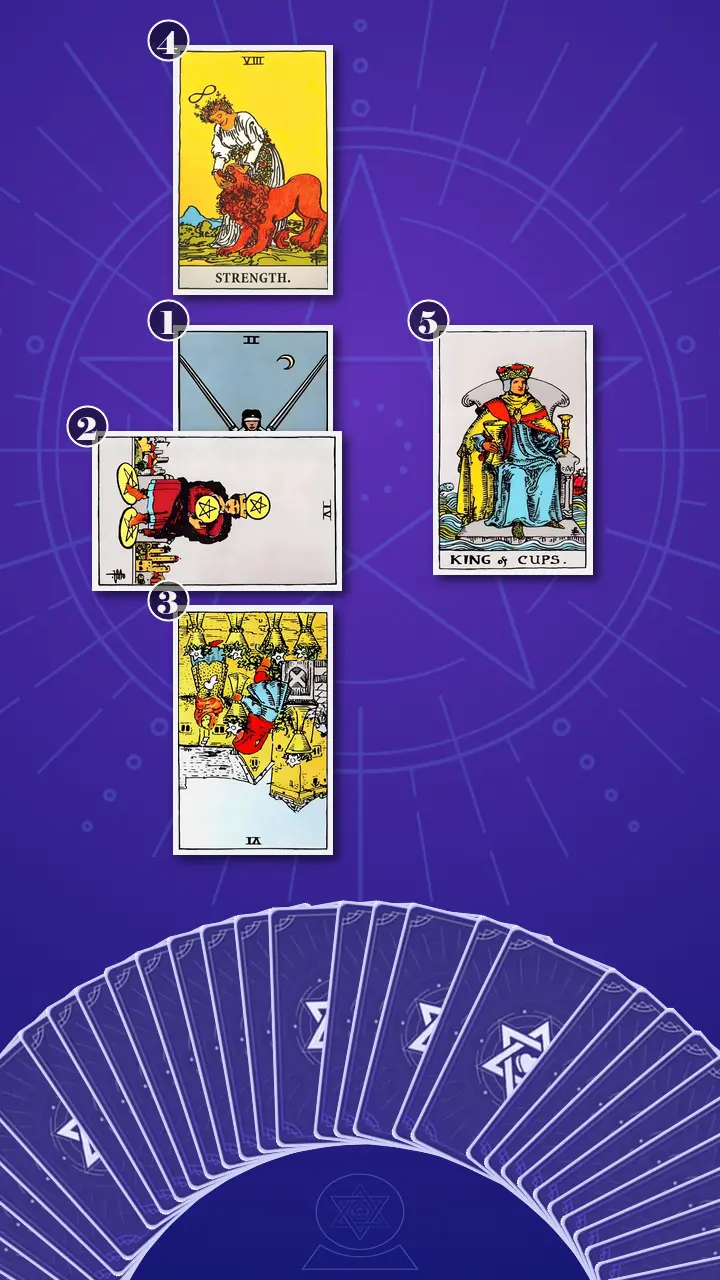
Reading the Map: The Air–Earth Lock in the Chat Box
Position 1: The moment of freeze
“Now what we’re turning over,” I said, “is the card that represents the moment of freeze: what your reply is doing in real time when ‘I love you’ appears.”
Two of Swords, upright.
This card always looks like protection pretending to be neutrality: the blindfold, the crossed blades held right over the heart, the still water behind. In real life, it’s exactly what Taylor described—seeing I love you on the lock screen on the subway or walking out of the office, thumb hovering, opening the chat, typing a few versions, deleting them, staring at the cursor, then closing the app like you’re “just thinking.”
Energetically, this is blockage—not lack of feeling, but a clarity block. Air energy (thought) becomes a sealed room. You can’t “see” your own truth because you’re prioritizing protection and perfect timing over a direct answer.
And the mind tries to dress it up as strategy: If I wait, I can stay uncommitted. If I joke, I can stay likeable. Intimacy versus leverage. Clarity versus control.
Taylor let out a short laugh that had a bitter edge, like they’d been caught on camera doing something they didn’t want to defend. “That’s… wow,” they said. “It’s accurate in a way that’s almost rude.” Their smile faded fast, and they pressed their tongue against the inside of their cheek—holding something back.
“I’m not here to roast you,” I said, keeping my voice steady. “I’m here to name the mechanism. The freeze is a protection move. Once we can name it, we can stop mistaking it for a personality flaw.”
Position 2: What clamps down
“Now what we’re turning over is the card that represents what clamps down: the specific self-protective block that stops an honest reply.”
Four of Pentacles, upright.
If the Two of Swords is the blindfolded pause, the Four of Pentacles is the grip that follows: arms wrapped tight, posture rigid, holding on like warmth is a scarce resource in an expensive city. In modern life, it’s Taylor editing their reply to remove anything too tender—no extra words, no softness, no risk. Sending a heart emoji instead of the sentence. Replying “you’re sweet” to keep it one step removed.
Energetically, this is excess—too much containment. Earth energy becomes a clamp. On the inside it says: If I give too much warmth, I’ll owe something. If I say it back, they’ll expect access to me on demand.
I nodded at the card. “Deflection is still a decision,” I said. “Not a bad one. A protective one. But it has a cost.”
Taylor’s shoulders rose a fraction higher, like their body wanted to argue before their mouth did. Then they exhaled through their nose—quiet, resigned. The look in their eyes said: Yeah. I know the cost.
“This is the Air–Earth lock,” I added, speaking like the calm analyst part of me. “Analysis plus control team up, and vulnerability gets delayed in real time. You’re not confused. You’re bracing.”
Position 3: The past pattern underneath
“Now what we’re turning over is the card that represents the past pattern: the learned relational script that shapes your reflex before you can choose.”
Six of Cups, reversed.
In the Rider-Waite image, it’s children exchanging flowers—sweetness, innocence, memory. Reversed, the sweetness gets complicated. The past tries to rewrite the present moment’s meaning and price.
In modern life, it’s that flash Taylor described: a past relationship montage that runs before the current person even finishes their sentence. Someone who said loving things early and later used them as pressure. A moment where affection became a demand. A sudden shift where “we’re close” turned into “you owe me.”
I held the card between us and wrote the scene the way my mind sees it—split-screen.
On the left: present-day iMessage thread. I love you. A clean, simple line from a person who is trying to be tender.
On the right: the “Previously on…” recap your nervous system queues up. I love you (then) meaning: Now prove it. Now perform it. Now don’t disappoint me.
“This person is not your past—unless you answer like they are,” I said softly. “Six of Cups reversed is ‘past-as-template.’ It’s the old cost showing up in your body.”
Taylor went still in a way that wasn’t shutdown—it was recognition. Their gaze unfocused for a second, like they were watching that montage. Then they whispered, barely audible, “Oh.”
That “oh” was the loosening. The separation. The first crack where choice becomes possible.
When Strength Spoke: A Gentle Brave Reply on the L Train
Position 4: The pivot
I could feel the room quiet down as I reached for the fourth card—like the city outside turned the volume knob slightly lower. “Now what we’re turning over is the card that represents the pivot: how to respond from self-leadership instead of the old script.”
Strength, upright.
The image is almost deceptively calm: a woman in white, a lion, a hand that doesn’t dominate—it meets. This isn’t the kind of courage that white-knuckles its way through. It’s regulated courage. The kind that stays present with a tight chest without turning the reply into a performance review.
Setup. I let Taylor’s own scene come back into the center: you’re on the L train at 8:47 PM, phone warm in your hand, and “I love you” is sitting on your lock screen like a notification that somehow weighs 50 pounds. You’re trapped between wanting to reciprocate and fearing that one text will trap you right back.
Delivery.
Not a perfectly managed reply, but a gentle brave one—the lion doesn’t need to be caged, it needs to be met.
I let the sentence hang there for a beat, the way a movie line hangs in the air right before the cut to black.
Reinforcement. Taylor’s face changed in layers. First, their eyes widened just slightly—the small shock of being seen. Then their jaw unclenched, like a lock giving way. Their shoulders dropped half an inch. Their hand, which had been curled tight around their coffee cup, loosened; their fingers spread and then rested flat on the table as if they were testing whether the surface could hold them. Their throat worked—swallow, pause—like their body was making room for a different answer. And then: a quiet exhale, not dramatic, but real. The kind of breath you take when you stop trying to “win” a moment and start trying to be in it.
“So it’s… not about getting it right,” they said, voice thinner at the edges, “it’s about leading myself.”
“Exactly,” I said. “Strength doesn’t bargain with fear. It puts a hand on it. It says: I can be warm without being trapped. I can be honest without overpromising.”
This is where I leaned into my own toolbox—the way I make meaning as an artist who grew up on classic cinema. “In my head,” I admitted, “your texting moment plays like a classic film choice-point.”
“There’s the Casablanca version,” I continued, “where you try to control the ending because the stakes feel enormous. And there’s the Roman Holiday version—where the truth is tender, the boundary is intact, and the moment is allowed to be real without becoming a contract.”
That’s my Classic Movie Model: not to romanticize your life, but to give your nervous system a new script that still respects autonomy. Strength is the Roman Holiday move—gentle bravery without possession, honesty without claiming control of the future.
I watched Taylor’s eyes flick down to where their phone would be if it were in their hand. “Now,” I asked, “with this new lens—can you think of one moment last week when the freeze hit, and this would have changed how it felt?”
They blinked once, slow. Their gaze slid to the window where rain had started to thread down the glass. “Thursday,” they said. “I got a sweet text. Not even ‘I love you’—just ‘I’m really happy you’re in my life.’ And I… joked. I made it small. I told myself I was being chill.”
“And if you’d met the lion instead of caging it?” I asked.
Taylor’s lips parted, and for a second they looked both relieved and oddly exposed—like stepping out of a costume you forgot you were wearing. “I would’ve just said, ‘That makes me happy too. I’m here.’”
That, right there, was the emotional transformation taking shape: from brace-for-impact outcome-management to paced, emotionally honest steadiness. Not certainty. Not control. But grounded intimacy as a practice.
Position 5: Integration
“Now what we’re turning over is the card that represents integration: what a healthier reply style looks like when you practice the pivot.”
King of Cups, upright.
This card is the grown-up version of emotional presence: a king holding a cup steadily while waves move around him. In modern life, it’s the opposite of what Taylor called “typing-bubble weather”—the chaos of watching read receipts like they’re relationship analytics, trying to forecast safety from tiny movements.
Energetically, this is balance. Water with a spine. Warmth with boundaries. A reply that’s direct but not dramatic.
“King of Cups texting,” I said, “doesn’t mean you match their intensity to prove anything. It means you’re emotionally legible. You can say ‘I love you too’ without a paragraph defending it. And you can set pace without disappearing.”
Taylor’s shoulders stayed lower now. Their face looked softer, but their eyes were sharper—like someone who’s finally stopped bargaining with a storm and started learning weather patterns.
The One-Page “Clean Replies” System: Actionable Next Steps
I slid the five cards into a line so Taylor could see the story in one glance: the Two of Swords freeze, crossed by the Four of Pentacles grip; the Six of Cups reversed underneath, running the old rerun; Strength above, offering gentle courage; and the King of Cups to the right, showing a steadier communication style.
“Here’s the through-line,” I said. “When ‘I love you’ hits, your system treats it like a high-stakes test. Air (thought) tries to solve it perfectly. Earth (control) tries to keep leverage. Underneath, Water memory says tenderness equals pressure. The blind spot isn’t that you don’t care—it’s that you try to manage the outcome of their reaction to feel safe.”
“And the transformation direction,” I continued, “is exactly what Strength teaches: shifting from outcome-management to one clear, emotionally honest sentence you can stand behind. A clean sentence beats a perfect sentence.”
Then Taylor hit me with the real-world obstacle—because of course they did. “But I literally can’t always do this in the moment,” they said, a little defensive, a little tired. “Like… I’m in meetings. I’m on the train. I’m dysregulated. I don’t have time to do a whole thing.”
I nodded. “Perfect. Then we won’t do a whole thing. We’ll do a design-system version. Small, repeatable components.”
Here are the next steps I gave them—practical, low-friction, and built for the exact moment your thumb freezes over the chat box:
- Pin “Clean Replies” (3 templates)In Notes, create a pinned note titled Clean Replies with three copy-paste options: (1) “I love you too. I’m really glad you said that.” (2) “I care about you a lot. I’m here with you—I just need a minute to respond properly.” (3) “I’m feeling warm and a little overwhelmed. I love you, and I’m taking that in.”If your brain says “cheesy,” treat it like a UI component library: you’re not being poetic—you’re being consistent. You can customize later; for now, reduce friction.
- Do the 90-second Strength reset (twice-breath + two drafts)Once this week, before replying to any emotionally loaded text, set a 90-second timer. Put one hand on your sternum. Inhale for 4, exhale for 6—twice. Then write two drafts: (1) “Past-script draft” (what you learned love leads to), (2) “Present-truth draft” (what’s true with this person today). Send one line from the present-truth draft.If you feel flooded, you’re allowed to send a pacing sentence instead: “I’m here. I’m feeling this. Give me a minute and I’ll text you properly.” If it’s too activating, stop and return to breathing—no forcing a breakthrough.
- Use an “Iconic Line Diagnosis” to hold your boundary (without deflecting)Pick one classic-movie-style anchor line that reminds you: tenderness isn’t a contract. Mine for Taylor was a Roman Holiday rule: truth without possession. Write your own one-liner and keep it at the top of the pinned note—something like, “Warm doesn’t mean trapped,” or “I can be paced and still real.” Read it once before you hit send.If you’re tempted to joke, ask: “Am I adding humor because it’s me—or because I’m scared to be seen?” Then choose intentionally.
None of these steps require you to be fearless. They require you to be legible—to yourself first, and then to the person you care about. That’s King of Cups energy: steady warmth, no disappearing act.

A Week Later: Warm and Paced, Not Perfect
About a week later, Taylor texted me a screenshot—cropped for privacy, but I could still see the shape of the moment. The message they’d received was simple: I love you.
And beneath it, their reply—sent within ten minutes, not after hours of Notes-app rehearsals—read: “I love you too. I’m really glad you said that.”
Then a second message, quieter: “My chest still did the thing. But I didn’t make it a joke. I didn’t vanish. I just… sent the clean line.”
Bittersweet, but real: they told me they celebrated by sitting alone in a coffee shop afterward, phone face-down for once, staring out at pedestrians like they were watching a life they’d finally joined—still a little shaky, but present.
That’s the journey to clarity I trust most. Not the kind where fear never shows up again—but the kind where fear shows up, and you don’t let it drive your thumbs.
When “I love you” hits your screen and your body goes tight, it’s not that you don’t feel love—it’s that part of you is trying to keep your freedom, your dignity, and your safety intact in the same breath.
If you didn’t have to manage their reaction for just one minute, what would your simplest present-truth sentence sound like?