From Typing-Bubble Anxiety to Self-Trust: A First-Date Follow-Up Journey
Finding Clarity in the 9:41 p.m. Phone Glow
If you’ve ever reread a text thread like it’s evidence—timestamps, punctuation, who texted last—because your brain decided this is a high-stakes quiz, that’s texting anxiety (not a personality flaw).
Jordan came onto my video call from a downtown Toronto apartment that looked exactly like the hour they were living in: streetlight leaking through blinds in thin, tired stripes; a TV murmuring at low volume like background noise you keep on so your thoughts don’t get too loud. They were in sweats, curled into the corner of the couch, phone screen lighting their face the way a campfire lights someone telling a ghost story.
Every few seconds, their thumb hovered over the chat thread, then slid up—scrolling—then stopped, as if the last message might change if they stared hard enough.
“I don’t even know what I’m waiting for,” they said, and the laugh that followed had a crack in it. “But I can’t hit send.”
I watched their shoulders inch upward toward their ears, like their body was bracing for impact from a notification that wasn’t coming.
They’d had a genuinely good first date. Warm. Easy. The kind that makes you walk home a little slower. And now the contradiction was grinding: they wanted to build connection—but they were terrified one wrong text would trigger rejection, prove they misread everything, prove they weren’t the kind of person people choose.
The feeling in their chest wasn’t just “nervous.” It was like holding a fragile glass too tightly—knuckles white, grip locked—because the moment you relax, you’re sure it will shatter.
“We’re not going to optimize a ‘perfect text,’” I told them gently. “We’re going to find clarity—what’s real, what’s projection, and what one grounded next step looks like in the next couple of days. Let’s draw a map through the fog.”
Choosing the Compass: The Celtic Cross · Context Edition
I asked Jordan to take one slow breath—not as a mystical ritual, but as a nervous-system handoff. A tiny transition from performing for the phone to listening to themselves. While they exhaled, I shuffled, letting the familiar weight of the deck steady my hands the way a railing steadies you on a narrow stair.
“Today we’ll use a spread called the Celtic Cross · Context Edition,” I said. “It’s a classic structure, but I’m tuning it to modern dating—especially that ‘what do I do next in the next 24 to 72 hours?’ question.”
For you reading this: the reason I like the Celtic Cross for texting anxiety after a first date is that the issue is rarely one sentence. It’s a system: the observable spiral, the mental obstacle, the deeper root, the outside noise (friends, TikTok rules, read receipts), and then the practical next step that creates information instead of more guessing.
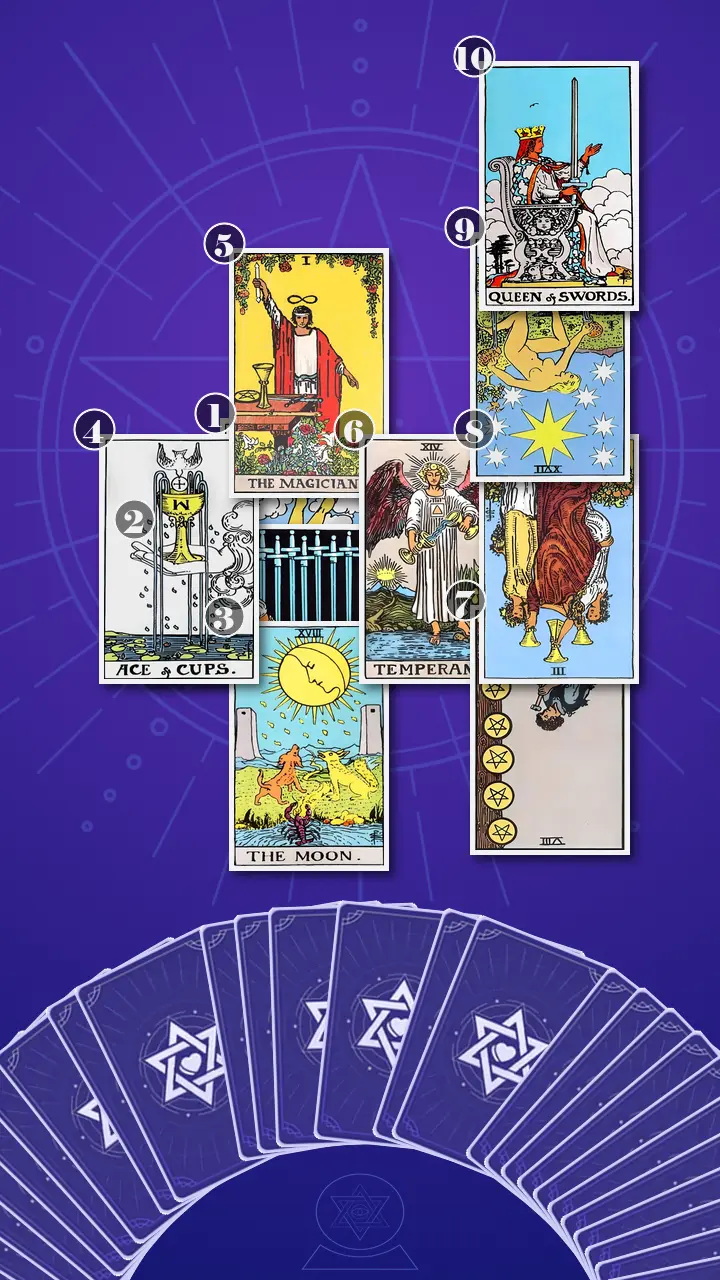
“Card 1,” I explained to Jordan, “shows what’s happening in the texting moment—what you’re doing on autopilot. Card 2 shows the crossing challenge, the thing that spikes the anxiety. Card 3 goes underneath, to the root—what ambiguity triggers. And Card 6 is the hinge: your most helpful next step soon, not someday.”
Jordan nodded, eyes flicking to their phone like it was still calling their name from the coffee table.
Reading the Map: Swords at Night, Screens as Evidence
Position 1 — The Spiral Behavior in Real Time
“Now we turn over the card representing what is happening right now in the texting moment—the most observable spiral behavior after the first date.”
The Page of Swords, reversed.
The Page in this deck is the vigilant messenger—always alert, sword raised, eyes scanning the horizon. Reversed, that alertness stops being curiosity and becomes surveillance.
“This is the phone-in-hand card,” I said. “Refreshing the messaging app. Reopening the thread every few minutes. Dissecting punctuation like it’s a compatibility report. Letting ‘curiosity’ turn into suspicion.”
Jordan let out a quick, uncomfortable laugh—bitter at the edges. “Okay,” they said, a little breathless. “That’s… honestly kind of rude. That’s literally me.”
I kept my voice warm. “It’s not a judgment. This card is describing an energy state: Air energy in blockage. Your mind is ‘on’ like a motion sensor that never stops detecting movement. It’s trying to protect you by catching certainty before it slips away.”
“And here’s a small practice embedded in this card,” I added. “Name one observable fact from the date and one assumption you’re making from the silence. Separate them before you draft anything. We’ll come back to that.”
Position 2 — The Obstacle That Turns Uncertainty into an Emergency
“Now we turn over the card representing the main mental-emotional obstacle that escalates the texting anxiety and keeps action stuck.”
Nine of Swords, upright.
The image is unmistakable: someone sitting up in bed, face in hands, the room dark, the air heavy—classic 3 a.m. brain. Not because something happened, but because the mind decided something might happen and started rehearsing it like a trial.
“This is the worst-case storyline,” I told Jordan. “Ghosting. A lukewarm reply. ‘I misread everything.’ The Nine doesn’t care what time it is—your body could be on the couch at 11:38 p.m., but your nervous system is in bed at 3:00 a.m.”
The energy here is Air in excess: thought multiplying faster than reality can respond. And it doesn’t feel like thinking—it feels like being pinned. Like the swords are lined up on the wall as if your mind hung them there one by one.
Jordan’s jaw tightened. Their gaze went slightly unfocused, as if they were replaying the date line-by-line in their head, searching for the moment they “messed up.”
“This card is important,” I said. “Because it tells us the problem isn’t a lack of willpower. Your body is treating uncertainty as danger.”
Position 3 — The Root: What the Silence Triggers Underneath
“Now we turn over the card representing the deeper root driving the spike—what uncertainty triggers underneath the surface.”
The Moon, upright.
I felt the room change the moment it landed. Even through a screen, The Moon has a way of dimming the lights.
“Early dating is low-information terrain,” I said. “The Moon is the card of the dim hallway—the one where the motion-sensor lights haven’t turned on yet, so your brain fills in shapes. A typing bubble becomes a trailer for the whole relationship. A ‘seen’ indicator becomes a plot twist.”
I paused, then offered it as a split-screen, simple enough for the nervous system to hold:
Observable data: you had a good date.
Story built from missing data: silence means rejection; delayed reply means fading; no notification means you’re not worth choosing.
Jordan went very still—micro-freeze first, like their breath paused on the inhale. Then their eyes softened, and their shoulders dropped a few millimeters, as if something in them recognized the difference.
“Wait,” they said quietly. “Yeah. I’m… I’m filling in blanks.”
As a Jungian psychologist, this is where I often think of stained glass: how one light source can look entirely different depending on the window it passes through. The Moon tells me the “window” right now is fear—so the same neutral silence gets colored into a verdict.
Position 4 — What Opened the Stakes
“Now we turn over the card representing what opened the emotional stakes—what the first date activated that makes the follow-up feel high-risk.”
Ace of Cups, upright.
It was almost tender to see it here. The overflowing cup, the water spilling in five streams—an emotional beginning that’s real enough to be scary.
“This is the spark,” I said. “You didn’t imagine the warmth. You got home genuinely lit up… and then panicked because that warmth suddenly felt like something you could lose.”
The Ace is Water in balance—a clean, honest feeling. But when we care, our nervous system raises the stakes. The phone becomes the gatekeeper. The message becomes a test of worth and compatibility.
Jordan swallowed and nodded. Hope, embarrassment, and self-doubt braided together on their face in a way I’ve seen on a thousand voyages—people staring at an ocean of possibility, thrilled and terrified by the same horizon.
Position 5 — The “Ideal Script” You’re Trying to Engineer
“Now we turn over the card representing what you’re trying to accomplish by texting—the conscious aim and the ideal script you’re chasing.”
The Magician, upright.
Jordan exhaled like they’d been caught. “Of course,” they murmured. “That’s me trying to… do it right.”
“Exactly,” I said. “The Magician is agency. Tools on the table. The belief that the right words and timing can manifest the outcome.”
In a texting context, it’s the impulse to run A/B tests on your personality: swap the emoji, soften the line, delete the exclamation point, rephrase the invite—until the message stops sounding like you and starts sounding like dating-content advice.
This is power in excess. Not in a villain way—more like your competence spilling into a space where competence can’t purchase certainty.
“The Magician can build connection when it serves truth,” I said. “But when it serves control, it becomes exhausting. And it keeps you in the loop: ‘If I say this, they’ll think…’ branching scenarios forever.”
When Temperance Poured Between Two Cups
Position 6 — The Next 24–72 Hours: The Bridge Out of the Spiral
I let myself slow down before I turned the next card. “We’re about to flip the hinge of this whole reading,” I told Jordan. “The card that answers: what’s your next step?”
“Now we turn over the card representing the most helpful next step within the next 24–72 hours—the action that reduces spiraling and increases clarity.”
Temperance, upright.
Even the image feels like breath: an angel pouring water between two cups, one foot on land, one in water, a path leading to a golden horizon.
“This is emotional pacing,” I said. “One warm message that matches the reality of a first date—then space for the conversation to breathe.”
“Not flooding,” I added, “with over-explaining to prove you’re worthy. And not vanishing for days to look unbothered. Temperance is the middle.”
The Aha Moment (Setup → Delivery → Reinforcement)
Setup: Jordan, right now your mind is stuck in a very specific trap: you’re treating one text like a trapdoor. Like if you step wrong, you drop into rejection. So you hover. You edit. You wait for certainty that can’t arrive before you send anything real.
Delivery:
Not ‘a perfect text to control the outcome,’ but a measured pour between two cups—one clear message that blends warmth and self-respect.
I let the sentence sit. No rushing. No filling the space with advice, because the nervous system needs a beat to feel the floor under it.
Reinforcement: Jordan’s reaction came in layers. First, a brief freeze—eyes wider, breath caught. Then the cognitive shift: their gaze slid away from the phone and landed somewhere above my shoulder, like they were replaying their last hour and realizing they’d been trying to engineer safety. Then the emotional release: a small, shaky exhale, shoulders lowering as if they’d been carrying a backpack they forgot they could set down.
“But,” they said, and there was sudden heat—an unexpected flash of irritation under the softness. “If that’s true… does that mean I’ve been doing it wrong? Like, this whole time?”
I nodded slowly. “It means you’ve been doing what a nervous system does when it’s trying to protect belonging. It’s not ‘wrong.’ It’s just expensive.”
Then I offered them the tool that Temperance is asking for, in real-world language: “A text isn’t a trapdoor. It’s a doorbell. You ring once, clearly—and you let reality answer. A reply is information, not a verdict.”
As someone who grew up among Venetian canals, I can’t help thinking in bridges. And this is where my Bridge-Corridor Theory clicks into place: some messages are bridges—simple connections between two people. But anxiety turns the chat thread into a corridor you pace up and down, checking every door, listening for echoes, trying to predict what’s behind the wall.
“Temperance is a bridge,” I told Jordan. “One steady connection. The corridor behavior is reopening the thread, rereading, rewriting. Your next step is to build the bridge—then stop walking the corridor.”
I leaned in. “Now, with this new lens—bridge, not corridor—think back to last week. Was there a moment when a ‘measured pour’ would’ve changed how your body felt? One moment where a simple message would’ve been kinder than another hour of guessing?”
Jordan blinked, eyes a little wet, and nodded once. “Tonight,” they said. “Literally tonight.”
And that’s the shift: from spiky anticipation and mental replay toward discomfort you can actually act inside—choosing clarity over guessing, and building steadier self-trust.
Position 7 — Your Role: Where Effort Turns into Compulsion
“Now we turn over the card representing your role in the loop—how your habits and self-protective style shape the texting dynamic.”
Eight of Pentacles, reversed.
“You can’t edit your way into certainty,” I said, and Jordan gave a tiny, helpless smile—recognition without pride.
The Eight of Pentacles is craftsmanship. Reversed, it’s diminishing returns: the moment effort becomes compulsion and quality actually drops instead of rising.
“This is you treating a text like a deliverable,” I said. “Like it’s a product launch. Swapping one emoji in and out like it’s a brand decision. Keeping the draft open while you half-watch the show.”
This is Earth energy in blockage: you’re trying to build stability through work, but the work isn’t building anything real—because the only thing that creates clarity here is sending a simple, honest signal and letting the response arrive.
Position 8 — The Outside Noise: Committee Energy
“Now we turn over the card representing external influences—friends, dating culture norms, and social comparison that affect your choices.”
Three of Cups, reversed.
Jordan winced before I even spoke. “The group chat,” they said immediately.
“Yes,” I said, smiling softly. “This is committee energy. Screenshotting the thread. Polling three friends. Getting three different rules. And now instead of one nervous system, you’re managing four.”
The Three of Cups reversed is Water in excess—not too much friendship, but too much outside input shaping intimate communication.
“Stop crowd-sourcing your nervous system,” I said plainly. “If you want feedback, choose one trusted sounding board, and ask one specific question: ‘Does this sound like me?’ Not ‘What should I do with my life?’”
Position 9 — Hopes and Fears: Wanting Reassurance, Doubting You’ll Get It
“Now we turn over the card representing the emotional double-bind—what you’re secretly hoping the text will prove, and what you’re afraid it will confirm.”
The Star, reversed.
“This one always hurts a little,” I said. “Because it’s not dramatic. It’s quiet.”
Reversed, The Star is the dimming of inner guidance. It’s craving reassurance while doubting it will arrive. It’s treating a reply as proof you’re lovable, instead of letting it be one data point about fit and timing.
This is hope in deficiency. Not because you don’t have hope—you do—but because you’re outsourcing it.
“Temperance will help you keep hope in your own hands,” I told Jordan. “Hope that can coexist with uncertainty.”
Position 10 — Integration: Clarity with Boundaries
“Now we turn over the card representing how this integrates if you take the balanced next step—the healthier communication stance you can embody.”
Queen of Swords, upright.
The Queen sits with an upright sword and an open hand. I love that combination: discernment without closing the heart.
“This is where you land when you stop mind-reading,” I said. “Clean language. Respectful directness. No apology-padding.”
“Clarity isn’t cold,” I added. “It’s clean.”
The Queen’s energy is Air in balance: thought that serves truth, not panic. The message is concise, and then you let the other person meet you there—or not—and either way, you keep your dignity.
The Pacing Protocol: One Warm Message, Then Space to Breathe
I looked at the spread as a whole and told Jordan the story it was telling—because tarot works best when it becomes coherent, not just accurate.
“Here’s the arc,” I said. “A genuine opening happened (Ace of Cups), which raised the stakes. Underneath, you’re walking through low-information uncertainty (The Moon), and your mind tries to solve that with optimization and vigilance (Magician + Page of Swords reversed). But that strategy runs straight into suffering at night (Nine of Swords). Your environment adds noise (Three of Cups reversed). The way out isn’t a perfect script. It’s Temperance: one measured, honest signal—and then Queen of Swords: clean boundaries that let the response be information.”
The cognitive blind spot, I explained, was subtle but brutal: treating the next text as a tool to secure your worth instead of a tool to gather real-world information about compatibility and timing. That’s why the spiral feels endless—because no wording hack can deliver the certainty your nervous system is trying to purchase.
“Your transformation direction is clear,” I said. “From ‘I need the perfect text to be safe’ to ‘I can send one clear, low-pressure message and let their response give me information.’”
Jordan nodded, then frowned. “Okay, but… the second I send it, I’m going to want to check. Like, immediately.”
“That’s not a failure,” I said. “That’s the corridor calling you back. We’ll build a bridge and we’ll block off the corridor entrance.”
- Write the ‘Temperance Text’ (Two Sentences)Set a 10-minute timer. Draft one warm line of enjoyment + one simple invite: “Had a really nice time last night. Want to grab a coffee or a walk this week?” Read it out loud once, then hit send when the timer ends.Use my Lace Communication Method: early dating is Burano-lace precision—clean, light, and intentional. If you feel the urge to over-explain, remind yourself: clarity, not a memoir.
- Do the 30-Minute ‘No Reopen’ BoundaryRight after you send, set a second timer for 30 minutes. During that window, do not reopen the chat thread—no rereading, no scanning for “seen,” no typing-bubble watching. Put your phone face-down, or in another room if you can.Use my Gondola Balance Technique: you’re redistributing emotional “load.” The entire weight of your worth doesn’t get to sit in one tiny screen. If 30 minutes feels impossible, start with 10. This is an experiment, not a rule you have to white-knuckle.
- Anchor Yourself: Fact vs Assumption + a Two-Line NoteBefore you send (or right after, if anxiety spikes), write: Fact: one observable thing that happened on the date. Assumption: the story you’re building from silence. Then add two lines: (1) “It’s okay that I’m hoping.” (2) “I’ll be okay even if the reply is slow or no.”If shame shows up (“I’m being ridiculous”), replace it with a neutral label: “My nervous system is trying to get certainty.” Neutral naming reduces the Nine of Swords power.
“And one more boundary,” I added, glancing at the Three of Cups reversed. “If you ask for feedback, one person max. One question: ‘Does this sound like me?’ No group chat votes.”

A Week Later: Ownership, Not Certainty
Five days later, Jordan’s name popped up on my phone with a short voice note. I could hear street noise behind them—Toronto moving at its usual pace.
“I did it,” they said. “Two sentences. I read it out loud like you told me, which felt cringe, but it helped. And then I put my phone in the bathroom and set the timer. I… paced for the first two minutes, I’m not gonna lie. But it got easier.”
They paused. “They replied the next morning. Normal. Kind. We’re grabbing coffee Saturday.”
Then, softer: “And even before they replied… it felt different. Like I didn’t abandon myself while waiting.”
Clear, but still a little vulnerable: they slept through the night, then woke up with the first thought—what if I was too much?—and this time, they just exhaled, made coffee, and didn’t open the thread in bed.
I sat for a moment with that quiet proof. This is what a Journey to Clarity often looks like: not fireworks, not instant confidence—just a steadier hand on the steering wheel.
When you want connection but you’re terrified one “wrong” text will prove you’re not worth choosing, your body starts treating a silent screen like a verdict—and you grip your phone like it could shatter.
If you didn’t need this next message to secure anything—only to give you real information—what’s the simplest, warmest sentence you’d feel okay standing behind tonight?