When Their Voice Notes Dodge You: One Question, One Boundary Text
The Five-Minute Voice Note That Said Everything Except the Answer
You’re a 20-something in a big city, and you’ve listened to a five-minute voice note that somehow dodges one simple yes/no question—hello, mixed signals.
Taylor said it like she was confessing a crime, shoulders tucked up toward her ears on our video call. “It’s not even what he’s saying,” she told me. “It’s the fact that he can talk for four minutes and still not answer one question.”
She described 11:34 PM in her Toronto condo: screen brightness at the lowest setting, the room quiet except for the fridge’s faint hum, her thumb hovering over the little audio bar like it could bite. She replayed the same twenty seconds to catch the pause before “maybe.” Her phone was warm in her hand, like it had been working overtime too.
“My jaw locks when I hit play,” she said, and I watched her mouth tighten as if her body was bracing ahead of her mind. “Then my stomach does that drop thing. And I’m in Notes drafting the same reply three different ways so I don’t sound… intense.”
I could hear the loop running under her words—an internal operating system that kept rebooting: Maybe I asked wrong. Maybe I should wait. Maybe I’m doing too much.
The contradiction was right there in her posture: she wanted clear, direct answers and emotional consistency, but she was scared that pressing for clarity would start a fight—or worse, make him pull away.
“That tight-jaw, knot-in-the-stomach feeling?” I said gently. “It’s like your nervous system is holding its breath, waiting for one solid piece of ground. Let’s do a Journey to Clarity—no drama, no mind games. Just a map: what’s happening, why it hooks you, and your next move that protects your dignity.”

Choosing the Compass: Celtic Cross · Context Edition
I asked Taylor to take one slow breath and let the question become simple in her mind: After their long voice notes dodge my questions, what’s my next move? I shuffled slowly—not as a ritual for luck, but as a way to move her attention out of the chat thread and back into her body.
“Today I’m using a spread called the Celtic Cross · Context Edition,” I told her. “It’s based on the classic Celtic Cross, but the final position is reframed from ‘outcome’ to integration as a next move. Because you don’t need a prediction—you need something actionable.”
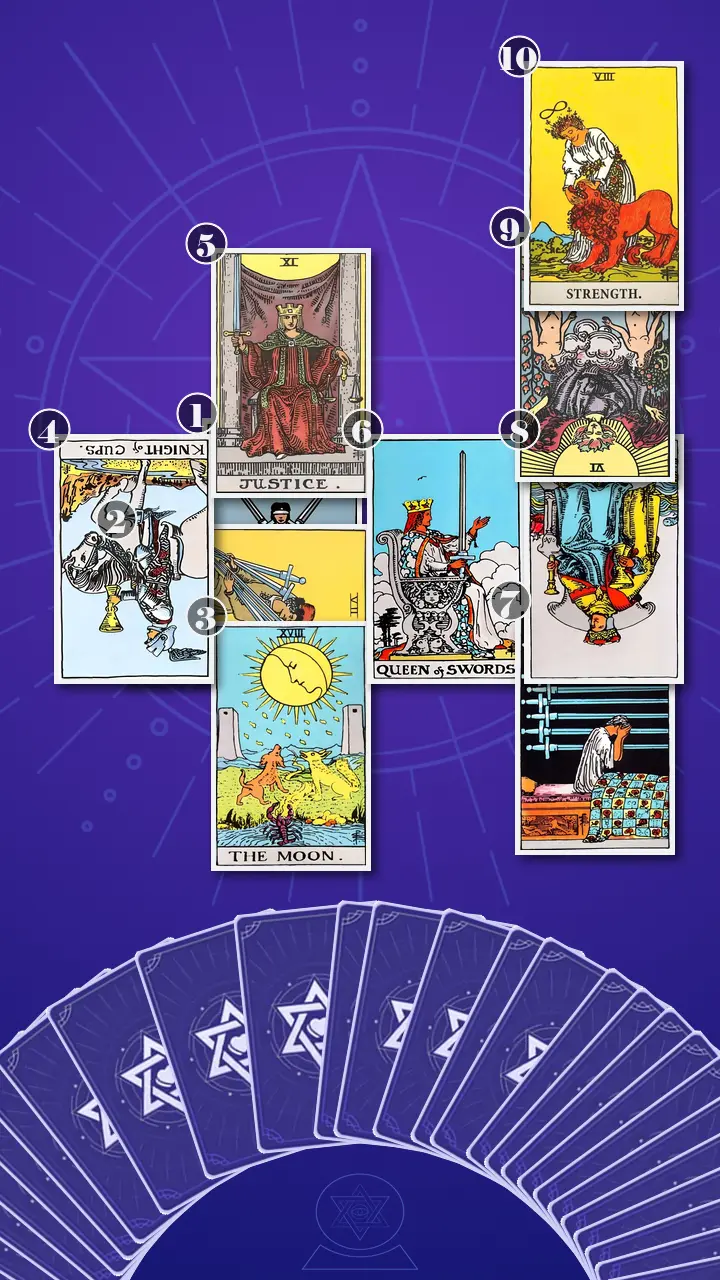
For readers who wonder how tarot works in a situation like this: this spread is built for the full chain. It separates (1) the surface dynamic in the thread, (2) the real obstacle to clarity, (3) the deeper emotional driver underneath your response pattern, and then (4) the boundary-based next steps that restore self-trust. It’s a “card meanings in context” approach—less mystique, more usable insight.
“The first two cards show what’s happening and what’s blocking it,” I said. “A card below the center shows what’s driving your urge to keep trying. And near the end, we’ll look at the ‘next conversation step’ and your most empowering integration.”
Reading the Thread Like a Map
Position 1 — The current communication dynamic
“Now flipping over,” I said, “is the card representing the current communication dynamic: what is actually happening between you and the other person right now.”
Two of Swords, upright.
In modern life, this is keeping a browser tab open for days because closing it feels like choosing. Taylor wasn’t ending it, but she wasn’t moving it forward either—holding the chat thread like a live wire. She listened on the streetcar, then again in bed, telling herself she’d reply when she was calmer… while the stalemate quietly became the relationship pattern.
Energetically, the Two of Swords is a blockage of decision-energy. It’s self-protection that’s gone stale: the blindfold says, “If I don’t look too directly, I won’t have to feel the impact.” The crossed swords over the chest say, “I’m bracing.”
Taylor let out a small laugh that had no humor in it. “That’s… brutal,” she said, rubbing her jaw with her knuckles. “Like—accurate, but brutal.”
“Not brutal,” I corrected softly. “Honest. And it’s important: you’re not ‘bad at communicating.’ You’re paused because pausing feels safer than choosing.”
Position 2 — The immediate obstacle
“Now flipping over is the card for the immediate obstacle: what most blocks clarity and forward movement in this conversation.”
Seven of Swords, upright.
This one is painfully specific to voice-note dodging: they send something long that sounds personal and caring, but it’s engineered to avoid the one direct question. They take the parts that keep connection (attention, emotional vibe) and leave behind the part that creates accountability (a clear yes/no, a plan, a definition).
Energetically, the Seven of Swords is strategic avoidance—not always evil, but definitely selective. It’s the energy of a coworker who replies to every line of your email except the actual question. The look-back in the card is that tell: “I know what I’m doing.”
I grounded it in one line, the way I do when I’m trying to end self-blame without turning the other person into a villain: You’re holding your breath. They’re keeping their options.
Taylor went quiet, eyes dropping to the lower edge of her screen. Her shoulders loosened a millimeter, like her body recognized the pattern before her pride could argue with it.
“A warm voice note can still be a non-answer,” I added. “And your obstacle isn’t your ability to ask. It’s their willingness to answer plainly.”
Position 3 — The unconscious driver
“Now flipping over is the card for the unconscious driver: what emotional or psychological need is underneath your response pattern.”
The Moon, upright.
Underneath the drafts and the disclaimers is the discomfort of not knowing—so her brain goes full detective: pauses, laughter, timing, whether he sounded “guilty,” whether he said her name quickly or slowly. The uncertainty becomes fog, and fear starts writing the story: If I ask directly, I’ll lose him.
Energetically, The Moon is a surplus of imagination and a deficiency of usable data. The card doesn’t say you’re irrational—it says you’re trying to navigate without headlights.
“This is where mixed signals become a kind of emotional currency,” I told her. “Your mind keeps paying attention hoping it can purchase clarity.”
She swallowed, then admitted, “If he pulls away because I ask once—like a normal person—I think it means I’m… not worth the effort.”
Position 4 — Recent pattern
“Now flipping over is the card representing the recent pattern: what has been setting the tone leading up to this moment.”
Knight of Cups, reversed.
This is the romance-coded mini-podcast: tender voice notes, soft apologies, emotional storytelling. Warmth as a detour. The cup is offered, but in reverse it’s more like: Here’s a feeling instead of an answer.
Energetically, it’s a distortion of emotional expression—beautiful delivery without specificity. And the overcorrection risk is real: you match the vibe with your own long careful message, hoping more context will force a direct answer. The cycle repeats.
Taylor made a face like she’d bitten something sour. “I hate that it works,” she said. “I soften instantly.”
“Of course you do,” I said. “You want intimacy. You just don’t want intimacy that costs you your self-respect.”
Position 5 — What you’re seeking
“Now flipping over is the card representing what you’re seeking: the clarity or reassurance you want from this.”
Justice, upright.
I felt Taylor sit up a little. Justice brings structure to fog. In real life, it’s the moment you realize you’re not trying to ‘win’—you’re trying to make reality make sense. Direct questions get direct answers. Words match behavior.
Energetically, Justice is balance with a blade. Scales for tone, sword for standard. This is where I always say it out loud because it changes the whole nervous system math: Tone isn’t truth. Follow-through is.
As an artist, I think of Justice like a clean gallery label next to a painting—no florid paragraph to persuade you, just the title, the date, the medium. The facts don’t kill the feeling. They hold it.
“If this was happening to your best friend,” I asked, “what would ‘fair’ look like?”
“One sentence,” Taylor said immediately. “Like… answer the thing I asked.”
Position 6 — The next conversation step
“Now flipping over is the card representing the next conversation step: the most likely immediate direction if you change how you respond.”
Queen of Swords, upright.
This is the format change. No more multi-paragraph explanations, no more cushioning your question with apologies. One short message, one direct question, one timeframe. In energy terms, it’s clean Air: precision without cruelty.
I watched Taylor’s eyes flick toward her phone off-screen, like the Queen’s upright sword had turned into an actual tool on her nightstand.
“Here’s the micro-moment,” I told her, echoing what the card is asking for. “You delete the disclaimers. You stop adjusting screen brightness like you can dim your needs. You send one sentence.”
“Can you answer this directly: are you open to (X)—yes or no? If you’re not sure, ‘not sure’ is okay too.”
She breathed out like she’d been holding air in her chest for an hour. “I could send that,” she said, surprised by her own voice.
“One question. One timeframe. Then you watch what happens,” I said. “That’s Queen of Swords energy in a texting situation.”
Position 7 — Your stance
“Now flipping over is the card representing your stance: how your mindset and self-image shape the way you reply and interpret.”
Nine of Swords, upright.
This is you doing the conversation twice: once in the chat, and once alone at night in your head. It’s 1 AM, your brain is taking mental screenshots like it’s building a case file. Tight jaw. Stomach knot. Forty minutes lost to replaying the same audio.
Energetically, the Nine of Swords is a surplus of mental labor and a deficiency of rest. When you’re stuck decoding, even a small dodge can feel like a big threat to self-worth.
I asked, “What concrete information do you have… and what is your mind filling in?”
“I have… warmth,” she said slowly. “But not an answer.”
Position 8 — External context
“Now flipping over is the card representing external context: how the other person and the environment influence the dynamic.”
King of Cups, reversed.
This is emotionally fluent but slippery: calm, caring, reasonable-sounding—while still avoiding specifics. The calm tone can subtly pressure you to drop it, like if you insist on an answer you’re the one “making it a thing.”
Energetically, it’s a blockage of emotional accountability. Composure becomes a shield, not a bridge.
“So the room you’re trying to have a real conversation in,” I said, “is one where calmness is used as leverage. That matters. It’s why you start self-editing.”
Position 9 — Your hope/fear hinge
“Now flipping over is the card for your hope/fear hinge: what you’re afraid will happen if you’re direct—and what you hope directness might unlock.”
The Lovers, reversed.
This isn’t just romance; it’s values. Connection versus self-respect. You hope directness creates alignment. You fear it reveals misalignment—and then you’ll have to act on that truth.
Energetically, it’s a tension between harmony and honesty. The stress comes from trying to keep closeness without getting clarity.
Taylor’s voice dropped. “What if I ask and he basically… disappears?”
“Then you’d have information,” I said, not unkindly. “And you’d stop auditioning for clarity.”
When Strength Held the Line
Position 10 — Integration as a next move
“We’re turning over the most decisive card now,” I said, and even through a screen I felt the air change—like the moment in a classic film when the soundtrack goes quiet and a character finally tells the truth.
Strength, upright.
Setup: It’s 11:30 PM, you’re replaying the voice note for the third time, jaw tight, trying to find the one sentence that will finally make them answer without making you look “intense.” You’re still hoping the right wording will open the door.
Delivery:
Not chasing answers through endless explanations—choosing calm strength, holding your line, and letting the lion be tamed by self-respect, not by more words.
I let the line sit there. No extra commentary. Just space.
Reinforcement: Taylor’s whole face did a three-part shift: first a tiny freeze—breath caught, eyes widening like she’d just been called out by her own conscience; then a soft unfocus, like she was replaying last week’s thread in her mind and seeing it without the Moon’s fog; then a slow exhale that lowered her shoulders and unclenched her jaw. She looked a little stunned, the way people do when relief shows up but also demands responsibility.
“But if I do that,” she said, and there was a flash of anger in it—at him, at herself, at the whole performance—“doesn’t it mean I’ve been doing this wrong?”
“It means you’ve been working hard for something you were always allowed to require,” I said. “That’s different.”
This is where my own brain always reaches for film, because boundaries are easier to hold when you can see them. “Strength reminds me of Casablanca,” I told her. “Rick doesn’t win by saying the perfect sentence. He wins by choosing his standard and holding it—even when it hurts. It’s not cold. It’s dignified.”
Then I gave her the practical version, straight from the card: “Try this in under ten minutes. Write one clean question plus one timeframe in Notes. Read it out loud once. If your body tenses, soften your tone—not your boundary. Then choose: send it now, or send it tomorrow before you’re tired. Either way, no replaying the voice note tonight. If that feels impossible, mute the thread for twelve hours so you can actually sleep.”
I watched her nod, slower this time, as if her body believed it before her habits did.
“Now,” I asked her, “use this new lens and look back at last week: was there a moment where this would’ve changed how you felt?”
She didn’t answer immediately. She just looked down and said, very quietly, “Yeah. When I wrote a whole paragraph apologizing for asking.”
“Strength is your move from mental spinning into grounded self-respect,” I said. “This is the beginning of the shift: from trying to earn clarity with perfect wording to setting a calm boundary and letting behavior tell the truth.”
The One-Screen Text: Actionable Advice for Communication Limbo
When I stitched the whole spread together, the story was almost embarrassingly clear: the thread is stuck because evasion meets hesitation. Two of Swords says you’ve been pausing to avoid conflict; Seven of Swords says the other person benefits from ambiguity. The Moon explains why it hooks so hard—uncertainty turns your mind into a forensic lab. Knight of Cups reversed shows the seductive detour of warmth without specificity. Justice is your actual desire: a fair baseline. Queen of Swords is the skill—clean language. And Strength is the integration: calm boundaries that don’t beg.
The cognitive blind spot here is thinking, If I can just explain better, I can extract honesty without risking discomfort. The transformation direction is the opposite: state one clear question, set one clear boundary, then observe follow-through. Clarity becomes something you require, not something you coax.
I gave Taylor a few “next steps” she could actually do between meetings—practical, low-drama, and designed for decision fatigue.
- The Clean Question (Queen of Swords)Send one text that fits on one screen: “Can you answer this directly: are you open to (X)—yes or no? If you’re not sure, ‘not sure’ is okay too.” Then stop typing.Draft it in Notes, wait 10 minutes, then send—so you’re not writing from tight-jaw mode.
- The Timeframe (Justice → Strength)Add one real deadline you can live with: “If I don’t hear back by tomorrow night, I’m going to assume it’s a no and I’ll step back.”A timeframe isn’t punishment; it’s information about how you protect your peace.
- The No-Replay Night (Strength)Do a 24-hour “listen once” experiment. After you listen, put your phone face-down and mute/archive the chat until morning—no midnight replays.If you feel activated, take six slow breaths before you touch the thread again. Your boundary works best when your body is steady.
Before we ended, I used one of my own tools—my Iconic Line Diagnosis. I asked, “If this situation had one movie line that defines it, what is it?”
Taylor thought for a second, then said, “‘I’m not asking for a novel, I’m asking for an answer.’”
“Perfect,” I said. “That’s your script. And remember the refrain: Clarity isn’t something you coax—it’s something you require.”

A Week Later: Ownership, Not Certainty
Six days later, Taylor texted me a screenshot—not of his voice note, but of her own message. One screen. One question. One timeframe. Under it she wrote: “I sent it at 2:15 PM, not at midnight. Then I walked around the block and didn’t check my phone until dinner.”
Her update wasn’t fireworks. It was quieter than that: she slept a full night, but told me her first thought in the morning was still, “What if I was too intense?”—and then, this time, she actually laughed and went to make coffee anyway.
That’s what a real Journey to Clarity usually looks like in relationships: not instant certainty, but steadier self-respect—letting actions, not explanations, define what you accept.
When someone’s voice note sounds intimate but keeps your real question unanswered, it can feel like you’re stuck holding your breath—trying to stay “easygoing” while your body begs for something solid.
If you didn’t have to earn clarity with perfect wording, what’s the one clean question you’d ask—and what boundary would help you actually believe your own answer?