Three Draft Texts, One Earbud Out—And the One Line I Could Stand By

The 8:47 p.m. Lock-Screen Tap
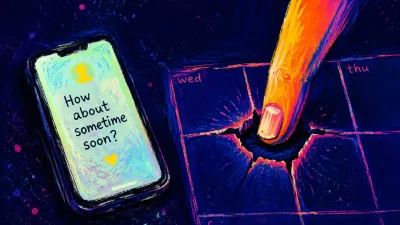
You see a missed call, put your phone face-up on the desk like it’s evidence, and suddenly you’re refreshing WhatsApp like it’s a live scoreboard.
Jordan (name changed for privacy) sat across from me with the kind of posture you learn in a hybrid office job—shoulders squared, face composed—while her hands gave away the truth. Her thumb kept tracing the edge of her phone case as if the plastic could tell her what the silence meant.
She described Tuesday, 8:47 p.m., in her Zone 2 flat kitchen: the extractor fan humming, takeaway smelling aggressively of garlic and oil, her phone face-up on the table like a tiny witness stand. Tap. Tap again. Her thumb slightly sweaty. Chest tight. Jaw clamped. Type “Hey, all good?” delete it. Then draft two more versions, delete those too.
“It’s one missed call,” she said, almost laughing at herself. “But my brain treats it like… a relationship referendum.”
I nodded, because I’ve heard this exact pattern a thousand modern ways, and it always carries the same old ache. “You want clear connection,” I said, “but the second ambiguity shows up, your mind turns it into rejection—and then you try to think your way back to safety.”
Her breathing was fast and shallow, like she’d been jogging without moving. The anxiety wasn’t an abstract feeling; it sat in her body like a tight chest in a crowded carriage, a clenched jaw that refused to unclench, a restless urge to do something right now—anything—to stop the unknown from becoming an answer.
“We’re not here to decide what their missed call ‘means,’” I told her. “We’re here to find what it triggers in you—so you can stay on your own side long enough for clarity to arrive. Let’s draw a map through the fog.”
Choosing the Compass: The Four-Layer Insight Ladder
I asked Jordan to take one slow breath—nothing mystical, just a clean moment of focus—then I shuffled while she held the question in her mind: They missed one call—what old fear makes me overthink?
“Today I’m using a spread I designed called the Four-Layer Insight Ladder · Context Edition,” I said. I always tell my clients the same thing I told students in Cambridge: methods matter because they keep us honest.
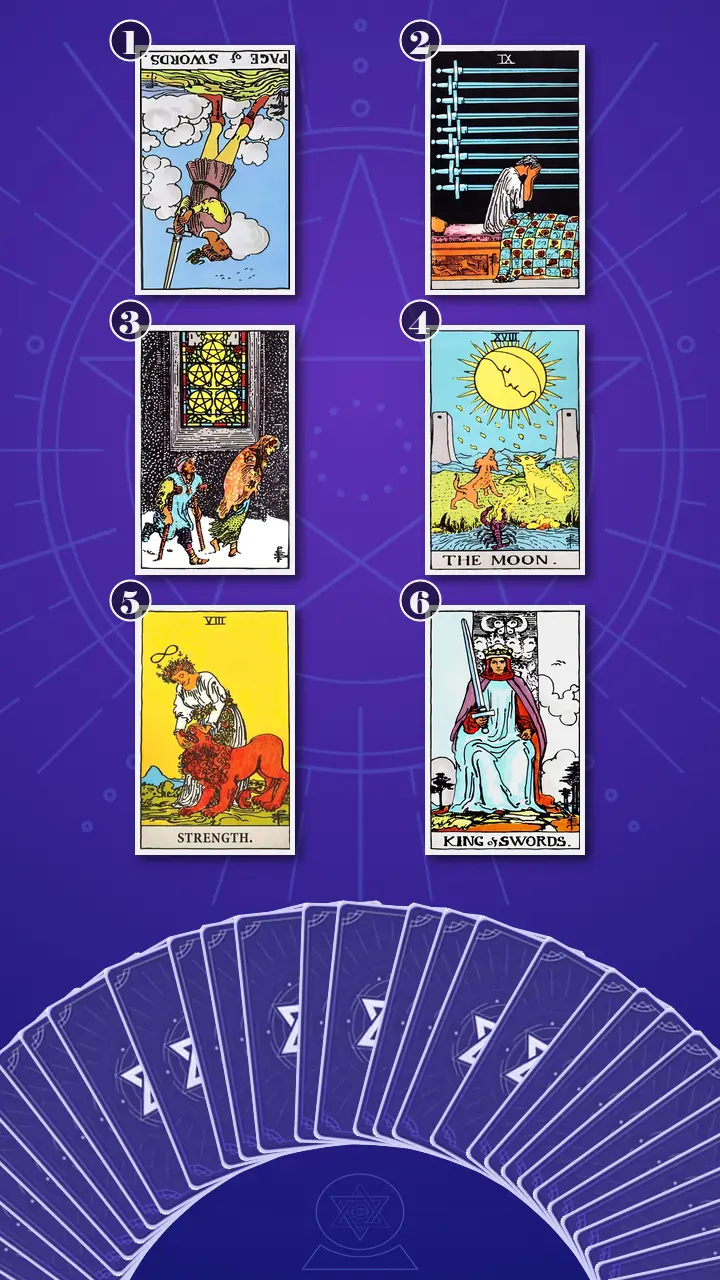
For a missed-call spiral, prediction is the wrong tool. The external trigger is small; the internal reaction is huge. So the reading has to separate the symptom from the source: surface reaction → mental weather → old fear → subconscious story → key shift → grounded next step. It’s a compact six-card grid meant for deep inner work—more like an archaeological trench than a crystal ball.
I previewed the structure for her (and, really, for anyone reading this who’s wondered how tarot works in real life): the first card shows the immediate “missed call ritual.” The middle cards reveal what ancient part of you is getting poked. And the final row is the exit: the inner shift and one practical move—clear communication or a boundary—that stabilizes you.
Reading the Map: From Surveillance to Fog
Position 1: Surface reaction — Page of Swords (reversed)
“Now we turn over the card that represents your surface reaction: the specific, observable way you respond right after the missed call.”
The Page of Swords, reversed.
I didn’t need to reach for anything esoteric. This card lives in Jordan’s daily micro-behaviours. “Right after the missed call,” I said, “you put your phone face-up like it’s evidence, keep one AirPod out ‘just in case,’ and start a silent investigation: WhatsApp thread open, timestamps checked, your last message reread for tone, then three drafts written and deleted because none of them sound perfectly chill.”
Reversed, the Page’s Air energy isn’t clarity—it’s hypervigilance. Too much scanning, too much forecasting. The Page becomes The Watcher: quick, sharp, and—under stress—stuck in surveillance mode.
In my mind I saw it the way my archaeological teams used to watch a storm front move in over a dig site: everyone staring at the horizon as if staring could change the weather. That’s what this does. It treats your phone like an airplane cockpit dashboard in turbulence—staring harder at the instruments doesn’t clear the sky.
I said it plainly, because she needed plain. “Check → interpret → rewrite → freeze. Control versus connection.”
Jordan let out a sharp exhale and nodded immediately, like she’d been caught mid-scroll. “It’s so embarrassing,” she muttered. “I’m literally doing a full Sherlock Holmes on a chat thread.”
“You’re not ‘too much,’” I told her. “You’re trying to feel safe in fog.”
Position 2: Mental weather — Nine of Swords (upright)
“Now we turn over the card that represents your mental weather: the thought-loop, images, and assumptions your mind generates in the uncertainty gap.”
Nine of Swords, upright.
“Later—usually when you’re tired and alone—the missed call turns into a whole midnight documentary,” I said. “You’re in bed with the screen glow on your face, stomach tight, replaying the last week of messages like you’re looking for the exact frame where things went wrong.”
This is Air energy in excess, but it’s not useful thinking. It’s the kind of cognition that punishes. The card often looks like insomnia, but what it really is: a late-night courtroom with no new evidence.
“Your mind becomes the prosecutor,” I said, “rerunning the same case: Exhibit A, the missed call. Exhibit B, that one emoji they didn’t send. Exhibit C, ‘last seen’ at 22:14. And the verdict is always somehow guilty—you guilty.”
Jordan went quiet in that uncomfortable way that means the truth has landed. Her eyes dropped to the table, then flicked back to the card, as if rereading it might make it less accurate. Finally she said, “Yeah. It’s like I can’t rest until I know. And I never know.”
Position 3: Old fear — Five of Pentacles (upright)
“Now we turn over the card that represents the old fear: the deeper emotional wound being poked—what you’re trying to protect yourself from.”
Five of Pentacles, upright.
Here the reading dropped from the mind into the body. “Underneath the overthinking is a colder, older feeling,” I said. “Being on the outside of warmth, watching other people get chosen more easily. The missed call doesn’t register as ‘busy’—it hits like ‘I’m forgettable.’”
This is Earth energy in scarcity: not enough safety, not enough belonging. When that old wound is active, it makes perfect sense that Air panics and tries to manufacture certainty.
Jordan’s mouth tightened. She gave a small, bitter laugh. “That’s… kind of brutal.” Then softer: “But yes. It’s like I’m outside looking in.”
As an archaeologist, I’ve learned that the deepest layers aren’t dramatic—they’re persistent. This fear isn’t about one person on one Tuesday. It’s a strata you’ve walked over for years.
Position 4: Subconscious story — The Moon (upright)
“Now we turn over the card that represents the subconscious story: the hidden narrative or projection that makes the fear feel like facts.”
The Moon, upright.
“This is the fog-layer,” I said. “The part where you can know you don’t have enough information—and still feel convinced you can sense the rejection.”
I drew an invisible line down the centre of the table, like a historian dividing a primary source from a rumour.
Fact track: They missed one call.
Fog track: They’re pulling away. You embarrassed yourself. You should have played it cooler. This is going to end like it ended before.
“A missed call is data, not a verdict,” I said, and I watched her shoulders shift—just a few millimetres—as if her body was considering standing down.
To make it practical, I gave her the Moon’s exercise in the most London way possible: “Imagine you’re on the Tube platform, typing, then deleting. Give me three neutral explanations—one practical, one benign, one boring.”
Jordan blinked, then tried. “Practical: they’re in a meeting. Benign: their phone died. Boring: they called by accident.”
That tiny loosening came—a quiet “oh… I’m telling myself a story” feeling—without any forced positivity. Just widened possibility.
When Strength Tamed the Lion in the Kitchen Light
Position 5 (Key Shift): Strength (upright)
I paused before turning the next card. The room felt suddenly still, the way a library goes quiet when someone reaches the end of a sentence that matters.
“Now we turn over the card that represents the key shift: the inner capacity that helps you tolerate ambiguity without abandoning yourself.”
Strength, upright.
Jordan’s default strategy has been to outthink her nervous system. Strength asks for something more courageous: to stay with the feeling without obeying it. “Instead of trying to outthink the panic,” I said, “you practice staying with it. You notice the jaw locked, the chest tight, the urge to send a second text—and you choose the gentle power move: soften, breathe, hold your dignity steady.”
As a professor, I can’t help but use time as a lens. One of my core tools is what I call Emotional Historiography: reading relationships through time, not through one dramatic moment. “Strength is asking you to judge this connection like a historian,” I told her, “not like a panicked journalist chasing a breaking headline. One missed call is not a whole era. You’re allowed to wait for pattern to emerge.”
I watched Jordan in the exact place the spread predicted: 8:47 p.m., overhead light too bright, phone face-up like a tiny stage—one missed call, and her body braced as if something bad already happened. She was trapped between ‘I need to be chill’ and ‘I need to feel safe.’
Stop trying to win control through overthinking, and start building quiet inner strength—the gentle lion-taming that keeps your dignity intact even when the phone stays silent.
There was a visible reaction chain—three steps, quick but unmistakable. First, a brief freeze: her breath caught, and her fingers stopped moving like someone had paused a video mid-frame. Second, the cognition seeped in: her gaze went slightly unfocused, as if an old memory replayed—the other times silence arrived with no explanation, the way she’d tried to “behave correctly” to prevent it. Third, the release: her shoulders dropped, and she exhaled a little shakily through her nose, like her body had been holding a door shut and could finally stop pushing.
“But if I stop doing that,” she said, and there was a flash of anger under the vulnerability, “doesn’t that mean I’ve been… wrong? Like I made this whole thing up?”
I kept my voice steady. “It means you were trying to survive in low light,” I said. “That’s not stupidity. That’s adaptation. Strength isn’t humiliation; it’s an upgrade.”
Then I offered the reset as a ten-minute excavation—layer by layer, artefact by artefact—so she could feel the difference, not just understand it:
(1) Write one sentence of fact: “They missed one call.” (2) Write one sentence of fear-story: “This means I’m not wanted.” (3) Put a hand on your chest, unclench your jaw, and take 6 slow breaths (longer exhale). (4) If you still want to text, send one bounded line (no edits after 60 seconds), then turn on Do Not Disturb for 45 minutes and do one offline task (shower, dishes, short walk). If you feel more activated while doing this, you can stop at any point—your only job is to come back to your body, not to ‘get it right.’
I leaned in slightly. “Now—with this new lens—think back to last week. Was there a moment when the urge hit, and if you’d done this, you would’ve felt even five percent more steady?”
Jordan swallowed. “Sunday night,” she said. “I rewrote a text for forty minutes. Forty.” Then, quieter: “I could’ve… just sent one normal line. And gone and taken a shower.”
That was the turning point: not from anxious to fearless, but from abandoning herself in ambiguity to staying kind and steady long enough for reality to show up.
Position 6: Grounded next step — King of Swords (upright)
“Now we turn over the card that represents the grounded next step: one clear communication or boundary move aligned with self-respect rather than panic.”
King of Swords, upright.
“This,” I said, tapping the card gently, “is Air restored. Not surveillance Air. Not courtroom Air. Clean Air.”
I gave her the modern-life translation exactly as her nervous system needed it: “One clean, respectful line that doesn’t hint, test, or audition for approval. Something like: ‘Hey—saw I missed your call. Free after 7 if you want to try again.’ Then you stop monitoring and let consistency over time be the data.”
Jordan’s eyes flicked up. You could see the impulse to screenshot the wording, to cling to something simple.
“Clean words beat perfect timing,” I added. “And here’s the part people miss: the boundary isn’t for them. It’s for the part of you that thinks you have to stay on-call to be chosen.”
From Fog to Facts: Actionable Advice You Can Actually Do
I drew the story back together for her, the way I’d reconstruct a site report: the sequence matters.
“Here’s what I see,” I said. “A missed call triggers the Page of Swords reversed—your immediate ‘digital surveillance’ ritual. That spirals into the Nine of Swords, where your mind runs a late-night trial with you as the defendant. Underneath, the Five of Pentacles is the real engine: an old fear of being outside warmth, being forgettable, being the one not chosen. The Moon then paints shadows onto silence and convinces your body those shadows are facts. Strength interrupts the jump—meeting the fear in your body with steadiness. And the King of Swords finishes it with clean, bounded communication.”
The cognitive blind spot was clear: Jordan believed overthinking was the price of not being hurt—like certainty could be earned through enough monitoring. The transformation direction was equally clear: regulate first, then choose one clear, time-bound action.
To make it concrete, I offered her a simple version of my Pictogram Dialogue strategy—because when you’re activated, long explanations become another maze. We reduce it to a few symbols on a sticky note: [FACT] [STORY] [BODY] [WORDS]. No essays. No negotiating with the fog.
- The Fog-to-Facts NoteOpen your Notes app and write two lines: [FACT] “They missed one call.” Then [STORY] “This means I’m not wanted.” Read both once, out loud, and stop there.If you feel the urge to add a third line, that’s the cue to pause—two lines only. You’re naming the pattern, not building a case.
- The 20-Minute Message WindowSet a 20-minute timer. You can draft one message, but when the timer ends you choose one version and send it—or choose not to send. No editing after 60 seconds once you’ve picked a line.Expect resistance like “but what if I miss something important.” You’re not banning your phone—you’re delaying compulsion. If 20 feels big, do the 5-minute version.
- Clean Words + 45 Minutes of QuietSend one King-of-Swords line: “Hey—saw I missed your call. Free after 7 if you want to try again.” Then turn on Do Not Disturb for 45 minutes and do one offline anchor task (shower, dishes, or a short walk to the corner shop).If you catch yourself rereading the thread, say once: “I’m in surveillance mode,” put the phone face-down for five minutes, and return to the task.

A Week Later: The Quiet Proof
Five days later, Jordan messaged me—not a paragraph, not a thesis, just a small report from the field. She’d missed another call from the same person. She did the two-line Notes split. She sent one clean text. She put her phone on Do Not Disturb and washed the dishes while the kettle boiled. “I still felt wobbly,” she wrote, “but I didn’t spiral.”
That’s what a Journey to Clarity usually looks like: not a dramatic transformation, but one moment where your dignity returns to your own hands.
We’ve all had that moment where a silent phone makes your chest go tight—not because you need a reply to survive, but because ambiguity pokes the old fear that being ignored means you don’t belong.
If you didn’t have to earn certainty by overthinking tonight, what’s one small way you could stay on your own side for the next 45 minutes?
Every reading at AceTarot is a Journey to connect with inner wisdom and empower next step.
Learn more about our Journey to Clarity.