Leaving the Bank-App Refresh Spiral for a Minimum Sustainable Week

The 10:41 p.m. Bank-App Loop
You’re a freelancer in a high-cost city (hi, Toronto) and the invoice is overdue—so you start doing “one more task” at night like effort can substitute for cash flow.
Jordan (name changed for privacy) sat down across from me on a video call, still in a hoodie like she’d been wearing it as armor. She told me she’d skipped the gym again, and she didn’t even sound surprised—more like she was reporting weather.
As she talked, I could almost see the scene she described because I’ve lived some version of it myself: 10:41 PM on a Tuesday at the kitchen counter in a downtown Toronto condo. The laptop fan doing that thin, anxious whir. The screen glow making the room feel colder than it is. Her phone warm from refreshing her banking app—RBC, TD, Scotiabank, it doesn’t matter; they all feel like the same slot machine pull at midnight.
She hovered over an invoice follow-up draft, then switched tabs to “just fix” a client deck. The gym bag by the door wasn’t messy—it was worse than messy. It was neatly ready, like a quiet witness. And her shoulders, she said, had crept up toward her ears so slowly she hadn’t noticed until her jaw started aching.
“I’m not even asking for a favor,” she said, a little too fast. “I’m asking to be paid. And somehow I still can’t send the reminder without feeling like I’m stepping on a social landmine.”
Frustrated depletion is the only label that fits, but the lived sensation is sharper than a label: it’s like trying to walk through waist-high wet cement while someone keeps telling you to “just be more disciplined.” Heavy legs. Tight neck. That wired-but-tired buzz at night where you’re exhausted and still can’t fully shut down.
I let her finish, and I didn’t rush to “fix” it—because I’ve learned that, for most people, being seen clearly is the first real relief.
“Okay,” I said. “We’re not going to treat this like a character issue. Late payment triggers a safety alarm, not a character flaw. Let’s use tarot like a diagnostic tool—work, money, body—so we can see exactly where the leak is and what actually closes it. This is a Journey to Clarity, not a lecture.”

Choosing the Compass: A 7-Card Burnout Diagnostic Spread
I asked Jordan to take one slow breath—nothing mystical, just a nervous-system reset—and to hold one sentence in mind: “Unpaid invoice plus skipped gym—where is burnout leaking: work, money, or body?” Then I shuffled, the soft riffle of cards acting like a metronome for attention.
For this, I chose my own structure: Energy Diagnostic Map (7) · Context Edition.
If you’ve ever Googled “how to follow up on an unpaid invoice without sounding rude” at 1 a.m., you already know why a simple yes/no reading won’t help. This isn’t one problem. It’s a multi-domain burnout pattern where the unpaid invoice and the skipped workouts are symptoms of a single underlying mechanism. This spread works because it scans the surface leak, names the inner tug-of-war, identifies the external pressure, then drills into the core blockage—before moving into usable resources, one turning-point integration, and a grounded next step.
In plain language: symptom → mechanism → blockage → resource → transformation → action. No fortune-telling. No “do this or else.” Just clarity and next steps.
“Here’s what to watch for,” I told her. “The first card will show what the leak looks like day-to-day. The fourth card, at the center, names the knot tying the whole thing together. And the sixth card is the turning point—what changes the system so you’re not running your life on adrenaline.”
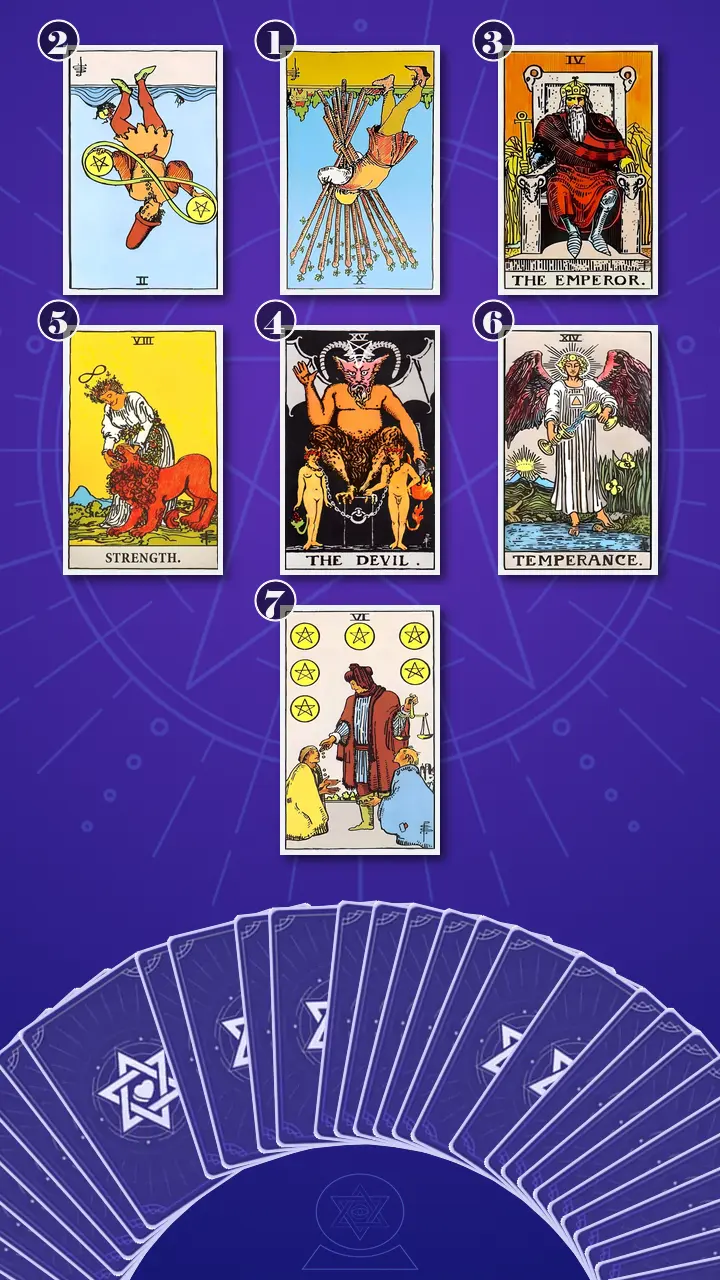
Reading the Leak: Where Your Week Is Bleeding Energy
Position 1: The Concrete Burnout Leak Right Now
“Now flipped over,” I said, “is the card representing the concrete burnout leak behavior right now—what you’re doing around the unpaid invoice and skipping the gym.”
Ten of Wands, reversed.
I pointed to the image—someone bent forward, overloaded, vision blocked by what they’re carrying. “This is you carrying work stress and money uncertainty in your body like a backpack you forgot to take off: late-night ‘one more task,’ constant tab-switching between client work and your banking app, and then waking up too depleted to hit the gym—so the routine drops first because everything feels heavy.”
Reversed, the energy isn’t heroic endurance. It’s collapse. Not dramatic collapse—more like the slow kind, where the body quietly becomes the buffer that pays for everything you can’t control.
“The reversal is important,” I added. “It’s not saying, ‘carry it better.’ It’s saying, ‘put something down.’ And notice how the wands block the figure’s view—overload narrows your options until even a simple invoice follow-up feels impossible.”
Jordan stared at the card, then gave a short laugh that sounded like it had a little rust in it. “That’s… honestly too accurate. Like, it’s almost rude.”
“It can feel brutal,” I said gently. “But it’s also good news. If the leak is overload, we can work with overload. We can triage.”
I asked her the question this position demands: “In the last 72 hours, what’s the exact moment you avoided the invoice follow-up or skipped movement—and what did you do instead?”
She didn’t even have to think. “I opened the email draft. Saw the word ‘overdue.’ Deleted it. And then I went back to kerning. Like kerning was going to pay my rent.”
Position 2: The Inner Tug-of-War
“Now flipped over,” I said, “is the card representing the core contradiction between work/money demands and body maintenance—how it plays out in decisions.”
Two of Pentacles, reversed.
“This is reactive juggling,” I said. “Your week is built around ‘after this one thing.’ You keep promising yourself you’ll do the gym and the follow-up after the next email, after the next tweak, after the next deliverable—but your schedule keeps bending to urgency.”
I tapped the infinity loop. “This is the mental loop: invoice → bank balance → guilt → skip gym → work more → repeat. Reversed, it tips into imbalance. It’s not that you can’t be consistent. It’s that the system you’re using can’t hold both needs at once.”
In tarot terms, this is Earth energy (time, money, practicality) getting wobbly. In real life terms, it’s like having eighteen tabs open and wondering why your laptop—your body—starts overheating.
Jordan’s eyes flicked away from the camera, like she was replaying a familiar Thursday morning. “I literally block the workout. And then at 7:12 I see ‘URGENT’ and it’s over.”
“And then your brain turns it into morality,” I said. “Like it means something about you.”
Her mouth tightened. That small, self-protective expression I’ve seen in a hundred clients. “Yeah. Like I don’t have whatever other people have.”
“Consistency is a rhythm, not a personality trait,” I said, and I watched her shoulders drop a millimeter—just enough to count as a crack in the armor.
Position 3: The External Pressure Tightening the Loop
“Now flipped over,” I said, “is the card representing the real-world pressures that intensify the burnout loop—clients, timelines, financial volatility, social comparison.”
The Emperor, upright.
“This makes so much sense for a freelance brand designer in Toronto,” I said. “The Emperor is the pressure of structure and authority—but here, it’s a rigid professionalism script: fast replies, flawless deliverables, never seeming messy.”
I pointed out the stone throne and the armor under the robes. “This is the part of you that believes stability comes only from strict control and relentless reliability. The armor isn’t bad—sometimes it protects you. But when it’s running the show, your body needs and fair-pay boundaries get treated as optional.”
My mind flashed—just for a second—to an old film editing room I used to haunt in New York, watching directors cut scenes until 3 a.m. Everyone looked composed, like intensity was competence. It reminded me of The Bear as a vibe: urgency as proof you’re good—until your nervous system taps out.
Jordan nodded, then swallowed. “It’s like I can hear this voice saying, ‘Don’t make it weird. Be chill. Keep them happy.’”
“Exactly,” I said. “The Emperor pressure isn’t just deadlines. It’s the fear of looking difficult.”
Position 4: The Core Blockage Underneath It All
“Now flipped over,” I said, “is the card representing the underlying fear or belief driving both the invoice avoidance and the skipped body routine.”
The Devil, upright.
The air changed in that subtle way it does when a card names something you’ve been trying not to say out loud. Even through the screen, Jordan went still.
“This,” I said carefully, “is the unpaid invoice triggering a worth-and-safety spiral. Instead of sending the clean follow-up, you overwork to soothe anxiety, as if output can force certainty.”
I leaned in a little. “It’s like checking your bank app is a slot machine pull. You know it won’t fix the system, but the tiny chance of relief keeps you hooked.”
And then I used the echo technique I’ve learned matters most with this card: I narrated the micro-moment without judging it. “You open the draft. Your chest tightens. You hear the inner contract: ‘If I have to chase it, I wasn’t valuable enough.’ So you switch tabs. You do more work. You ‘earn’ payment emotionally. And the gym becomes symbolic—if you go, it feels like you’re being irresponsible, even though you’re just trying to be a human with a body.”
“That’s literally it,” Jordan said, quieter now. “If I relax, I feel like I’m tempting fate.”
“The Devil’s detail that people miss,” I told her, “is the chain is loose. It’s an illusion of captivity. There’s real leverage here—one clear boundary can break the loop, even if it feels emotionally risky.”
Her fingers had been twisting the cord of her earbuds; she let it go, then picked it up again. A three-step reaction chain I’ve come to recognize: a breath held (freeze), eyes unfocusing (the memory replay), then a small, involuntary exhale (emotional contact).
“Finish this sentence,” I asked. “If they don’t pay on time, it proves ___.”
She shut her eyes for half a second. “It proves I’m not safe.”
“Thank you,” I said. “That’s the knot.”
Position 5: The Resource You Can Access Right Now
“Now flipped over,” I said, “is the card representing the inner resource that helps you regulate stress and act without overreacting—especially around money conversations.”
Strength, upright.
The shift was immediate. Strength doesn’t erase the lion; it changes how you hold it.
“Your resource is regulated steadiness,” I said. “You can feel the money panic rise, pause, and still send a firm-but-neutral invoice message without apologizing or escalating. The same energy returns you to movement gently—short workout, no punishment, repeat.”
I described the gentle hand on the lion the way I would describe a real nervous-system skill: “Feet on the floor. Exhale longer than you inhale. Five times. Then write one clean sentence.”
I watched Jordan do it without me asking—her shoulders lowering as she breathed out. Not a transformation montage. Just a small, real exhale.
“This is why I say,” I added, “Busy isn’t the same thing as paid. Strength is the part of you that can tolerate the discomfort of the email—without trying to buy relief with extra work.”
She nodded once. “That actually feels… possible.”
When Temperance Started Pouring: Finding Clarity Without Waiting to Get Paid
Position 6 (Key Transformation): The Integration That Unlocks Movement
I paused before turning the next card. “We’re flipping the turning point now,” I said. “This is the card that defines the shift from crisis management into a sustainable system.”
Temperance, upright.
“Temperance is the moment you stop waiting for a perfect week,” I said, “and build a minimum sustainable rhythm: two protected admin blocks for money, two realistic workouts, and clear work blocks—so work, money, and body can coexist without turning every week into a crisis sprint.”
Setup (what you’re stuck in): It’s that familiar late-night moment: laptop open, bank app refreshed, gym bag ignored, and your body holding the stress like a clenched fist. You’re trying to be responsible, but responsibility has turned into adrenaline—like you’re only allowed to recover after the client behaves correctly.
Delivery (the sentence that changes the frame):
Stop treating balance like a reward you earn after you get paid—start mixing your time and energy intentionally, like Temperance, so work, money, and your body can coexist in the same week.
I let that sit. No extra commentary. The room—her room, my room, the little digital tunnel between us—went quiet in the way it does when something lands.
Reinforcement (the reaction + the lever): Jordan’s face changed in layers. First, a stillness—like her brain had paused to load a new page. Her eyes widened just slightly, then softened. Her shoulders, which had been held up as if by invisible strings, dropped a notch. She swallowed and her jaw unclenched like she’d just realized she’d been biting down for hours.
Then came the unexpected reaction: a flare of anger, quick and honest. “But if that’s true,” she said, voice sharper for a moment, “doesn’t that mean I’ve been doing it wrong? Like… I’ve been punishing myself for nothing?”
“Not for nothing,” I answered. “For safety. Your nervous system chose what it thought would keep you safe. But Temperance is showing you a different kind of safety: a paced system, not a panic sprint.”
Her breathing hitched—freeze—then her gaze drifted to the side—replay—then she exhaled through her nose, long and shaky—release. “I hate how true that is,” she whispered, and there was relief in it, and also a new vulnerability: if safety comes from a system, then she has to build it. Not perfectly. Just intentionally.
“Now,” I said, “use this new lens and look back at last week. Was there a moment when you treated balance like a reward? A moment where you thought, ‘I’ll move my body after I get paid’?”
She didn’t hesitate. “Thursday. I literally thought, ‘Once that invoice hits, I’ll go back to normal.’ And then it didn’t hit, so I stayed in work mode like… indefinitely.”
That was the hinge: not just about an overdue invoice, but about moving from frustrated depletion and reactive juggling toward grounded calm through a paced, repeatable system.
This is where I brought in my signature tool—because Temperance isn’t only a feeling; it’s a design problem.
“I’m going to borrow something from how I build paintings,” I said. “It’s a technique I call the Mondrian Grid Method. Think of your week like a canvas. Mondrian didn’t paint ‘balance’ as a mood—he built it as blocks. Clean lines. Intentional proportions. Temperance is asking for the same: not a perfect week, a composed week.”
“So instead of one giant ‘get my life together’ plan,” I continued, “we draw three or four blocks that must exist even when the week gets messy: money admin, two body appointments, and focused work. Small pours. Repeatable rhythm. That’s Temperance.”
The One-Week Repair Plan: Calibration, Not Confrontation
When I looked at the whole map, the story was clean: overload collapses first (Ten of Wands reversed), which turns your week into reactive juggling (Two of Pentacles reversed). External pressure tightens you into armor (The Emperor), and the core blockage is the old contract that says, “I can’t relax until money is certain” (The Devil). Strength shows you can regulate first instead of spiraling, and Temperance shows the integration: a minimum sustainable rhythm that doesn’t wait for the invoice to rescue you.
The cognitive blind spot was equally clear: Jordan kept trying to create safety by pushing harder—more work, more tweaks, more late nights—when the thing that actually creates safety is a system with explicit payment boundaries and protected recovery time.
“You don’t need a motivational speech,” I told her. “You need a week that’s built to survive real life.”
And then we grounded it with the final card’s energy—fair exchange.
“A payment follow-up isn’t confrontation—it’s calibration,” I said. “Like balancing a spreadsheet. Like restoring the terms of service: you deliver, they pay—no extra emotional fine print.”
Jordan made a face—half laugh, half grimace. “Okay, but… I don’t have time. I can’t even find five minutes without someone emailing me.”
“That’s real,” I said. “So we’re not going to rely on willpower. We’re going to schedule it like you’d schedule something you can’t ‘get around to.’”
Here are the next steps we designed—small, specific, and intentionally unglamorous:
- The 20-Minute Admin BlockPut a 20-minute calendar event called “Money Admin (protected)” on two specific days this week (for example: Tuesday 1:00 p.m. and Friday 11:30 a.m.). During that block, draft one invoice follow-up email that includes the invoice number, original due date, outstanding amount, and one clear next step: “Can you confirm payment will be processed by Thursday at 5 p.m.?”If sending feels too intense, schedule-send it for business hours so you’re not sitting in the emotional aftermath. If you start rewriting, set a 7-minute timer and send the “good enough” version when it ends.
- The Neutral Template (So You Don’t Rewrite From Scratch)Create a saved email snippet titled “Payment Follow-Up (Neutral)”. Next time this happens, you only change three variables: name, amount, date.Before you edit, do one quick Strength check: “Is this sentence getting me paid, or just getting me liked?” Keep it neutral, clear, done.
- Two Body Appointments (The 12-Minute Version Counts)Choose two 30-minute movement slots this week and label them like appointments (for example: “Gym—like a meeting”). If the full gym feels like too much, do the 12-minute “show up” version: walk there, do 2–3 lifts, leave.Expect the all-or-nothing thought (“If it’s not a full workout, it doesn’t count”). Your workaround is the minimum effective dose rule: the goal is showing up, not proving anything.
Before we ended, I offered one more tool from my own toolbox—not because she needed to perform, but because she needed a script that would stop her from apologizing for existing.
“If you want,” I said, “we can use something I call Oscars Speech Training. It’s a two-minute self-pitch, but for boundaries. Two minutes, no rambling, no over-explaining. Your email doesn’t need to sound like you’re asking permission to be paid. It needs to sound like you’re confirming logistics.”
Jordan laughed—this time, cleaner. “Okay. I can do two minutes.”

A Week Later: The Quiet Proof
Six days after our session, Jordan messaged me. No essay. No dramatic update. Just: “Scheduled the admin blocks. Wrote the neutral email. Schedule-sent it. And I did the 12-minute gym ‘show up’ thing twice. It was unglamorous. But I feel… less haunted.”
I pictured her in a coffee shop on a gray Toronto afternoon, not euphoric—just steadier. The same city noise, the same cost-of-living pressure, the same imperfect week. But one small difference: she wasn’t bargaining with her body for permission to be responsible.
That’s what this Journey to Clarity really was. Not a promise that clients will always pay on time. Not a fantasy of a perfectly disciplined routine. Just a shift from crisis-driven juggling to a minimum sustainable rhythm—explicit payment boundaries and protected body appointments—so safety comes from a repeatable system, not adrenaline.
When money feels uncertain, it’s brutal how fast your shoulders tense and your week narrows into proving you’re safe—like rest and directness are the two things you’re not allowed to have at the same time.
If you didn’t have to earn balance as a reward, what’s one small, specific boundary or body appointment you’d be willing to treat as ‘normal’ this week—just as an experiment?