My 'Sure, Let's Split' Was a Mask: How I Stopped Silent Scorekeeping

Finding Clarity in the “Split the Bill?” Glow
If you’ve ever typed three versions of “sure, we can split!” so you sound chill, then felt your stomach drop the second you hit send—I see you. I serve espresso for a living, but I’ve learned there’s a very specific kind of caffeine buzz that isn’t caffeine at all. It’s resentment: sharp, fizzy, and quietly exhausting.
Jordan (name changed for privacy) came into my little Italian café on a Thursday night when the street outside was slick with winter rain and the windows kept fogging at the edges. They slid into the corner table like someone trying not to take up too much space, phone face-down at first, then face-up again, like it was magnetized to their palm.
“It’s stupid,” they said, voice low, like the sentence itself might trigger another notification. “I got the text—‘Split the bill?’—and I said yes right away. Like, instantly. And then… I hate that I’m mad about it later.”
I watched their hands hover over the phone without touching it. Their jaw was tight in that way you don’t notice until you try to swallow. Resentment isn’t loud. It’s the feeling of chewing something too dry, over and over, because you don’t want to ask for water.
Under the words, the contradiction was clean: wanting financial reciprocity and self-respect, while fearing that naming a preference will make you look petty or unlovable. I nodded once, slow. “We’re not here to make you ‘more chill,’” I said. “We’re here to help you find clarity—so you can stop paying twice: once with money, and again with your peace.”

Choosing the Compass: The Decision Cross · Context Edition
I didn’t light candles or make it mystical. I did what I always do before a hard conversation: I invited Jordan to take one breath in through the nose, and on the exhale, to let their shoulders drop an inch. “We’re just giving your nervous system a doorway,” I told them. “A tiny pause before the automatic ‘sure!’ kicks in.”
While my grinder ran for a moment—warm, nutty, steady—I shuffled the deck. “Today we’ll use the Decision Cross · Context Edition,” I said, “a tarot spread for money boundaries and resentment. It’s built for exactly this kind of fork in the road: your default response versus the boundary that would actually heal the resentment.”
For you reading this: the reason this spread works is simple. Money moments are rarely about math alone. They’re about agreement—spoken or unspoken. The cross shape holds the tension between two choices (Option A and Option B), then gives us a North Star (Advice) and a grounded goal (Integration) so it doesn’t become a spiral.
“Position 1 shows the real knot—what’s uneven beneath the ‘split?’ text,” I said. “Position 2 is your default path, the one that keeps things smooth. Position 3 is the self-respecting alternative—mostly about how you communicate. Then we’ll pull Advice and Integration so you leave with next steps, not just insight.”
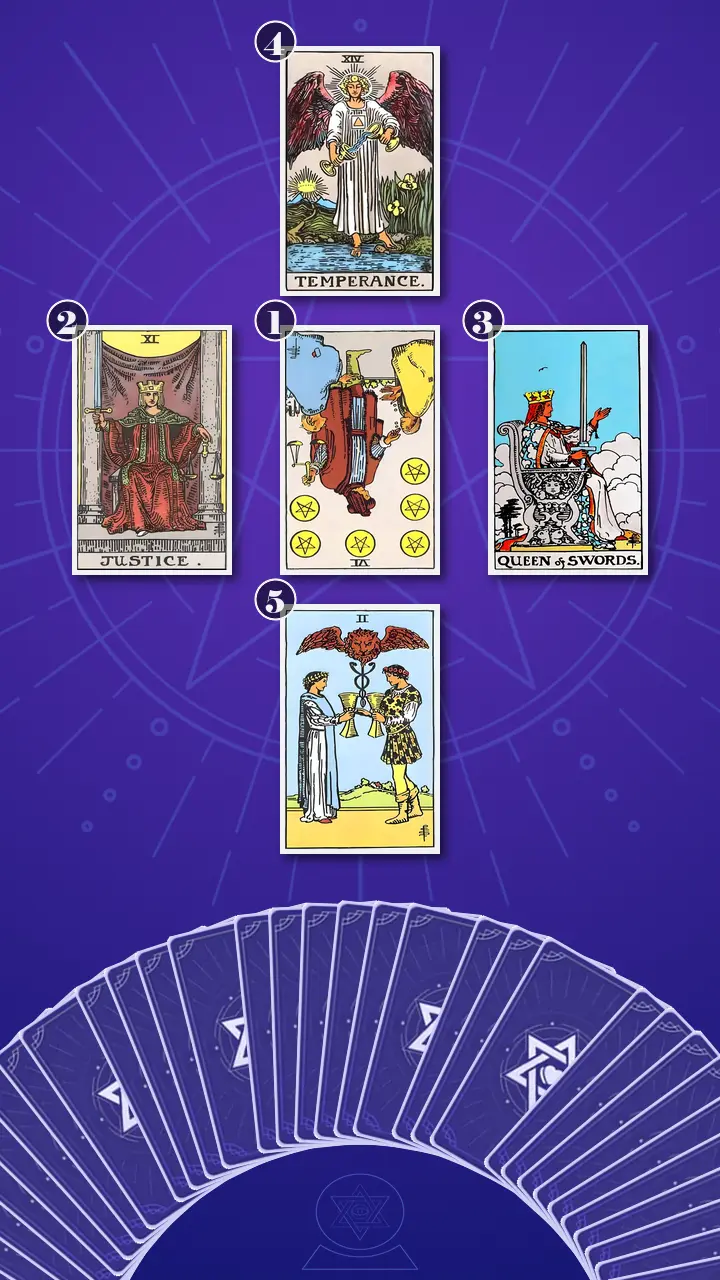
Reading the Map: When Fair on Paper Isn’t Fair in Your Body
Position 1: Present dynamic — Six of Pentacles (reversed)
“Now turning over the card representing the present dynamic: the specific money/resentment knot activated by the ‘Split the bill?’ text,” I said, and laid it down. “Six of Pentacles, reversed.”
I tapped the image lightly, the way I tap a saucer to stop it rattling. “This card is the moment you get the Venmo request after dinner and hit ‘Pay’ instantly to prove you’re easygoing,” I said, “and then later, alone in your room, you reopen the app and re-run the night like an audit: who chose the place, who thanked who, who seemed thoughtful—trying to find the exact second you started feeling undervalued.”
Reversed, the energy here is blocked Earth: giving and receiving gets distorted. Not necessarily because someone is evil—because the terms are unspoken, and the unspoken is where resentment grows roots. A split can be fair on paper and still feel uneven in your body.
Jordan let out a small laugh—thin, a little bitter. “Okay,” they said. “That’s… brutal. Like you just dragged my Notes app into the light.”
“Not brutal,” I replied, keeping my voice warm. “Specific. And specificity is how we stop shame from taking over.” I paused, then asked softly, “When you hit ‘Pay’ fast, what are you trying to prove?”
They didn’t answer right away. Their thumb traced the edge of their phone case. That was the wince-and-nod moment: recognition without self-attack.
Position 2: Option A — Justice (upright)
“Now turning over the card representing Option A: the default response you choose to keep things smooth,” I said. “Justice, upright.”
Justice is the clean policy energy: the scales and the sword. In modern life it’s: “We always split, no exceptions.” It’s orderly, adult, and it calms the nervous system because it removes improvisation. No awkward pause outside the restaurant. No post-date debate in the group chat.
But I pointed to the sword. “Justice isn’t only ‘split 50/50.’ It’s truth-telling.” The energy here is balance—with a risk of becoming a shield. This is the Terms & Conditions version of fairness: you check the box, you keep the vibe safe, but you may also silence the part of you that wants to feel chosen.
“There’s a difference,” I told Jordan, “between choosing equality because it’s your value, and choosing equality because you’re afraid to be disliked.”
They went still for a beat—eyes narrowing like they were reading fine print. “Yeah,” they murmured. “Fair can be… safe.”
When the Queen Raised Her Sword: The One-Sentence Boundary
Position 3: Option B — Queen of Swords (upright) (Key Card)
When I reached for the next card, the café felt quieter, like even the espresso machine had decided to listen. “Now we’re turning over the card representing Option B: the self-respecting boundary that would reduce resentment—especially in how you communicate it,” I said. “This is the bridge in your spread. The hinge.”
I flipped it. “Queen of Swords, upright.”
I looked at Jordan first, not the card. “This is the version of you who deletes the paragraph,” I said. “You start typing a whole explanation—your rent, your budget, how you’re ‘not trying to be weird’—and then you backspace until it’s one clean line: ‘I’m good to split sometimes, but I’d feel more cared for if you grabbed this one and I get next—what works for you?’ Then you stop. You don’t pad it with jokes. You let the response be information.”
Setup: I could feel the familiar loop in them—the one that turns a text message into a referendum on belonging. The fear underneath the resentment was simple and sharp: If I ask, I’ll look high-maintenance. If I look high-maintenance, I’ll be rejected. Their body was already bracing for the moment after hitting “send,” like waiting for a grade.
Delivery:
Stop trying to sound chill while swallowing it—raise the Queen’s sword and name your preference plainly, then let the response give you real data.
I let the sentence hang in the warm, coffee-scented air. No rescuing it with more words.
Reinforcement: Jordan’s reaction came in a three-part wave. First, a tiny freeze: their breath caught, and their hands stopped moving like they’d been paused mid-scroll. Then the cognition landed—their eyes unfocused for a second, as if replaying a dozen receipts and Venmo requests in fast-forward. And then the emotion arrived: a slow exhale that softened their face, followed immediately by a flicker of irritation.
“But that sucks,” they blurted, surprising themself. “Because it means I have to be the one to bring it up. Like—I’m doing the emotional labor again.”
I nodded, because that reaction is real. “I hear that,” I said. “And here’s the part where the Queen is quietly radical: you’re not doing emotional labor to keep things smooth. You’re doing one sentence to keep things honest. Clarity isn’t conflict—it’s data.”
Then I brought in my own lens—my café lens—because this is where my work lives. “I call this a Stress Flavor Profile,” I said. “Resentment is like an over-extracted espresso shot. The beans aren’t ‘bad.’ The water isn’t ‘wrong.’ But the timing is off. You push too much pressure through the moment to avoid a five-second pause, and what you get later is bitter.”
I gestured between us, like the space was a small bar counter. “The Queen adjusts the extraction. One clean sentence. No essay. And then you let their response tell you if this relationship can meet you in reciprocity.”
I leaned in slightly. “Now—with this new perspective—think back to last week. Was there a moment when, if you’d sent one clean sentence instead of ‘sure!,’ your body would’ve felt even 10% different?”
Jordan swallowed. Their shoulders lowered, but there was that brief dizziness you get when you stop clenching and realize how long you’ve been holding your breath. “Yeah,” they said. “On the L train. Phone in my hand. I could feel my jaw lock. I thought being chill was being… good.”
“This,” I said gently, “is a move from tight resentment and silent scorekeeping to steady self-respect. Not a personality transplant. A single practice.”
Position 4: Advice — Temperance (upright)
“Now turning over the card representing advice: how to express the boundary so it stays calm and workable,” I said. “Temperance, upright.”
This is the card that stops the Queen from becoming icy. Temperance is the pour between two cups: blending honesty with warmth, logistics with tenderness. The energy here is balance—not the rigid balance of a rule, but the repeatable rhythm of an agreement.
“Temperance says you don’t need the perfect money policy,” I told Jordan. “You need a rhythm you can repeat in NYC without turning every dinner into a trial.”
I gave them a few realistic examples, simple and non-ideological:
“Alternate dinners.”
“Split mains, rotate who covers tip.”
“For bigger tickets—concerts, weekends—name the plan before you buy: 50/50, or scale it based on income.”
Jordan’s face softened in visible relief—like someone had finally said they didn’t have to solve dating etiquette for the entire internet.
Position 5: Integration — Two of Cups (upright)
“Now turning over the card representing integration: the healthiest relational outcome to aim for internally,” I said. “Two of Cups, upright.”
The modern translation is immediate: after you name your preference, they respond like a teammate—“Yeah, that makes sense. Let me grab this.” And your body gets the message before your brain can argue with it. Shoulders drop. Jaw unclenches. No Splitwise-in-your-head background app draining your battery all night.
The energy here is balance in Water: mutuality you can feel. Not mind-reading a Venmo request for meaning—hearing meaning spoken out loud.
The One-Page Plan: Actionable Advice for Money Boundaries (Without the Essay)
I sat back and let the whole cross come into focus. “Here’s the story your cards told,” I said. “You start in Six of Pentacles reversed—an uneven exchange that’s not always about the number, but about the loneliness of carrying the agreement in your head. Justice offers a clean rule—50/50—to keep things ‘fair’ and keep you safe. But the Queen of Swords is the bridge: one clear sentence that protects self-respect and turns the moment into real information. Temperance keeps it warm and workable, and Two of Cups is the goal—reciprocity that feels like you’re on the same team.”
“Your blind spot,” I added, “is thinking the only options are: be chill and swallow it, or speak up and ruin the vibe. The spread shows a third option: speak cleanly and let the response be data.”
Then I moved us from insight to next steps—small, doable, NYC-real. I also used my own café strategy because money boundaries are nervous-system work as much as language work. In my world, we don’t fix a burned espresso shot by yelling at it. We adjust the process.
- The 20-Second Jaw Unclench (before you reply)When the “Split the bill?” text hits, don’t open Venmo yet. Drop your shoulders, unclench your jaw, and ask: “What do I actually prefer here?” Then reply with one sentence only.If your hands feel restless, set a 20-second timer. A tiny pause prevents a five-day spiral.
- Save Your Queen-of-Swords Script (no-essay reply rule)Create one go-to text you can copy/paste: “I’m good to split sometimes, but I’d feel more cared for if you grabbed this one and I get next—what works for you?” Use it on dates, with friends, or even for roommate expenses.Write it in Notes first. Optional: save it as a keyboard shortcut so you can’t overthink it into a paragraph.
- The Riposo Delay Line (when you’re too activated)If you feel your chest tighten and you know you’ll people-please, buy space: “I’m stepping into the subway—can I reply in 10?” Then step away from the thread and come back calm.I call this Cafe Therapy: a modern riposo. A pause isn’t avoidance; it’s maintenance—like letting an espresso machine reset pressure.
“And if you want a Temperance add-on,” I said, “keep a tiny menu ready: alternate, split mains/rotate tip, or 50/50 tonight and rotate next time. Two options and one question. Collaborative, not ideological.”
Jordan hesitated—then asked the most honest practical question: “What if I can’t even find five minutes to think? I’m always exhausted after work.”
“Then we go smaller,” I said. “Five minutes is a lot in Midtown. Do a five-breath version.” I slid them a small cup of coffee. “Smell. Inhale once. Exhale slow. That’s your nervous system getting out of panic math. Then: one sentence.”

A Week Later: The Quiet Proof
A week later, Jordan messaged me. Not an essay. Just: “I used the one-sentence script. They said, ‘Oh yeah—totally, I can grab this.’ I didn’t spiral afterward. I felt… normal.”
They added a second text, almost shy: “I still woke up the next morning thinking, ‘What if I’m being too much?’ But then I remembered you saying clarity is data, and I didn’t punish myself for it.”
I pictured it clearly—clear but still a little tender: they slept through the night, but their first morning thought still tried to pull them back into old fear. This time, they noticed it… and let it pass.
That’s what a Journey to Clarity usually looks like in real life. Not fireworks. More like a jaw unclenching you didn’t realize was possible.
When you say “sure, let’s split” with a tight jaw and a sinking stomach, it’s not the dollars that haunt you later—it’s the loneliness of having to be easygoing while secretly begging to feel chosen.
If you let yourself be just 10% more honest next time, what would your one clean sentence about money sound like—so you can stop guessing and start getting real data?