Freezing on 'What Do You Need?' The Shift to One Honest Sentence

The “What Do You Need?” Freeze in a Too-Bright Kitchen
You can say exactly what your partner needs in a conflict, but the second they ask “What do you need?” you blank out and default to “I’m fine” (and then spiral later).
Jordan (name changed for privacy) told me that line like they were confessing to a small crime.
They were 27, a junior product designer in Toronto, the kind of person everyone describes as “easy to talk to”—which, in practice, often means “great at holding space while quietly disappearing.” When we met, they had the careful calm of someone who’s already rehearsed the conversation in their head a dozen times… and still doesn’t trust their own words to show up on time.
They described an 8:12 PM Wednesday in their tiny condo kitchen: the range hood humming while they rinsed a mug that didn’t need rinsing. Their partner stood a few feet away, voice gentle: “Okay—what do you need from me right now?” The overhead light felt too bright. Jordan’s jaw locked like a phone that won’t unlock with Face ID. They stared at the faucet as if the running water could generate the correct answer.
“I want closeness,” they said, fingers worrying the edge of their sleeve. “But the second I’m asked for it directly, my body acts like a need is a grenade.”
I watched their throat work like they were swallowing words that hadn’t formed yet. The fear wasn’t dramatic—it was physical: tight chest, shallow breath, a frozen jaw, as if language had to squeeze through a too-narrow gate.
“And then later,” they added, voice flat with exhaustion, “I’m on the edge of the bed with my Notes app open, drafting and deleting for forty minutes. Like… if I can just find the perfect wording, I can fix the moment I failed.”
In my head, I pictured the loop as a scent trapped under a lid: the feeling is absolutely there, but it can’t evaporate into the air where it can be named.
“You’re not the only one who freezes when someone asks what you need,” I told them. “And you’re not broken for it. Today, let’s try something simpler than a ‘perfect answer.’ Let’s map what happens in the moment—so you can find one honest, workable sentence that doesn’t require you to disappear.”

Choosing the Compass: The Four-Layer Insight Ladder Spread
I began the way I always do—not with mystique, but with a nervous-system handrail. I asked Jordan to put one palm on their chest, feel the rise and fall, and take one inhale that didn’t have to prove anything. Then I shuffled slowly, the soft snap of cards like a metronome.
Because I’m a Paris-trained perfumer, I also offered a tiny scent strip—something clean and steady, a whisper of cedar and bergamot. Not “magic,” just sensory psychology: a grounded smell gives the body a reference point when the mind wants to sprint.
“Today,” I said, “we’ll use a spread called the Four-Layer Insight Ladder · Context Edition.”
And for you reading along: this spread is designed for moments like Jordan’s—when the question isn’t about predicting an outcome, but about unlocking a repeatable skill. A classic, sprawling spread like the Celtic Cross can add noise when the problem is a real-time freeze response. The Ladder keeps the minimum structure needed to move from the visible shutdown → the mechanism underneath → the support that’s available → the pivot point → a speakable script you can try this week.
It’s a 2×3 grid that reads like a staircase: each row is a dialogue between what’s happening inside and what’s possible in the relationship. We’d start with the freeze itself, then the mental “trapdoor,” then the deeper emotional root, then what healthy receiving can look like, then the key shift, and finally the practical sentence.
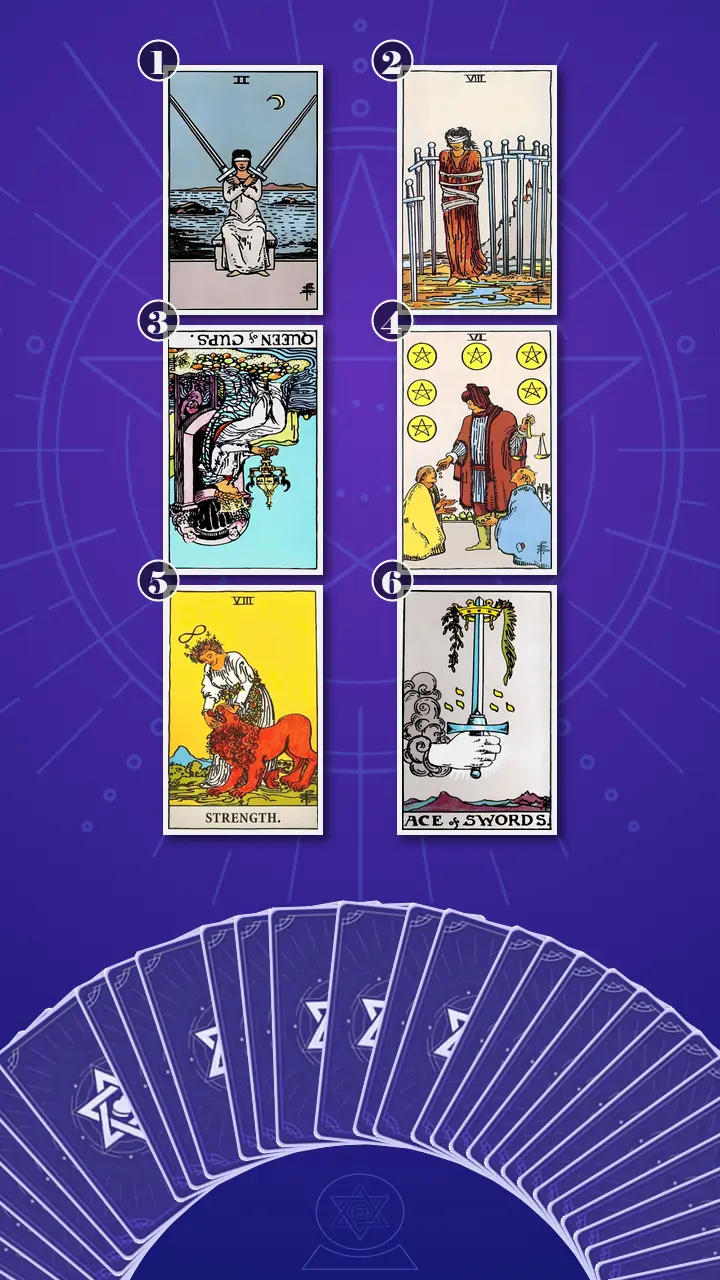
Reading the Map: Where the Words Go Missing
Position 1 — The visible freeze
“Now we’re turning over the card that represents the visible freeze: what happens in the moment your words disappear,” I said.
The card was the Two of Swords, upright.
In modern life terms, this is painfully specific: someone you care about asks, “What do you need?” and you go neutral—face calm, voice small—because you’re trying to keep the peace. Inside, two fears clash: “If I ask for anything, I’m too much” vs “If I don’t ask, I disappear.” You pick silence because it feels like the only way not to tip the relationship.
That’s the Two of Swords energy as blockage: not a lack of needs, but a protective freeze. The blindfold isn’t ignorance—it’s a choice your nervous system makes in a millisecond: don’t look too directly, don’t name it, don’t make a ripple. The crossed swords over the chest are the physical posture of holding your breath to hold the peace.
I leaned in. “This is your body trying to keep closeness and safety open at the same time—like holding two browser tabs, ‘I want closeness’ and ‘I can’t be a burden,’ and the laptop fan starts screaming.”
Jordan let out a short laugh—sharp, a little bitter. “That’s… cruelly accurate,” they said. “Like, yes. That’s exactly what I do.” Their eyes stayed on the table, but their shoulders dropped a fraction, the tiniest exhale of recognition.
Position 2 — The internal trapdoor
“Now we’re turning over the card that represents the internal trapdoor: the immediate thoughts and constraints that tighten your body and block speech,” I said.
The card was the Eight of Swords, upright.
This is the moment your thoughts box you in: the question lands and your mind starts searching for the one ‘safe’ answer—like there’s a hidden script you must find to avoid conflict. You can feel yourself trapped in self-editing: every option sounds wrong, needy, dramatic, or unfair. The longer you think, the tighter your jaw gets, until “I don’t know” becomes the only escape hatch.
The Eight of Swords energy here is excess—too much mental rule-making, too much self-monitoring. It’s like trying to choose the perfect Slack message while your boss is watching the typing bubble. The pressure isn’t just “say something,” it’s “say something that can’t possibly disappoint anyone.”
I pointed at the binding in the illustration. “These are invisible rules. Things like: ‘Don’t be needy.’ ‘Don’t make it worse.’ ‘Say it perfectly or don’t say it.’”
Jordan’s mouth tightened. Their tongue pressed briefly against their teeth like it was stuck behind a gate. They whispered, “Yeah. The rule is… don’t start a fight. Don’t be the reason it gets heavy.” Their shoulders climbed toward their ears, exactly as if the card had reached out and pulled the strings.
“I want you to hear this clearly,” I said, keeping my voice calm. “This isn’t a character flaw. It’s a mechanism. Self-editing became a strategy… and then it became a cage.”
Position 3 — The deeper root
“Now we’re turning over the card that represents the deeper root: the emotional habit and underlying fear that makes needing feel unsafe,” I said.
The card was the Queen of Cups, reversed.
This one often lands like a truth people already knew in their body: you’re deeply attuned to other people’s feelings—tone changes, facial micro-shifts, the whole vibe. But when it’s your turn, your own feelings feel sealed up. You know something hurts (tight throat, heat behind the eyes), yet you can’t translate it into a need without building a case for why it’s valid.
The Queen of Cups reversed is Water energy in deficiency—not because you don’t feel, but because your feelings don’t get treated as authoritative data in the moment. The lid stays on. Under pressure, sensitivity turns inward as self-doubt: “Is this real? Am I being dramatic? Do I have the right to want this?”
I said one of my gentlest reframes—because shame loves to crowd the room at this stage. “You’re not bad at needs—you’re practiced at disappearing.”
Jordan went still. Their breathing paused for a beat (freeze), then their gaze unfocused as if replaying a memory (recognition), and then their eyes glossed, just slightly (release). “I hate how true that is,” they said. “I can translate everyone else in real time. But me? It’s like… my own language pack won’t download.”
As a perfumer, I’ve spent years translating invisible things into language: what “clean” actually means to someone, why “sweet” can feel safe to one person and suffocating to another. I thought about how often people choose a scent that helps them be palatable, not honest. And I asked Jordan, “When you want to be seen as easy, what kind of fragrance do you reach for?”
They blinked. “Something… clean. Like soap. Skin scent. Nothing that takes up space.”
“And when you’re alone and you actually want comfort?”
“Warmer,” they admitted. “Vanilla. Something with depth.”
They looked up then, because that was the point. The contradiction wasn’t theoretical—it lived in their choices. Wanting closeness and support… while fearing that asking for anything will make them a burden or start conflict.
Position 4 — The support channel
“Now we’re turning over the card that represents the support channel: what healthy receiving and mutuality could look like in this interaction,” I said.
The card was the Six of Pentacles, upright.
This card reframes the whole question. Instead of hearing “What do you need?” as pressure, you start hearing it as an offer. The other person is trying to meet you halfway—not grade your emotional skills. When you name something tangible (reassurance, a hug, ten minutes of space, help with one task), the whole interaction gets calmer because care becomes actionable.
The Six of Pentacles is Earth energy in balance. It says: we can make care specific. We can make support measurable. We can do consent + logistics instead of mind-reading.
I offered Jordan a micro-dialogue, because their nervous system needed something concrete:
“Imagine your partner says: ‘Do you want reassurance, space, or help with a task?’ That’s not a trap. That’s a menu.”
Jordan’s forehead softened, just a little. “A menu feels… doable,” they said, like the word itself lowered their heart rate.
“Exactly,” I said. “Clarity isn’t a demand. It’s a map.”
When Strength Held the Lion: The Pivot From Perfect to Honest
Position 5 — The key shift
I slowed my hands before turning the next card. “We’re about to flip the pivot point—the transformation moment. The one that changes the pattern.” The room felt quieter, as if even the street noise outside had turned its volume down.
“Now we’re turning over the card that represents the key shift: the inner quality that lets you stay present and choose honesty over self-protection,” I said.
The card was Strength, upright.
Strength doesn’t tell you to muscle your way into bravery. It tells you something almost irritatingly simple: get brave by staying gentle and present with the fear. Gentle hands on the lion. One slow breath that creates space in the throat. A pause that isn’t an apology.
In my work, I call this part of the process the first phase of an Emotional Repair Pathway: not “fixing the conflict,” but rebuilding enough internal safety to be honest without self-erasing. It’s intimacy repair at the level of the nervous system.
Jordan swallowed. I could see their old strategy trying to boot up: find the perfect, conflict-proof sentence or say nothing. And that’s when the setup became obvious—their most familiar moment:
It’s 10:43 PM and you’re on the edge of the bed with your Notes app open, rewriting the same text again and again—trying to turn that throat-lump into a request that won’t sound “too much.”
Stop treating your needs like a wild lion that must be contained, and start meeting them with gentle hands so one clear sentence can come through.
Jordan’s reaction came in waves, not all at once.
First, their breath caught—an involuntary freeze, like the sentence landed directly on the part of them that thought needing was dangerous. Then their eyes went slightly unfocused, as if their brain started replaying every moment they’d said “I’m fine” while their body was screaming the opposite. Finally, their shoulders loosened in a slow drop, and their jaw unclenched like they’d just realized they’d been biting down for years.
“But… if I do that,” they said, and there was a flash of anger under the fear—quick, clean, honest—“doesn’t it mean I’ve been doing it wrong this whole time?”
I nodded, because pretending that question isn’t there is how people stay stuck. “It means you did what worked to keep connection safe,” I said. “And now it costs you. Strength isn’t shaming you for surviving. It’s offering you a different way: you can be scared and still speak. The pause is not a failure—it’s where you come back to yourself.”
I let the silence do its work. Then I asked, softly but directly: “Now, with this new lens—can you remember a moment from last week where you froze? If you could rewind ten seconds, what gentle hand could you place on yourself first—one breath, a hand on your chest, or simply saying, ‘Give me a moment’?”
Jordan closed their eyes. “Sunday,” they said. “In the kitchen. If I’d had ten seconds, I think I could’ve said… ‘I need reassurance that you’re not done with me.’” Their voice shook on the last words, but it didn’t disappear.
That was the shift in real time: from freeze-and-self-censorship to calm, concrete self-advocacy. Not a personality overhaul—just a new move available in the moment.
Position 6 — The practical sentence
“Now we’re turning over the card that represents the practical sentence: how to translate your needs into clear, doable words this week,” I said.
The card was the Ace of Swords, upright.
This card is permission. One sword = one sentence. The crown = you don’t have to build a court-case of evidence to be allowed to ask for something.
In modern life: instead of writing a paragraph, you offer one clean line someone can actually respond to. “Right now, I need reassurance,” or “I need ten minutes to calm down and then I can talk.” Clarity becomes the bridge back to closeness.
I watched Jordan’s hands twitch like they wanted to grab their phone and draft a ten-line follow-up. “I know your brain wants to over-explain,” I said. “But this is the Ace’s rule: one honest sentence beats a perfect paragraph.”
From Insight to Action: The Two-Sentence Needs Script
I pulled the whole ladder together for them, like threading beads onto a string.
“Here’s the story the cards are telling,” I said. “When the question hits, you freeze on the outside (Two of Swords) because your nervous system equates clarity with risk. Then your mind slams down a set of invisible rules—find the safe script, don’t be needy, don’t make it worse (Eight of Swords). Underneath that, there’s a deeper habit of treating your own emotions like they need permission before they get language (Queen of Cups reversed). The way out isn’t ‘try harder.’ It’s learning that receiving can be mutual and specific (Six of Pentacles), so you can hold the fear with gentleness instead of suppression (Strength), and then use one clean sentence that someone can actually respond to (Ace of Swords).”
“Your cognitive blind spot,” I added, “is that you keep treating the moment like a communication test. As if there’s a single correct answer that will guarantee belonging. But belonging doesn’t come from being effortless. It comes from being real—and being clear enough that someone can actually meet you.”
“The transformation direction is simple,” I said, tapping the Ace lightly. “Shift from searching for the perfect, conflict-proof need to naming one honest, concrete need in a single sentence.”
Jordan made a face—half laugh, half panic. “Okay, but what if I can’t even access it in the moment?”
“Then we build the access,” I said. “Tiny, specific, repeatable. No performances.”
- The 10-Second Check-In (your process sentence)Once a day—not only in conflict—say out loud: “Give me ten seconds to check in with myself.” Practice it while choosing dinner, replying to a text, or deciding whether to go out. You’re training your body that a pause is allowed.If your brain argues “that’s dramatic,” treat it as Eight of Swords noise. Do the five-second version and count it.
- The Notes App List: “Needs I’m Allowed to Have”Make a tiny list with five items only: reassurance, space, help, a softer tone, clarity. Keep it on purposefully short. When you freeze, you’re not inventing needs from scratch—you’re choosing from a list.If you start writing a paragraph, that’s your cue to stop and pick one word from the list.
- The Two-Sentence Script (Strength → Ace of Swords)Set a 7-minute timer to rehearse once this week (yes, rehearse—like a voice note you don’t send). Sentence 1: “Give me ten seconds—I’m checking in with myself.” Sentence 2: “Right now, I need ___” (reassurance / a hug / space for 10 minutes / help with one task / a calmer tone). Add an option B if you want: “If that’s hard, I can take ten minutes and we can try again.”Put one hand on your chest and do a longer exhale before you speak. Your only goal is practice, not performance.
Because Jordan’s system responded so strongly to sensory anchors, I offered one optional add-on from my perfumer toolkit: choose a “pause scent.” Something you only use when you’re coming back to yourself—maybe a small rollerball of lavender or bergamot. Not to make you “calm,” but to give your body a consistent cue: this is the moment I stop auditioning for easy and start practicing clear.
“And if your partner is willing,” I said, “you can make the Six of Pentacles real by asking for a menu. ‘Do you have the bandwidth for reassurance, or do you prefer to give me space?’ Support works better when it has consent and a shape.”

A Week Later: Ownership, Not Perfection
A week later, Jordan messaged me from the TTC—Line 1, heading south, tunnel noise in the background. Their text was short enough that I knew it was real practice, not a rewritten essay.
“Used the process sentence,” they wrote. “Said: ‘Give me ten seconds.’ Then: ‘Right now I need reassurance.’ I didn’t apologize. My voice shook, but I said it.”
They added, almost as an afterthought: “Still felt weird after. But I didn’t spiral for forty minutes. That’s new.”
That’s what I love about this kind of tarot work—especially with the Four-Layer Insight Ladder · Context Edition. It doesn’t promise you’ll never feel fear again. It gives you a map from shutdown to one usable next step, so you can find clarity in real time.
When someone asks, “What do you need?”, it can feel like your throat locks—not because you don’t have needs, but because part of you is still trying to earn belonging by being effortless.
If you didn’t have to find the perfect, conflict-proof answer—what’s one small, concrete need you’d be willing to name in a single sentence this week?