Called Low-Maintenance but Feeling Unseen—Practicing One Timely Ask

Called “Low-Maintenance,” Still Feeling Unseen on the Night Bus
If you’ve ever been called “low-maintenance” right after you swallowed a preference—and you smiled like it was a compliment while your throat quietly tightened.
Jordan (name changed for privacy) showed up to our session from their Toronto bedroom, camera angled like they’d set it up three times and still didn’t trust it. Behind them, I could hear roommates clinking dishes in the kitchen—just enough noise to make silence feel risky. The only sharp light was the little LED from a charger by their bed; everything else was soft, late, and a bit unfinished.
“It was on the TTC,” they told me, rubbing their sternum like they were trying to smooth out a wrinkle from the inside. “Line 1. They texted, ‘you’re so low-maintenance, love that.’ I wrote back, ‘haha I’m chill.’ And then… my chest did that thing. Like I swallowed a pebble.”
I watched their eyes flick down, not quite meeting the lens. The loneliness wasn’t dramatic—no tears, no big story. It was more like the quiet, clinical hum of a fridge at 2 a.m.: constant, easy to ignore, and impossible to un-hear once you notice it.
“I don’t want to be a problem,” they said. “But then I get home, open Notes, draft the text I actually want to send—‘I’d love a check-in tomorrow’—and delete it. I’m ‘chill’ until I’m suddenly not.”
I nodded. “That makes so much sense. We’re not here to shame the ‘chill’ part of you—it protected you for a reason. But today, let’s figure out what part of you goes unseen when you accept that label, and how to make you visible without turning your relationships into a confrontation. Let’s draw a map through the fog—your own little journey to clarity.”

Choosing the Compass: The Four-Layer Insight Ladder Spread
I asked Jordan to take one breath in through the nose and exhale longer than they inhaled—not as a ritual, just a nervous-system handrail. While they did that, I shuffled slowly, the way I used to on long ocean crossings when someone would come to me on a cruise deck at midnight and whisper, “I think I’m about to ruin something good.”
“Today I’m going to use something I call the Four-Layer Insight Ladder · Context Edition,” I said. “It’s a linear six-card tarot spread designed for relationship clarity—especially when the question isn’t ‘What do they mean?’ but ‘What am I doing to be chosen, and what does it cost me?’”
For you reading along: this spread works because it moves in a clean, modern sequence. Card 1 shows the surface role—the persona that gets rewarded. Card 3 drops us into the underlying fear that locks the pattern in place. Then we climb back up through a key reframe and a practical next step, so the reading ends with actionable advice instead of vibes.
“We’re going to lay six cards like a ladder,” I told Jordan, “top to bottom. We’ll start with the ‘low-maintenance’ role you’re playing, then the emotional cost, then the root belief. The fourth card is the hidden heart—what actually wants care. The fifth is the turning point. The sixth is one grounded thing you can practice this week.”
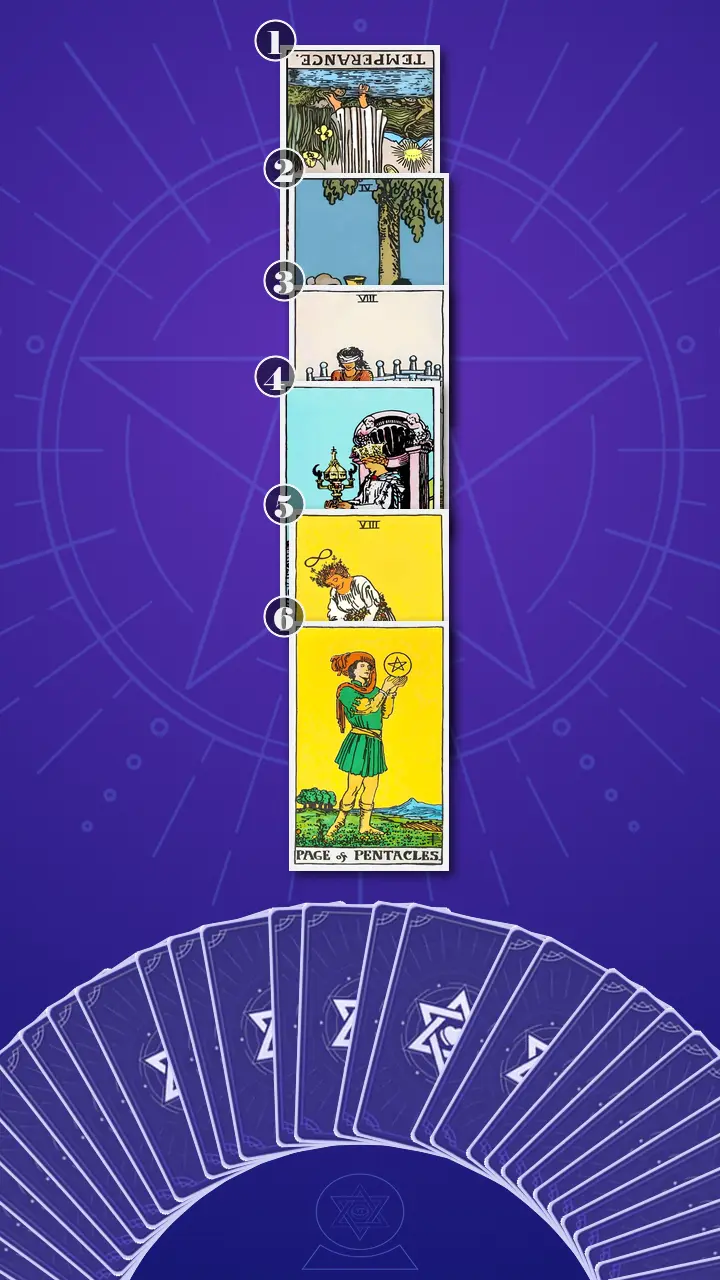
Reading the Ladder: Card Meanings in Context
Position 1: The smooth role you play to stay ‘easy’
“Now we’re turning over the card that represents the surface role you’re playing when others call you ‘low-maintenance,’” I said, and flipped the first card.
Temperance, reversed.
“This is the one that always looks like harmony,” I said, “but reversed it can be harmony-by-erasure.” I described the image—the angel mixing between two cups—and then I translated it into Jordan’s real life: “You’re on a date, they say, ‘I love how low-maintenance you are,’ right after you agree to a plan you don’t want. You keep the vibe smooth by blending your preference out—time, place, pace, texting expectations—then you do the emotional math later and wonder why you feel unseen.”
Reversed, Temperance isn’t balance. It’s over-adjustment. A kind of relational auto-correct where you keep editing yourself so the other person never has to adapt.
Jordan let out a small laugh that didn’t reach their eyes. “That’s… brutal,” they said, and the laugh cracked into something bitter. Their shoulders stayed up near their ears for a beat, then dropped an inch—like their body was admitting the truth before their mouth wanted to.
I leaned in. “Low-maintenance can be a compliment—or a permission slip to not notice you.”
Then I did what I often do when a pattern is hiding in plain sight: I held it up like a split-screen. “Left side: you in real time, smiling, saying, ‘Whatever you want.’ Right side: later that night, thumb hovering over the keyboard, rewriting a simple ask into a paragraph, then deleting it.”
I watched Jordan’s gaze go unfocused, like they were replaying a memory: It’s not a big deal. Then, quieter: It kind of is. Then the familiar cliff-edge: But if I say it… And finally: Never mind.
Position 2: What gets swallowed—and what it costs you
“Now we’re turning over the card that represents what gets minimized to maintain that ‘easygoing’ image,” I said.
Four of Cups, upright.
“This is the card of the unopened notification,” I told them. “A bid for closeness shows up, and you don’t tap it—not because you don’t want it, but because you’ve learned that wanting is dangerous.”
In modern terms: “They give you a tiny opening—‘What do you want to do?’ or ‘Are you okay?’—and you shrug it off with ‘I’m good, whatever.’ Later you feel oddly numb and detached, like you’re watching your own dating life from the outside while the cup of being met just… hovers there.”
Four of Cups is emotional cost as a slow fade. Not a fight. Not a breakup. Just the feeling that intimacy is happening near you, not with you.
Jordan’s hands went still in their lap. Their jaw tightened once, then released. “I always tell myself it’s not a big deal,” they said. “But I keep replaying it.”
“Exactly,” I said gently. “If you were truly fine, your body wouldn’t keep the receipt.”
Position 3: The root fear that freezes your ask
“Now we’re turning over the card that represents the underlying belief or fear that makes it hard to speak up in the moment,” I said.
Eight of Swords, upright.
Eight of Swords is the perfect image for the ‘I can’t’ that’s really ‘I’m terrified.’ A blindfold. Loose bindings. Swords planted like consequences. It feels absolute—even when there’s room to move.
I gave Jordan the translation that always lands with people who live in their Notes app: “You rehearse a simple request for hours—‘Can we set a day for next week?’ ‘Can you check in tomorrow?’—and then decide it’s not worth it. It feels like you can’t ask without consequences, so you pre-limit yourself… and then resent that nobody magically knows you.”
In energy terms, this isn’t a lack of courage. It’s a blockage: your voice gets routed through a threat-detector that overestimates the danger of being real.
I asked, “Finish this sentence honestly: ‘If I ask for what I need, they’ll _____.’”
Jordan stared at the bottom edge of their screen like the answer was printed there. “Lose interest,” they said. “Or… think I’m needy. Like I was a fun, easy version before, and now I’m work.”
I nodded. “That’s the bind. You’re trying to secure belonging by becoming low-friction—like a product experience where the user never hits an error message—except the error is your needs getting silently routed to spam.”
Position 4: The unseen part of you that wants recognition
“Now we’re turning over the card that represents the unseen part of you that wants recognition and care,” I said, and the room—on both sides of the screen—felt a touch quieter.
Queen of Cups, upright.
“This,” I told Jordan, “is the part of you that’s not dramatic. It’s devoted. It’s attuned.”
I described the Queen’s ornate, closed cup. “Her feelings are real, deep, and carefully held—but they’re not automatically visible. No one can respond to what never becomes speakable.”
Then I put it in Jordan’s language: “You’re the one who notices tone shifts, remembers details, tracks response times, senses micro-reactions. People experience you as ‘easy,’ but they don’t realize you’re processing the relationship in high definition.”
I paused and offered the reveal line I use when I can feel someone’s tenderness hiding behind competence: “You’re not low-maintenance. You’re high-attunement—just under-expressed.”
Jordan’s face softened in that unmistakable way—eyes a little wetter, mouth less armored. They didn’t nod right away. They swallowed once, slow. “Oh,” they said, almost annoyed with how accurate it felt. “That’s… the part I keep hidden.”
As a Jungian psychologist, I’ve learned: when a person is called “chill,” it can hook an archetype—the Good, Easy One—so hard that their deeper self gets exiled. The Queen of Cups is that exiled self, waiting to be invited back in.
When Strength Spoke: Warm and Clear, Not Chill and Invisible
Position 5 (Key Transformation): The energy that unlocks movement
“Now we’re turning over the card that represents the key transformation—how you can be both kind and clear,” I said. “This is the hinge card.”
Strength, upright.
The image is simple: a calm figure, a lion, and a gentleness that is not weakness. “Strength isn’t being endlessly easy,” I said. “It’s staying warm while telling the truth. It’s calm self-advocacy.”
Setup: Jordan was stuck in that exact loop: they’d get the ‘so chill’ text, smile, and then end up in bed rereading their own “all good!” message while their Notes app filled with the message they never sent—hoping being effortless would earn them being seen.
Delivery:
Stop proving you’re ‘easy’ by disappearing; start practicing gentle courage, like Strength, and let the lion of your needs be handled with respect instead of silence.
I let it hang there. No rushing to soften it. Just space.
Reinforcement: Jordan’s reaction came in a chain—first the body, then the mind, then the heart. Their breath stopped for half a second, like a door catching on the frame. Their eyes widened just enough to show the hit. Then their gaze drifted off-camera, unfocusing, as if they were replaying every time they’d laughed and said “I’m easy” while their chest tightened. Finally, their shoulders lowered, slow and heavy, and a long exhale left them like they’d been holding it since the TTC text.
“But if I do that,” they said, voice sharper for a moment, “doesn’t it mean I’ve been… doing it wrong? Like I’ve been kind of lying?”
I didn’t correct them. I reframed. “It means you’ve been crossing the relationship without using your own bridge.”
This is where my Bridge-Corridor Theory comes in—an old Venice habit that never left my hands. “In Venice, bridges connect two banks. Some are bright and public; some are narrow and private. What you’ve been doing is staying on your bank, waving warmly, hoping they’ll build the bridge for you. Strength says: you can place one plank. One sentence. Not to force them across—just to make a corridor where the real you can actually be met.”
I added the piece that turns tarot into practical relationship advice: “Your needs aren’t the lion that ruins things. The lion is just power. The risk is pretending it isn’t there and then going numb.”
I asked them—exactly when it matters most—“Now, with this new lens, can you think back to last week: was there a moment when this would’ve let you feel different?”
Jordan blinked, then nodded once, small. “When they asked what I wanted for Friday,” they said. “I could’ve said, ‘I’d love somewhere we can sit and actually talk.’ Instead I said, ‘anything’s fine.’”
“That’s the shift,” I said. “From performing ‘easy/chill’ while feeling quietly lonely to warm, clear self-expression that allows real closeness. Not a personality overhaul—just one honest plank on the bridge.”
Position 6: The grounded next step you can practice this week
“Now we’re turning over the card that represents a concrete next step,” I said, and flipped the last card.
Page of Pentacles, upright.
“Perfect,” I said, and I meant it. “This is beginner energy—practical, measurable, repeatable. No grand speech. One request. One data point.”
I gave them the modern-life scenario: “You treat visibility like a skill: one measurable request, one time. ‘Can we pick a day for next week?’ or ‘Can we do 7:30 instead of 6?’ becomes a rep. You stop hinting and start collecting real data on who can meet you.”
Jordan’s mouth twitched, the first almost-smile. “I can do one rep,” they said. “I can’t do… a whole TED Talk about my feelings.”
“Good,” I said. “We’re not doing a TED Talk. We’re doing a clean sentence.”
The One-Request Experiment: Actionable Advice for Being Seen
I stitched the story of the spread back together for them, top to bottom: Temperance reversed showed how Jordan keeps the connection smooth by diluting their preferences. Four of Cups showed the emotional cost—numbness, that ‘watching from outside’ feeling. Eight of Swords named the rule running in the background: If I ask, I lose belonging. Queen of Cups revealed what’s actually true: Jordan is deeply attuned and wants care, not convenience. Strength redefined power as calm honesty. And Page of Pentacles promised a way out that doesn’t require a personality transplant—just practice.
“Your blind spot,” I said, “is thinking you have to earn closeness by being effortless. But closeness is built through information: preferences, needs, timing. If your needs only exist in your Notes app, no one can meet them.”
Then I gave Jordan a simple framework using my Lace Communication Method—a Burano-inspired rule: precision without extra thread. “Lace holds because it’s clear where each loop begins and ends,” I said. “Your request gets to be one loop. One sentence. No apology. No second paragraph.”
- The 10-Minute AskWithin 10 minutes of making plans (in the same chat), send one no-apology preference: “Can we do 7:30 instead of 6?” or “I’d rather do a place with seats so we can actually talk.”If your brain screams “Don’t be needy,” treat it like an old alarm, not a command. Start with a low-stakes ask (time/place/pacing).
- The Strength Sentence TemplateUse this once this week, exactly one blank: “I like you, and I also need ___ to feel close.” (Examples: “a check-in tomorrow,” “a plan for next week,” “more consistency around texting.”)Keep your shoulders down and your breathing steady. No rushed explaining. Warm and clear beats chill and invisible.
- Phone-Down Nervous System ResetAfter you send the ask, put your phone face-down for 5 minutes. Let your body settle before you check for a reply.If you feel the urge to backpedal or add a smiley, set a 2-minute timer and just notice throat/chest tightness. The goal is exposure to clarity, not forcing a confrontation.
Jordan hesitated, then gave me the real-world obstacle. “But what if they don’t respond,” they said, “and I spiral?”
“Then the experiment still works,” I said. “Silence is also data. You don’t have to argue your needs into existence. You just notice what happens when the real you is in the room.”

A Week Later: The Quiet Proof
Six days after our session, Jordan messaged me a screenshot. One clean line: “Can we pick a day for next week before Sunday?” No apology. No explanation. Under it, a typing bubble. Then: “Yeah—Thursday?”
Their follow-up text said, “I sent it and then sat in a coffee shop alone for like an hour. I felt weirdly shaky and proud at the same time. The first thought the next morning was still ‘what if I’m too much?’—but it didn’t run my whole day.”
That’s what I call clarity in real life: not certainty, but ownership. A small request that stops your inner world from living in drafts. A bridge plank laid with steady hands.
When someone calls you “low-maintenance,” it can land like praise—until you feel that tightness in your throat because what they’re really enjoying is how little they have to adjust to you.
If you didn’t have to earn closeness by being effortless, what’s one small, specific thing you’d let yourself ask for this week—just to see what happens when the real you is in the room?