The Notes-App Legal Brief: The Two-Sentence NYE Text That Sticks
The 8:47 p.m. Notes-App Legal Brief
You’ve rewritten the same NYE text 12 times because you’re trying to sound equally loyal to everyone—and now it’s basically a tiny legal document.
Jordan (name changed for privacy) slid into the chair across from me like they were trying not to take up space. Their phone stayed face-up on the table, screen dimming and waking again in quick little panics. Even before they spoke, I could see the loop: that micro-flinch when a notification lands, the thumb hover, the inhale that never quite becomes a full breath.
They described a very New York Tuesday: 8:47 p.m., overhead kitchen light buzzing, coffee gone cold and bitter on the counter. Friends group chat on one thread—already deep in pregame/midnight/afters logistics. Then a last-minute invite from someone new they actually cared about. Both chats open like two tabs they were afraid to click. “It’s like,” they said, voice tight, “whichever one I choose, I’m proving something bad about myself.”
They looked embarrassed as they admitted the details: drafting and deleting, rereading “Liked” reactions like emotional weather reports, checking response times as if the correct choice would reveal itself in a typing bubble. “I don’t want anyone to feel like I picked them second,” they said. “Why does a party feel like a loyalty test?”
The guilt wasn’t abstract. It lived in their body like a vise around the ribs—tight chest, keyed-up restlessness, the kind that keeps you standing in the doorway of your own night with your coat on, waiting for permission to exist.
“You’re not undecided,” I told them gently. “You’re trying to make the choice consequence-free. And that’s… such a human thing to try.”
I let a beat of quiet settle between us, the city’s distant siren sliding by like a reminder that time keeps moving whether we answer texts or not. “Let’s try to give this fog a map,” I said. “Not a perfect plan. Clarity.”

Choosing the Compass: The Decision Cross Tarot Spread
I asked Jordan to take one slow breath—not as a ritual for the universe, but as a reset for the nervous system. Then I shuffled, steady and unhurried, the way I do when someone’s mind is running faster than their heart can keep up.
“For this,” I said, “I want to use a simple layout called the Decision Cross.”
If you’ve ever wondered how tarot works in a practical situation: this is one of my favorite examples. A minimal spread keeps the brain from building a thousand escape routes. The Decision Cross separates two options cleanly (friends vs. them) and—crucially—gives the guilt its own seat at the table. Because when you’re dealing with people-pleasing and decision fatigue, the real problem usually isn’t the calendar. It’s the hidden rule you’re living by.
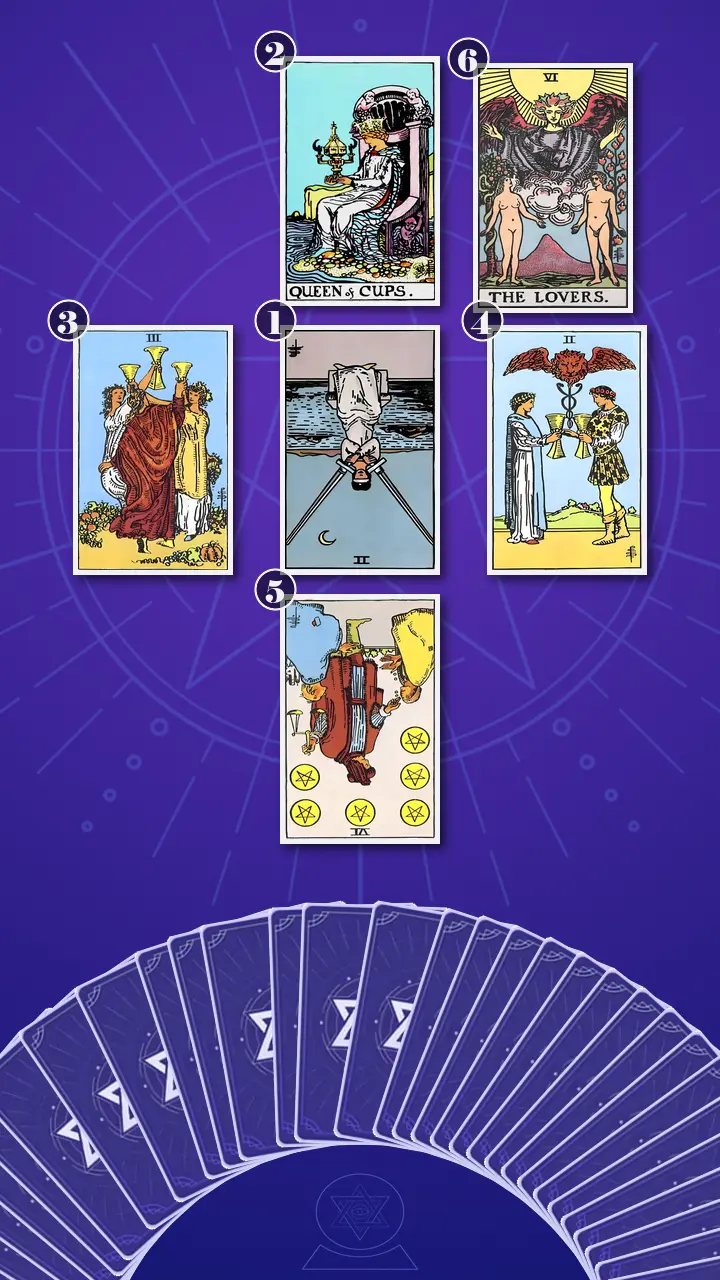
“We’ll start with the current knot—how the stuckness shows up in your actual behavior,” I said. “Then we’ll pull your inner truth—what you need to choose without self-betrayal. After that, we’ll look at each path, and finally, we’ll name where the guilt comes from and the cleanest next step.”
Reading the Map: Two Open Tabs, Two Real Needs
The Current Knot (Position 1): Two of Swords, reversed
“Now we’re turning over the card that represents the current knot: the exact way indecision and guilt show up in your behavior right now.”
Two of Swords, reversed.
Right away, it matched the modern scene perfectly: Jordan standing in their NYC kitchen with two message threads open—friends group chat on one screen, the NYE invite on the other—rewriting the same reply over and over. Not neutrality. Bracing. The blindfold in the classic image is that refusal to look at what you actually want, because preference feels dangerous. The crossed swords held tight to the chest? That’s defensive fairness—“I must be fair”—turning into a physical clamp.
Energetically, reversed here is Air in excess and in blockage: thoughts multiplying, no landing. Like drafting a Slack update for 25 minutes so nobody can read you as rude… and then hating it anyway. The longer you stall, the more your nervous system pays the price, because the decision doesn’t pause—only your ability to breathe does.
I leaned in a touch. “I want to use a contrast technique I call a ‘two-screen check,’” I said, slipping into the kind of calm analysis that keeps shame from taking the mic. “One screen is your Notes app turning into a courtroom.”
“Exhibit A: their invite. Exhibit B: the group chat. Exhibit C: the hypothetical disappointment. And you’re trying to win a case where the judge is… everyone’s mood at midnight.”
Jordan gave a small laugh that had a bitter edge to it. “That’s… yeah. That’s exactly it. It’s kind of brutal hearing it out loud.” Their leg bounced once, twice, then slowed, like their body recognized itself in the description.
Your Inner Truth (Position 2): Queen of Cups, upright
“Now we’re turning over the card that represents your inner truth: what you actually need to choose without self-betrayal.”
Queen of Cups, upright.
In modern life, this is the moment Jordan puts the phone down and checks in with their body before checking reactions. The Queen’s lidded cup matters here: feelings are real without being performed. You don’t have to turn your emotions into a public argument for them to count.
Energetically, this is Water in balance—self-attunement. It softens the Two of Swords’ mental lock. I asked, “If nobody could be mad at you—if your friends weren’t a jury and your date wasn’t a verdict—what would you want NYE to feel like in your body?”
Outside my window, the city sounded like it always does: distant traffic, a laugh from the sidewalk, the low hum of other people living. Inside, Jordan’s shoulders dropped a fraction. They didn’t look at their phone. They looked down at their hands.
“Quieter,” they admitted. “More… intentional. I love my friends. But I’m tired of performing ‘best night ever.’”
I nodded. “That’s Queen of Cups. Not anti-friends. Just honest.”
Path A — Friends (Position 3): Three of Cups, upright
“Now we’re turning over the card that represents Path A (friends): what this choice offers and what it asks of you emotionally and socially.”
Three of Cups, upright.
The card felt like a Partiful invite in picture form: slipping into a familiar ritual—pregame apartment, shared playlist, midnight group photo, inside jokes that start before you even get there. This is real belonging. Warm. Loud. A circle you don’t have to explain yourself to.
But energetically, it can also be Water in excess—group momentum. The raised cups are joy, but they’re also expectation: show up as the version of you that keeps the circle intact. If you choose this path, the question becomes: are you saying yes because it lights you up, or because you’re afraid of missing the inside jokes and the photos that become “proof of belonging”?
Jordan nodded quickly, like I’d named something they’d been pretending not to know. “It’s the photos,” they said, almost whispering. “I hate that it’s the photos.”
“No shame,” I said. “NYC social life can turn even a normal night into a public narrative. That’s not you being shallow. That’s you being human in 2026.”
Path B — Them (Position 4): Two of Cups, upright
“Now we’re turning over the card that represents Path B (them): what this choice offers and what it asks of you emotionally and socially.”
Two of Cups, upright.
This path is a different texture entirely: fewer people, more presence. It’s not a ‘better’ night—it’s a different kind of connection that can’t be replicated in a group setting. It asks Jordan to be clean about the yes: “I’m choosing this with you,” without buffering it with “but I’ll also try to…”
Energetically, this is Water in balance again, but in a one-to-one form—mutuality, mirrored effort, directness. It’s the difference between being in a loud circle where you’re part of the chorus and being across from someone who’s looking you in the eye.
I watched Jordan’s face soften at that. Then the old fear flickered back in. “But then my friends will think I’m ditching,” they said. “Like I’m choosing a new person over them.”
“This isn’t ‘friends vs them,’” I said, keeping my tone steady. “It’s ‘what kind of connection am I practicing this year?’ Both are real needs. You’re not immoral for having more than one.”
The Guilt Mechanism (Position 5): Six of Pentacles, reversed
“Now we’re turning over the card that represents the guilt mechanism: the underlying belief or imbalance that makes the decision feel like a moral verdict.”
Six of Pentacles, reversed.
Jordan’s guilt, plain as day: an invisible social accounting system. Who invited you last. Who will notice. Who might keep score. NYE becomes a currency exchange—time traded for approval—and you try to overpay (splitting the night, long explanations) so you don’t feel like you’re in debt to anyone’s disappointment.
Energetically, this is Earth in blockage: stability and reciprocity turning into transactional belonging. And I said the line I’ve learned people need to hear when they’re stuck in this pattern:
When time turns into currency, every invite starts to feel like a debt.
Jordan winced, then let out a short laugh. “I literally did the math,” they admitted. “Like—‘they came to my birthday, I owe them this.’ I even looked at Venmo and felt weirdly… audited.”
“That’s the card,” I said. “Not because you’re calculating on purpose, but because your nervous system thinks belonging is something you have to buy.”
The room felt quieter for a moment. The buzzing overhead light in my studio suddenly seemed louder, like the environment was conspiring to underline the truth: you can’t spreadsheet your way into being loved.
When The Lovers Replaced the Apology Essay
Integration Move (Position 6): The Lovers, upright
I let my hand rest on the deck for a second longer than usual. “We’re flipping the most important card now,” I told Jordan. “This is the integration move: the cleanest next step that aligns with your values and reduces future resentment.”
The Lovers, upright.
The card’s image is open—witnessed. No blindfold. No hidden ledger. An angel overhead like a reminder that alignment is less about being liked in every direction and more about being honest in one direction.
Setup. I could feel Jordan right back at that kitchen counter: cold coffee, two open threads, rewriting “I’m so sorry” like it was the only safe opener. Their chest tight because they were trying to predict everyone’s reaction before they were “allowed” to choose.
Delivery.
Stop treating NYE like a loyalty trial, choose the connection you want to practice, and let The Lovers’ open, blessed ‘yes’ replace apology-driven explaining.
Reinforcement. Jordan’s body reacted before their mind could edit it. First: a freeze—breath caught, fingers still, eyes fixed on the card like it had just said their name. Second: the cognitive seep—their gaze went slightly unfocused, like they were replaying every draft they’d written, every “maybe I can do both,” every paragraph that was really a request for permission to be loved. Third: the emotional release—an exhale that sounded almost like a laugh but wasn’t, shoulders dropping as if someone had finally unhooked a weight from the back of their neck.
Then, unexpectedly, the release turned into a flash of anger. “But if I choose,” they said, voice sharper, “doesn’t that mean I’ve been doing it wrong? Like—have I just been… manipulating everyone with apology texts?”
I didn’t flinch. “It means you’ve been trying to survive social uncertainty by controlling the outcome,” I said. “That’s not villain behavior. That’s a nervous system that learned, somewhere along the way, that disappointment equals danger.”
I paused, then anchored it for them—because this is the actual pivot point in a tarot reading for decision-making without guilt. “You don’t need a guilt-proof choice. You need a values-based choice—and a message that doesn’t negotiate your worth.”
As an artist, I think in scenes. And The Lovers always makes me think of classic film moments where the point isn’t romance—it’s integrity. “Have you ever watched Casablanca and felt that ache in the airport scene?” I asked. “Not because anyone ‘wins,’ but because someone chooses what they stand for, without a speech to make it painless.”
Jordan’s eyes watered a little at that. “Yeah,” they said quietly. “And it still hurts.”
“Exactly,” I said. “Clarity doesn’t erase discomfort. It gives the discomfort a backbone.”
I leaned forward. “Now—use this new lens and look back at last week. Was there a moment you were about to send the apology essay? A moment when a clean yes would’ve been kinder than a guilty maybe?”
Jordan nodded once, slow. “Sunday,” they said. “I drafted three paragraphs. I didn’t send anything. I just… disappeared.”
“That’s the shift,” I said. “From managing reactions to grounded self-trust. Not perfect confidence. Just an honest spine.”
Two Sentences, One Clarification: Next Steps for NYE
I gathered the whole spread into one story for them—the kind that turns tarot card meanings in context into something you can actually do on a Tuesday night.
“Here’s what I see,” I said. “You start in Air: mental stalemate, trying to keep the peace by doing nothing. Then Water shows up: what you actually need is permission to want what you want. The two paths aren’t moral opposites—one is circle belonging, one is one-to-one intimacy. Then Earth reveals the trap: treating time like currency, like you have to pay for belonging. And The Lovers closes it out with the adult truth: choose based on your values, communicate cleanly, and let relationships flex.”
The cognitive blind spot was clear: Jordan kept treating a normal scheduling conflict like a referendum on their loyalty. The transformation direction was just as clear: shift from preventing disappointment to choosing by values—and communicating without overexplaining.
Jordan swallowed. “Okay,” they said. “But I can feel the panic right before I hit send. Like I have to add one more sentence so nobody hates me.”
“That’s the moment to practice,” I said. “And we’ll keep it painfully simple.”
I call this my Iconic Line Diagnosis: when you’re trapped in overexplaining, you pick one line—one sentence—that captures your value, the way a great film does without a monologue. Not to text to anyone. Just to steer you. For Jordan, it was: A clean yes is kinder than a guilty maybe.
“Now we make the plan as clean as that line,” I said. “Two sentences. One clarification max. Then you let people have their feelings.”
- The One-Check-In Pause (90 seconds)Before you reply to anyone, set a 90-second timer. Hand on chest or belly. Ask: “If nobody could be mad, what would I choose for NYE?” Write the first answer in Notes without editing.If your brain starts building arguments, stop. This is a check-in, not a verdict—come back later and do another 90 seconds.
- No Two Locations RuleDecide: you will not do two stops. Even if Citymapper says it’s possible. Pick one anchor for the night: “Where am I at midnight?” Everything else becomes optional, not promised.If you feel the urge to “make it fair,” ask: “Is this connection… or is this compensation?”
- The Two-Sentence Text Rule (send within 24 hours)Write and send: “I’m doing NYE with [X/friends] this year. Love you—I’m in for [specific plan] on [date/time] if you want.” If someone asks logistics, you clarify once—then stop defending.After you hit send, put your phone face down for 10 minutes. Let the reassurance-urge crest and pass without feeding it.
Because Jordan is in marketing—because their mind loves a soundtrack—I added a small bonus from my Vinyl Playlist Suggestions strategy: “Pick three steady songs for the 10-minute phone-down window,” I told them. “Not hype tracks. Not heartbreak spirals. Something that says: I can feel discomfort and still stay here.”

A Week Later: Ownership, Not Certainty
A week later, Jordan DM’d me a screenshot: the two-sentence text, sent. No apology preamble. No paragraph. The message underneath from their friend: “Love you. Have fun. Brunch Jan 1?” Under that, a simple heart from the person they were seeing. Not a fireworks show. Just… relationships flexing like they’re allowed to.
They told me something else, too—small but real. “I slept,” they wrote. “Like, a full night. Woke up and still had the ‘what if I messed up’ thought. But I didn’t spiral. I made coffee and laughed at myself a little.”
That’s the Journey to Clarity I trust most: not instant certainty, but a nervous system that finally unclenches enough to enjoy the night you’re actually living.
When you’re stuck between two invites, it can feel like your chest is in a vise—not because you don’t care, but because you’re trying to guarantee belonging by managing everyone’s feelings at once.
If you let this be a values choice—not a loyalty trial—what would your cleanest, kindest two-sentence text sound like tonight?
Every reading at AceTarot is a journey to connect with inner wisdom and empower your next step. The stories shared here are psychological mirrors, not private records—crafted to reflect universal emotional loops and help you find your own clarity. Learn more about our Journey to Clarity.
Author Profile