"Also I’m with Jamie lol"—And the Boundary Text That Named It a Date

King West, Heat Lamps, and the Text That Made Your Face Go Hot
You’re a 20-something Toronto professional who can run a meeting like it’s nothing, but one weird dating moment turns you into a Notes-app poet drafting five versions of the same text—hello, overthinking spiral.
Casey (name changed for privacy) sat down across from me with her phone already in her hand, screen brightness turned low like it could hide the whole situation. Even before she spoke, I could see it in her body: that “I’m fine” smile hovering while her throat worked like it was trying to swallow a sentence that wouldn’t go down.
She described it like a scene she couldn’t stop rewatching. A Friday night on a King West patio—heat lamps ticking softly, glasses clinking, the air smelling like fryer oil and perfume. She arrived a minute early, the kind of early that says I care, and then her phone buzzed: “On my way!” followed by, “Also I’m with Jamie lol.”
“I laughed,” she told me, and the laugh she did in my room was the same one she’d used that night—too bright, too quick. “Like it was totally normal. And it was… humiliating? Not even mad first. Just—hot. My face got hot.”
Her words sped up the way they do when someone is trying to sound rational about something that landed in the nervous system first. “I don’t want to make it a thing, but it was definitely a thing. Maybe I’m overreacting, but also… who brings a friend to a date?”
I watched her thumb hover over her Notes app, the way a person hovers over a stove they already know is on. Her confusion wasn’t abstract—it was physical: a tight throat, a hot, tense face, like her body had hit “mute” at the exact moment her mind needed a first sentence. And underneath it was the core bind: she wanted respect and clarity in dating, but she was terrified that asking for it would make her seem “too much” and cost her the connection.
I leaned forward slightly, keeping my voice warm and plain. “Wanting a real date to be one-on-one isn’t dramatic. It’s just… a date.”
She exhaled like that sentence had been sitting on her chest.
“Let’s try something together,” I said. “Not to predict your entire love life. Just to find clarity for what boundary you set next—so you can speak cleanly, and trust yourself no matter how they respond.”

Choosing the Compass: A Five-Card Cross for Relationship Boundaries
I invited Casey to take one slow inhale, then a longer exhale—long enough to tell her nervous system, we’re not on that patio anymore. While she breathed, I shuffled the deck the way I always do: steady, not theatrical. The point isn’t magic. The point is focus—giving your mind a container so it stops free-floating into worst-case stories.
“For this,” I told her, “we’ll use a Five-Card Cross.”
For readers who wonder how tarot works in a moment like this: I chose this spread because it’s structured without being overwhelming. This isn’t a question that needs a full Celtic Cross and ten layers of history. It’s a relationship-boundary question at a very specific crossroads: something awkward happened, you froze, and now you need language and a grounded next step. The Five-Card Cross keeps the arc tight while separating what matters:
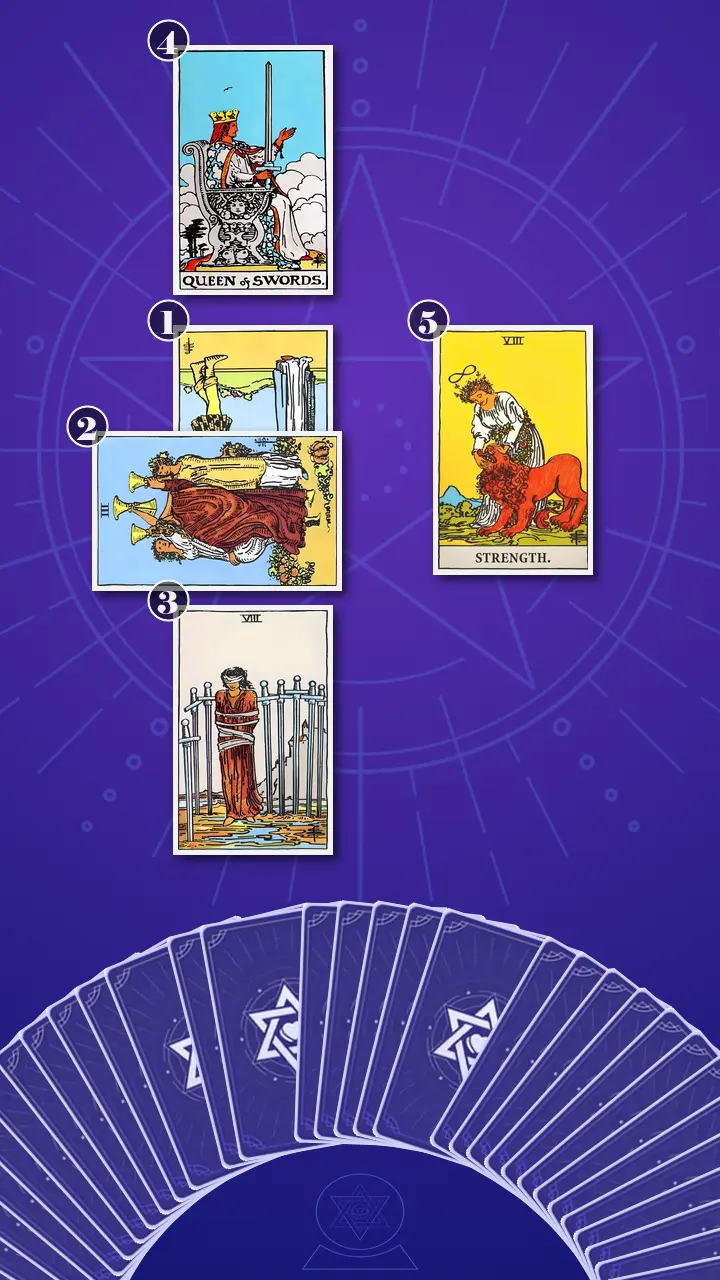
It shows (1) the visible situation you keep replaying, (2) the real friction underneath, (3) the deeper self-silencing driver, (4) the boundary voice you’re being asked to embody, and (5) how to stay steady after you say it—without chasing reassurance.
“We’ll read it bottom-to-top and then out to the right,” I said, placing the cards in a clean cross. “Like lifting your voice… and then choosing what you do with the information.”
From Crowded Cups to Clear Air: Card Meanings in Context
Position 1 — The Moment You Keep Replaying
“Now flipped over,” I said, “is the card that represents how the ‘friend on the date’ situation is currently being interpreted and replayed.”
Two of Cups, reversed.
I kept my tone practical. “This is the card of mutuality—two people meeting each other with the same intention. Reversed, it’s not necessarily ‘bad.’ It’s more like the signal gets distorted.”
I looked at Casey, then at the card again. “In real life, this often shows up exactly like what you described: you walk into what you thought was a one-on-one date, and you realize—mid-smile—that you’re the only one holding it like a date. After, you reread the invite text, replay the conversation, and keep asking yourself if you’re ‘allowed’ to want more intention than that. You start drafting a message that sounds chill enough to not scare them off, even though your body knows it didn’t feel mutual.”
“Energetically,” I added, “this is blocked water. The connection impulse is there, but the container is unclear. Instead of feeling met, you start adjusting to them.”
Casey let out a small laugh—sharp at the edges, like it surprised even her. “That’s… too accurate,” she said, and her eyes flicked down to her phone. “Like, it’s honestly kind of brutal.”
I nodded. “Not brutal. Specific. And specificity is how we get unstuck.”
Position 2 — What’s Truly Disruptive Here
“Now we turn to the card representing what’s truly disruptive here—third-party energy, mixed signals, disrespect, or blurred expectations.”
Three of Cups, reversed.
“This card is celebration and friendship when it’s upright,” I said. “Reversed, it can highlight exactly what happened: a third person changes the entire container. It gets louder, more performative, and suddenly you’re monitoring who’s included instead of enjoying intimacy.”
I let the image do some of the talking. “It’s like trying to have a real conversation while someone keeps adding people to the group chat. You booked a two-top and they turned it into a drop-in hang.”
“And the tension isn’t ‘their friend is evil,’” I continued, careful and fair. “It’s that your date container was diluted without your consent. That’s why it keeps replaying. Your system is trying to solve: Was I being chosen… or slotted?”
Casey’s jaw tightened, then released. She nodded once—small, decisive. A quiet “oh” moved through her chest before she even spoke, the kind that says the truth just landed.
“I hate that I’m still thinking about it,” she admitted. “I keep reading the ‘lol’ like it’s a code.”
“That’s your mind trying to do risk management,” I said gently. “A very normal response in early dating boundary confusion.”
Position 3 — The Root Driver Under the Freeze
“Now flipped,” I said, “is the card that represents the underlying fear/belief that makes it hard to speak up in the moment.”
Eight of Swords, upright.
“This is the freeze card,” I said simply. “Not because you’re weak. Because your brain predicts consequences.”
I watched Casey’s shoulders rise half an inch as if bracing for impact. “In real life, this is: your throat tightens, your face gets hot, and you go still—not because you don’t know what you want, but because your mind starts mind-reading. It opens seventeen tabs of worst-case outcomes and you can’t click ‘send.’”
“The Eight of Swords is a deficiency of perceived options,” I explained. “The bindings are loose. You actually do have choices. But your nervous system doesn’t believe it’s safe to move.”
Casey looked at the card and then away, like she’d just remembered a moment on that patio when her mouth had gone dry.
“In the moment you went quiet,” I asked, “what were you trying to prevent—awkwardness, being judged, or the possibility they’d decide you’re ‘too much’?”
She didn’t answer right away. Her fingers curled around her phone, then loosened. “All of it,” she said finally. “Mostly… being judged.”
I felt that familiar ache of recognition. In the Highlands, we’d call this a weather front: not the storm itself, but the pressure shift that tells the body to brace. In cities, it looks like a woman who can speak in a boardroom without blinking—but can’t find one sentence when her belonging feels at risk.
Position 4 — The Boundary Voice You’re Being Asked to Embody
I let the room get quieter before turning the fourth card. “We’re flipping the most central card now,” I said. “The one that defines the boundary to set and the communication tone that honors self-respect without escalation.”
Queen of Swords, upright.
I could feel Casey tense, anticipating some complicated script. Her brain was already halfway into the TTC, Notes app open, rewriting “Hey” into five different personalities.
“Here’s what this card says in modern life,” I told her. “You stop trying to sound like the easiest person to date and send one clean message that doesn’t apologize for having a standard: ‘I’m into seeing you. If it’s a date, I prefer it to be just us—are you down for that?’ No jokes cushioning it. No over-explaining.”
Then I slowed down, because this is where clarity can sting before it soothes.
Stop auditioning for “easygoing” and start speaking with clean precision—the Queen of Swords holds the line with one sharp sentence and no extra apologies.
There was a pause where even the building sounds felt farther away.
And this is where I used my Relationship Pattern Recognition—my way of spotting the recurring emotional script behind the surface moment. “Casey,” I said, “this isn’t just about one date turning into a group hang. This is a pattern your system knows: you get put in a situation where you have to choose between being ‘pleasant’ and being ‘precise.’ And your old script says, be pleasant now, earn the right to be precise later.”
“But the Queen of Swords doesn’t earn the right to have a need,” I continued. “She assumes her needs are normal. She doesn’t make a case. She names a standard.”
Casey’s reaction came in a small chain—three steps, clear as day. First, her breath paused, like her body had hit a tiny freeze. Second, her eyes unfocused for a moment, like she was replaying every text she’d softened with ‘lol sorry if this is weird.’ Third, a shaky exhale escaped and her shoulders dropped, just a little, as if the weight of performing ‘chill’ had finally been set down.
“But if I say it like that,” she said, voice tight with something that was half fear, half anger, “won’t I sound… needy?”
I didn’t flinch. “That question is the Eight of Swords talking,” I said. “It’s trying to pre-manage their reaction.”
“Clarity doesn’t need a five-paragraph apology,” I added. “And—this matters—a boundary isn’t a debate. It’s information.”
I asked her, “Right now, if you imagine sending one clean sentence, what feeling shows up first—relief, fear, or embarrassment? And where does it land in your body?”
“Relief first,” she admitted. “Like my chest would finally have space. And then fear. Right in my throat.”
“Good,” I said softly. “That’s the shift beginning: from embarrassed freeze toward clean self-validation—‘my needs are normal’—and calm directness.”
Position 5 — Holding Steady After You Speak
“Now we turn to the last card,” I said, “representing the healthiest next step and how to stay grounded after you set the boundary, regardless of their reaction.”
Strength, upright.
“This is not the card of winning,” I said. “It’s the card of holding yourself.”
I connected it to her real life without romanticizing it. “After you set the boundary, the real work is what you don’t do: you don’t send three follow-ups, you don’t pre-emptively soften it, you don’t chase reassurance. You stay warm, but steady. Phone face down. Shoulders drop. Their response becomes information, not a referendum on whether you deserve connection.”
“Strength is balanced fire,” I explained. “Courage without adrenaline. Warm firmness.”
Casey nodded again, slower this time. Her fingers relaxed from the death-grip they’d had on her phone since she walked in.
The One-Page Boundary Plan: From Insight to Actionable Advice
I gathered the spread into a single thread, the way I’d gather wind, rain, and light into the truth of a season.
“Here’s the story these cards tell,” I said. “Reversed Cups at the start: you wanted a one-on-one date, but the container got muddied—mutuality blurred, then crowded by third-party energy. That’s why you’re feeling stuck and replaying it. Then the Eight of Swords: your body froze because your mind predicted rejection if you asked for basic respect. The Queen of Swords is the antidote: one clear standard, spoken cleanly. And Strength is the follow-through: staying steady afterward, letting their response be data—not a verdict.”
“Your cognitive blind spot,” I added gently, “is believing you have to be ‘low-maintenance’ to deserve belonging. That makes you treat clarity like escalation.”
“The direction we’re moving,” I said, “is simple and brave: shift from auditioning to be easygoing to stating one clear expectation—and letting their response provide information.”
I offered her a practical plan—small steps, no dramatic overhaul.
- The Two-Sentence Send (Queen of Swords)In your Notes app, write one version only: two sentences max, and include the word date and one-on-one. Example: “I had fun seeing you. For dates I prefer it to be just us—are you up for that?”Read it out loud once. If it sounds harsh, soften the tone (add warmth), not the standard (don’t remove one-on-one).
- Breath Sync Before You Hit Send (Warm Firmness)Do my couple breathing sync exercise—solo version: inhale for 4, exhale for 6, three rounds. Then place one hand on your chest and ask: “Am I communicating… or pre-apologizing for having a need?”If you feel your throat tighten, wait 7 minutes (timer on), then send the same two sentences without adding disclaimers.
- Hands-Off-The-Phone Pause (Strength)If you choose to send, put your phone face down for 10 minutes immediately after. Do one physical reset: refill water, wash dishes, or walk around the block.If you want to double-text, write it in Notes and wait 24 hours. Treat the urge as stress—normal, but not a command.
- The Date Container Rule (Reversed Cups Lesson)For the next month, keep one rule in your Notes app: “If it’s a date, it’s 1:1. If it’s a hang, it can be group.” Before the next plan, ask one clarifying question: “Is this just us?”Short is kinder. Long explanations reopen negotiation.
“If they want to see you again,” I said, “choose a container that supports intimacy. A simple shared meal—coffee, ramen, anything easy—can be a grounding boundary without a lecture. You’re not punishing them. You’re selecting the kind of connection you’re available for.”

A Week Later: The Quiet Proof of Finding Clarity
A week later, Casey messaged me. No essay. Just a screenshot of a text bubble—clean, two sentences, the word date right there in the open. Under it she wrote: “Sent it. Phone face down. Walked to Queen Street and back. Didn’t die.”
Then she added, “Woke up the next morning and my first thought was still ‘what if I was too much?’—but I kind of smiled. Like… okay. Even if I am, I’m allowed.”
That’s the journey to clarity I care about: not certainty, not control—just the steady return of self-trust. The moment you stop negotiating yourself down, you can finally see what’s aligned without squinting.
When you’re sitting at what was supposed to be a two-person table and it quietly turns into a group hang, it’s not just awkward—you can feel your throat tighten because you’re weighing respect against the fear of being seen as ‘too much.’
If you let yourself stop trying to be ‘low-maintenance’ for one minute—what’s the single, simplest expectation you’d actually like to name next time?
Author Profile