The 11:38 PM PTO 'Submit' Hover—and the Two-Sentence Boundary

Finding Clarity in the 11:38 p.m. “Submit” Hover
If you’re a late-20s PM in a fast-moving Toronto tech team and you’ve reopened the PTO request page three times tonight, you already know the specific flavor of guilt that comes with a simple “request”—aka PTO anxiety.
Jordan (name changed for privacy) angled their laptop toward me on our video call like they needed a witness. The PTO portal sat open in the blue glow, and their phone kept lighting up with the Google Calendar team overlay—refresh, refresh—like the fifth time would magically reveal a week where nobody needed them.
Behind them: a condo kitchen near King West. The fridge hummed. The overhead light made everything feel slightly too sharp. Even through the screen, I could see it in their body—jaw locked like they were bracing for impact, shoulders subtly lifted as if Slack could physically grab them by the collar.
“The request is due,” Jordan said, voice low, like we were talking about a confession. “My family is doing this thing next month. It’s one of those weekends where if I’m not there, I’m not there. But work… it’s packed. And it’s understaffed. And I don’t want anyone to think I’m choosing my life over my job like that’s a character flaw.”
Guilt, on Jordan, didn’t look like tears. It looked like a cursor hovering over “Submit” the way you hover over an unread message you’re afraid will change the whole mood of your night—like the button could stamp you “less committed” in permanent ink.
I softened my voice the way I do when I can tell someone’s nervous system has been doing unpaid overtime. “I’m with you. We’re not here to judge whether you’re a ‘good’ employee or a ‘good’ family member. We’re here to find clarity—what’s fair, what’s true for you, and what one clean next step looks like.”

Choosing the Compass: The Decision Cross · Context Edition Spread
I asked Jordan to take one slow breath—not as a mystical ritual, just as a gear shift. “Let your shoulders drop a millimeter,” I said. “Keep the question simple in your mind: ‘How do I choose PTO without guilt—and communicate it clearly?’”
While they shuffled, I explained what I was doing for anyone reading along who’s ever Googled how tarot works at 1 a.m. Tarot, at its best, isn’t a fortune-teller. It’s a structure for thinking—especially when your thoughts are looping so fast they stop being useful.
“Today, we’ll use a spread called the Decision Cross · Context Edition,” I said. “It’s built for true two-path dilemmas—work expectations versus family time—plus the hidden emotional driver that turns a practical choice into a moral test.”
In this layout, I told them, the center card shows the lived behavior loop. Left and right show each option’s energy—what it costs, what it restores. The card above exposes the unseen pressure. And the final card below isn’t a prediction; it’s integration: the boundary mindset and next steps that move you out of decision paralysis.
“We’re going to look at three things closely,” I added, letting my voice stay calm and concrete. “What your stuck pattern actually is. What ‘choosing work’ is protecting you from. And what ‘choosing family’ is really trying to restore.”
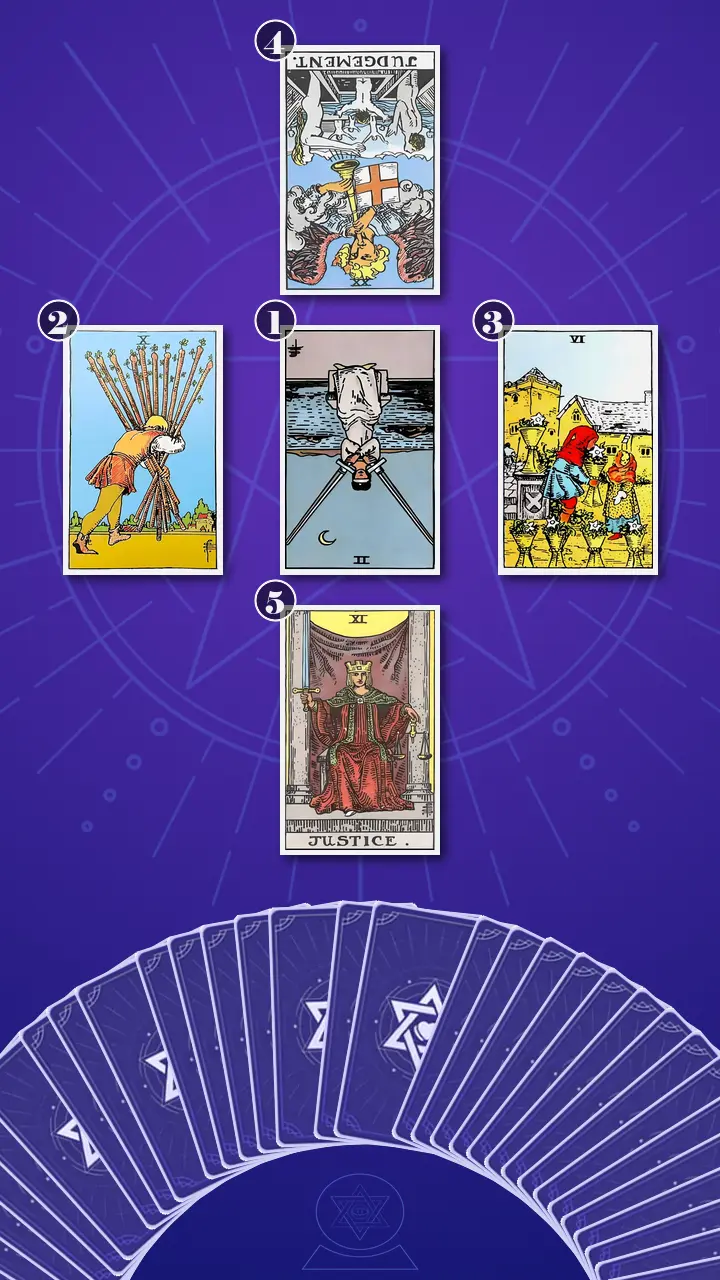
Reading the Map: Card Meanings in Context (Work vs Family PTO)
Position 1 — The current dilemma as lived behavior
“Now we flip the card that represents the current dilemma as lived behavior—where decision paralysis and guilt show up around submitting the PTO request.”
Two of Swords, reversed.
I didn’t need to dramatize it; Jordan’s face did that for me. The blindfold, the crossed swords at the chest, the still water behind—except reversed, the stillness doesn’t feel peaceful. It feels like pressure building with nowhere to go.
“This is the exact loop you described,” I said, and I let the imagery become a split-screen in the air between us.
Left side: Workday/BambooHR PTO screen. Google Calendar overlay. Slack activity dots. Jira sprint capacity. Re-open, re-check, re-draft.
Right side: Your thumb hovering over Submit like it’s a confession.
“Here’s the inner monologue the Two of Swords reversed runs,” I continued, keeping the rhythm intentional, repetitive—because that’s how the loop works.
“If I send it now… it’ll look like I don’t care. If I wait… I’m being responsible.”
“If I send it now… I’ll inconvenience everyone. If I wait… maybe the calendar will look kinder tomorrow.”
I watched Jordan swallow. Their eyes flicked toward their second monitor like the calendar might argue back.
“Reversed, this is blocked Air energy,” I said. “Clarity wants to cut through. But it keeps getting interrupted by a protective strategy: ‘If I don’t choose yet, I can’t be rejected yet.’ The problem is—indecision isn’t neutral. It’s turning a normal benefit into an all-night stress task.”
Jordan let out a small laugh that didn’t reach their eyes. “That’s… kind of brutal. But yeah. That’s literally me.”
Position 2 — Option A energy: choosing ‘them’ (work) right now
“Now we flip the card for Option A energy—what it costs and protects if you choose work/team expectations right now.”
Ten of Wands, upright.
“This is the ‘reliable’ path as your body experiences it,” I said. “Not just the meetings and tickets—the posture.”
I described the modern-life version of it, because Jordan didn’t need a medieval figure with sticks; they needed Toronto-tech reality. “Choosing work here looks like volunteering to carry the team’s stress as if it’s your personal backpack. You offer to cover meetings, pre-write contingencies, take one more ticket so nobody feels your absence.”
And then I made it even more specific, like adding weight to a backpack one item at a time: “One more doc. One more meeting. One more ‘quick ask.’ One more handoff detail you didn’t need to include.”
“Energetically, Ten of Wands is Fire in excess,” I said. “Duty pressure. Endurance as proof.”
Jordan’s mouth tightened. Their knee bounced just out of frame.
“Here’s the cost nobody praises,” I added gently. “You start getting shorter with people. You feel resentful. And then you feel guilty for the resentment—so you carry even more to compensate.”
Jordan nodded once, sharp. “I hate how true that is.” Their voice had that mix of relief and irritation—like someone finally named the thing they’ve been pretending isn’t heavy.
Position 3 — Option B energy: choosing family time right now
“Now we flip the card for Option B energy—what it restores and challenges if you choose family time right now.”
Six of Cups, upright.
I felt the room change, even through a webcam. The story slowed. The light in their kitchen looked warmer somehow—maybe because Jordan’s shoulders dropped a fraction when they saw it.
“This isn’t escapism,” I said. “It’s replenishment. The nervous system downshifting.”
I spoke the modern scenario aloud, so it could land in their body: “Choosing family looks less like a dramatic statement and more like a couple days where nobody tracks your responsiveness. You’re not ‘on call’ emotionally. You remember what it feels like to be wanted for being you, not for being useful.”
Jordan’s breath deepened—one small exhale, like someone finally took a hand off their chest.
“The challenge here,” I continued, “isn’t travel logistics. It’s letting yourself accept warmth without turning it into something you have to justify.”
They stared at the card and whispered, almost embarrassed: “I want that.”
That’s the thing about the Six of Cups—it doesn’t argue. It offers.
Position 4 — The hidden driver: what turns PTO into a guilt-loaded moral test
“Now we flip the card for the hidden driver—the underlying fear or belief that turns a practical request into a guilt-loaded moral test.”
Judgement, reversed.
Jordan’s eyes narrowed, not at me—at themselves. The reversed trumpet felt loud anyway.
“This is the internal courtroom,” I said, naming it plainly. “The real blocker isn’t your manager or the calendar—it’s the storyline that your PTO request becomes a permanent mark on your reputation.”
I let the courtroom motif take over, because Judgement reversed begs for it: “You write your message like a defense brief. Reasons. Context. Proof you’re still a good employee. You rehearse your justification while doing dishes—cross-examining yourself—while nobody has actually objected.”
Jordan went still in a way I’ve learned to recognize: breath pauses; fingers freeze over the trackpad; eyes unfocus, as if replaying a memory of being evaluated.
Then the emotion hit last—quiet, but sharp. Their voice came out tighter. “It really does feel like it goes in a file. Like… ‘team player or not.’”
“Exactly,” I said. “And when that fear runs the show, you start over-performing before PTO to ‘earn’ it—late nights, extra tasks, perfect handoff standards—then you arrive at family time depleted and still checking Slack. Because you never actually left the trial.”
I watched Jordan’s shoulders creep up again, as if the card itself had turned on fluorescent lighting.
“Also,” I added, because it mattered, “over-explaining is just people-pleasing in business casual.”
Jordan’s laugh came back—small, but real this time. And then they winced, like being seen that clearly was both comforting and exposing.
When Justice Spoke: From Courtroom to Contract
Position 5 — Integration guidance: the boundary mindset and next step
I took a breath with them. “This last card is integration guidance—the clearest boundary/communication mindset and one grounded next step to choose without guilt.”
“This is the heart of how to request PTO without feeling guilty,” I said, and I let my tone get even calmer—adult-to-adult.
Justice, upright.
The scales. The upright sword. The steady gaze. No drama—just structure.
“Justice is you treating PTO like the adult agreement it is,” I said. “Dates, impact, handoff. You’re not begging. You’re communicating.”
And because I’m Juniper Wilde—artist brain, film brain—I pulled one of my signature lenses off the shelf: Classic Movie Models.
“Jordan, right now you’re living this like Casablanca,” I said. “Like there’s a noble sacrifice required—duty versus love, and someone has to lose for you to be ‘good.’”
They blinked, caught off guard. “Okay… yeah. That’s… weirdly accurate.”
“But Justice is a different movie model,” I continued. “Justice is the contract scene you don’t notice because it’s not romantic. It’s the part where adults agree to terms that let both lives exist. It’s also Roman Holiday in one specific way: you’re allowed a day where the world doesn’t get to consume you. Not because you earned it through suffering—because you’re a person.”
Jordan’s expression shifted through a three-step chain that told me we were at the edge of the breakthrough: first a micro-freeze (their lips parted and their breath stopped), then the cognition seeped in (their eyes unfocused, as if scanning their own week for evidence), then the emotion arrived (a shaky exhale that loosened their jaw).
But instead of instant relief, they flashed with something hotter.
“But… if I do it that cleanly,” Jordan said, voice rising, “doesn’t that mean I’ve been doing it wrong? Like I’ve been… auditioning this whole time?”
I didn’t rush to soothe that. I met it. “It means you used a strategy that kept you safe,” I said. “A lot of high-performing people do. You didn’t do it ‘wrong.’ You did it expensively.”
I let the air go quiet for a beat, like a theater right before the line that changes the film.
Setup. It’s late. The PTO portal is open. Slack is half-drafted. Your phone is hot from refreshing the team calendar. Your shoulders are up. Your jaw is tight. And somehow a normal benefit feels like you’re asking to be forgiven.
Delivery.
Stop putting yourself on trial and start weighing what’s fair—let the scales guide your choice and let the sword be one clear message.
I let that hang, the way a good director lets silence do the work.
Reinforcement. Jordan’s eyes filled, not with tears spilling, but with that glassy edge that says the nervous system is finally admitting the truth. Their shoulders lowered like they’d been holding a shrug for months. Their fingers—still on the trackpad—curled into a fist without them noticing, then slowly uncurled as if the body was learning a new ending. They inhaled and it caught halfway, then they let it out in a long, unguarded breath that sounded like relief and fear tangled together.
“I feel… lighter,” they said, and then—honest, human—“and also kind of sick? Like I don’t know who I am if I’m not managing everyone’s comfort.”
“That’s normal,” I said. “That’s the moment the old safety strategy loses control. The discomfort isn’t proof you’re selfish. It’s proof you’re changing the frame.”
I leaned in a little. “Now, with this new lens—tell me. Last week, was there a moment when you were about to add another paragraph, another apology, another ‘if it’s okay…’? A moment where this could have felt different?”
Jordan looked up toward the ceiling like they were replaying a scene. “Yesterday. I had the message drafted and I added, like, a whole explanation about sprint capacity. Nobody asked. I just… did it.”
“That’s the exact pivot,” I said. “This isn’t just about PTO dates. This is you moving from guilt-driven people-pleasing and internal judgement to grounded, self-respecting boundary-setting with clear communication.”
And then I used one of my Iconic Line Diagnosis tools—because sometimes a single line is the difference between spiraling and shipping.
“If this were a movie,” I said, “your old script is: ‘Please don’t be mad at me for needing a life.’ Justice rewrites the line into: ‘Here are the dates. Here is the plan.’ No apology. No audition.”
Jordan nodded slowly. “PTO isn’t a moral test,” they said, tasting the sentence like it could become a new habit.
“Exactly,” I replied. “PTO isn’t a moral test. It’s a boundary in a contract.”
The Justice Message: Actionable Advice for the Next 48 Hours
I brought the spread together in one clear story—the kind that makes the next step feel like an actual step, not a vibe.
“Here’s what the Decision Cross showed,” I said. “You’re stuck not because you don’t know what you want, but because you’re trying to avoid the emotional risk of being evaluated (Two of Swords reversed). Choosing work protects you from that imagined verdict, but it costs you by turning you into the default owner of everything (Ten of Wands). Choosing family restores you—real warmth, real off—but it triggers the shame story that you have to earn rest (Six of Cups + Judgement reversed). Justice is the bridge: you become your own fair arbiter. You decide based on values and fairness, then you communicate in one clean message.”
“The blind spot,” I added, “is that you’ve been trying to solve a logistics problem with a reputation defense. That’s why it keeps expanding. The transformation direction is simple and hard: move from seeking permission through over-justification to making a values-based decision and communicating it clearly in one clean message.”
Jordan shifted in their chair. “Okay,” they said. “But… I genuinely don’t have time for a whole… process. And my team is slammed.”
“Good,” I said, staying practical. “We’re not doing a whole process. We’re doing a minimum viable boundary.”
“Dates. Handoff. One clean sentence about availability. Nothing else,” I reminded them.
- Write the Two-Sentence PTO MessageIn Notes (not Slack), type exactly: “I’m taking PTO from [date] to [date]. I’ll share a handoff doc by [day/time] and will be offline during PTO.” Copy/paste it into your PTO request or message as-is.If your chest tightens and you want to add context, that’s your cue to stop—set a 20-minute timer, then send at the buzzer. No “tomorrow.”
- Create a Handoff Minimum Viable Plan (3 Bullets Only)Make a tiny handoff doc with just three bullets: (1) top priorities while you’re out, (2) owner/backup for each, (3) where docs/links live. Share it with your manager/team in the same thread as your PTO notice.Stop at three bullets even if you want to add five more—perfectionism is just the internal courtroom wearing a Notion template.
- Do the 5-Minute “Justice Check,” Then Hit SubmitBefore you send, ask: (1) Is this fair to me? (2) Is this fair to the team? (3) Is this clear? If the answer is yes, you’re done. Submit.Stop negotiating against yourself before anyone replies. Clarity isn’t a feeling—sometimes it’s a decision you honor.
As a final touch—because my work always comes with a little art—I offered a tiny Vinyl Playlist Suggestion as an anchor for the nervous system after you send a scary-but-clean message.
“After you hit submit,” I told Jordan, “play one track that makes your shoulders drop—something with steadiness, not adrenaline. You’re training your brain to associate boundaries with safety, not punishment.”

A Week Later: The Quiet Proof
Six days later, Jordan messaged me a screenshot: a PTO confirmation and, beneath it, a two-sentence Slack note—no apology, no essay. “I sent it,” they wrote. “My manager replied: ‘Sounds good—thanks for the handoff.’ That’s it. No trial. I went for a walk after and didn’t check Slack for two hours.”
It wasn’t a Hollywood ending. They added, “I still felt weird for a minute. Like… who do I think I am. But then it passed.”
That was the point. The journey wasn’t from guilt to never feeling guilt again. It was from being ruled by the internal courtroom to becoming the person who can notice it, name it, and choose anyway—quietly, steadily.
When you’re hovering over “Submit” with a tight jaw, it’s not the dates you’re afraid of—it’s the feeling that one choice could stick to you as “less committed,” even when you’re just trying to be a whole person.
If you let PTO be a boundary instead of a verdict on your work ethic, what would your simplest, two-sentence “Justice message” sound like today?
Every reading at AceTarot is a Journey to connect with inner wisdom and empower next step.
Learn more about our Journey to Clarity.