The One-Breath Boundary Sentence: From Brunch Freeze to Calm Directness

The 11:26 a.m. Patio Deposition
If you’re the friend who can write a flawless campaign brief at work but turns into a shaky lawyer for your own life the second brunch questions get sharp—welcome to the people-pleasing spiral.
Taylor (name changed for privacy) met me at my little Italian café off Queen West, but she didn’t really arrive until she told me what happened last Saturday. King West patio. Espresso machine hissing like it had opinions. Forks clinking against heavy ceramic plates. Her phone face-down beside the syrup bottle, still buzzing like a trapped insect.
“She leaned in with that half-smile,” Taylor said, staring at my sugar jar like it might testify. “And she goes: ‘No, but seriously, why would you do that?’”
As she repeated it, I watched her throat move like she was swallowing something too dry. Her jaw tightened in that particular way—like your molars are holding a secret meeting. Embarrassment sat on her like a damp coat she couldn’t take off, even inside a warm room. It wasn’t just discomfort; it was the feeling of being asked to perform your own life on demand, under bright patio light, while pretending you’re “totally chill.”
“I don’t want to make it weird,” she said, voice lifting into a laugh that didn’t quite belong to her. “But it already feels weird.”
She wanted to keep her best-friend bond light and close. But she also knew that if she set a clear limit—one boundary, one line—it might trigger conflict, judgment, or distance. And the part of her that loves the friendship was terrified that a boundary would read as rejection.
I set a small demitasse cup between us like a grounding point. “We’re not here to turn brunch into a courtroom,” I said gently. “We’re here to find clarity—what boundary you need now, and how to hold it without losing yourself in the explaining.”

Choosing the Compass: The Relationship Spread · Context Edition
I asked Taylor to take one slow breath—not as a ritual, just as a nervous-system handrail. While I shuffled, the café did its usual symphony: milk steaming, a grinder pulsing, someone laughing at the window seat. Familiar sounds, familiar warmth—proof that not everything had to be high stakes.
“Today,” I told her, “we’ll use a spread I call the Relationship Spread · Context Edition.”
For you reading this: this spread is perfect when the question isn’t “Will we stay friends?” but “What is the pattern here—and what do I do next?” It reads the brunch moment as a relationship dynamic rather than a one-off conflict. It moves from your real-time freeze response → your friend’s conversational stance → the deeper belonging wound underneath → the specific boundary that restores self-trust → the communication pacing that makes it workable → the healthier pattern you’re aiming for. It’s practical tarot: less prediction, more actionable advice.
I pointed to the layout as I placed the cards. “Card 1 is what your body/mind did in the moment—the observable stuck behavior. Card 3 is the deeper trigger underneath the grilling. And Card 4—right here under the center—is the boundary line. The sentence.”
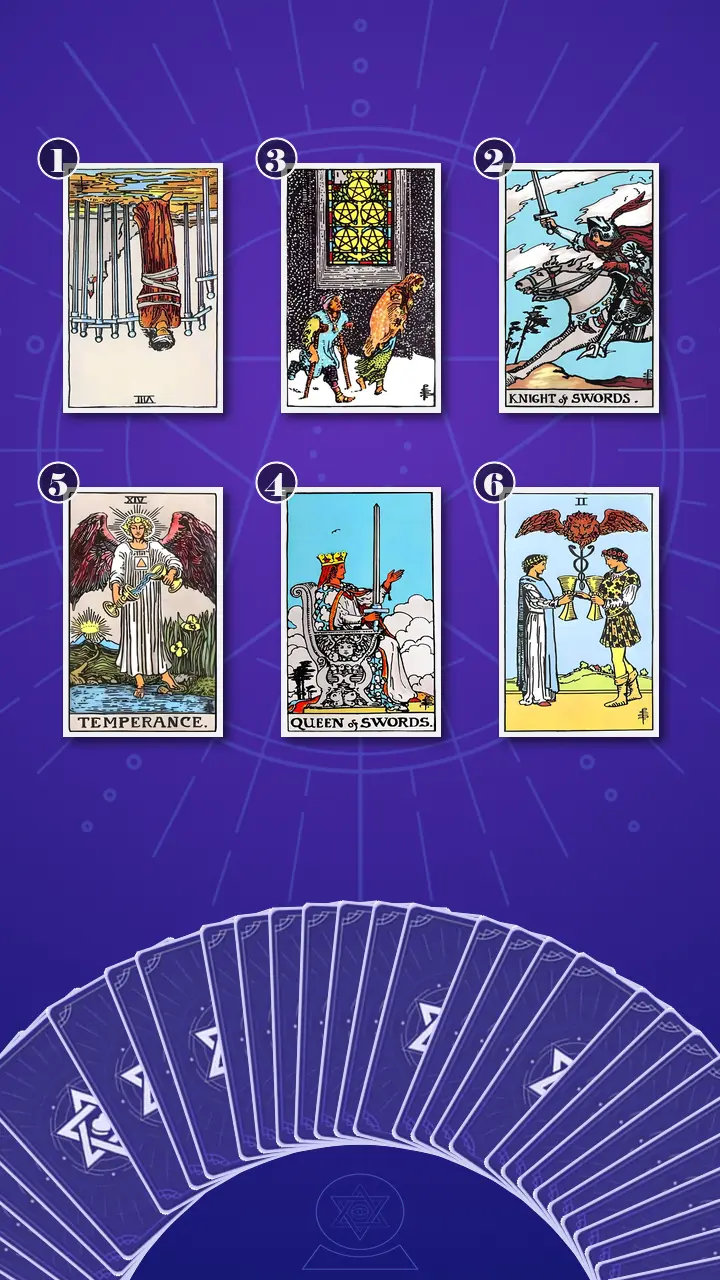
Reading the Table: When Swords Show Up
Position 1: What your body/mind did in the brunch moment
“Now flipped,” I said, “is the card representing what your body/mind did in the brunch moment—the observable ‘stuck’ behavior you want to change.”
Eight of Swords, reversed.
In modern life, this is painfully specific: at a loud weekend brunch, you feel cornered by rapid questions about a personal choice. You smile, keep your tone light, and start explaining in bullet points like you’re trying to prove you’re reasonable. Then, alone, you replay it like a cringe highlight reel, draft a boundary text in Notes, delete it, and numb out by scrolling because speaking up felt too risky.
Reversed, the Eight of Swords is blockage loosening—agency exists, but your nervous system doesn’t trust it in real time. The ropes aren’t iron; they’re just tight enough to make you forget you can move.
I said it plainly: “Technically, you could have redirected. But your body treated ‘redirecting’ like it would blow up belonging.”
Taylor let out a small, bitter laugh—one sharp exhale that tried to be casual and failed. Then came the three-step reaction chain I’ve come to recognize in people who’ve been performing their way through closeness: her breath paused (freeze), her eyes unfocused like she was replaying the patio scene in 4K (cognition landing), and then her shoulders dropped a fraction with a quiet, defeated, “Oh my god… yeah.” (emotion releasing).
“That’s… honestly kind of brutal,” she said. “Like, too accurate.”
“You didn’t ‘freeze’ because you’re weak—you froze because your body thought belonging was at stake,” I told her. “That’s not a character flaw. It’s a pattern. And patterns can be updated.”
Position 2: Your best friend’s style/energy in the interaction
“Now flipped is the card representing your best friend’s style/energy in the interaction—how their approach lands, regardless of intent.”
Knight of Swords, upright.
In modern life terms: your best friend’s conversational style is fast, blunt, ‘let’s get to the point.’ At brunch it lands like debate-club energy—follow-ups stacked on follow-ups, certainty delivered as care, and a vibe that implies your answer should be decisive right now.
Upright, this is excess: too much speed, too much intensity. Not evil—momentum. Like a group chat thread where the notifications don’t stop long enough for you to feel what you feel.
“This is what I call ‘double-espresso energy,’” I said, leaning into my own language. “It’s strong. It’s not inherently wrong. But if someone keeps sliding you double espresso shots when your system needs a latte—softened, paced, with room to breathe—your body will revolt.”
Taylor’s mouth tightened, then softened. “She thinks it’s intimacy,” she said. “Like, if we’re real friends, we can say anything.”
“Sometimes people confuse intensity with closeness,” I replied. “But consent matters in conversation, too.”
Position 3: The deeper trigger underneath the grilling
“Now flipped is the card representing the deeper trigger underneath the grilling—the wound or belief that got touched.”
Five of Pentacles, upright.
In modern life: under the irritation is a belonging alarm. When you get grilled, your body reacts like you might lose your place in the group. Privacy feels like distance, and distance feels like being left out—like you’re outside a warm window in the cold, trying to earn your way back by being agreeable and well-explained.
Upright, this is deficiency: not enough felt safety. The warmth exists, but your brain can’t access it. You have the key, but your body still believes the door is locked.
I watched Taylor’s hand drift to her throat without her noticing, fingertips grazing the spot that always tightens when someone says, “I’m just being honest.”
“So the real threat isn’t the question,” I said. “It’s the meaning your body assigns to the question: If I disappoint you, I’m out in the cold. That’s why you over-share. You’re not answering brunch—you’re paying dues for belonging.”
Her eyes went glossy for a second, then she blinked hard like she was clearing steam off a mirror. “That’s… exactly it,” she whispered. “If I push back, are we still okay?”
Position 4 (Key Card): The boundary you need now
When I reached for the fourth card—the one beneath the center—I felt the room go quieter, even with the espresso machine still working behind me. It’s always like that with a true boundary card: the air thins, because the nervous system knows a line is about to be drawn.
“Now flipped,” I said, “is the card representing the boundary you need now—clear, specific, and aligned with self-respect.”
Queen of Swords, upright.
In modern life, the Queen is simple and almost shockingly brief: one clean line that ends the cross-exam without ending the friendship. Calm voice. Short sentence. No extra details. Your limit isn’t a debate topic; it’s your availability.
Upright, this is balance: clarity without cruelty. The raised sword says “this is not up for negotiation.” The open hand says “I’m not attacking you.”
And this is where my café brain always steps in with my own diagnostic tool—what I call Relationship Stage Diagnosis. I picture the connection as a menu:
Espresso stage is intense truth, fast pace, high heat. Latte stage is warmth, gentleness, shared sweetness. Americano stage is boundaries and space—still coffee, but with room to breathe.
“Your brunch dynamic right now,” I told her, “is your friend ordering espresso truth—extra shots—and you trying to make it latte-friendly by adding a whole speech worth of foam. The Queen of Swords says: stop re-foaming it. Just put down the cup and name the limit.”
Taylor’s eyebrows rose, half amused, half wounded. “So… I’m not supposed to make it more digestible for her.”
That moment when you’re halfway through eggs and suddenly you’re explaining your life like a closing argument—jaw tight, throat tight, laughing so nobody thinks you’re ‘too sensitive.’
You don’t need a perfect explanation to deserve respect; you need one clear limit—and the willingness to hold it.
I let the sentence sit between us like a demitasse placed down on a saucer. No rush. No extra words to rescue it.
Taylor’s reaction came in layers—exactly the way the Queen works on a nervous system that’s been over-performing. First: she went still, like her brain had paused to buffer. Second: her lips parted, then pressed together, as if she was trying not to argue with the idea. Third: her shoulders lowered and her jaw unclenched in a slow, startled way, like she’d just realized she’d been biting down for years.
Then the unexpected reaction hit: a flicker of anger, not at me—at the pattern. “But if I do that,” she said, voice sharper, “doesn’t that mean I was wrong? Like I’ve been… letting her?”
I nodded once, steady. “It means you’ve been surviving the moment the best way you knew how. That’s not ‘wrong.’ But it is expensive.” I tapped the Queen gently. “Explaining is not the price of being liked.”
She stared at the card again, and the anger softened into something braver. Her eyes flicked up to mine. “Okay,” she said, quietly. “What would I have said last Saturday?”
“Before we answer that,” I asked, “use this new lens and think back: last week, was there a moment when you felt that throat-tightening start—where one clean sentence would’ve changed your whole body?”
She didn’t answer right away. She breathed in, slow. “Yeah,” she said. “Right when she said ‘No, but seriously.’ That was the doorway.”
This was the shift in real time: from post-brunch embarrassment and rumination to calm directness and self-trust—one boundary sentence, held without a performance.
Position 5: How to communicate the boundary
“Now flipped is the card representing how to communicate the boundary—tone, pacing, and the repair path that fits you.”
Temperance, upright.
In modern life: you communicate this boundary best outside the heat of the table—a quiet follow-up text, a walk, or a 1:1 coffee where your nervous system can stay online. You name impact, make one request, then let the conversation breathe. You don’t match their speed; you set a pace where respect can actually land.
Temperance is calibration. Not less honesty—less volatility. It’s the volume knob: same truth, lower intensity.
I felt my own little inner flashback: twenty years of watching people get louder when they’re scared, stirring their cappuccino like they can whip anxiety into certainty. In my café, the best drinks aren’t rushed. The crema needs a moment to form. And people, honestly, do too.
“Temperance says: choose the setting,” I told her. “Not in the middle of a loud table where your body is already in defense mode. After-work walk. Coffee one-on-one. Or a simple text within 48 hours.”
Taylor exhaled—small, but real. The idea of not doing conflict resolution on a crowded patio looked like relief on her face.
Position 6: What healthier friendship can look like if the boundary is respected
“Now flipped is the card representing what a healthier friendship pattern can look like if the boundary is respected—the direction of growth, not a prediction.”
Two of Cups, upright.
In modern life: conversational consent. Checking in instead of interrogating. Advice offered with permission. Mutual respect when someone says “not today.” If the boundary is respected, the connection feels more equal—close without being cornered. If it isn’t, you get clarity without self-blame: reciprocity is the standard.
This is balance again, but in water: equal exchange. You don’t earn warmth by self-abandoning. You choose what you share, and the other person respects the choice.
“Real closeness can handle a boundary without turning it into a debate,” I said. “That’s the Two of Cups standard.”
From Insight to Action: The One-Sentence Line and the Slow Pour
I slid the cards into a neat line, like a story you can actually follow: freeze and over-explain (Eight of Swords reversed) meets blunt momentum (Knight of Swords), which triggers a belonging wound (Five of Pentacles). The correction isn’t a better argument. It’s a clean boundary (Queen of Swords), delivered with paced timing (Temperance), to test for mutual respect (Two of Cups).
The cognitive blind spot here is sneaky: you think the danger is “making it awkward,” so you keep explaining to keep the vibe smooth. But the real cost is that each over-explanation trains your body to distrust your own no in real time.
The transformation direction is clear: shift from explaining to be approved to stating a limit and pausing, letting the other person manage their reaction.
I gave Taylor what I call, in café language, a Clean Line Order: one sentence, no extra foam. Then I added the Temperance method: pour slowly, don’t spill your nervous system all over the table.
- The One-Breath BoundaryWrite one sentence you can actually say out loud in one breath. Use it at brunch if needed: “I’m not getting into that at brunch.” Then stop talking—no follow-up explanation.Pin it as a phone note or wallpaper for 7 days. Minimum-version if you panic: one sentence + a neutral redirect (“Anyway, what are you watching lately?”).
- The Pause-and-Sip ResetPractice the pause in a low-stakes moment this week. When someone asks a personal-ish question (coworker, acquaintance), say: “I’m keeping that one private,” take one sip of water/coffee, and let the silence be normal.If your throat tightens, unclench your jaw before you speak. Your job isn’t to manage their reaction. Your job is to name your availability.
- The Temperance Repair Text (48-Hour Rule)Send a short repair text within 48 hours—no thesis. Template: “Hey—yesterday got a little intense for me. I’m not up for being grilled about [topic]. I’m happy to chat, just not in that mode.”Revise once, not ten times. If it feels activating, voice-note it to yourself once first; then decide whether to send.

A Week Later: The Quiet Proof
Six days later, Taylor messaged me a screenshot. Not a paragraph. Not a manifesto. Just one line, sent to her friend on a Tuesday afternoon: “Hey—last brunch felt intense. I’m not up for being grilled about my dating life. I’m happy to hang, just not in that mode.”
Under it, her friend’s reply: “Oh. I didn’t realize it landed like that. I’m sorry. I’ll chill.”
“My heart was pounding,” Taylor wrote. “And then… nothing exploded. It was just… new.”
Her update was the bittersweet kind of progress I trust most: she slept a full night, but in the morning her first thought was still, What if I did it wrong? And then she remembered the Queen’s open hand, took one slow breath, and got on with her day.
That’s the real Journey to Clarity for a friendship boundary after an uncomfortable brunch: not a perfect confrontation, not a dramatic cutoff—just one clean line, held calmly enough for your self-respect to catch up with your mouth.
When a friend’s questions come fast and sharp, it can feel like your whole place in the group is on the line—so you keep explaining even as your throat tightens, because part of you is terrified that one clear ‘no’ will cost you closeness.
If you didn’t need their approval to belong for one single moment, what’s the one calm sentence you’d let yourself say the next time brunch turns into a cross-exam?