That “Easy to Love” Compliment—and the Text Spiral It Triggers

The Tuesday Night “Lol No Worries” Reflex
If you’ve ever been told you’re “easy to love” and immediately felt the pressure to stay low-maintenance—like one honest request might ruin the vibe—you’re not imagining that tension.
Jordan (name changed for privacy) sat cross-legged on her couch in Toronto, close enough to the TTC line that the evening hum felt like it lived in the walls. Her laptop was still open to a campaign deck—bright slides, cheerful headlines, the kind of work that rewards being upbeat and flexible. Her phone screen, too bright for the dim room, warmed her palm as she stared at a draft text.
She’d typed: I’d really like to see you Saturday—are you free?
Then she deleted it. Added a joke. Deleted again. Rewrote it so casual it barely meant anything. In the end, she didn’t send a sentence at all—just a thumbs-up reaction to their vague “maybe this weekend.”
“The compliment was sweet,” she said, voice tight like she was speaking around something lodged in her throat. “He said I’m… ‘easy to love.’ And I smiled. And then I immediately felt like I had to stay… easy. Like if I ask for an actual plan, I’m going to be annoying.”
I watched her swallow—literally. The need went down before it got air. Her shoulders stayed lifted, as if she were bracing for a hit that hadn’t happened yet.
That kind of insecurity isn’t loud. It’s a private constriction. Like trying to breathe through a sweater sleeve: your chest is technically expanding, but nothing feels like it’s really getting in.
“We can work with that,” I told her, keeping my tone soft and steady. “Not to diagnose you as ‘too much’ or ‘not enough’—but to understand what story gets activated by that compliment. Let’s see if we can turn this into a map. A little journey to clarity.”

Choosing the Ladder: A Tarot Spread for the Compliment That Hurts
I asked Jordan to take one slow inhale, then exhale like she was fogging a mirror—just enough to shift her system out of “performing” and into “noticing.” While she breathed, I shuffled. Not as a mystical flourish, but as a focusing tool: something rhythmic that tells your brain, we’re looking at the real thing now.
“Today,” I said, “we’ll use a spread called the Four-Layer Insight Ladder · Context Edition.”
For readers: I chose this spread because Jordan’s question isn’t really predictive. It’s excavation. When someone says “you’re easy to love,” the issue usually isn’t the person saying it—it’s the internal rule that turns the compliment into pressure. This ladder layout is built to move in a clean psychological progression: visible behavior → emotional cost → core belief → what’s missing at the root → the inner pivot → the practical integration. It’s a compact tarot spread for self-worth and people-pleasing in relationships—small enough to stay concrete, deep enough to name the loop.
I pointed at the vertical line I’d make on the table. “We’ll read straight down like a story. The top card shows what’s happening on the surface—your ‘easy to love’ performance in real time. The middle will name the belief underneath it. And near the bottom, we’ll find the pivot—what helps you stop self-silencing without turning intimacy into a fight.”
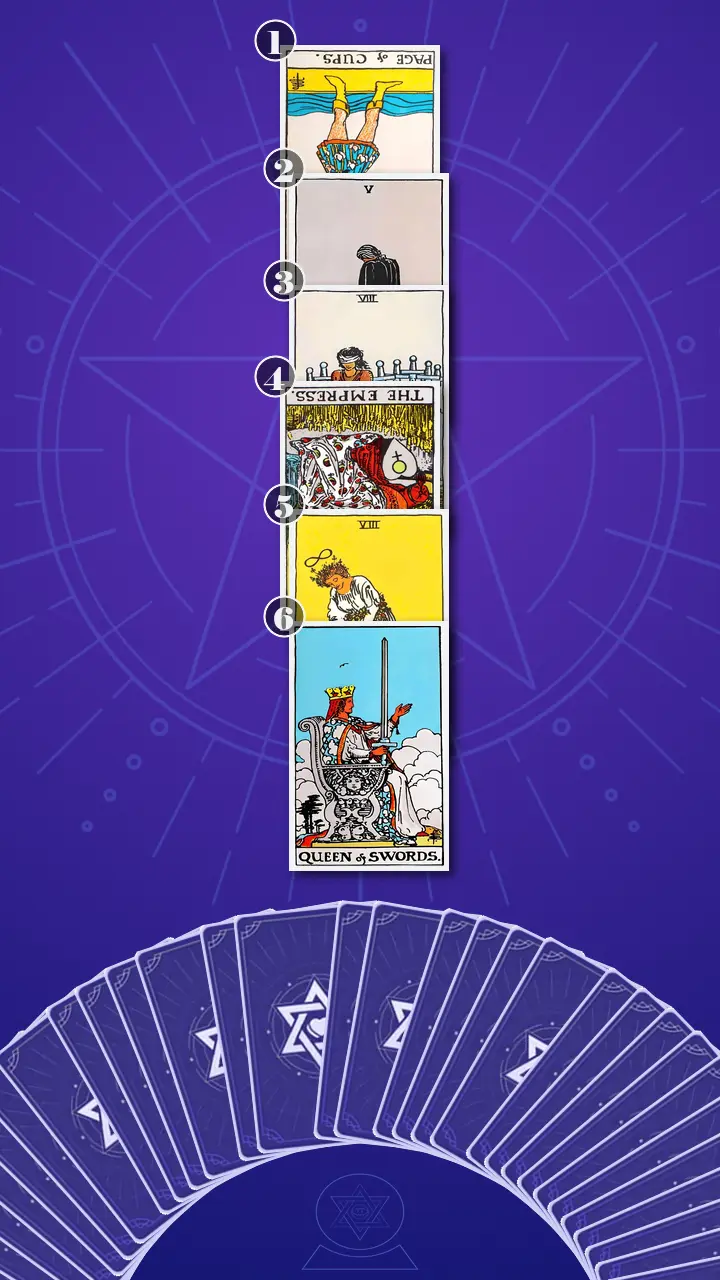
Reading Down the Rungs: From Cute Feelings to Quiet Grief
Position 1: The Surface Pattern You Call “Being Chill”
“Now flipped over,” I said, “is the card representing Surface pattern: how you perform ‘easy to love’ in observable relationship behavior.”
Page of Cups, reversed.
Immediately, I thought of film editing—how you can color-grade a scene until the lighting looks effortless, romantic, weightless. I’ve done it with my own art: soften the edges, make it palatable, make it easy to consume. The reversal here felt like that exact impulse, applied to a human need.
“This is like when you type a real request,” I said, “and then you flip it into something ‘cute’ so nobody has to respond seriously.”
And it matched her life perfectly: Jordan on her couch after a marketing day, laptop still open, typing, ‘I’d love to see you Saturday. Are you free?’ Then deleting it, rewriting it as ‘lol what’s your weekend vibe?’ adding a joke, deleting again—until she finally reacts with a thumbs-up so she doesn’t have to risk wanting something clearly.
Energetically, Page of Cups is tender emotional openness. Reversed, that openness becomes a blockage: sweetness as self-editing. Vulnerability gets disguised as “no big deal.”
I used the “two drafts” device out loud, because it matters that this isn’t abstract—it’s behavior you can notice in the first sixty seconds.
“Draft one is: ‘I want to see you Saturday.’ Draft two is: ‘lol whatever.’ And the inner monologue is: If I make it a thing, I’ll lose the thing.”
Jordan let out a small laugh that wasn’t amused—more like she’d been caught. “That’s… too accurate,” she said, lips pulling into a smile with a bitter edge. “Like, even hearing it sounds kind of… brutal.”
“I know,” I said. “And I’m not saying it to shame you. I’m saying it so you can see the pattern clearly. Because ‘easy to love’ can start to sound like: ‘Stay convenient, and you’ll stay safe.’”
Position 2: The Emotional Cost You Pay Later
“Now flipped over is the card representing Emotional cost: what it feels like underneath when you keep yourself low-maintenance.”
Five of Cups, upright.
“This is the aftermath,” I said. “The moment the plan is set, the adrenaline drops, and you’re alone with what didn’t happen.”
In her world, it looked like this: agreeing to the plan she didn’t want—whatever works for you—and then later, at 11:38 PM with the kitchen light buzzing too bright, scrolling Hinge and Instagram Stories with a weird hollowness in her chest. Nothing ‘bad’ happened. But something nourishing didn’t happen either.
Five of Cups is grief—selective attention to loss. Not a dramatic sobbing scene. More like the quiet sting of realizing you traded truth for approval.
Jordan’s shoulders finally lowered a fraction. She exhaled. “That’s exactly the feeling I couldn’t explain,” she said. “Like… I’m ‘fine.’ But I’m not fed.”
I nodded. “You don’t want to be adored—you want to be known.”
Position 3: The Self-Worth Story That Blocks You
“Now flipped over is the card representing Blocking self-worth story: the specific belief that keeps you stuck in the pattern.”
Eight of Swords, upright.
Eight of Swords is what I call the hidden Terms & Conditions card. The kind you agreed to without reading, because you needed the connection to download. And the fine print is always some variation of: No needs. No friction. Stay chill.
Jordan’s modern-life version was immediate: right as she considered asking for consistency—clearer plans, more check-ins—her mind ran a fast internal slideshow. One request → imagined label (“needy”) → imagined withdrawal → imagined replacement. It happened so fast it felt like reality, not a thought. So she decided she had “no choice” but to stay easy.
“This card’s energy is restriction,” I said. “Not because you’re actually bound—but because your mind treats asking like a threat.”
“It’s like having ten browser tabs open,” I continued, “all worst-case scenarios. Your inner critic is running a Slack channel in all caps: DON’T ASK. DON’T RUIN IT. DON’T BE A PROBLEM.”
Jordan’s fingers tightened around her mug. Her throat moved again—another swallow. “I didn’t realize I treat asking like… a weapon,” she said quietly. “Like if I say what I want, I’m basically daring them to leave.”
“Exactly,” I said. “And here’s the loop: the compliment triggers the rule. The rule triggers self-silencing. And then the self-silencing creates the Five of Cups emptiness.”
I paused, then added the line I wanted her nervous system to hear: “If you need it, it counts—even if you have to name it.”
Position 4: The Root Nourishment Gap
“Now flipped over is the card representing Root nourishment gap: where self-receiving and self-care are blocked, keeping worth conditional.”
The Empress, reversed.
In my head, I saw a gallery wall: The Empress is abundance, softness, receiving, the embodied truth that you don’t have to earn warmth to deserve it. Reversed, it becomes a logistical problem—a life run like you’re always on-call.
Jordan’s calendar looked normal on paper—groceries, workouts, a friend’s birthday—but it kept rearranging around whether this person might be free. She’d skip making a real dinner because she was “waiting to see.” She’d postpone rest until she felt secure again, like care only counted if someone else gave it to her first.
“This is a blocked receiving pattern,” I said. “You give warmth outward. But you don’t let it land inward unless someone validates it first.”
Jordan’s eyes flicked down, then back up—quick, embarrassed. “I outsource my calm to other people,” she said. “Like if they text, I can eat. If they don’t, I’m… suspended.”
“That’s the Empress reversed in plain English,” I said. “And it matters because self-worth doesn’t grow in a vacuum. It grows in how you treat yourself on the days you don’t feel chosen.”
When Strength Spoke: Holding the Lion Without Shrinking
Before I turned the next card, the room got very quiet—the way it does right before a film cuts to the line that changes the whole scene.
“We’re flipping the card representing Key transformation: the inner capacity that directly counters the blocking story,” I told her.
Strength, upright.
The image is simple: a woman, calm hands, a lion. No battle. No drama. Just presence. Strength’s energy is steady courage—not aggressive, not performative, not a TED Talk about confidence. It’s the moment you stay in your body while you tell the truth.
I slid in one of my own frameworks—because this card always makes me think in cinema. “I use what I call Classic Movie Models,” I said. “They’re not about romanticizing pain. They’re about noticing what kind of scene you’re living in.”
“Right now, your dating life is stuck in a ‘banter-only’ act—like the first half of Roman Holiday, where everything is charming as long as nobody names what they need. Strength is the scene where the protagonist stops soft-launching her heart and speaks like she belongs in the story. Not to force an outcome—just to be real.”
The Setup
It’s that moment after a sweet message—your chest tightens, your fingers hover, and you start translating what you actually want into something “chill” so you won’t scare them off.
The Line That Lands
Stop mistaking self-silencing for being lovable; choose steady self-respect and name one true need—like Strength calmly holding the lion instead of shrinking away from it.
The Reinforcement
Jordan froze in a way that was almost imperceptible—like the pause before someone starts crying but isn’t sure they’re allowed to. Her breath stopped for half a second. Her eyes unfocused, as if her mind replayed a dozen moments: a draft text erased, a swallowed preference, a laugh added to soften a truth.
Then her face changed in layers. First: a tiny widening of the eyes—recognition. Second: a tightening at the corners of her mouth—resistance. Third: a softening, like her jaw finally let go of a clench it had been holding all week.
“But if I do that,” she said, and there was a flash of anger in it—more protective than hostile—“doesn’t that mean I’ve been doing it wrong? Like… I’ve been training people to love the edited version of me.”
I didn’t rush to reassure her. I let the honesty have its full weight.
“It means you learned a strategy that kept you safe,” I said. “And now you’re outgrowing it. That’s not failure. That’s the beginning of self-respect.”
I leaned in slightly. “Here’s the other piece: Self-worth isn’t proven by being easy. It’s practiced by telling the truth kindly. Strength is practice.”
Then I gave her the micro-intervention exactly as I’d want it if it were me spiraling over a draft text.
“Do a 6-minute ‘Strength Pause’ once this week,” I said. “Open your draft text. Set a timer for 2 minutes. Write one unsweetened sentence that names a preference or need—no jokes, no disclaimers. Then take 4 slow breaths before deciding whether to send it. If your body spikes into panic, you can stop—saving the sentence in Notes still counts as practice.”
Her shoulders dropped again, this time more fully. She inhaled like she’d found a little extra room in her ribs. “I can do six minutes,” she said, voice quieter—steadier. “That feels… possible.”
“Good,” I said. “Because this isn’t just about a decision. It’s the shift from approval-driven self-editing to calm self-respect—and letting yourself be fully known.”
I asked her, gently: “Now, with that new lens—can you remember a moment last week when one honest sentence would’ve changed how you felt in your body?”
Jordan stared at the Strength card for a beat, then nodded once. “Saturday. He texted last minute. I wanted an actual plan. I said ‘sure!’ like I didn’t care. And I felt sick after.”
“That’s the lion,” I said. “Not dangerous. Just real.”
Position 6: The Integration Step You Can Actually Do This Week
“Now flipped over is the card representing Integration step: how to embody the shift through one clear relational behavior this week.”
Queen of Swords, upright.
I love this card for people who think clarity is cruelty. The Queen holds an upright sword—truth—while her other hand stays open: invitation.
In Jordan’s life, it looked like this: sending one clear sentence that holds warmth and a boundary—“I like you, and consistency matters to me.” Then not sending a follow-up paragraph to cushion it. Watching the response as information about fit and care—rather than proof she did something wrong by asking.
“Queen of Swords energy is warm clarity,” I said. “Polite, direct, consistent. Customer support energy, but for your nervous system.”
Jordan nodded, already half in her Notes app mentally. “One sentence,” she repeated. “Not a whole essay.”
“Exactly,” I said. “One clear sentence is not ‘being difficult.’ It’s giving love somewhere real to land.”
From Insight to Action: The Unsweetened Sentence Plan
I looked back down the ladder and stitched the story together for her, the way I’d explain a plot to a friend leaving the theater: “You learned to be lovable by being easy—Page of Cups reversed—so you package real feelings into something casual. But the cost is Five of Cups: that hollow, private grief after you ‘keep it chill.’ Eight of Swords is the contract underneath it: if I have needs, I get left. Empress reversed shows the foundation leak—receiving is blocked, so you wait for someone else to settle you. Strength is the pivot: gentle courage. And Queen of Swords is how you make it real: one warm, clear sentence.”
“The blind spot,” I added, “is thinking the only options are: be easy and keep them, or be honest and lose them. That’s Eight of Swords logic. The transformation direction here is different: you move from ‘being easy to love’ to ‘being fully known’ by naming one honest preference—small, specific, real.”
Then I offered her next steps—low-stakes, concrete, and designed for a busy weeknight brain.
- The Strength Pause (6 minutes)Once this week, open the draft text you keep rewriting. Set a 2-minute timer and write one unsweetened sentence naming a preference (day/time/place) or need (consistency, clarity). No jokes, no “lol,” no disclaimers. Then take 4 slow breaths before deciding whether to send.If panic spikes, don’t force the send. Save it in Notes. Practice still counts—your nervous system is learning that “new” isn’t the same as “danger.”
- One Warm-Clarity ScriptSend one sentence this week that is both warm and clear: “I like you, and consistency matters to me.” Then stop. No follow-up paragraph. Let their response be data about compatibility, not a verdict on your worth.If you feel the urge to overexplain, use a rule: one sentence, then set your phone down for 5 minutes.
- An Empress Move (Receiving Without Earning)Pick one basic need you’ve been delaying—make a real dinner, take an early night, go to the workout class—even if you feel uncertain about where you stand with someone. Afterward, write one line: “My needs are not a tax.”Keep it small and private so it doesn’t become performative. The point isn’t to “prove” anything—it’s to come back into your own care.

A Week Later: The Quiet Proof
A week later, Jordan messaged me. Not a long paragraph—just a screenshot and one line.
She’d sent: “I’m free Saturday. If that doesn’t work, I’d rather pick another day than do a last-minute maybe.”
And then, beneath it: “I didn’t die. I put my phone down for five minutes like you said. My chest was buzzing, but it passed.”
Her update wasn’t a fairy tale ending. It was something better: a nervous system learning a new fact.
Clear but vulnerable: she told me she slept through the night for the first time in a while, then woke up and her first thought was still, What if I ruined it? She paused, put a hand on her chest, and whispered, “Or what if I finally showed up.”
That’s what this journey to clarity looked like—moving from a tight throat and a curated “easy” persona toward calm self-respect, where love has somewhere real to meet you.
When someone calls you “easy to love” and your throat tightens as you rush to stay low-maintenance, it can feel like one honest need would be the thing that proves you’re replaceable.
If you didn’t have to stay pleasant to stay chosen, what’s one small preference or need you’d let yourself name—just once, just this week?
Every reading at AceTarot is a Journey to connect with inner wisdom and empower next step.
Learn more about our Journey to Clarity.