Nitpicking Was My Safety Move: How I Practiced Warmth Before Verdict

Finding Clarity in the 10:58 p.m. Notes App Spiral
“You’re a 20-something/early-30s city person who can ship clean work in a day—but after a great date, you can spend two hours rewriting one ‘normal’ text because you’re terrified of sounding too into it (hello, text tone analysis).”
I said it gently, like I was sliding a warm mug across a table instead of calling someone out. Alex (name changed for privacy) gave me a short laugh that turned bitter halfway through—like her chest wanted to agree but her pride wanted to stay standing.
She told me the story in a single breath: a great few weeks with someone new, the kind of connection that makes Toronto feel less like a carousel of Hinge prompts and more like something you could actually build. Then—right after closeness—she’d flip. One tiny word choice. A weird pause. A “should” instead of a “can’t wait.” And suddenly she’d be cross-examining the whole relationship like she was in Figma comments mode, leaving little annotations everywhere: unclear intent, potential red flag, inconsistent tone.
“Why do I turn into a lawyer the moment it gets real?” she asked, jaw already locked, shoulders trying to climb into her ears.
As she described 10:58 p.m. in her Toronto apartment—shoes kicked off by the door, kitchen light too bright, fridge hum weirdly loud—I could feel the unease she meant: not a thought, but a tight elastic band across the stomach, the restless urge to fix something immediately so the sweetness couldn’t make you stupid. Part of her wanted to text, I had such a good time. Another part needed to find the flaw first so it couldn’t hurt her later.
“Okay,” I said, keeping my voice at that friend-level honesty I use on air when someone calls in with a heartbreak that sounds like a loop. “We’re not here to judge you for this. That nitpick isn’t random—it’s a safety move. Let’s map the pattern, find the old script underneath it, and get you to something closer to clarity—something you can actually do next time the warmth hits.”

Choosing the Compass: The Cross Spread Tarot Layout
I’m Alison Melody—radio host, music-therapy nerd, and the kind of tarot reader who thinks of a reading like a sound check. Not a mystical performance. A practical way to isolate what’s feeding the noise, what’s boosting the feedback, and what small adjustment changes the whole mix.
I asked Alex to take one slow inhale, then another, and to hold one clear question in mind: After we get close, why do I nitpick—what old script am I in? I shuffled slowly—not for drama, but for focus. It gives the mind a bridge from spiraling to observing.
“Today we’ll use a Cross Spread,” I explained. “It’s a five-card tarot spread for relationship self-sabotage, fear of intimacy, and the old script behind nitpicking. It’s minimal, but it covers the whole chain: what you do now, what triggers it, what belief runs it, where you learned it, and what new response you can practice.”
For you reading along: this is one of the clearest ways to see how tarot works in real life—less prediction, more pattern recognition. The Cross Spread’s shape even mirrors what Alex described: intimacy in the center, then something cutting across it the moment it starts to feel real.
“Card one,” I told her, “is the pattern in the moment—what happens right after closeness. Card two crosses it—the trigger that flips you from warmth into critique. Card three is the old script underneath. Card four shows where that template was learned. Card five is the most workable new stance—your next move.”
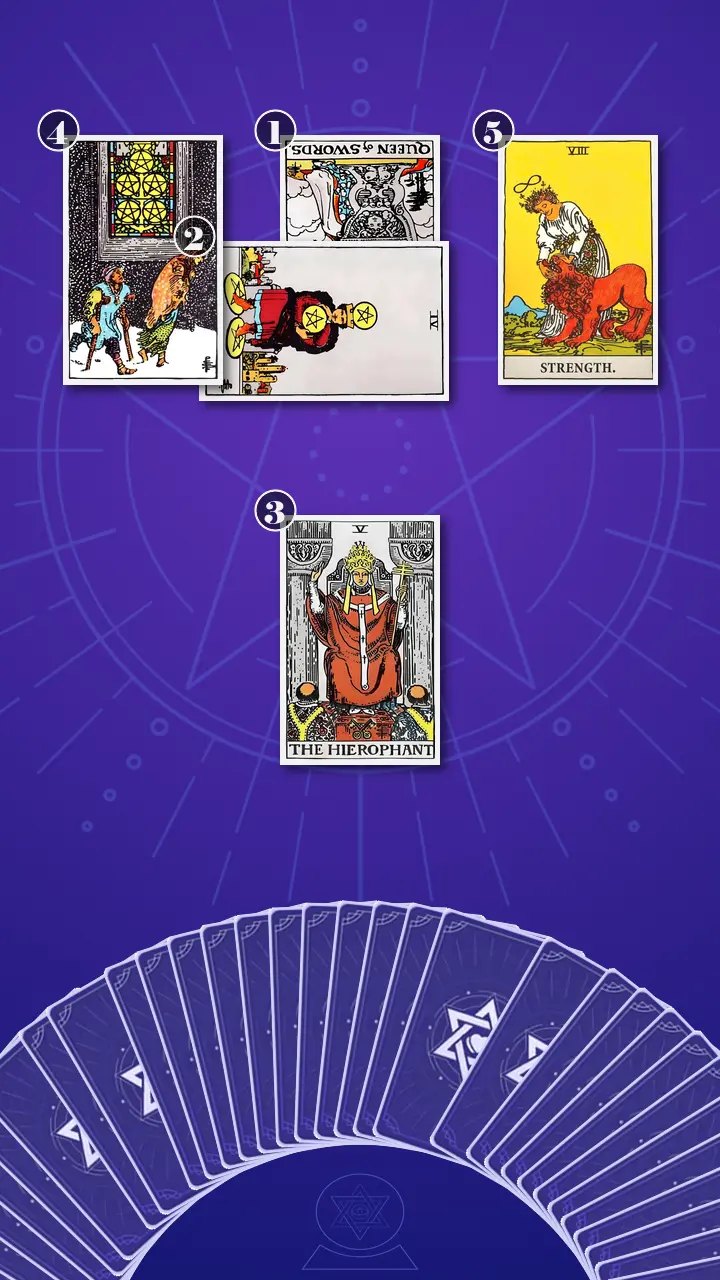
Position 1: The nitpicking pattern in the moment
Now we turn over the card that represents the nitpicking pattern in the moment: how it shows up right after closeness.
Queen of Swords, reversed.
In real life, this is exactly what you described: right after a sweet, intimate moment, your brain snaps into editor mode. You replay one sentence like a clip on loop, open Notes to list what felt “off,” and draft a “quick clarification” text that’s technically polite but emotionally chilled—because precision feels safer than being seen.
In tarot terms, the Queen of Swords upright is clean discernment—truth with boundaries. Reversed, that Air energy gets blocked and turns sharp. It becomes “clarity” used like a blade. Not because you’re mean. Because part of you believes warmth is dangerous unless you can control it.
As I spoke, Alex did that very Toronto-professional thing of trying to smile while her body gave her away. First: her breath paused. Then: her eyes flicked down like she was watching a memory replay. Then: she let out a soft, pained laugh.
“That’s… insanely accurate,” she said. “Like—too accurate. Even a bit cruel.”
I shook my head. “Not cruel. Just clean. You can be discerning without being defensive. The question is: what feeling are you trying not to feel when the sword goes up?”
Behind her, the fridge hummed on a low note, steady and indifferent—like the room was conspiring to keep time while her nervous system rushed ahead. That contrast mattered. The warmth didn’t vanish. Her mind just wouldn’t let it land.
Position 2: What crosses the connection—the trigger that flips warmth into critique
Now we turn over the card that represents what crosses the connection: the trigger that flips you from warmth into critique.
Four of Pentacles, upright.
This card isn’t about someone doing something terrible. It’s about the moment the connection starts to matter. Alex feels herself getting attached and tries to lock down safety by controlling tone, timing, and expectations. She clings to a “neutral” vibe, tightens her body, and turns small details into rules so she doesn’t have to sit in uncertainty.
Earth energy here is excessive—too tight, too guarded. The pentacle to the chest is the heart being protected. The pentacle on the crown is the mind trying to control the story.
It pulled me straight into the scene she’d mentioned: the TTC ride home on Line 1, the car rattling, headphones in, phone warm in her hand. Refresh iMessage. Refresh Instagram. Refresh iMessage again. A tiny, frantic ritual like the next notification will decide your worth.
“This starts in your body,” I said. “Before the argument. Before the ‘issue.’ Your jaw clamps. Your shoulders lift. Then your mind writes a reason so the clench feels justified.”
Alex’s eyebrows lifted—small, startled. “Oh,” she said, quieter. “Yeah. It’s like… my body slams the door first. Then I go looking for the legal paperwork to prove it was smart.”
Position 3: The old script beneath the surface
Now we turn over the card that represents the old script: the internalized rule-set driving the behavior beneath the surface.
The Hierophant, upright.
Under the nitpicking is an invisible rubric: how a partner should text, how quickly feelings should progress, how you should stay cool. You aren’t only reacting to the person in front of you—you’re obeying an inner authority voice that equates love with correctness and approval.
I leaned in slightly. “I want to try something with you,” I said. “Because this card always sounds like multiple voices.”
“Voice one,” I began, and I lifted my hand like I was reading copy on the radio. “The teacher: ‘If it’s real, it should feel effortless. Mature people don’t need reassurance. If they like you, they’ll just know.’”
“Voice two,” I continued, sharper. “The editor: cutting sentences, deleting warmth. ‘Don’t say you had fun. Don’t use an exclamation point. Don’t be cringe.’”
Alex’s mouth tightened as if she was trying not to nod too hard.
“And voice three,” I said, softer. “The one the crossed keys are asking for—the permission voice: ‘I’m allowed to want. I’m allowed to feel nervous after closeness. I’m allowed to be human in love.’”
Alex exhaled, small but real. “That voice… doesn’t sound like me,” she admitted. “It sounds like something I absorbed.”
“Exactly,” I told her. “This is my rulebook talking, not my present.”
In my head, I flashed back to my early years in sound research—how a room can ring with a frequency that isn’t the musician’s fault. The mic isn’t ‘bad.’ It’s just interacting with the room. The Hierophant is that room: the old acoustics you learned to perform inside.
Position 4: Where the script was learned—the template that taught closeness has a cost
Now we turn over the card that represents where the script was learned: the earlier emotional template that taught you closeness has a cost.
Five of Pentacles, upright.
This is the “outside the warm room” card. The image always gets me: there’s light right there—stained-glass warmth—yet the figures are in the cold, convinced they don’t belong inside.
In modern life, it’s the morning after: light through the blinds, coffee mug hot against your palm, and your chest still drops like an elevator because you sense a tiny decrease in intensity and your nervous system interprets it as a prophecy. You think, Here it is. This is where it fades. So you bring up something small—timing, wording, etiquette—because it’s safer than admitting, I liked you. That scares me.
This card’s energy is a deficiency of felt belonging. And when belonging feels scarce, the mind becomes an accountant: keeping receipts, auditing tone, building an exit ramp.
I watched Alex’s gaze drift past me, like she was looking through a window that wasn’t in my studio. Her fingers tightened around her water glass, then loosened.
“One data point is not a prophecy,” I said. “A slower reply is not the same as rejection. A normal lull is not the end of the story. But your body learned to treat it like it is.”
When Strength Held the Lion (and the Phone)
I could feel the reading pivoting. The air in the room got quieter—not silent, but focused, like the moment right before a chorus drops and you realize the song is about to change key.
Now we turn over the card that represents the new response: the most workable inner stance to practice when closeness rises.
Strength, upright.
Strength isn’t about “being tougher.” It’s about warm self-regulation—the kind that keeps you present with discomfort without turning it into critique. The lion is the urge to fix, control, or test. The gentle hand is the part of you that can say, I feel the surge, and I’m not going to swing the sword.
Because of my work with sound, I use something I call my Melodic Mirror: we look at your emotional pattern through your personal playlists. I asked her, “After a good date, what do you listen to?”
Alex snorted. “I have a playlist literally called ‘don’t text him.’ It’s… not calm.”
“That makes sense,” I said. “Your system is trying to match an internal tempo. When your body goes into threat mode, you reach for music that keeps the BPM high—so you can stay in motion and avoid the soft part. Strength asks for the opposite: lower the BPM so your body stops demanding a verdict.”
Setup: You’re standing in your kitchen after a great date, phone glowing, Notes app open, already drafting the “clarifying” text. Your jaw is tight and you can feel the urge to fix something—anything—before the warmth has a chance to land.
Stop treating intimacy like a test you must pass; start holding your fear like Strength holds the lion—firm, gentle, and present.
The sentence landed, and Alex had an “unexpected reaction” in three clean beats. First: she froze—chin lifted a fraction, like her body didn’t want to give it to me. Second: her eyes softened and unfocused, as if she was replaying last weekend’s good-night kiss and the immediate aftershock of wanting more. Third: she exhaled, long and shaky, and her shoulders dropped like they’d been carrying groceries for miles.
“But if I don’t catch it early,” she said, voice edged with irritation, “doesn’t that mean I’ve been wrong this whole time? Like I’ve been… making things up?”
“No,” I said, steady. “It means you’ve been protecting yourself with the tool you had. The tool just has a cost.” I let that sit for a second. “Try this once within the next week: when you notice the urge to correct, pause for 90 seconds. Unclench jaw, drop shoulders, take 3 slow breaths. Then send one feeling-first line—no explanation, no critique. If it feels like too much, you can stop after writing it in Notes—you don’t owe anyone a performance of vulnerability.”
I watched her swallow, then nod, like she was signing something that scared her but also made her feel taller. “Okay,” she whispered. “No verdict. Just presence.”
“Exactly,” I said. “This is the pivot from post-closeness unease and defensive nitpicking to calm self-trust, curiosity, and steadier connection. Not overnight. But one rep at a time.”
Then I asked, “Now—with this new lens—can you think of a moment last week when you felt the urge to correct, and if you’d done the 90 seconds first, you might have felt different?”
Alex blinked fast. “On the TTC,” she said. “When he didn’t reply for like… forty minutes. I could’ve just… breathed. Instead I drafted a ‘lol you’re busy?’ text that was basically a jab.”
“Warmth first,” I reminded her. “Verdict later.”
Warmth First, Verdict Later: Actionable Next Steps
I stitched the whole Cross Spread together for her in plain language: the Queen of Swords reversed shows the present pattern—Editor Mode right after closeness. The Four of Pentacles shows the trigger—your body clamps down when it starts to matter. The Hierophant reveals the engine—an invisible rulebook that equates love with being correct and approved. The Five of Pentacles explains why that rulebook feels life-or-death—your nervous system remembers being outside the warm room. And Strength is the antidote—a new kind of power: courage that’s gentle enough to keep the heart online.
The cognitive blind spot here is brutal but freeing: you’ve been treating discomfort as evidence that something is wrong with the relationship, when a lot of the time it’s just your system reacting to stakes. The transformation direction is the key shift: from “finding what’s wrong to stay safe” to “naming what you need and staying curious before you correct.”
Here are three small experiments—designed to be doable even on a Tuesday night when your brain wants to build a case:
- The 90-Second Unclench (your Strength rep)When you feel the urge to correct a text, tone, or tiny detail, set a 90-second timer. Unclench your jaw, drop your shoulders, and take 3 slow breaths before you type anything.Use my Emotional BPM trick: put on one track around 60–75 BPM (lo-fi, acoustic, anything steady). Let your body match the tempo before your mind writes a verdict.
- The Feeling-First Line (one sentence, then stop)Send one warm, direct line before any feedback: “I felt a little nervous after last night because I really liked it.” No extra paragraphs. No debate.If it feels too vulnerable, write it in Notes first and don’t send. You’re practicing access to warmth, not forcing a big talk.
- The Curiosity Swap (question instead of correction)Replace one correction with one curiosity question: “When you said that, what did you mean?” instead of “That came off weird.”If you hear a recurring harsh line in your head, name it with my Memory Melody cue: “This is my rulebook talking, not my present.” Then ask the question.
And one boundary that saves a lot of good things: no big decisions for 12 hours after closeness. No break-up fantasies, no confrontations, no psychoanalyzing. Let the nervous system settle before you “review the file.”

A Week Later: The Quiet Proof
Six days later, Alex DM’d me a screenshot: a single text she’d actually sent—no drafts, no extra armor. “Had such a good time last night. I got a little nervous after because I liked it.” Under it, the reply: “Same. I was literally thinking about you on my way home.”
She added, “I still felt the urge to nitpick. I still wanted to make it a trial. But I did the 90 seconds on Line 1 with a slow song. And I didn’t start a logistics fight just to feel in control.”
That’s what a Journey to Clarity usually looks like in real life: not a personality transplant—just one moment where you don’t abandon warmth. One moment where you hold the lion instead of letting it run the room.
When closeness finally feels warm, it can be terrifying to notice your body brace and your mind reach for a tiny flaw—because part of you would rather create distance on purpose than risk being fully seen and left anyway.
If you didn’t have to solve the relationship tonight, what’s one small, honest sentence you’d allow yourself to say—or even just admit to yourself—before you start correcting?