Hovering Over "Submit" to a Time-Bound Next Step Before Friday

The 11:47 p.m. Transfer Portal Spiral
If you’ve reopened the internal transfer form so many times this week that your browser autofills it, but you still can’t click submit—welcome to deadline-driven decision paralysis.
Jordan (name changed for privacy) sat down across from me with their phone face-down on the table like it might buzz and accuse them. They were 28, Toronto-based, mid-level IC—smart, steady, the kind of person other people quietly rely on. And yet their hands kept doing this restless thing: thumb to index finger, thumb to index finger, like they were trying to sand down an invisible splinter.
They described Thursday night in their condo rental as if they were reporting from a scene they couldn’t escape: laptop open on the internal transfer portal, Slack on the other monitor, harsh screen glow on a dark kitchen counter. The fridge hummed. A late Slack ping made their shoulders jump like a jump cut from Severance. Their cursor hovered over “Submit.”
“I want the switch,” they said, voice tight at the edges. “Growth. Visibility. The kind of work where I’m actually learning again.” Their jaw flexed as if the sentence hurt. “But if I go and I’m not instantly good, everyone will see I was never that talented. And the deadline’s Friday, so it’s like… if I don’t do it, it proves I’m scared. If I do it, it might prove I’m not good enough.”
I could practically see the contradiction hanging in the air between us: wanting growth and visibility by switching teams vs fearing that a wrong move will expose you as not good enough.
The fear wasn’t an abstract feeling. It lived in their body like a clamp: a tight chest, jaw locked, stomach fluttering—like standing on a subway platform and hearing the train before you see it, bracing for the wind.
“We’re not here to force you into a ‘brave’ choice,” I told them. “We’re here to find clarity. Not certainty—clarity. Let’s draw a map through the fog, and make sure the next step is something your nervous system can actually follow.”

Choosing the Compass: The Decision Cross · Context Edition
I asked Jordan to take one slow breath—not as a ritual for mystery, but as a clean transition. The kind of pause you take before you hit send on something important. I shuffled while they held the question in mind: Transfer deadline Friday—switch teams for growth or stay from fear?
“Today I’m using a spread called the Decision Cross · Context Edition,” I said. “It’s a five-card cross designed for a tight deadline with two competing pulls. It separates the two options while keeping your inner conflict visible in the center—so we’re not pretending this is a purely logical choice when your body is clearly involved.”
For you reading this: this spread works well when you’re stuck at a career crossroads under pressure because it does something your brain can’t do in a spiral—it creates structure. One card names the loop you’re stuck in. Two cards show the realistic energy of each option. One card exposes the underlying fear that’s turning a form into a threat. And the final card gives advice framed as a concrete, pre-deadline next step—not a prediction, not a guarantee.
“We’ll read from the center outward,” I added. “Card 1 is the mental loop. Cards 2 and 3 are the two paths—transfer for growth versus staying for safety. Card 4 names what’s really driving the stakes. Card 5 is the best next step you can take before Friday to build self-trust.”
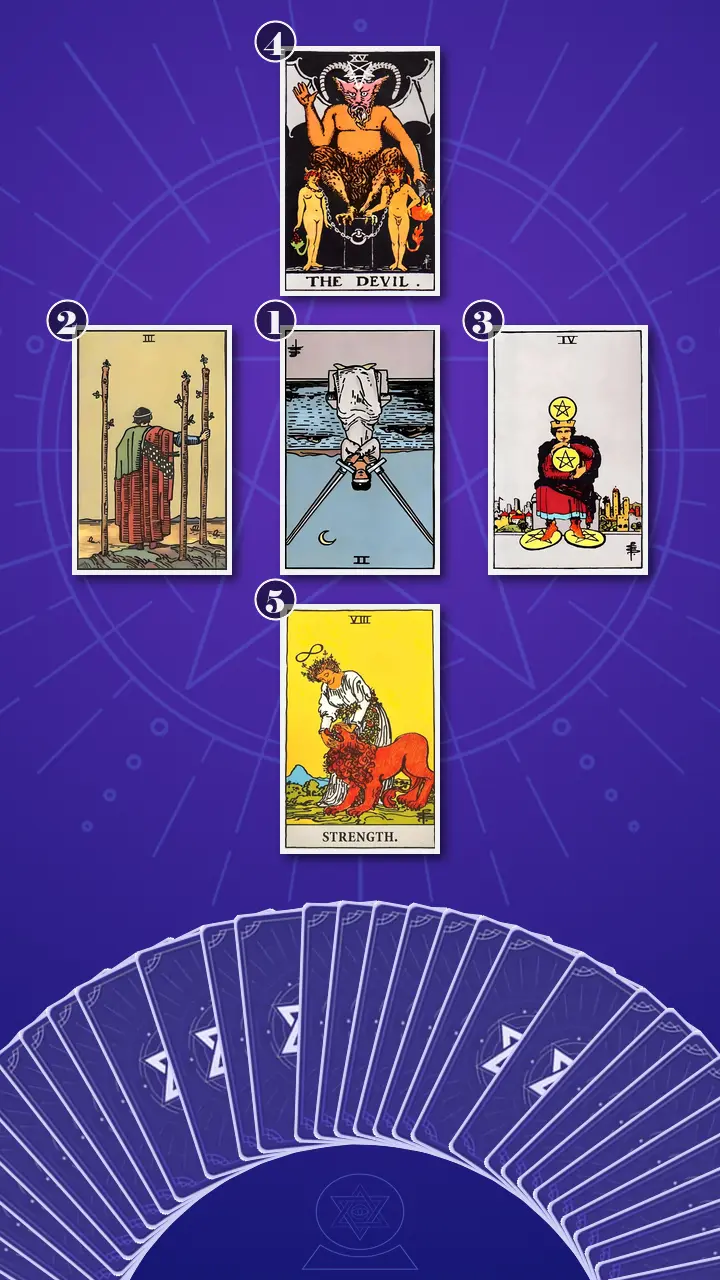
Reading the Map: Career Crossroads Under a Friday Deadline
Position 1: The loop that keeps you stuck right now
“Now flipped over,” I said, “is the card representing the presenting behavior and mental loop that keeps you stuck right now, especially as the deadline approaches.”
Two of Swords, reversed.
In plain life terms, it’s the moment you keep a calm face in meetings, but privately you’re stuck in a loop: reopen the transfer portal, tweak one sentence in your rationale, close the laptop, and tell yourself you’re being “thoughtful.” Really, you’re trying to think your way into certainty so you don’t have to risk being seen choosing.
Reversed, the Two of Swords feels like a blindfold that’s slipping. The stalemate isn’t stable anymore—it’s cracking under the Friday deadline. Air energy (thought, analysis, “what if?”) is in excess and also blocked: too many thoughts, not enough motion.
“Polishing is not the same thing as choosing,” I said gently, watching Jordan’s fingers tighten around the edge of their phone.
They didn’t nod right away. Instead, they did something more honest: a small, bitter laugh that sounded like a lid popping off a jar. “That’s… so accurate it’s almost rude,” they said.
The reaction came in a chain—three quick steps I’ve learned to notice. First: their breath stalled for half a second, like their body froze. Second: their gaze slid off the card and unfocused, as if their brain replayed the exact image of the portal and the unsent Slack DM. Third: the laugh—soft, edged—followed by a long exhale that loosened their shoulders just a millimeter.
“That loop,” I said, “is giving you short-term relief because no one can evaluate your choice yet. But the long-term cost is brutal: every time you delay, you teach yourself you can’t trust yourself under pressure.”
Position 2: Option A—choosing the transfer for growth
“Now flipped over,” I said, “is the card representing Option A: what choosing the transfer for growth is inviting you into—energy, lessons, realistic benefits.”
Three of Wands, upright.
This is you picturing the new team as a wider horizon: new stakeholders, new problems, a faster learning curve, and work that stretches you. You won’t feel instantly certain, but you’ll feel in motion—getting real feedback instead of living in imagined worst-case scenarios.
Upright, the Three of Wands is Fire in balance: not reckless, but forward. It says clarity comes after you step onto the dock and let the ships meet you. In work terms: you don’t think your way into being ready—you build readiness by being in the role.
I watched Jordan’s face as I spoke. The tension didn’t disappear, but a flicker of something else cut through it—like when clouds shift and you get one clean slice of sky.
“That’s the part I keep forgetting,” they admitted. “That the whole point is the learning. Not… proving I already know.”
“Exactly,” I said. “The growth path doesn’t promise comfort. It promises information. And information is what your spiral is trying to manufacture without risk.”
Position 3: Option B—staying, and what it preserves or costs when fear is driving
“Now flipped over,” I said, “is the card representing Option B: what staying is protecting, preserving, or costing you when the choice is driven by fear.”
Four of Pentacles, upright.
Staying looks like holding tightly to what’s proven: you know the people, the politics, and how to be ‘good’ here. It feels like immediate relief. But the tight grip also shows up as a quiet rule: don’t risk being a beginner where anyone can watch you learn.
Earth energy here is in excess: security that turns into rigidity. The body language on the card—coin clutched to the chest—mirrors the way Jordan’s jaw has been clenching around the idea of “not messing up.”
“Safety and growth aren’t enemies—control and growth are,” I said. “The Four of Pentacles isn’t judging you for wanting stability. It’s pointing to the moment stability becomes hiding.”
I used the scene that usually lands: “Your current team sounds like the warm, reliable hoodie you keep reaching for. It’s comfortable because it’s familiar. It’s also possible it doesn’t fit the moment anymore.”
Jordan’s shoulders dropped. Not dramatically—just enough that the chair stopped squeaking under their tension. “At least here I know the rules,” they said quietly. “At least here I’m not a beginner. At least here no one can question my judgment.”
The “oh” arrived exactly like the cards said it would: not an epiphany, more like a soft recognition that their delay was protection, not laziness.
Position 4: The underlying fear making this feel personal and high-stakes
“Now flipped over,” I said, “is the card representing the underlying fear and attachment that makes the decision feel high-stakes and personal.”
The Devil, upright.
This is the part where the transfer stops being about fit and becomes about worth. Your mind treats early struggle as exposure, and exposure as proof you’re not good enough. So you default to image management—choosing the option that keeps you looking competent, even if it keeps you smaller than you want to be.
In readings, I’m careful with The Devil because people hear it as doom. I don’t read it that way. I read it as: here’s the chain you can finally see. The fear isn’t subtle—it’s just normalized.
“This isn’t a transfer form. It’s a worth test in disguise,” I said, letting the sentence sit between us.
Jordan blinked hard once. Their mouth tightened, then relaxed. “Yeah,” they said. “It’s like I’ve been running… a private performance review on myself. All week. Like it’s my job.”
That line—image management as a job you never applied for—is The Devil in a corporate context. It’s the invisible role that eats your evenings: rewriting the message, searching Slack threads, trying to draft a sentence that guarantees you won’t be judged.
“And the thing about The Devil,” I continued, “is the chains are often loose enough to remove. But you have to notice you’re the one holding them.”
When Strength Took the Wheel
Position 5: The best next step before Friday (clarity without a guarantee)
I touched the last card in the cross. “Now flipped over,” I said, “is the card representing the best next step you can take before Friday that increases clarity and self-trust—without needing a guaranteed outcome.”
Strength, upright.
The room felt quieter as soon as it hit the table—like the building exhaled with us. Outside, somewhere down the street, a streetcar bell cut cleanly through the night air. It sounded like punctuation.
Strength is you taking one grounded step while fear is still present: sending the message, asking one direct question, or submitting with a transition plan. Not dramatic confidence—just calm self-leadership that says, “I can be new and still be capable. I can learn in public without it meaning I’m worthless.”
Jordan’s eyes stayed on the card. Their hand hovered over the trackpad of their own laptop—an unconscious echo of the portal moment.
Setup (the stuck moment): It’s Thursday night again in their head—cursor hovering over “Submit,” jaw clenched. They’ve rewritten the same message three times, telling themselves they’re being responsible, but it’s starting to feel like they’re just trying to avoid being seen choosing.
I lowered my voice, because this part isn’t about convincing—it’s about landing the truth in the body. “Fear doesn’t disqualify your decision,” I said. “It just needs a leader.”
Delivery (the line I want you to feel in your bones):
Not ‘wait until you feel certain’; practice Strength—hold the lion softly, then take one deliberate step that matches your values.
I let the silence do some work.
Reinforcement (what changed in Jordan): Their breathing caught—tiny, almost imperceptible. Then their eyes went glassy for a second, like they were seeing every unsent draft stacked behind their eyelids. Their jaw unclenched in a way that looked unfamiliar to them, like their face didn’t know it was allowed to do that. Their shoulders lowered. Their fingers—thumb to index finger—stopped moving, then restarted slower, gentler.
“But if I’m scared,” they said, and there was a flash of irritation in it, “doesn’t that mean I’m not ready? Like—if I was actually competent, I wouldn’t be doing this.”
There it was: the hidden contract. Fear = incompetence.
My mind flashed back to my Wall Street years—my hand on a mouse, a trade ticket open, a market moving fast enough to make your stomach drop. We never eliminated risk. We sized it. We named it. We set a rule. And we executed.
“On a trading floor,” I told them, “fear shows up when something matters and you can’t control every variable. It’s not a verdict. It’s a signal. Strength isn’t ‘no fear.’ Strength is nervous-system leadership. Fear can come with you. It just can’t drive.”
Then I brought in my own framework—the one I use when people feel trapped between two doors. “Let’s do a quick version of my Risk-Reward Matrix—a three-scenario forecast. Not to spreadsheet your feelings. To stop your mind from treating the worst-case as the only case.”
“Scenario one: you transfer and the first month is awkward. Base case. You ask questions. You learn. That’s not exposure—it’s onboarding. Scenario two: you transfer and you thrive. Bull case. Scenario three: you transfer and it’s a poor fit. Bear case. Even then, it’s data—you pivot, you negotiate scope, you move again. None of these scenarios equals ‘you are worthless.’ That’s The Devil trying to turn a career move into a moral score.”
I slid the card toward them. “Now, use this new lens and tell me: last week, was there a moment when you felt the spiral start—like on the TTC, or late at night—when this perspective could’ve changed how you responded?”
Jordan stared at the card, then nodded once. “Wednesday. 2 p.m. I was rewriting the first line to the receiving manager. I was trying to write a sentence that made it impossible for them to judge me.” They swallowed. “If I’d had this… I could’ve just sent the message. Not perfect. Just real.”
That was the shift: from tight, deadline-driven dread and analysis paralysis to regulated courage and time-bound self-trust. Not a personality overhaul. A single gear clicking into place.
The One-Page Decision Ledger (and Your Next 48 Hours)
I gathered the spread into one story for Jordan, the way you’d brief a team before a high-stakes meeting.
“Here’s what the cross is saying,” I summarized. “Two of Swords reversed is the loop: you keep reopening the portal and rewriting messages because you’re trying to think your way into certainty. Three of Wands is the truth of the transfer path: growth through exposure and real feedback—momentum over imagination. Four of Pentacles is the seduction of staying: immediate relief and the identity of being ‘the competent one,’ but at the cost of shrinking your horizon. The Devil is the driver: you’re treating this as a worth test. And Strength is the direction: lead fear gently, make one deliberate, time-bound move, and let action create clarity.”
“Your cognitive blind spot,” I told them, “is that you’ve been trying to eliminate risk as proof you’re ready. But readiness isn’t the absence of fear—it’s self-trust under fear. The transformation direction is clear: move from ‘I need certainty’ to ‘I need a time-bound next step.’”
Jordan exhaled. Then—practicality snapped back in, as it always does. “Okay,” they said. “But I genuinely don’t have time. I’m in back-to-back meetings tomorrow. I can’t do some big journaling thing.”
“Perfect,” I said. “We won’t. We’ll do boardroom-simple.”
I pulled out my Boardroom-style decision ledger—a weighted scoring system I used in M&A when we had to decide with imperfect information. “This isn’t to make the choice for you,” I said. “It’s to stop fear from secretly assigning all the weights.”
- The 7-Minute Values SwapSet a 7-minute timer. Open a blank note and write two lines only: (1) “If I transfer, I’m choosing ___.” (2) “If I stay, I’m choosing ___.” Circle the one you can stand behind for the next 7 days—not forever.Expect your brain to call this “too simple.” If your chest tightens or you start spiraling, put both feet on the floor and end early. You can come back later—you’re not required to push through discomfort to ‘do it right.’
- The One-Question Clarity DMPick one non-negotiable safety condition (e.g., onboarding expectations or first-30-days goals). Send the receiving manager one direct question in Slack/email: “What would a strong first 30 days look like on your team?”Don’t add a paragraph of justification. One question is enough. You’re collecting real data, not auditioning.
- Schedule-Send the Manager NoteDraft a 4-line message to your current manager that’s honest and non-apologetic. Save it, then schedule-send it for a specific time Friday morning (or earlier) so you’re not relying on late-night courage.Use my trading-floor pre-commitment rule: decide the send time while you’re regulated, then let the calendar do the brave part.
“You don’t have to decide your whole future,” I reminded them. “You just have to take one clean step before Friday that proves to your nervous system: I can act while fear is present.”

A Week Later: The Quiet Proof
Six days later, I got a message from Jordan.
“Did the 7-minute thing,” they wrote. “Circled ‘transfer’ and realized I’m choosing growth and learning, not ‘being impressive.’ Sent one question to the receiving manager. They replied with actual onboarding expectations. I scheduled the message to my manager instead of waiting for 11 p.m. courage. I’m still scared, but it’s not driving.”
They added one more line: “Slept through the night. Woke up and thought, ‘What if I’m wrong?’ Then I smiled a little because… at least now I know what I’m doing next.”
That’s the journey to clarity I trust: not a perfect guarantee, but a real loosening—fear still in the room, and you still in the lead.
When a deadline is loud, it’s easy to confuse “I’m scared” with “I’m not ready”—and end up gripping the version of yourself that already knows the rules, even while part of you aches to grow.
If you didn’t have to feel fearless—just steady—what’s one time-bound next step you could take in the next 24 hours that would build trust in yourself, even if the outcome stays uncertain?