The Sweet Weekend Crash—and the One Question That Shifted the Ick Spiral

Finding Clarity in the Monday-Morning WhatsApp Scroll
You had a genuinely sweet weekend, and then 24–48 hours later you’re hit with post-date whiplash—rewatching every moment like you’re looking for a reason to distrust it.
Taylor (name changed for privacy) arrived looking put-together in that specific London way—clean coat, hair pinned like she’d made a decision about it—but her attention kept snapping back to her phone like it had a magnet in it.
She described it exactly as I’ve heard it a hundred times, but never quite the same twice: 8:41 AM on a Monday, shoulder-to-shoulder on the Central line at Oxford Circus, phone screen bright against the grey. The carriage rattling. Someone’s headphones leaking tinny bass. Her thumb opening the WhatsApp thread just to reread it—then closing it—then opening it again, as if repetition could turn a feeling into a fact.
“It was… genuinely sweet,” she said, and I watched her throat tighten on the word sweet, like it had teeth. “So why do I suddenly feel turned off?”
There it was: the core contradiction in its most modern outfit—torn between naming the ick as fear of intimacy and treating it as a real mismatch.
As she spoke, I noticed the precise tells she probably didn’t: the swallow she couldn’t quite finish; the small, involuntary wince when she imagined a second date; the way her shoulders lifted a fraction, as if bracing for impact from a question as ordinary as, “So… what are you looking for?”
Her unease wasn’t an abstract emotion. It was a physical stomach-drop, like stepping off the Tube and realising you’ve walked onto the wrong platform—followed by a tight-throat pressure that made honesty feel like it might get stuck halfway out.
“I don’t want to lead them on,” she added, faster now, the words bumping into each other. “But I also don’t want to self-sabotage. If I can’t explain the ick logically, I don’t trust it.”
I nodded. “That makes sense. Your mind is trying to protect you by building a case. But we can do something kinder than a courtroom today.” I let the silence sit for half a beat. “Let’s try to map the fog—so you can find clarity without forcing certainty.”

Choosing the Compass: The Decision Cross · Context Edition
I don’t treat tarot like a theatrical ritual; I treat it like a structured conversation with your attention. I asked Taylor to take one slow breath—slower than her instinct wanted—and to hold the question in her mind: Is this ick fear of intimacy, or a real mismatch?
As I shuffled, the sound of the cards was dry and ordinary—like turning pages in a paperback on a rainy commute. That’s the point. It’s a psychological threshold: from spiralling privately into looking at something together, in daylight.
“We’re going to use a spread called the Decision Cross · Context Edition,” I said. “It’s built for exactly this: separating two competing interpretations of the same experience—the post-weekend ick as protection versus the ick as incompatibility—without pretending we can get a perfect verdict from one sitting.”
For you reading this: this is how tarot works when it’s done well. Not prophecy—pattern recognition. A shape that helps the mind stop spinning in circles.
This spread is simple and ruthless in the best way: one card for the immediate reality (what’s actually happening in your thoughts, body, behaviour), two cards for the competing lenses (fear of intimacy vs mismatch), one card as a clarifier (what to ask/notice/communicate), and one card for integration (a grounded next step that builds self-trust).
I pointed to the space where the cards would land. “Card 1 will name what the ick is doing right now. Cards 2 and 3 will show the two stories you’re torn between. Card 4 will give you the clean question—the clarifier. And Card 5 will be the practical next step. Not a prediction. A direction you can test.”
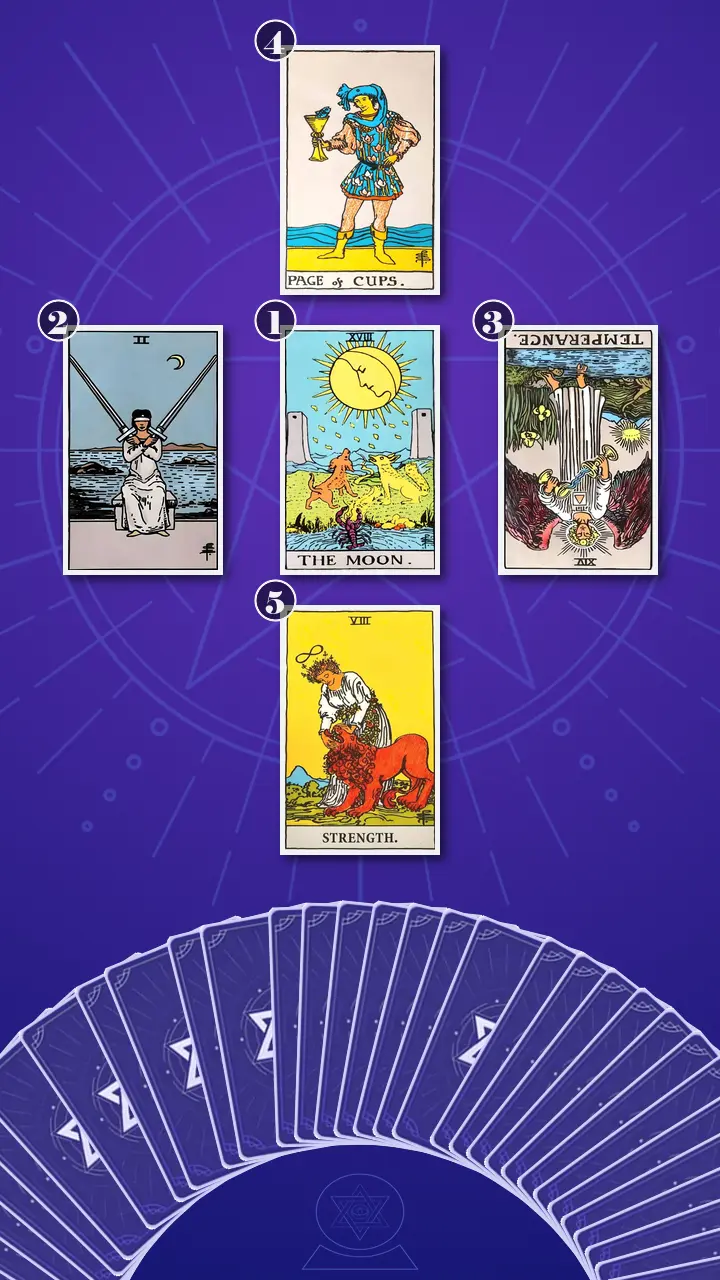
Reading the Map: Fear of Intimacy vs Real Mismatch
Position 1 — The immediate reality: what the ick is doing right now
“Now we turn over the card that represents the immediate reality: what the ick is doing in your thoughts, body, and behaviour right after the sweet weekend.”
The Moon, upright.
The image is all low visibility: a winding path disappearing into dim light, creatures rising from water, and two animals—one tame, one wild—howling at the same moon. In my experience, The Moon doesn’t mean “something is wrong.” It means “you’re trying to make a decision in bad lighting.”
I said, “This is like the night after the sweet weekend—you’re lying in bed, scrolling back through messages, and one tiny comment replays in a harsher tone than it had in the moment. Nothing objectively happened, but your stomach drops anyway. Your brain starts imagining the next date as awkward before it even exists.”
Her eyes flicked up—caught—and then down again to the table, as if she’d been seen doing something slightly embarrassing.
“Energy-wise,” I continued, “this is low-visibility Water. Not wrong, not right—just fog. In fog, the nervous system does something very human: it grabs for certainty. It tries to lock onto one detail as proof you should end it, because uncertainty feels unbearable.”
Then I offered her a clean tool, not a lecture. “The Moon asks for a split-screen: three observable facts from the weekend—what was said and done—and three interpretations—the story your mind is telling. Facts and stories often get fused after closeness. Unfusing them is the first rung of clarity.”
Position 2 — Lens A: if the ick is primarily fear of intimacy
“Now we turn over the card that represents Lens A: what it looks like if the ick is primarily fear of intimacy—your protective pattern when closeness increases.”
Two of Swords, upright.
Blindfold. Crossed swords right across the heart. Calm water behind her that she can’t fully see. This is the card of emotional input blocked so the mind can stay in control.
“Here’s the modern version,” I said. “You tell yourself you’re just busy, but you’re using delay as armour. Waiting longer to reply. Avoiding making the next plan. Keeping the conversation light so you don’t have to find out what you actually feel. You’re not rejecting them—you’re freezing the whole situation so you can’t be ‘wrong’ about it.”
I used an analogy Taylor’s face told me she’d understand immediately. “It’s like your phone is locked, but you keep waking the screen—checking the notification preview without opening the message. That little hit of control without the risk of being real.”
“Distance lowers the pressure,” I added, “but it also lowers the data.”
Taylor made a sound that was half-laugh, half-wince. “That’s… painfully accurate,” she said. “If I don’t choose, I can’t be wrong. But then I’m also… stuck.”
“Exactly,” I replied, keeping my tone steady. “This isn’t shameful. It’s logical self-protection. The question is the cost: the longer you stay blindfolded, the more The Moon-fog grows. Less contact, less information, more imagination.”
Position 3 — Lens B: if the ick is primarily a real mismatch
“Now we turn over the card that represents Lens B: what it looks like if the ick is primarily a real mismatch—genuine lack of fit, pacing, or values.”
Temperance, reversed.
Temperance is usually the art of blending—water pouring between two cups, one foot on land, one in water. Reversed, that blend doesn’t settle. The rhythm stays off.
“This card doesn’t villainise anyone,” I said. “It simply says: the mix may not be stabilising in real life.”
I translated it into her week. “The weekend felt easy in a curated bubble. But weekday reality doesn’t blend: texting pace feels too much or too little, planning style feels chaotic or rigid, emotional tone slightly off. And then you start compensating—editing yourself to make the mix work—saying yes when you mean maybe, laughing when you feel irritated.”
Her mouth tightened, and she nodded once, very small.
“Temperance reversed is often the moment someone realises,” I said, “‘If you’re doing all the blending, that’s not being chill—that’s self-editing.’ And self-editing fatigue can show up as an ick spike.”
As an archaeologist, I can’t help thinking in layers. “In a dig, if one layer keeps showing the same imbalance—same kind of pottery, same burn marks—you don’t call it a one-off. You call it a pattern. Temperance reversed asks: where are you consistently adjusting your natural pace to keep things smooth?”
Position 4 — The clarifier: what you need to ask, notice, or communicate
“Now we turn over the card that represents the clarifier: what you need to ask, notice, or communicate to tell fear from incompatibility without rushing to a verdict.”
Page of Cups, upright.
The Page stands relaxed, holding out a cup with a fish peeking out—an odd little messenger. This is my favourite kind of guidance card because it’s not dramatic. It’s curious.
“This is the ‘weird feeling as a notification’ card,” I said. “Not ‘abort mission.’ More like: look here.”
I leaned slightly forward. “A gentle truth beats a perfect theory. The Page asks you to make one small clarity move—one kind, direct question or one pacing preference—so you get new information instead of reassurance.”
Then I offered a micro-script, keeping it simple on purpose—my own version of what I call Pictogram Dialogue: if conflict is a whole essay in your head, communicate with the equivalent of street signs. Clear. Minimal. Impossible to misread.
“Something like,” I said, “‘I had such a nice time. I’m noticing I can get in my head after closeness—can we keep it slow and do something low-key this week?’”
Her thumb unconsciously mimed hovering over a Send button. And I saw it—tiny, but real: her throat unclenched a millimetre at the idea that honesty didn’t have to be a twelve-paragraph confession.
“That message isn’t asking them to fix your feelings,” I added. “It’s inviting real data.”
When Strength Stayed Gentle
Position 5 — Integration and next step: a grounded move that builds self-trust
I took a breath before turning the last card. The room felt quieter—not mystical, simply focused, the way a library does when someone finally finds the book they’ve been searching for.
“Now we turn over the card that represents integration and next step: the most grounded way to move forward this week that supports self-trust.”
Strength, upright.
Strength is not about overpowering anything. It’s a calm figure with gentle hands on a lion—instinct, intensity, urge—held with steadiness rather than force.
Setup (what you know if you’ve lived it): it’s that 24–48 hour window after a genuinely sweet weekend—your commute starts, you open the chat thread, and suddenly your stomach drops like you’ve missed some obvious red flag everyone else can see. Your mind panics and tries to choose between two harsh stories: “I’m self-sabotaging” or “This is doomed.”
Delivery (and I said it slowly, letting it land):
Stop treating the ick as a verdict and start treating it as a sensation you can hold with steady courage—like Strength, you tame the impulse to bolt by staying gentle and present.
There was a pause where Taylor didn’t move at all.
Reinforcement: I watched the reaction travel through her in three steps. First, a physiological freeze—her breath caught, and her fingers went still on the edge of her sleeve. Then cognition seeped in: her eyes unfocused, as if she were replaying the exact moment she’d felt the stomach-drop on the Tube, hearing that metallic screech and mistaking it for danger. And then the release: a long, careful exhale that sounded like she was putting something heavy down without making a noise.
“But if I don’t listen to it…” she began, and her voice tightened with a sudden edge—brief anger, almost—“doesn’t that mean I’ve been wrong before? Like I’ve ignored red flags?”
I didn’t contradict her. I widened the frame. “This is where my work often becomes what I call Emotional Historiography—reading feelings through time, not through one dramatic moment. In archaeology, a single shard can be important, but you don’t declare an entire civilisation from one broken cup. You date it. You place it in a layer. You compare it to other finds.”
“Strength isn’t ‘ignore it,’” I said. “Strength is ‘stay in the room with it long enough to learn what it is.’ You don’t have to obey the impulse to bolt to prove you’re discerning. You also don’t have to shame the impulse to bolt to prove you’re mature.”
Then I asked her the question that turns insight into usable clarity. “Now, with this new lens—just for a moment—think back to last week. Was there a point where you felt the stomach drop and immediately reached for distance? If you’d treated that sensation as information, not a sentence, what would you have done differently for five minutes?”
Taylor blinked hard, then gave the smallest nod. “I would’ve… replied normally,” she said. “Or at least not rewritten the reply six times. I would’ve asked one question instead of disappearing.”
And there it was: not certainty, but self-trust beginning—shifting from post-date unease and evidence-hunting for proof to calm curiosity that treats the ick as workable information.
The One Clean Next Step: Actionable Advice for the Next 48 Hours
I gathered the spread into a single story, because scattered insights don’t help when you’re back on the Central line with your phone in your hand.
“Here’s the pattern the cards describe,” I told her. “The Moon says you’re in low visibility after closeness—your nervous system is loud, and your mind wants certainty. Two of Swords shows your control move: you freeze, you slow-reply, you delay plans so you can’t be wrong. Temperance reversed admits a second truth: sometimes the blend really is off, and you’ve been mixing yourself down to keep it smooth. Page of Cups gives you the ethical method: one gentle, curious message instead of a disappearing act. Strength makes it practical: calm courage, one grounded next step, no verdict required.”
Her cognitive blind spot, I named plainly: “You’re treating the ick as if it must be either a truth you obey or a flaw you eradicate. That binary keeps you stuck.”
And the transformation direction: “We move from interpretation to experimentation. From proving to learning. From ‘I need certainty before I act’ to ‘I need one clean next step so I can get real information.’”
Then I offered the smallest possible actions—because courage in dating is rarely a grand speech. It’s usually a three-sentence text and a boundary you actually keep.
- The 3 Facts vs 3 Stories Note (Moon antidote)On your commute today, open Notes and write: 3 observable facts from the weekend (what was said/done) and 3 interpretations you’re tempted to make. Circle only what you can verify.Keep it time-limited: one stop per bullet. If you catch yourself building a 30-line “case,” stop—your nervous system wants safety, not more evidence.
- Send the Page-of-Cups Text (curious, not courtroom)Send one warm, low-pressure message: “I had a really nice time. I’m noticing I get a bit in my head after closeness—could we keep it slow and do something low-key this week?”If it feels cringe, make it smaller. Write it, leave it in Drafts for 10 minutes, reread once, then send. You’re not confessing your life story—you’re stating a pacing preference.
- The Pacing Non‑Negotiable (Temperance reversed test)Choose one domain for 7 days—texting rhythm or frequency of dates or physical pace—and stop “mixing yourself down.” Example: “I’m not great at all-day texting during workdays—can we do a call later this week instead?”This is my Amphora Balance rule: two people carry equal weight. If the connection only works when you do all the adjusting, that’s data—not a personal failing.
Finally, I reframed commitment the way I do in my own work—what I call Covenant Evolution: “You’re not signing a lifetime contract by planning one low-key date. You’re making a small, historically normal move: gathering evidence over time, with boundaries.”

A Week Later: Relief, and a Little Curiosity
A week later, Taylor messaged me—not a paragraph, just a screenshot and two lines. She’d sent the Page-of-Cups text. She’d expected it to feel like handing someone a lever. Instead, the reply was simple: “Totally get that. Low-key sounds perfect. Want to do a walk and a pub on Wednesday?”
She wrote: “My stomach still did the drop. But I didn’t vanish. I did the 3 facts vs 3 stories thing on the Overground and realised half my ‘proof’ was… literally a story.”
Her clarity wasn’t a fireworks moment. It was a quieter proof: she was gathering real information without punishing herself for having a nervous system.
It wasn’t perfect, either—the kind of progress that actually happens in real life. She told me she slept properly that night, then woke up and her first thought was, What if I’m wrong? Only this time, she noticed the thought, breathed, and didn’t treat it like an emergency.
That’s the Journey to Clarity, as I see it: not certainty, but ownership. Not a verdict, but a method.
When something sweet gets real, your body tightens like it’s bracing for a future you can’t undo—and your mind tries to regain control by turning one tiny “off” moment into the whole verdict.
If you didn’t have to obey the ick or shame it—what’s one small, honest next step you’d be willing to try just to get real information?