From Hinge Spiral to Coworker-Dating Boundaries: A Low-Drama Next Step

Finding Clarity in the Sunday-Night Hinge Glow
You had a completely normal Slack exchange with a coworker… then they popped up on Hinge 20 minutes later, and now you’re stuck in workplace dating ambiguity.
Taylor (name changed for privacy) sank into the chair across from me like she’d been holding her shoulders up all day and only just remembered they were allowed to drop. She was 29, a junior PM in NYC, and her whole energy had that hybrid-office vigilance—like the world is half Zoom, half hallway, and both versions can gossip.
She described Sunday night at 10:41 PM in her tiny apartment: Hinge open on her phone, Slack still logged in on her laptop. The screen glow cut hard across the room; the radiator clicked like a metronome that refused to soften. Her thumb hovered over the match. Her jaw tightened. And when she pictured seeing him at the coffee machine Monday morning, her stomach dropped like she’d missed a step on the subway stairs.
“I’m not trying to start a rom-com in the break room,” she said, and then laughed once—small, embarrassed. “But I also don’t want to swipe away and wonder forever.”
She didn’t say “anxiety.” Her body did. It sat in her clenched molars and the way her chest stayed shallow, like she was trying to breathe through a straw while her brain ran a thousand little A/B tests: message vs unmatch, best case vs worst case, ‘ok.’ vs ‘okay!’—as if punctuation could predict her future.
“You want to explore mutual attraction,” I said, keeping my voice gentle and plain, “but you’re trying to avoid workplace awkwardness and reputational risk. That’s a real tug-of-war—especially in a team where vibe shifts get noticed.”
I set my hands on the deck. “Let’s not try to predict the perfect outcome. Let’s make you a map. We’re here for clarity—and for a next step you can respect yourself for on Monday.”

Choosing the Compass: The Decision Cross Spread
I asked Taylor to take one slow breath and name the question in one sentence—not for the cards, but for her nervous system. Then I shuffled at an unhurried pace, the way I learned to cue a radio segment: steady enough to ground the room, not dramatic enough to spike it.
“Today we’ll use a spread called the Decision Cross,” I told her, then turned slightly as if I was talking to you, the reader, too. “It’s perfect when the question has two explicit options—date or swipe away—and the real problem is that the decision criteria are tangled up with fear.”
The cross format does something practical: it separates Option A and Option B, while keeping the center card as the psychological loop driving the indecision. And it places a ‘bigger frame’ card at the top—so the reading stays empowering and realistic, not predictive. In other words: it’s decision architecture, not fate.
“Card 1 will show the inner stalemate,” I said. “Cards 2 and 3 are the two paths—what dating activates, and what swiping away protects or costs. Card 4 is the bigger context you can’t ignore—workplace norms, boundaries, policy. And Card 5 is your low-drama next step.”
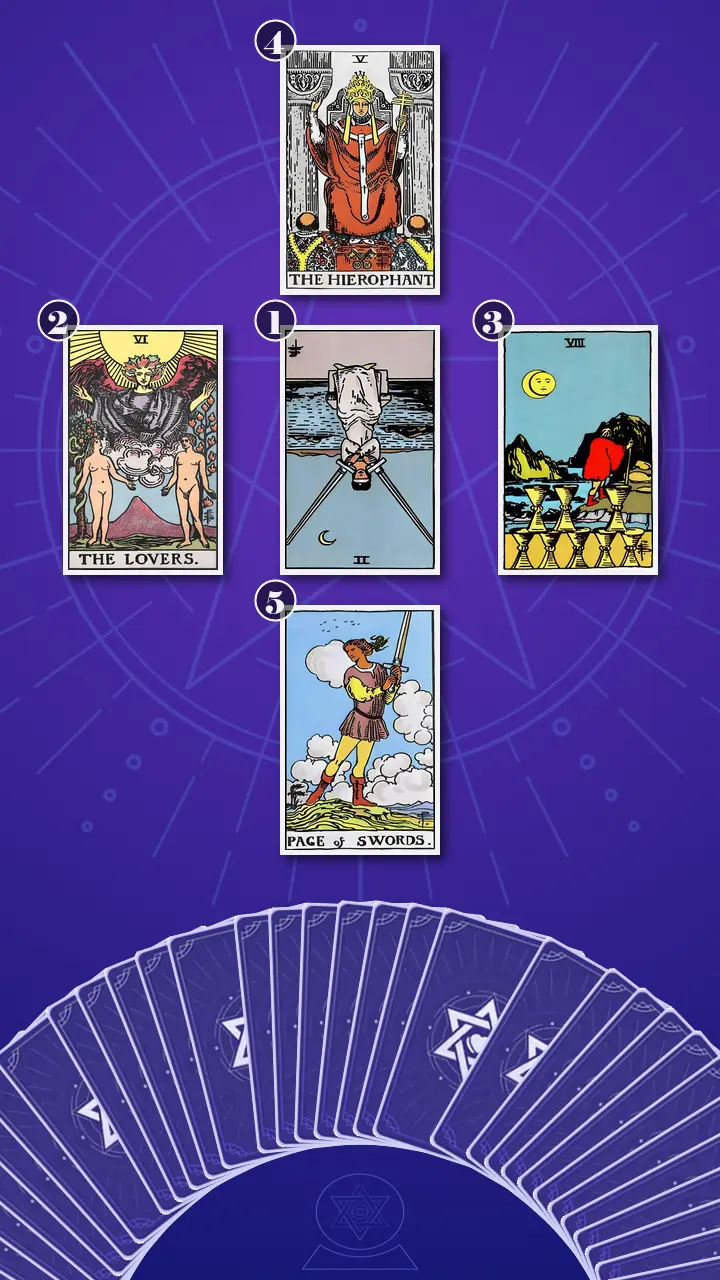
Reading the Map: The Loop, the Spark, and the Exit Door
Position 1: The current inner stalemate
“Now we’re turning over the card that represents the current inner stalemate and how it’s showing up in your behavior.”
Two of Swords, reversed.
I nodded toward the blindfold in the image. “This is the ‘I’ll just not decide yet’ strategy. And it’s not neutral. It’s tense.”
I put it into her exact life, because the cards were already there: “You’re on your couch after a long day, Hinge open, thumb hovering. You type a careful opener, delete it, then reopen Slack to reread his last message for tone. You keep the match in limbo because neutrality feels safer—but the longer you stall, the weirder you feel in meetings.”
Reversed, the energy isn’t calm. It’s blockage leaking into behavior. The swords aren’t protecting her anymore; they’re bracing her chest like a tight seatbelt she can’t unclick.
I mirrored it back the way she’d described it—like a subway transfer that never reaches the exit: open profile → draft in Notes → delete → scroll other matches to prove you have options → circle back. The inner monologue underneath it is always the same: “If I just wait, it’ll choose itself.” Safety vs aliveness, playing tug-of-war in her hands.
Taylor’s reaction was immediate and oddly sharp: she let out a breath that sounded like a laugh with teeth in it. “That’s… painfully accurate. Like, rude.” Her shoulders were practically up by her ears, and she noticed it only when I noticed it.
“Ambiguity is not neutral—it’s a slow leak in your attention,” I said softly. “And it costs you more than a ‘yes’ or ‘no’ would.”
Position 2: Path A — if you date
“Now we’re turning over the card that represents Path A: what dating this coworker would activate in you, and what it would require from you.”
The Lovers, upright.
This wasn’t a cheap “romance” card in this context. Upright, it’s balance—desire paired with accountability. “Notice the open sky,” I said. “This isn’t about hiding. It’s about choosing something you can stand behind.”
I translated it into her Monday reality: “You imagine messaging not to flirt for sport, but to make a respectful, intentional choice you won’t cringe about later. Dating him would ask you to be clear about what you want—and to act in a way you’d still feel okay about when you’re back in sprint planning and Slack threads.”
The Lovers’ energy, here, is heart-forward but not reckless. It’s the opposite of dopamine-swipe culture. It’s: What’s the cleanest, most respectful version of what I want?
Taylor’s face softened around her mouth. The jaw tension didn’t vanish, but it loosened like she’d stopped biting down on the thought. “I keep making it about optics,” she admitted, quieter. “But I do actually like him.”
Position 3: Path B — if you swipe away
“Now we’re turning over the card that represents Path B: what swiping away would protect, cost, or clarify for you.”
Eight of Cups, upright.
This card is often misunderstood as “running away.” In reality, upright it’s a decisive emotional exit—not dramatic, not punishing. “Look at the missing cup,” I said. “Something can be fine and still not be worth the ongoing proximity cost.”
I kept it in her modern scene: “You unmatch and feel your shoulders drop—like you just reclaimed your commute brain from a private soap opera. You decide you’d rather keep your work life steady than spend the next month calibrating eye contact and small talk.”
Then I did the relief-versus-erasure check out loud. “There are two micro-futures. One: you unmatch and you feel lighter in the elevator Monday morning. Two: you unmatch and immediately spiral into ‘I always shut things down.’ The question is: are you protecting your peace, or shrinking?”
Taylor’s breathing got deeper, but her eyes went a little glossy—relief mixed with grief, exactly as promised. “A no can be self-respect, not self-erasure,” she said, like she was trying the sentence on for size.
“Yes,” I told her. “And either way, you’re allowed to want spark and still protect your Monday.”
When the Hierophant Turned the Keys
When I reached for the next card, the room quieted in that specific way it does before a chorus hits—like even the radiator decided to listen.
Position 4: The bigger frame — the rules of the room
“Now we’re turning over the card that represents the bigger frame: workplace norms, boundaries, and the non-negotiable context influencing both paths.”
The Hierophant, upright.
“There’s a third person in this situation,” I said. “Not another date. Not another match. The workplace itself.”
I made it concrete: the HR policy PDF you read like an Ask a Manager thread at 11 PM, reporting lines, the speed at which happy-hour details become team lore without anyone meaning harm. “The Hierophant is structure,” I told her. “Not hidden versus exposed—contained versus improvised.”
And because my work lives in sound, I used my own lens—my Melodic Mirror. “Taylor, think of your week like a playlist. Right now, your mind is stuck on one looping track—same hook, same tension. The lyrics are basically: ‘If I choose wrong, work will remember forever.’”
I watched that sentence land. Her breathing paused. Her fingers froze on her water cup. Her eyes unfocused for half a second like she was replaying every time she’d over-edited a Slack message to sound ‘normal.’ Then she exhaled through her nose, sharp and almost annoyed.
“I hate that this has to be a whole… system thing,” she said, with a flash of anger. “Like my job gets a vote in my dating life.”
“That reaction makes sense,” I replied. “And it’s also the doorway. The Hierophant isn’t here to scold you. It’s here to hand you the keys so you stop feeling helpless.”
For a beat, I let her sit inside the real scene her body already knew—Hinge open, thumb hovering, then the Monday coffee machine. That stomach-drop. That split-second of ‘I need a guarantee.’
Stop waiting for the perfect, consequence-free sign; choose a clear code of conduct and use the Hierophant’s keys—structure and shared agreement—to unlock a safe next step.
The sentence hung in the air like a clean note held long enough to change the chord underneath it.
Taylor’s reaction came in a three-part wave. First: a tiny freeze—her lips parted, and her shoulders stopped mid-rise like her body had been caught adjusting armor. Second: the cognitive shift—her gaze dropped to the card’s crossed keys, and I could almost see her brain swapping from “rom-com risk” to “working agreement.” Third: the release—her shoulders lowered, and her jaw unclenched so visibly it was like watching a knot untie.
Her voice came out quieter, steadier. “So it’s not… ‘Do I like him enough?’”
“Exactly,” I said. “A coworker match isn’t a secret chemistry test—it’s a values-and-boundaries agreement inside a system that remembers.”
I slid her a notebook. “Open Notes—literally—and write two lines: (1) ‘My non-negotiables if I ever date a coworker are: ___, ___, ___.’ Privacy, pace, professionalism are common. (2) ‘My exit plan if it’s a no is: ___.’ Then pause for sixty seconds and notice what your jaw and chest do. If your body spikes, that’s data—not a push. If you feel steadier, you choose one tiny next step.”
I leaned in, gentle but direct. “Now—with this new lens—think back to last week. Was there a moment when you could’ve felt different if you’d been asking ‘container’ instead of ‘sign’?”
She swallowed, eyes a little wet. “Wednesday. In the glass conference room. I saw him look at me and I spent the rest of the meeting trying to decode it. If I’d had a code of conduct, I… wouldn’t have needed the decoding.”
That was the turn: from anxiety-driven overthinking and reputation protection to the first taste of calm confidence—because boundaries are something you can actually hold.
The Page of Swords and the One-Clean-Sentence Protocol
Position 5: A low-drama next step
“Now we’re turning over the card that represents a low-drama next step that restores self-trust and reduces uncertainty—no matter which option you pick.”
Page of Swords, upright.
“This is the part where you stop collecting clues and start creating clarity,” I said. “Curiosity with discipline.”
And I grounded it in exactly what her phone had been begging her to do: “Outside work hours, you send one brief, adult message that acknowledges the coworker overlap and keeps stakes low. Something like: ‘Hey—small world seeing you here. If you’re open to it, I’d be down for a low-key drink sometime, and we can keep it private/professional at work.’ If it’s a no, you unmatch cleanly and show up normally—no dramatic coldness.”
“One clean sentence beats ten imagined outcomes,” I added. “That’s Page of Swords energy.”
She let out a breath that sounded like the first real inhale of the session. “I can do one sentence,” she said. “I can’t do a whole movie.”
From Insight to Action: Your Monday-Test Boundaries
When I looked at the whole spread together, the story was almost obvious: the Two of Swords reversed showed how stalling had become its own stressor; The Lovers acknowledged the spark and asked for integrity; the Eight of Cups offered a dignified exit door without shame; the Hierophant reminded us the workplace is a real container; and the Page of Swords delivered the practical tool—language—that turns spiraling into information.
Taylor’s cognitive blind spot wasn’t “I don’t know what to do.” It was: believing she needed a consequence-free guarantee before she could act. The transformation direction was cleaner: set the container first, then make one small, values-aligned experiment.
“I’m going to give you three moves,” I said, “and none of them require you to become ‘messy.’ They just require you to be clear.”
- Write your one-sentence non-negotiableOpen Notes and write: “I only date coworkers if it stays private, stays outside work channels, and we can communicate directly if it gets awkward.” Keep it to one line.If your body tenses while writing, stop. That’s data. Come back later and do the five-minute version—not a manifesto.
- Do a 3-minute Monday testJournal two quick prompts: “If this goes well, what boundaries keep it clean?” and “If it doesn’t, what’s my exit plan to keep work normal?”Set a timer. End at three minutes even if it feels unfinished—your goal is clarity, not perfection.
- Send one clean sentence (or one clean unmatch)Outside work hours, either send the Page of Swords message—brief, adult, low-stakes—or unmatch once, cleanly, and keep your normal baseline at work.Use a 10-minute timer: decide and execute within the window, then close the app for the night either way.
Before she left, I added one more tool from my music-therapy side—my Emotional BPM strategy. “Notice how your nervous system has been living at panic-tempo,” I said. “Tonight, choose one song in the 90–110 BPM range—steady, not sleepy—and write your non-negotiable while it plays. You’re training your body to associate boundaries with steadiness, not dread.”

A Week Later: The Quiet Proof
Eight days later, Taylor texted me a screenshot—just the message bubble, no names. One clean sentence sent at 8:23 PM. His reply was simple: he was open to a low-key drink, and yes, keeping it private at work mattered to him too. “I slept,” she wrote. “Like, a full night. First one in a week.”
It wasn’t a rom-com. It was something better: a container.
That’s what this Journey to Clarity looked like in real life—moving from spinning and scanning to boundaries you can actually hold, and then one small, chosen next step that restores self-trust.
When attraction shows up in your workplace ecosystem, it can feel like you’re choosing between having a life and keeping your reputation intact—and your body carries that pressure before you say a single word.
If you didn’t need a consequence-free guarantee, what’s one small boundary you’d want in place—one key on your keyring—so your next step, yes or no, still feels like you can respect yourself on Monday?