I Kept Rewriting the House Rules Reply—Until We Started a Shared Agreement

Roommate House Rules and the 11:32 p.m. Spiral
You keep typing a response, deleting it, and then sending a tiny “sure!” because you’re scared of being the ‘difficult roommate,’ even though you pay equal rent.
Taylor (name changed for privacy) said that to me like she was confessing a crime, not describing a normal co-living problem. She was 27, a marketing coordinator in Toronto, and the kind of person who could run a campaign calendar with three stakeholder approvals—but couldn’t send one clean sentence to the person who shared her kitchen.
She described Tuesday night: 11:32 p.m., sitting on her bed in the dark while her phone screen lit up her hands. The roommate’s message sat there in bullet points and bolded phrases, that “just making sure we’re on the same page” tone that somehow felt like a verdict. The room was quiet except for the radiator clicking and the traffic hum outside. Notes was open with three drafts. Her jaw was so tight her teeth ached. Her chest had that bracing feeling—like her body had decided conflict was imminent, even if her brain kept insisting, Don’t make it a thing.
“I don’t want to make it a thing,” she told me, almost laughing at herself. “But it already is a thing.”
A long “house rules” text can feel like someone tried to manage your nervous system, not just your dishes.
I watched her thumb hover in the air as if she was still scrolling, still editing, still trying to find the perfect tone that would keep the apartment warm. Her tension wasn’t an abstract emotion—it was a physical clamp, like she was holding a door shut inside her own ribs.
“We can work with this,” I said gently. “Not by finding a perfect paragraph, but by finding clarity. Let’s draw a map for what’s fair—so you’re not negotiating against yourself in your own home.”

Choosing the Compass: A Relationship Tarot Spread for Roommate Boundaries
I always start the same way: not with mystery, but with a transition. I invited Taylor to take one slow breath in through her nose and out through her mouth—just enough to tell her body, We’re not in the text thread right now. Then I shuffled, not like I was “summoning” anything, but like I was clearing static and focusing the question.
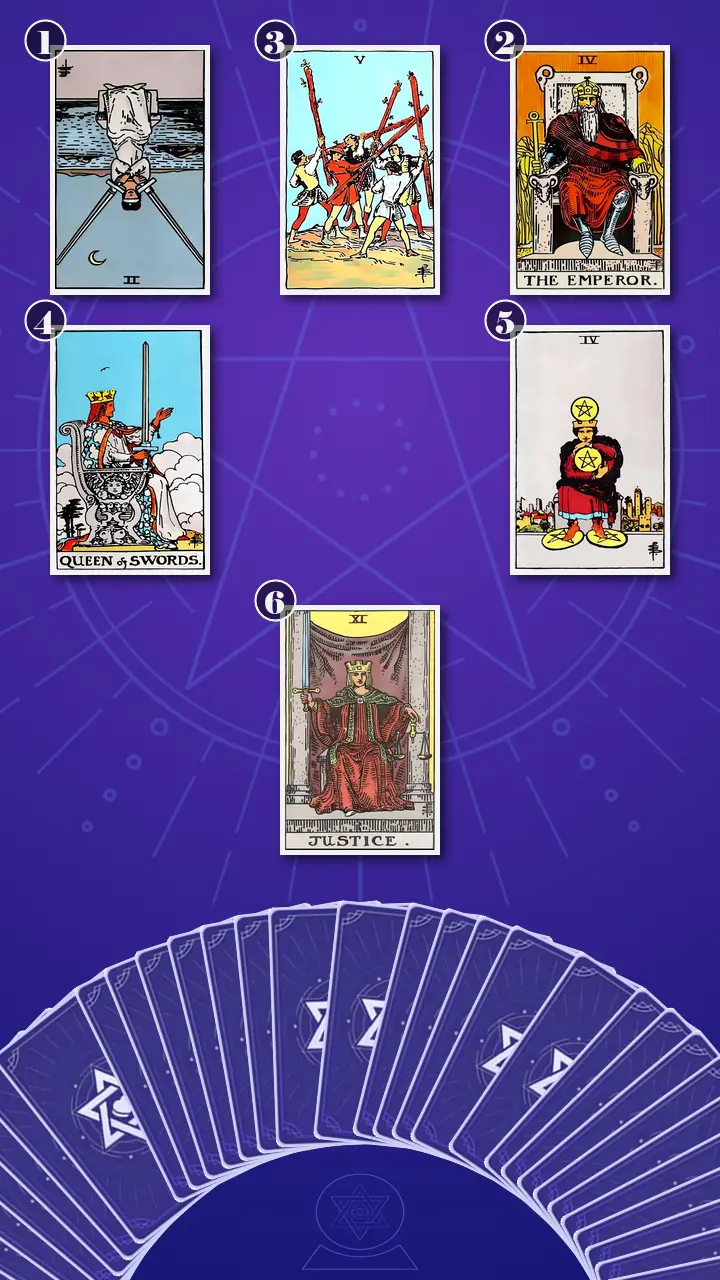
“For this,” I told her, “I’m using a classic Relationship Spread—it’s a relationship tarot spread for boundaries, and yes, roommates count.”
For readers: this spread fits because the issue isn’t a timeline (“what happens next?”) or a fork-in-the-road decision (“stay or leave?”). It’s a two-person negotiation in a shared space, where the real question is: what’s happening between us, what do we each need underneath the ‘rules,’ and what agreement makes it fair? The six positions give a complete, practical map: your pattern, their stance, the shared dynamic, your boundary, their underlying need, and a next step that turns clarity into structure—without pretending tarot is a prediction machine.
I gestured to the layout as I placed the cards: Taylor on the left, roommate on the right, the “room energy” in the center, then we drop down into needs and land on a concrete agreement. “Think of it like turning a tense text thread into a roommate contract,” I said. “Not romantic. Just stabilizing.”
“Okay,” Taylor exhaled. “That sounds… adult. In a way I hate, but also need.”
Reading the Apartment: From Vibes-Based Tension to Clear Terms
Position 1: Your current stance and communication pattern
“Now flipped over,” I said, “is the card representing your current stance and communication pattern in response to the house rules—the observable way you’re showing up.”
Two of Swords, reversed.
It was almost on-the-nose: the modern-life version is you sitting in bed at 11:30 p.m. with the rules on your screen and Notes open, toggling between two impulses—comply to keep the peace vs push back to protect your comfort—until you do neither. You either leave them on read or send that tiny “sure!” that buys short-term quiet and long-term resentment.
Reversed, this card feels like blocked Air: the energy of clear communication is there, but it’s jammed. Not because you don’t know what you want, but because self-protection is turning into self-silencing. The blindfold is, “I can’t tell what’s reasonable.” The crossed swords are you holding both options so tightly that you can’t actually choose.
I offered Taylor a split-screen image, exactly the way I’d frame it on-air when a caller is stuck: “On one side, there’s their message—bullets, bold headers, confident tone. On the other side, there’s your Notes app with five versions of the same sentence getting softer each time. It’s like you’re trying to A/B test a human conversation. And then the page times out—and the default becomes their rules.”
Taylor let out a small, bitter laugh. “That’s… yeah. That’s too accurate. Even a little brutal.”
“It’s not brutal,” I said, keeping my voice steady. “It’s information. And it’s not a character flaw. It’s a pattern your nervous system uses to keep you safe—until it costs you equal say.”
Position 2: Your roommate’s stance and the tone behind the rules
“Now we flip the card for your roommate’s stance—the tone behind the rules, what they’re prioritizing.”
The Emperor, upright.
I didn’t have to reach for anything mystical here. The Emperor is structure, authority, standards—someone who manages uncertainty by making rules and expecting them to hold.
“This is such ‘policy doc energy,’” I told her. “Like your roommate thinks they’re the admin of the apartment Slack workspace.”
In real life, it’s that fridge label, the decisive drawer slam, the checklist vibe: standards, procedures, enforcement. The Emperor’s upright energy is excess structure—not inherently evil, but intense when it’s unilateral.
And here’s the part that softens shame: “This card isn’t saying they’re a villain,” I said. “It’s saying structure might be how they do emotional security. The stone throne and armor are basically: I feel safe when things are controlled and clearly enforced. That doesn’t make their approach fair—but it does explain why their tone is so certain.”
Taylor’s shoulders dropped a millimeter. “So it’s not necessarily that they think I’m disgusting,” she said. “It’s… them trying to control the environment.”
“Exactly,” I said. “And when you meet structure with hints, the structure wins by default.”
Position 3: The shared apartment dynamic created by these rules
“Now we look at the shared apartment dynamic created by these rules—what’s actually happening between you.”
Five of Wands, upright.
Five of Wands isn’t always a blow-up. Often it’s a low-level sparring ring: dishes, noise, guests, cleaning cadence, what counts as ‘done.’ Everybody thinks they’re being reasonable, and the raised sticks cross anyway. No leader, no agreed system—just friction.
“This is why you feel like you have to ‘perform’ being easygoing in your own kitchen,” I said. “Not because you’re dramatic. Because the apartment is stuck in competition mode—competing ‘right ways’ to live.”
The energy here is Fire—active, irritating, reactive. And Fire doesn’t respond well to vague. Vague becomes fuel. That’s why your ‘sure!’ texts don’t calm anything long-term; they just keep the conflict simmering under the lid.
Taylor nodded without looking at me, eyes fixed on the card like it was a mirror she didn’t ask for.
Position 4 (Key Card): The boundary you need to set
I let my hands rest on the deck for a beat. Even the room seemed to quiet down—the fridge hum suddenly noticeable, the city noise outside like a distant ocean. “We’re flipping the most central card for your question,” I said. “This is the boundary you need to set—the clear line, the language, the standard you’ll uphold.”
Queen of Swords, upright.
The modern-life scenario is clean: you stop trying to write the perfect, unarguable paragraph. You choose one clear line and say it without apology: “I’m open to shared standards. I’m not okay with rules being set unilaterally—let’s agree together.” No backstory. No legal brief. You let clarity do the work.
Upright, the Queen is balanced Air: discernment, directness, self-respect. Not cruel. Not fluffy. Precise. The raised sword is the line. The open hand is, “I’ll discuss, but I’m not surrendering my vote.”
This is where my work as a music therapist always clicks in. I told Taylor, “I want to use my Melodic Mirror for a second. When people are people-pleasing, their playlists tend to have a pattern: lots of soft tempo, lots of yearning, lots of ‘maybe it’s me’ lyrics. When people are clear, there’s often a different pattern: steadier BPM, simpler chorus, fewer apologies.”
She blinked. “That’s… weirdly accurate.”
“So here’s a question,” I said. “If your response to that text had a soundtrack, what would it be? Something like a slow, anxious loop you keep replaying?”
“Yeah,” she said, almost embarrassed. “Sad indie. Late-night spiral energy.”
“The Queen of Swords doesn’t need sad indie to speak,” I replied. “She needs one clean line—more like a steady beat you can hold.”
The Aha Moment: the sentence that stops the spiral
Setup: It’s late, your phone is warm in your hand, and you’re staring at a draft that keeps getting softer the more you edit—because you’re trying to prevent pushback before it even happens.
Delivery:
Stop trying to be perfectly agreeable; start being precisely clear—like the Queen of Swords who names the line and holds it with calm.
I let that sit. Just long enough for the words to become a physical object in the space between us.
Reinforcement: Taylor’s reaction didn’t come out as instant relief. It came in layers—like a song changing key and your body needing a second to catch up.
First, a tiny freeze: her breath paused mid-inhale, and her fingers hovered above her water bottle as if she’d been interrupted in the act of bracing. Then, the cognitive part: her eyes unfocused for a second, like she was replaying every version of “Totally hear you!” she’d ever typed while swallowing her real opinion. Finally, the emotional release: a shaky exhale, shoulders lowering, jaw unclenching so visibly I could almost hear it.
And then—unexpectedly—irritation flashed across her face. “But if I do that,” she said, voice sharper, “doesn’t it mean I’ve been… wrong? Like I’ve been letting them run the place?”
I nodded. “It might mean you’ve been prioritizing safety over fairness. That’s not ‘wrong.’ That’s human. But you don’t have to keep paying for it.”
I leaned in just a little. “Now, with that new lens, think back to last week. Was there a moment—one message, one kitchen interaction—where clarity would’ve changed how you felt in your body?”
She swallowed. “Sunday. In the kitchen. I started cleaning faster because they wiped a spot I didn’t even notice.” She shook her head. “I was… performing.”
“That’s the shift,” I said softly. “This isn’t only about dishes. This is you moving from bracing tension and self-silencing to calm directness and equal-say confidence. The Queen of Swords is your nervous system learning: clarity creates safety more reliably than appeasement does.”
Position 5: What your roommate is really trying to protect or control
“Now we flip what your roommate is really trying to protect—the underlying need you can acknowledge without giving in.”
Four of Pentacles, upright.
Under the rules is a grip. This card is the pentacle held to the chest: security-seeking that can clamp down when the environment feels unpredictable.
“They might be afraid of chaos,” I said. “Or of being taken advantage of. Or of living in a space where nothing feels stable. That doesn’t justify unilateral rules. But it tells you what language will actually land: predictability, shared baselines, measurable standards.”
The energy here is Earth: practical, protective, stabilizing. When Earth is in excess, it can become controlling. Your job isn’t to pry their fingers off the pentacle with emotion. It’s to offer a fair structure that doesn’t require policing.
Taylor’s expression softened, not into compliance, but into understanding. “So I can validate it without… handing over the keys,” she said.
“Exactly,” I replied. “Validation is not compliance.”
Position 6: A fair, practical next step that both can live with
“Last card,” I said. “This represents a fair, practical next step to make the boundary real—an agreement, a structure, a conversation container.”
Justice, upright.
Justice is the moment the whole spread turns from personal tension into a workable system. Scales: equal voice. Sword: clear enforcement. The modern-life version is painfully simple and wildly effective: a shared Google Doc/Notion page that both people can edit—Shared Standards, Personal Preferences, and How We Revisit.
“This is ‘house agreement’ energy,” I said. “Not ‘house rules.’ The Emperor’s structure becomes mutual. The Queen’s clarity becomes written. And the Five of Wands friction stops being about who’s right, and starts being about what’s workable.”
I heard myself slip into my old radio-host cadence—calm, decisive, grounded. On-air, when callers spiral, I’ve learned the same lesson tarot keeps teaching: feelings are real, but structure is what changes the day-to-day.
The Justice Doc and the Two-Sentence Boundary
When I pulled the thread through all six cards, the story was clear: your roommate’s certainty (The Emperor) hit your conflict-avoidant freeze (Two of Swords reversed), and the apartment turned into low-grade competition (Five of Wands). The way out isn’t winning the vibe war. It’s the Queen of Swords boundary—clean, direct language—anchored by Justice: a fair structure in writing that makes “equal rent, equal say” real.
Your cognitive blind spot is subtle but brutal: when someone else sets the rules first, you start negotiating against yourself. You treat their bullet points like a final decision, and your brain responds by searching for the perfect wording that won’t trigger conflict—until you say nothing, or you comply by default.
The transformation direction is the opposite of what your anxiety suggests. It’s not “think harder.” It’s: move from drafting the perfect response in your head to proposing one concrete, fair house agreement in writing and discussing it face-to-face.
Here are your next steps—small, specific, and designed for real life (not for an imaginary version of you who never gets tired):
- The Two-Sentence Boundary (Notes, 2 minutes)In your Notes app, write—and stop at two sentences: “I’m open to shared standards. I’m not okay with rules being set unilaterally—let’s agree on them together.”If guilt spikes, shorten—don’t soften. Direct is not the same as defensive.
- The 10-Minute Container (Text, not debate)Send a scheduling message (no explanations): “Can we do a 10-minute chat tomorrow evening to turn this into a shared agreement?”If they try to pull you into the whole argument over text, repeat: “I want to talk about this, and I’m not doing it over text tonight.”
- Apartment Agreement v0.1 (Google Doc/Notion, 10 minutes)Create a shared doc titled “Apartment Agreement (v0.1)” with three headers: Shared Standards / Personal Preferences / How We Revisit. Add three bullets under each—then share it.Don’t write a constitution. Write a draft. Put a 2-week, 15-minute check-in on the calendar so it can evolve.
And because this is my world too, here’s an optional add-on using my Emotional BPM strategy: before the 10-minute chat, play one steady-tempo song (something that feels grounded, not hyped) while you read your two sentences out loud once. You’re not “getting psyched up.” You’re teaching your body a new pace for conflict: calm, direct, steady.

A Week Later: The Quiet Proof of Equal Say
Five days later, Taylor emailed me a screenshot. It wasn’t dramatic. It was almost boring—in the best way.
It was a Google Doc titled Apartment Agreement (v0.1). Three headers. A handful of bullets. And right above the doc link in their text thread was one clean line: “I’m open to shared standards. I’m not okay with rules being set unilaterally—let’s agree on them together.”
“I felt like I was going to throw up when I hit send,” she wrote. “But then we talked for literally ten minutes. It wasn’t warm and fuzzy. It was… workable. And afterward I didn’t spiral for two hours. I just went and made pasta.”
That’s the real Journey to Clarity. Not a personality rewrite. Not a perfectly conflict-free apartment. Just the moment your home stops feeling like a place where you have to earn comfort by being agreeable—and starts feeling like a place where you get equal voice because you pay equal rent.
When your home starts to feel like a place where you have to watch your tone, your footsteps, and your dishes, it’s not that you’re “too sensitive”—it’s that you’re craving equal say without being branded the problem.
If you let yourself be direct without proving you’re ‘nice’ first, what’s the one small agreement you’d want in writing so your home can feel like yours again?