From People-Pleasing Tone Anxiety to a Grounded RSVP: One Clean Question

The “RSVP by Friday” Spiral
You’ve reread “RSVP by Friday” three times, and somehow the answer you need still isn’t there—so you open the wedding site again instead of sending one text. Classic RSVP anxiety.
Jordan (name changed for privacy) met me over Zoom from Toronto. It was 8:06 p.m. on a Wednesday, and I could practically hear their condo through the screen: the fridge’s low hum, the faint street noise filtering in like someone left a window cracked. The wedding website glowed on their laptop. Their phone sat warm in their palm, thumb hovering over the chat thread like the glass might bite.
“I just don’t want to be that guest,” they said, and their jaw did that tiny lock-and-release thing people do when they’re trying to swallow urgency. “I can’t tell if I’m being reasonable or needy. I’m not trying to make it about me, I just need to plan.”
I watched their breathing flatten the second they opened the message thread—like their body had decided this was a threat, not a logistics question. The nervousness wasn’t abstract; it lived in the tight jaw, the shallow inhale, the restless fidgeting of their fingers against the phone case, as if they were sanding down their own words until nothing sharp—or honest—remained.
“Okay,” I said gently. “We’re not here to make you sound perfect. We’re here to help you ask for clarity in a way that still feels warm—and to make your RSVP feel like a clean decision, not a stress test. Let’s draw a map through the fog.”

Choosing the Compass: A Five-Card Cross for Communication Clarity
I asked Jordan to take one slow breath and hold the exact moment in their mind: the invite in one tab, the chat thread in the other, and that hovering-before-Send freeze. While I shuffled, I kept it practical—this wasn’t a mystical performance. It was a transition: from bracing to looking.
“Today, we’ll use a Five-Card Cross,” I told them, and for you reading along: this spread is ideal when a deadline is looming and the problem has a tight loop—behavior, block, root belief, best move, near-term outcome. It’s minimal on purpose. It doesn’t turn your life into a ten-card epic; it turns your stuck point into something you can actually work with.
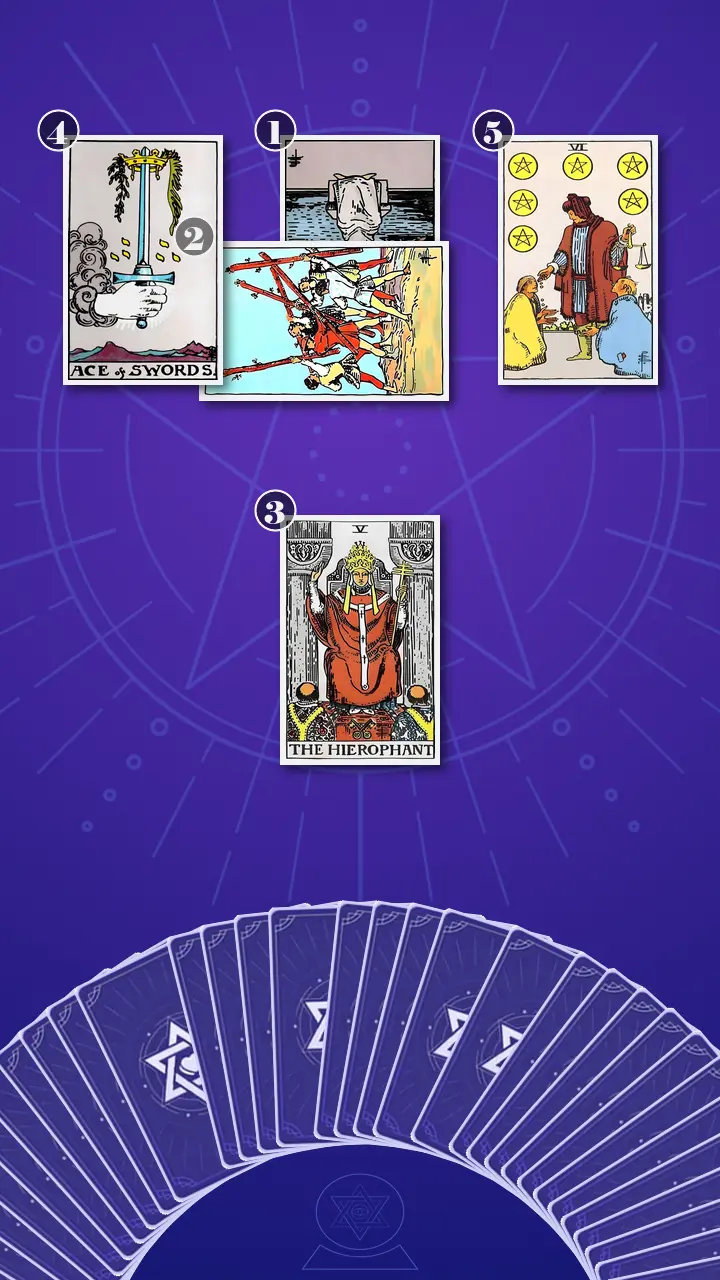
Card 1 will name the current RSVP stuck point—the exact loop playing on repeat. Card 2 shows what’s blocking clear asking—the friction that keeps the message unsent. Card 4 is the one we’re aiming for: the clarity move, the communication structure that respects you and the relationship.
Reading the Map: When Overthinking Looks Like Politeness
Position 1: The current RSVP stuck point — Two of Swords (reversed)
“Now we’re turning over the card that represents the current RSVP stuck point,” I said.
Two of Swords, reversed.
Immediately I saw Jordan in the scene the card always pulls from modern life: on the TTC home, flipping between the wedding website and the chat thread, typing “Hey! Quick question…” then backspacing, rewriting it three different ways. The RSVP form sits unopened because pressing Send feels riskier than missing the deadline.
Reversed, this isn’t balanced calm. It’s blocked Air: mental energy turning in place—over-editing, second-guessing, trying to “tone-check” your way into safety. The blindfold in this card isn’t a lack of information. It’s self-protection. You’re not confused—you’re bracing.
I leaned in a little. “This is the part where your brain runs your text through an imaginary tone checker the way you run code through a linter—until you never ship.”
Jordan let out a small laugh that had a bitter edge to it. “That’s… kind of brutal. But yes. I have drafts that are basically final_final2.” Their shoulders lifted toward their ears, then dropped a millimeter, like their body appreciated being accurately named.
Position 2: What’s blocking clear asking — Five of Wands (reversed)
“Now we’re turning over the card that represents what’s blocking clear asking,” I said.
Five of Wands, reversed.
The modern-life translation landed clean: Jordan treats a logistics question like it’s a potential confrontation. In their head, the group chat becomes a battleground where one wrong phrase starts a whole thing—so they keep quiet, hoping someone else asks first, while their stress climbs.
Reversed, this is conflict energy turned inward—not a real fight, but an imagined one you manage by silence. It’s the “I’ll prevent drama by needing nothing” strategy. It works for about five minutes. Then the RSVP deadline gets louder, and your nervous system calls it proof that you can’t handle simple social situations.
To mirror what I was seeing, I narrated it like a split-screen: “Left side: you reread the wedding website, scroll the group chat. Right side: your Notes app with five drafts titled ‘version 1/2/3/FINAL/FINAL2.’ And the internal dialogue is: ‘If I say it like this, I’m needy. If I say it like that, I’m cold.’”
Jordan nodded once—small, quick—like a reflex.
Position 3: The hidden driver — The Hierophant (upright)
“Now we’re turning over the card that represents the hidden driver,” I said.
The Hierophant, upright.
This card is weddings in a single image: ceremony, tradition, the pressure of doing it “the right way.” In Jordan’s real life it looked like 11:48 p.m., Night Shift on, Googling “RSVP etiquette” and reading the FAQ like scripture—chest tightening as if there’s a rule you’re about to break, even though you can’t name it.
“There’s a correct way to be a guest,” I said, “and you’re scared you’re about to fail it.”
Jordan covered their mouth for a second and laughed—quiet, embarrassed. “I literally read an article about ‘is it rude to ask about plus-ones’ like it was a court summons.”
I kept my voice warm but steady. “If you have to disappear to be ‘easy,’ that’s not politeness—that’s self-erasure. The Hierophant can be a guide, but it can also be a rulebook you wrote to earn belonging.”
Position 4: The clarity move — Ace of Swords (upright) (Key Card)
I paused before turning it over. The room went quiet in that particular Zoom way—no one speaking, the faintest hiss of city noise on the other end, like the world holding its breath with us.
“Now we’re turning over the card that represents the clarity move—how to communicate in a way that respects you and the couple,” I said.
Ace of Swords, upright.
The image is almost rude in its simplicity: one sword, upright, under an open sky. In advice positions, this card doesn’t beg. It doesn’t over-explain. It asks for one clean truth.
Setup. Jordan was stuck in the TTC version of a final exam—invite open in one tab, chat in the other—rewriting the same “quick question” because they were trying to predict every reaction before pressing Send. The deadline had turned a basic detail into a personality test.
Delivery.
Stop hiding behind the blindfold of ‘being polite’ and choose one clean sentence—the Ace’s upright sword—to ask exactly what you need.
I let the sentence sit for a beat.
Reinforcement. Jordan’s reaction came in a three-step wave. First: a freeze—breath caught, thumb hovering mid-air like the phone suddenly weighed more. Second: their gaze went slightly unfocused, as if they were replaying every draft they’d buried under “sorry to bother” and “no worries if…” Third: the release—an exhale that finally reached their ribs, followed by a sharp, defensive flash. “But… if it’s that simple,” they said, voice tightening, “does that mean I’ve been making this a whole thing for no reason?”
I shook my head. “It means you’ve been using politeness as armor. That’s not ‘for no reason.’ That’s a nervous system trying to keep you safe.”
This is where my Classic Movie Models always help me name the turn. “You know that moment in Casablanca,” I said, “when the script stops circling and the truth finally gets one clean line? The scene doesn’t become colder. It becomes clearer. A good line isn’t harsh—it’s usable.”
Jordan’s shoulders lowered, slow. Their eyes went glassy for a second—not tears exactly, more like the body recognizing relief before the mind catches up. I offered a concrete frame and also what to remove: “One warm line. One clear question. Then stop negotiating with your own message. No apology padding. No emoji cushioning. No pre-trial defense.”
“Now,” I asked them, “use this new lens and look back at last week. Was there a moment when one clean question would’ve made you feel different—like, even two percent freer?”
Jordan swallowed. “Yesterday. I had my PTO page open, and I closed it because I didn’t know the ceremony time. I could’ve just… asked.” Their voice softened. “I could’ve asked.”
And that was the shift in real time: from people-pleasing tone anxiety and RSVP deadline paralysis to respectful directness and grounded commitment—not perfection, but self-trust through follow-through.
Position 5: Integration — Six of Pentacles (upright)
“Now we’re turning over the card that represents integration—what becomes possible once you ask clearly and set a clean boundary,” I said.
Six of Pentacles, upright.
This card is reciprocity with scales in its hands. In modern terms: it’s Splitwise energy. It’s the calm reality check where you open your calendar and your banking app and stop paying for peace with stress.
“Clarity is part of reciprocity, not a special request,” I told Jordan. “Once you get the information, you can decide what’s fair: your time off, your travel costs, your actual bandwidth. Support doesn’t require self-erasure.”
Jordan nodded again, but slower this time—like they weren’t just agreeing, they were settling into the idea of being allowed to receive.
The Two-Sentence Text That Cuts Through (and How to Hit Send)
I pulled the whole story together for them, the way the spread had told it. “Here’s the loop: you’re stuck in a Two of Swords moment—checking, drafting, deleting—because the Five of Wands reversed has you pre-solving an argument that hasn’t happened. Underneath, the Hierophant is whispering that ‘good guests’ need nothing. The Ace of Swords cuts through that with one respectful ask, and the Six of Pentacles turns the answer into a fair, grounded RSVP.”
Then I named the blind spot plainly: “You’ve been treating tone as if it’s the only currency of belonging. That’s why your message keeps getting rewritten into dust. The transformation is moving from tone-guessing and over-apologizing to one clear, time-bounded question that gets you a usable answer.”
For action, I used my Iconic Line Diagnosis strategy—because sometimes your nervous system needs a memorable line more than another explanation. “Your line isn’t ‘Sorry to bother.’ Your line is: Here’s looking at you, kid—warm, direct, present. Two sentences. That’s the whole script.”
- Write the Two-Sentence RSVP Clarity TextIn Notes, draft: (1) one warm line (“I’m so excited for you.”) + (2) one decision-making question plus your deadline (“Quick question so I can RSVP by Friday: what time does the ceremony start?”).If your brain wants five questions, start a separate “parking lot” note for later—don’t add them to the text.
- Do the Read-Once SendRead it out loud one time. If it sounds like you, paste it into the chat and hit send—no second-pass edit.If you see red-flag phrases like “sorry to bother,” “just checking,” or “no worries if…,” replace them with a context line: “I’m sorting travel/PTO today so I can RSVP.”
- Run the 10-Minute “Send Button” DrillSet a timer for 10 minutes. Send the two-sentence text, then close the app for 10 minutes—no checking.If your body feels too keyed up, you can stop at “clear draft saved.” Your job is clarity, not forcing yourself past your limits.

A Week Later: The Quiet Proof
Six days later, Jordan messaged me: “Sent it. No apologies. They replied in like ten minutes—ceremony’s at 4. I requested PTO. RSVP’d yes. My chest feels… normal.”
It wasn’t a movie-ending fireworks moment. It was lighter than that: they’d done the scary five seconds, and the rest of their week stopped orbiting an unsent draft. The next morning they still had the first flicker of “What if I sounded weird?”—but this time they noticed it, exhaled, and didn’t reopen the thread.
This is what I love about tarot when it’s used as a real tool: it doesn’t just interpret your feelings. It gives you a next move—one that turns a spiral into a sentence.
When the RSVP clock is ticking, it can feel like you’re choosing between being “easy” and being real—so your jaw tightens, your message gets rewritten into dust, and you try to earn belonging by needing nothing.
If you trusted that one clear question is actually a form of respect, what’s the simplest sentence you’d send tonight to make your RSVP feel free again?