From 'Kids Soon' Panic to a Shared Pace: Defining What 'Soon' Means

The TTC Ride Where “Soon” Hit Like a Deadline
You’re a 29-year-old Toronto corporate professional who can handle Q4 planning at work, but when your partner casually says “I want kids soon,” you get hit with instant timeline panic and Sunday Scaries-level spiraling.
Taylor (name changed for privacy) said it like she was confessing something embarrassing, not dramatic. Like it would be easier if the problem was a screaming fight—but it wasn’t. It was just a word: soon. And the way it landed in her body before her brain could build a reasonable paragraph around it.
She described an 8:17 p.m. Tuesday—wedged into a Line 1 car heading north, the train rattling like it had opinions, fluorescent lights buzzing overhead. She’d opened a Notes app draft titled “timeline talk,” thumbs hovering, phone warm from being clutched too long. Then Instagram, because of course: a college friend’s “Baby #2 coming soon” post in Stories. Her jaw tightened so hard she felt it in her temples. Her chest did that hollow squeeze—part longing, part panic—because she does want a future. She just doesn’t want to get pushed into one.
“I love them,” she told me, voice low, almost irritated at herself. “But ‘soon’ makes me feel cornered. And then I do this… thing. I speed up for a week, like I’m proving I’m a good partner. Then I want to disappear.”
What sat between us—quietly, heavily—was the contradiction that fuels so many modern relationship crossroads: wanting to build a real future with them, while fearing that matching their timeline will cost your autonomy and expose you as “not ready.”
The anxiety wasn’t abstract. It was tactile: restless hands, tight jaw, the kind of chest tension that makes even a gentle text notification feel like a tiny siren. It felt to her like trying to read a street sign in a blizzard while someone keeps asking, “So which way are we going?”
I leaned in, not with mysticism, but with the simple steadiness of someone who has watched humans wrestle with time—across centuries, across empires, across kitchen tables. “We don’t have to solve your entire future today,” I said. “Let’s try something smaller and braver: we’ll map what’s happening in your nervous system, in your language, and in your choices—so you can find clarity without betraying yourself or your relationship.”

Choosing the Compass: The Decision Cross · Context Edition
I asked Taylor to take one slow breath—not as a ritual to summon fate, but as a clean transition from spiraling to observing. While she held her question in mind—After they said they want kids soon, do I speed up or step back?—I shuffled, letting the rhythm of the cards do what good structure always does: contain the chaos.
“For this,” I said, “I’m going to use a spread called the Decision Cross · Context Edition.”
And for anyone reading along who’s ever googled ‘tarot spread for speed up or step back in a relationship’ at 10:42 p.m. with your laptop glow on the wall: this layout fits because it makes a two-path question visible without turning it into a yes/no trap. Card 1 sits at the center as the current pressure point. Card 2 shows the energy of speeding up. Card 3 shows the energy of stepping back. Then the spread does something I love—especially for “kids soon” timeline pressure—by putting a truth card above the whole situation, and a grounded next step below it.
It’s a crossroads with a compass above and a single footstep below. Not prophecy. Not a verdict. A decision-making map.
“The center will show what’s running the show right now,” I told Taylor. “Left is what ‘speeding up’ would energize and risk. Right is what ‘stepping back’ could heal—if it’s done cleanly. The top is the principle that keeps you in integrity regardless of pace. And the bottom is the practical landing: what you do next week, not who you are forever.”
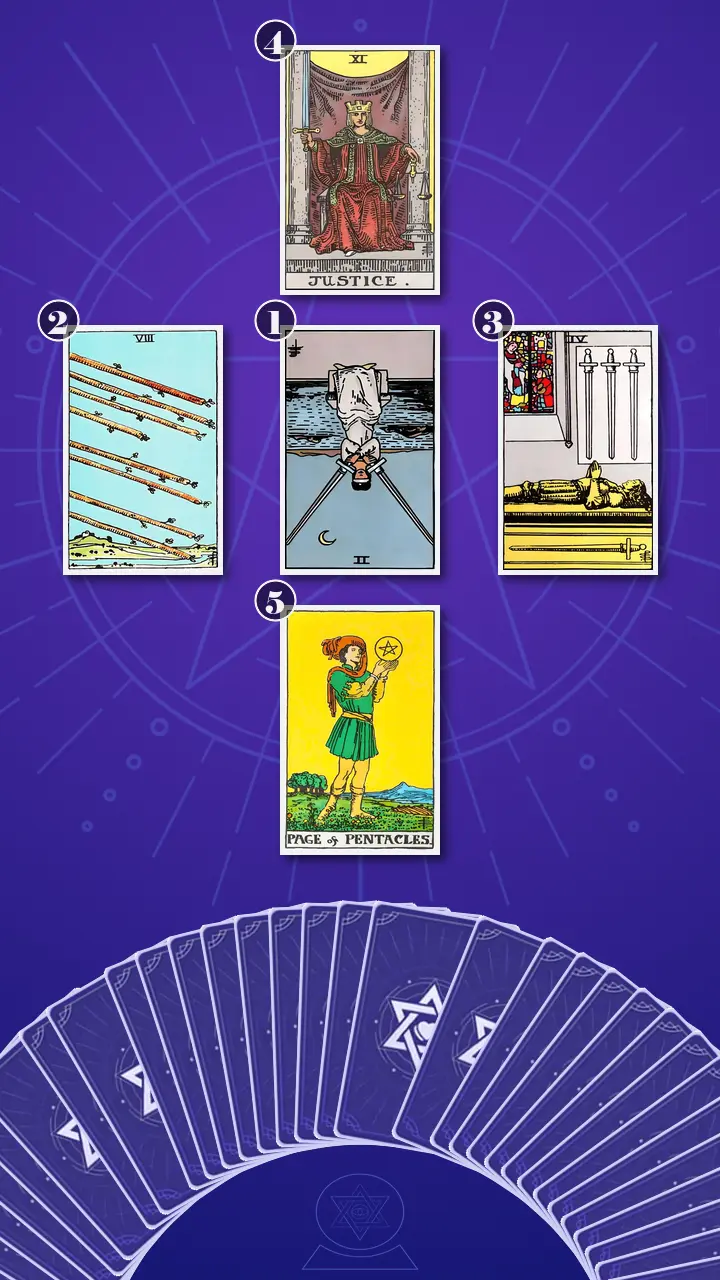
Reading the Map: The Pressure Point That’s Not Just About Kids
Position 1: The Immediate Pressure Point
“Now flipped,” I said, “is the card representing the immediate pressure point: how the kids-soon conversation is currently impacting your behavior, communication, and nervous system reactivity.”
Two of Swords, reversed.
In the old images, there’s a blindfold and crossed swords over the heart. It’s the portrait of a person trying to keep peace by not choosing—while emotion churns in the background like choppy water no one wants to look at.
And in Taylor’s modern life, it lands like this: you’re on your commute home with your phone in one hand and your work bag in the other, drafting a careful message about “timelines” in Notes. You delete the honest line—“soon freaks me out”—and replace it with something smoother. You’re trying to keep the relationship safe by not choosing, but the pressure is loud enough now that the non-answer is starting to crack.
Reversed, the energy here isn’t “calm neutrality.” It’s blockage—the kind that happens when your words refuse to move, but your body keeps moving anyway. The indecision is no longer protecting you. It’s costing you: self-trust, sleep, and the ability to feel your own yes/no without panic.
I watched Taylor’s mouth twitch as if she might joke her way out of it. Then she let out a short, bitter laugh. “That’s… mean,” she said. “Like, accurate. But mean.”
“It’s not moral,” I replied. “It’s mechanical.” And I let the sentence land with as little judgment as possible. “This card is basically saying: if you can’t say it clearly, your body will say it loudly.”
I could almost see her phone-screen confession play behind her eyes: five drafted texts, one deleted honest sentence, then the safer send—an emoji, an ‘lol yeah we’ll talk’—anything that buys temporary peace. If I say X, I risk Y. If I say Z, I risk W. So I’ll say… nothing.
She nodded, slowly, and her fingers—restless when she arrived—stilled on the edge of her sleeve for a second. Recognition can be uncomfortable, but it’s also the first real exit ramp.
The Fast Lane and the Sanctuary Pause
Position 2: Option A—Speed Up
“Now we’re looking at Option A—Speed up: what this path energizes, what it risks, and what it would ask you to embody,” I said, turning the next card.
Eight of Wands, upright.
This is momentum. Messages. Developments arriving quickly. In relationship terms, it’s the week where texts multiply, calendars fill, and “soon” starts to behave like a runaway train because nobody defined the terms.
I translated it into her lived montage: you decide to lean into their energy—more dates, more future talk, jokes about baby names, casual condo browsing links sent between meetings. Your phone buzzes constantly, screen warm, thumbs typing fast. On the outside, you look like the “yes partner.” Inside, you’re bracing, like speed is anesthesia for uncertainty.
Upright doesn’t mean wrong. It means excess risk if the speed is fueled by fear of being left—or by guilt that you’re “wasting their time.” The wands fly cleanly only when the aim is shared. Otherwise, speed becomes a way to outrun discomfort, and the crash comes later.
Taylor’s face tightened in a small wince. “This is literally me,” she said. “I can do one week of ‘sure, let’s plan everything.’ And then I wake up and I’m like… what did I agree to?”
“Exactly,” I said. “This card is asking a sharp question: is the momentum chosen—or is it panic momentum?”
Position 3: Option B—Step Back
“Now flipped is Option B—Step back: what space could reveal, what it heals, and what it would require to be healthy rather than avoidant.”
Four of Swords, upright.
I’ve excavated Roman sites where the most important discoveries were not the dramatic statues, but the quiet layers—ordinary shards and household tools—because they told the truth of daily life. This card feels like that: a deliberate pause that lets truth rise without adrenaline shouting over it.
For Taylor, it looks like this: instead of going quiet out of fear, you name a pause on purpose. You take one evening off from relationship-timeline talk, put your phone on Do Not Disturb, shower or make tea, and let your nervous system come back to baseline. You journal what you actually mean by “soon,” sleep, and notice how different your truth sounds when it’s not being shouted over by urgency.
This is balance energy—not withdrawal. It’s the difference between “I’m disappearing” and “I’m regulating.”
I said it as plainly as I could: “A pause with a label is care. A pause without a label becomes a story.”
Taylor’s shoulders dropped—an almost involuntary release—and she looked away toward my bookshelf as if her eyes needed somewhere to rest. “That’s what I’m scared of,” she admitted. “If I ask for space, they’ll make up a story. Or I will.”
“Then we don’t do it vaguely,” I said. “We do it with a label and a time.”
When Justice Spoke: Finding Clarity by Defining “Soon”
Position 4: The Decision-Making Truth
I let my hand rest on the deck for a beat longer before turning the next card. “This one,” I said, “is the anchor. It represents the decision-making truth: the value, boundary, or conversation principle that creates integrity regardless of pace.”
Justice, upright.
Justice is often misunderstood as cold. In practice, it’s cleaner than that. It’s language that can hold weight without collapsing into drama. The scales aren’t a spreadsheet; they’re mutual consent. The sword isn’t a weapon; it’s a boundary that cuts through vagueness.
In Taylor’s life, Justice looks like sitting at the kitchen table with phones face-down, and saying one crisp sentence without over-explaining. It’s defining terms. It’s naming what you can offer now, what you can’t offer yet, and what you need in order to keep showing up with a whole self.
And here’s where my own training always surfaces. Archaeology teaches you something brutal and freeing: words survive, but meanings evolve. A vow carved into stone is not identical to the same vow whispered in a hallway, even if the words match. So I used my Emotional Historiography—my habit of reading relationships through time, like layered soil—to frame what Justice was doing here.
“Taylor,” I said gently, “you’re treating ‘kids soon’ as if it’s a single historical event—like a conquest date. But in real life, it’s a term in a living treaty. Commitments aren’t static; they evolve. The question isn’t ‘Are you ready, yes or no?’ It’s: what covenant are you actually being asked to sign right now, and what parts of it need rewriting before you can consent?”
Her eyes narrowed slightly—not in disagreement, but in that protective way people look when they fear the implications of clarity.
Then the room got very quiet, as if even the city outside had paused to listen. This was the turning point of the spread.
Setup: I pictured the scene she’d described, because it’s the modern altar of indecision—the TTC ride, Notes app open to a draft called “timeline talk,” then another baby announcement in Stories. Chest tightening. And suddenly “soon” doesn’t sound like a dream; it sounds like a deadline she didn’t agree to. She’d been trapped in the belief that she had to respond with certainty or risk losing love.
Delivery:
Stop treating ‘soon’ like a verdict; start treating it like a shared agreement—let Justice’s scales and sword turn pressure into clear, fair language.
I didn’t rush to soften it. I let it echo.
Reinforcement: Taylor’s reaction came in layers—a small, human chain. First, a physical freeze: her breathing caught, and her fingers hovered in midair like they’d been about to grab her phone out of habit. Then the cognitive shift: her gaze unfocused, as if replaying every “reasonable” script she’d drafted and every time her body had screamed under the politeness. Finally, the emotional release: a clean, involuntary “oh,” the kind that sounds like a door unlocking.
And then—because clarity can sting—she frowned. “But if I say that,” she said, a flash of anger underneath the vulnerability, “doesn’t that basically mean I’ve been… lying? Like I’ve been leading them on?”
I met it calmly. “It means you’ve been trying to protect two precious things with one tight grip,” I said. “The relationship, and your autonomy. That’s not malice. That’s pressure.”
I slid the card a fraction closer to her. “Justice isn’t accusing you. It’s offering you a better tool than avoidance. A fair agreement requires definitions. Without definitions, ‘soon’ becomes whatever your nervous system fears most.”
Then I gave her a practice—not as homework to perform, but as a way to lower the stakes and bring her body back into the conversation.
“Do this once, tonight,” I said. “Ten minutes. Notes app. Three lines:”
(1) “When I hear ‘soon,’ my body does ____.”
(2) “To me, ‘soon’ could mean ____ (a range, not a date).”
(3) “One decision I’m not making today is ____.”
“If you start feeling flooded,” I added, “pause. Put the phone down. Four slow breaths. This is clarity work, not a performance.”
I watched her swallow, then nod—slow, like she was consenting to her own honesty for the first time in days.
“Now,” I said, “with this new lens—what would you say if you weren’t trying to manage their reaction? Just trying to be truthful and fair to both of you?”
She stared at the card, and her voice came out quieter. “I’d say… ‘I’m not against it. I’m just scared of agreeing to a vibe.’”
That, right there, was the shift: from pressure-driven mental ping-pong to consent-based clarity. Not certainty. But direction.
The Minimum Viable Plan That Keeps Love and Autonomy in the Same Room
Position 5: Integration and Next Step (Not a Prediction)
“Now we land,” I said, turning the final card. “This represents integration and next step: the most grounded action that turns clarity into a workable, mutual plan.”
Page of Pentacles, upright.
This is the card I wish more people trusted in relationship timeline pressure. It says: you don’t need a lifetime answer today. You need a beginner-friendly experiment—something practical enough to reduce fear, and small enough that it doesn’t feel like clicking ‘Agree’ on terms and conditions just to get past the screen.
In Taylor’s world, the Page is a time-boxed planning conversation with a timer and a shared note: money, workload, living logistics, support systems. Not romance-killing—clarity-making. It’s taking “soon” out of the clouds and placing it on a table where both of you can actually look at it.
“Planning isn’t promising,” I told her. “It’s just making the conversation real enough to hold.”
She exhaled—longer this time. “That sounds… doable,” she said. “Like I could do one chat without deciding my whole life.”
From Spiral to Shared Pace: Actionable Next Steps for the ‘Kids Soon’ Talk
I gathered the spread into a single story, because that’s what tarot does when it’s used well: it converts chaos into sequence.
Here’s what I saw, in plain language. The Two of Swords reversed showed the current pattern: avoidance-as-peacekeeping—drafting, deleting, going quiet—because uncertainty feels unsafe. The Eight of Wands showed the temptation to outrun discomfort by speeding up, letting momentum substitute for consent. The Four of Swords offered the corrective: a regulated pause that is named and time-bound. Justice revealed the real bridge: define terms, name boundaries, and treat “soon” as negotiable language, not a love test. And the Page of Pentacles grounded it all: a small practical test-plan that turns the forever-question into workable next steps.
The cognitive blind spot here is subtle but common: treating certainty as the price of admission for love. As if you must deliver a final date in order to be a good partner. Justice says: no. Integrity is not “being definitive about everything at once.” Integrity is clean consent, clean language, and equal partnership.
And this is where I brought in one of my own strategies—something I call Covenant Evolution. In history, treaties endure because they’re revised when conditions change. Healthy commitment is not a single signature; it’s a living document. You can ask for a timeline conversation that evolves—without either of you feeling tricked.
Here are the practical steps I gave Taylor—small, specific, and designed to work even if you’re still unsure:
- Write the Two-Sentence Justice ScriptIn your Notes app, write two speakable sentences: (1) “When you say ‘soon,’ I notice I feel pressure. For me, ‘soon’ would mean something like [a range: 1–2 years / 3–5 years].” (2) “I’m not deciding [a final date / trying immediately] today, but I am willing to talk about [definitions / what would need to be true].”If you start over-explaining, pause and return to one sentence. Awkward isn’t a sign you’re doing it wrong.
- Send a Pause-With-a-Label Text (If You’re Flooded)If you’re activated after a conversation, send: “I want to talk about this thoughtfully. Can we set a time on Thursday? I need tonight to decompress so I can be present.”Keep it time-bound so it doesn’t become avoidance. Even a 24-hour pause counts.
- Do a 30-Minute Reality-Check SprintPropose one practical planning chat with a timer: “Can we do one logistics conversation—just 30 minutes—so ‘soon’ isn’t this vague cloud?” Open a shared note with three headings: “What would need to be true,” “What support we’d need,” “Questions we don’t have to answer yet.”Lower difficulty: choose one category only (money or living logistics or workload). Planning is not promising.

A Week Later: Ownership, Not Certainty
Six days later, I received a message from Taylor that was almost comically short for someone who usually drafts paragraphs: “Did the two sentences. Felt weird. Didn’t die.” Then, a minute later: “We set Thursday. Phones face-down at the table. I said the range. They didn’t freak out.”
She told me she’d slept a full night after that. In the morning, her first thought was still, What if I’m wrong?—but this time she noticed her shoulders weren’t up by her ears. She made coffee, stared out at the grey Toronto sky for a moment, and felt something unfamiliar: room to breathe.
That’s the Journey to Clarity I trust most: not lightning-bolt certainty, but a steadier self inside the conversation. Justice doesn’t demand you be ready on command. It asks you to be honest enough to build a pace you can consent to—together.
And for anyone reading this who recognizes the tight chest, the Notes app drafts, the comparison fatigue, the impulse to either reassure too fast or go silent: when someone says “kids soon” and your body goes on high alert, it’s not because you don’t love them—it’s because you’re trying to protect both the relationship and your autonomy with the same tight grip. Your timeline is not a test of your love.
If you didn’t have to solve the entire future today, what’s one small definition you’d want on the table—just so “soon” stops being a pressure word and starts becoming a shared agreement?