When Game-Night Teasing Stings: The One-Sentence Boundary to Repeat

Finding Clarity in the “Just a Joke” Trap
If you’ve ever been at a game night where the trash talk is ‘just jokes’—and you’re laughing while your jaw is clenched because you don’t want to be the “too sensitive” friend.
Taylor (name changed for privacy) said that to me like it was a confession she’d been carrying in her tote bag all week. She was 28, a marketing coordinator in Toronto, and you could tell her social life mattered because she talked about it the way people talk about air—something you don’t notice until it’s tight.
She described 9:18 PM on a Friday in a condo living room: perched on the edge of the couch, a drink sweating onto a coaster, someone cracking a joke about her job right as it was her turn. The room got louder with the competition. The overhead light had that faint electrical hum you only notice when you’re trying not to cry. Her phone was warm in her palm, like a tiny radiator of group-chat reactions waiting to happen.
“My throat does that thing,” she said, fingers hovering at the base of her neck. “It tightens. My jaw locks. And I smile anyway—like I’m… holding my face in place.”
Embarrassment sat on her like a too-small hoodie: not dramatic enough to name out loud, but restrictive enough to change how she breathed.
“I want respect,” she said. “But if I speak up, I’m scared I’ll be the friend who can’t take anything. Like I killed the vibe.”
I nodded, letting the silence do what it’s meant to do in a reading—make room for the truth to show up without being rushed. “We’re going to aim for clarity,” I told her. “Not a perfect comeback. A map. Something you can actually use when the room is loud and your body goes tight.”

Choosing the Compass: Relationship Spread · Context Edition
I asked Taylor to take one slow breath in, one slow breath out—less “ritual,” more nervous-system reset. While I shuffled, I listened the way I listen on-air when a caller is trying to be casual about something that actually hurts.
“Today I’m using the Relationship Spread · Context Edition,” I said. “It’s built for dynamics like this—friend-group teasing, group-chat pile-ons, all the stuff that gets framed as banter.”
For you reading this: the reason I choose this spread in a situation like friends keep teasing me and say it’s just a joke is that it’s symmetrical and non-blaming. It shows your stance, their social energy, the emotional impact, the mechanism that keeps the loop going, then—crucially—the bridge: the exact boundary language that fits how to set a boundary without killing the vibe.
I previewed the map for Taylor: “First we’ll look at your default move in the exact second it stings. Then we’ll look at the group’s teasing energy without turning them into villains. The center card is the bridge—the boundary to set. And the last card is follow-through, so this doesn’t depend on you having the perfect moment.”
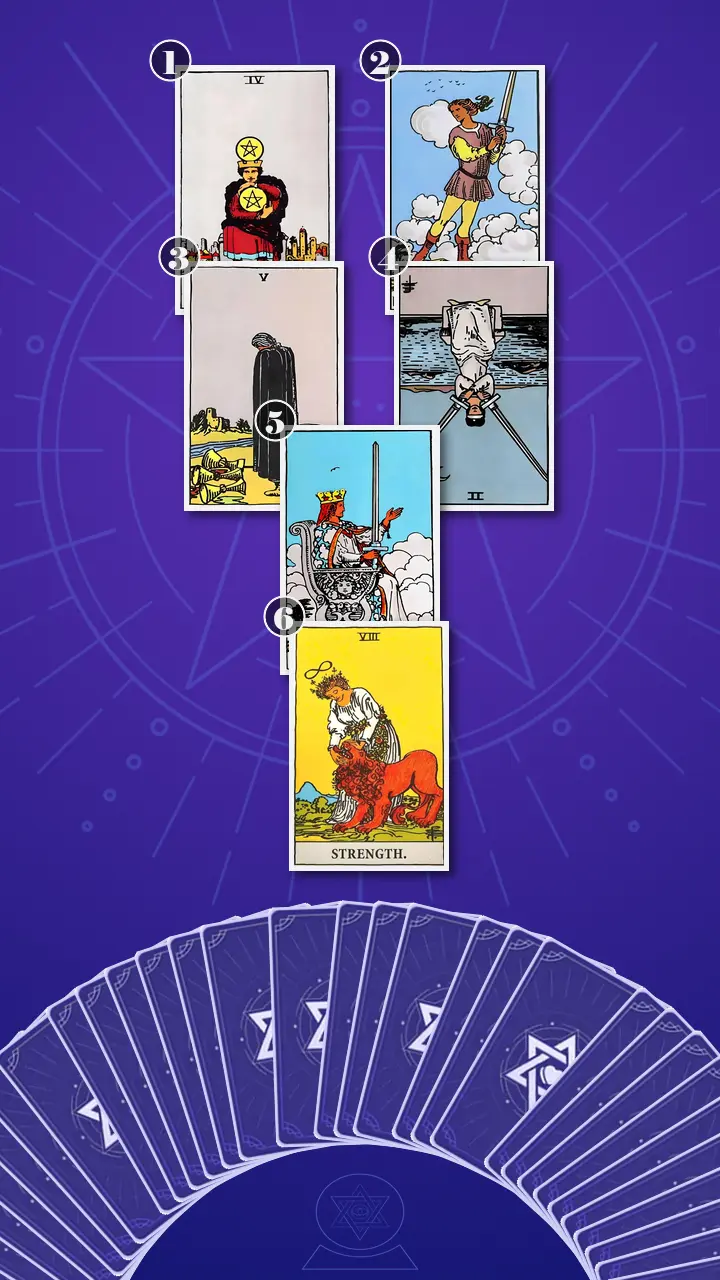
Reading the Map: Six Cards, One Repeatable Sentence
Position 1 — Your current stance at game night
“Now flipped over is the card that represents your current stance at game night: the specific self-protective behavior you default to in the moment.”
Four of Pentacles, upright.
I tapped the image lightly. “This is 9:00 PM at game night and you’re physically present but emotionally braced—smiling like armor, keeping your laugh small, and holding your real reaction in your chest so nobody has to deal with discomfort. You’re ‘buying’ belonging by staying easygoing in the moment, even when it costs you dignity later.”
In energy terms, this is blockage through constriction. Not weakness—control. Your system clamps down to keep the social temperature stable. It’s like keeping your phone on Low Power Mode all night so the group vibe doesn’t dip… then wondering why you crash afterward.
Taylor let out a small laugh that wasn’t funny. “That’s… brutal,” she said, but there was relief in it too, like she’d been waiting for someone to name it without making her feel ridiculous.
“You’re not ‘too sensitive,’” I said. “You’re getting data. Your throat and jaw are basically a notification you can’t mute.”
Position 2 — Their social energy in this dynamic
“Now flipped over is the card that represents their social energy in this dynamic: how the friends express themselves when they tease, without assuming malice.”
Page of Swords, upright.
“Your friends’ vibe is quick, clever, and a little competitive—the kind of humor where someone tosses a spicy one-liner just to see if it lands, especially with an audience,” I said. “It’s not automatically malicious, but it is impact-blind: the room laughs, the comment gets reinforced, and suddenly you’re the punchline before anyone checks how it feels to you.”
Energetically, this is excess Air: speed, wit, testing. Like a group chat algorithm rewarding the sharpest joke with the most reactions. Intent and impact are two separate lanes—and the Page lives in the “intent” lane while you’re getting hit in the “impact” lane.
Taylor’s shoulders lowered a fraction. Her eyes flicked up like: So it’s not just me being uniquely unfun. That reframe matters. It reduces self-blame without excusing what hurts.
Position 3 — What the teasing activates in you emotionally
“Now flipped over is the card that represents what the teasing activates in you emotionally: the meaning you’re making and what feels at stake.”
Five of Cups, upright.
“After the hangout, one comment becomes the headline in your brain,” I said. “You can’t unhear it, and it changes how safe you feel with the group—even if there were good moments too. The hurt isn’t just about the joke; it’s the feeling of being unprotected in the room, like nobody noticed you tense up.”
This is imbalance through fixation: not because you’re dramatic, but because the nervous system files social safety as survival. One spill colors the whole memory of the night.
Taylor looked down at her hands. “It’s like… if I have to laugh to keep my seat, it’s not really a seat.”
I felt that one land in the room like a low note. “Exactly,” I said softly. “That’s the emotional ledger Five of Cups keeps.”
Position 4 — What keeps the pattern going
“Now flipped over is the card that represents what keeps the pattern going: the inner stalemate, belief, or communication block that prevents a boundary.”
Two of Swords, reversed.
“You get stuck in a silent choose-your-own-adventure you never choose,” I said. “Say something and risk being labeled dramatic, or stay quiet and keep your spot. So you do neither—you laugh, you move on, you draft texts later, and you keep waiting for the mythical ‘less awkward’ moment that never shows up.”
In energy terms, this is blockage through avoidance—a stalemate that keeps your boundary stuck in your head instead of in the room.
I leaned in, and used the contrast I could already hear in her story: “There’s the thought: ‘I need more proof.’ And then there’s the truth: ‘My body already voted.’ The tight throat, the locked jaw—that’s the vote.”
I pictured what she’d described, and named it back: “It’s 12:11 AM, you’re hovering over a Notes app draft, rereading it like it’s a legal document, then deleting it because you can’t predict their reaction. Likable vs honest. Warm vs clear. Belonging vs self-respect.”
Taylor went still in a three-part wave: her breath paused; then her gaze unfocused like she was watching the memory replay; then she exhaled an “ugh… yeah” from deep in her chest. A quiet nod followed, like surrender—not to the group, but to the fact that the loop had a name now.
“That’s literally my life,” she said. “And I hate that I’m so… stuck.”
“You’re not stuck,” I replied. “You’re protecting belonging the only way you’ve learned in loud rooms. But we can update the strategy.”
Position 5 — The boundary to set (Key Card)
The air in my studio shifted—like the moment right before a song drops into the chorus. “We’re flipping the bridge card now,” I said. “This is the boundary to set: the clearest, healthiest line and the communication tone that fits it.”
Queen of Swords, upright.
“In the moment the joke crosses the line, you say one clear sentence out loud—calm, specific, and not apologetic,” I said. “Then you go right back to the game. You’re not trying to win the banter; you’re teaching the room where the line is.”
Here’s the setup I wanted her to recognize: you know that moment at the table when everyone laughs, your throat tightens, and you smile anyway—then you replay it on the walk home and draft the perfect text you never send. That’s the exact moment Queen of Swords is built for.
Stop trying to be the “cool one” who can take anything; be the clear one with the raised sword and the open hand.
That sentence hung between us. Even my shuffle-still hands felt quieter.
Taylor’s reaction came in layers. First: a freeze—her lips parted slightly, like the brain’s usual comeback-script had nowhere to attach. Second: recognition—her eyes got glossy, not dramatic, just honest, and her jaw softened as if the muscle had been waiting for permission to unclench. Third: release—she let out a shaky breath and laughed once, but this time it sounded like relief, not armor.
“But if I say that…” she started, and then the resistance flashed into her face—an almost-angry pinch between her eyebrows. “Doesn’t that mean I’ve been doing it wrong? Like I’ve been… letting them?”
I shook my head. “No. It means you’ve been surviving the room. And now you’re choosing a new role in it.”
This is where my work with music therapy slides in—not as a gimmick, but as a diagnostic lens. I call it my Melodic Mirror: I look at emotional patterns the way I’d look at someone’s playlists.
“When you’re heading home on the TTC after a night like that,” I asked, “what do you put on? Not what you should listen to—what you actually play.”
She blinked. “Honestly? Either angry music or super sad stuff. And then I spiral.”
“Right,” I said. “Your nervous system is building a soundtrack for the post-mortem. Queen of Swords is a different chorus: short, repeatable, and clean. Not a whole song. One line.”
I gave her the script with stage directions—the Queen’s way of speaking:
“Normal volume. Slower than the room. No apology smile. And then—this is key—you pick the cards/dice right back up.”
“Hey—don’t joke about my job. Not fun for me.” (beat)shuffle, roll, draw.
And if it happens again: repeat. Don’t defend. Don’t bring a speech to a boundary. Bring a sentence.
Then I asked what I always ask at the hinge of change: “Now, with that new lens—think about last week. Was there a moment where this one sentence would’ve changed how you felt in your body, even by 5%?”
Taylor swallowed. “Yes,” she said quietly. “When they made that comment about my campaign at work. I laughed and my face went numb. If I’d said that line and then just… kept playing?” She shook her head like she could see it. “The night wouldn’t have imploded.”
“That’s the shift,” I said. “From smile-as-armor people-pleasing and fear of being seen as ‘too sensitive’ to warm, firm self-respect through one clear boundary sentence.”
Position 6 — How to follow through
“Now flipped over is the card that represents how to follow through: the best way to hold the boundary consistently while staying aligned with your values.”
Strength, upright.
“Your heart spikes, but you stay steady,” I said. “If it happens again, you repeat the same boundary in the same tone—and you follow through gently: you step away for one round, get water, or change seats without making a scene. The power move isn’t intensity; it’s consistency that doesn’t collapse into compliance.”
This is balance: warmth with a backbone. Or as I tell my listeners on my show, “Warm doesn’t mean available for everything.”
Taylor’s shoulders dropped like they’d been holding a backpack she forgot she was wearing. She took a breath that actually reached her ribs. I watched her jaw loosen, and I knew Strength had landed where it’s supposed to: in the body, not just the brain.
The One-Sentence Boundary Plan (Actionable Advice You Can Use Next Game Night)
I pulled the whole story together for her, because clarity isn’t six separate meanings—it’s one coherent explanation of why you freeze and what to do next.
The spread showed a simple arc: you walk into game night already gripping for social safety (Four of Pentacles). The room rewards sharpness and speed (Page of Swords), so the teasing escalates in front of an audience. Then you carry the emotional bill home, where one comment becomes the headline (Five of Cups). The pattern keeps repeating because you treat your body’s “no” like it needs a committee vote (Two of Swords reversed). The exit is not the perfect comeback—it’s mature, clean language (Queen of Swords), backed by warm, regulated follow-through (Strength).
Your cognitive blind spot here is thinking you need to manage everyone’s reaction before you speak. That’s the stalemate. The transformation direction is the key shift: from hoping they’ll “get the hint” to stating one clear boundary sentence in real time and repeating it without over-explaining.
Here’s what I gave Taylor as her next steps—small, practical, and designed for real life in a loud room:
- Write Your One-Sentence BoundaryBefore the next hangout, pick ONE off-limits topic (appearance, competence, dating life, money—whatever is the consistent sting). Write: “Hey—don’t joke about my ___. Not fun for me.” Keep it under 12 words if you can.If you feel the urge to justify, remind yourself: a boundary is a house rule, not a courtroom argument.
- Do the 10-Second Line Drill (3 Minutes)Set a 3-minute timer. Stand with both feet on the floor. Say your line out loud twice in a calm, normal volume. Then add your follow-through line: “If it keeps going, I’m stepping out for a round.”If you start feeling shaky, you can stop immediately—this is practice, not performance. The goal isn’t sounding fearless; it’s sounding repeatable.
- Repeat-and-Return at the TableAt game night, if it happens: say the sentence once, then immediately return to the game (shuffle, roll, draw). If it happens again: repeat the same sentence, then step away for one round—“I’m grabbing water—back in a minute.”Go slower if the room gets louder. You don’t need eye contact the whole time—look at the cards, then speak.
- Use Emotional BPM to Stay RegulatedOn the TTC ride to the hangout, play 1–2 songs in a steady, medium tempo (think: walking pace, not hype). You’re setting your nervous system’s pace so your boundary line can come out calm when needed.If you notice you’re choosing “spiral music,” swap in one grounded track first—then you can listen to whatever you want after. Consistency teaches people how to treat you, but it also teaches your body it’s safe to speak.

A Week Later: The Quiet Proof
Six days later, Taylor sent me a voice note. I could hear a café espresso machine behind her, the clink of a spoon—normal life sounds, which is exactly what I want after a boundary: normal.
“It happened,” she said. “Someone made the joke about my job and I did it. I said, ‘Hey—don’t joke about my job. Not fun for me.’ And then I picked up the cards again. My voice wobbled a little. No one yelled. One person went, ‘Oh—my bad,’ and the game moved on.”
She paused. “I still felt weird after,” she admitted, like she was telling the truth to herself. “But… I didn’t go home and write a Notes app essay. I just—took the streetcar, listened to something steady, and I slept.”
That’s the journey to clarity I trust: not a personality makeover, just a single sentence that changes what your nervous system believes is possible.
When you’re laughing at the table but your throat is tight and your jaw is locked, it’s not that you “can’t take a joke”—it’s that you’ve been paying for belonging with silence.
If you trusted that one calm sentence could protect your dignity without killing the vibe, what would you want that sentence to be—word for word?