From Polite Laughing to Calm Boundaries: Ending the 'Work Spouse' Label

The 8:47 a.m. Slack Wink (and the Work Spouse Boundary You Didn’t Ask For)
If you’ve ever been called someone’s “work spouse” in a meeting and laughed along—then spent your commute home doing post-game analysis on what you should’ve said… yeah.
Jordan (name changed for privacy) came to me from Toronto with that exact kind of tired-in-your-bones restraint that looks like competence on the outside.
She described an 8:47 AM Monday in her hybrid office: fluorescent lights with that faint buzz, coffee that tasted slightly burnt, Slack already open before her coat was fully off. A message popped up: “Morning, work spouse 😉.” She didn’t even notice she’d clenched her jaw until her molars started to ache. Her cursor hovered in the reply box, blinking like it was waiting for her to choose a personality.
“I want to be friendly,” she said, voice low like she didn’t want the office to overhear even though we were alone. “Not… fused. But if I shut it down, I’m scared I’ll look dramatic or uptight. And if I let it keep going… it feels like I’m agreeing to it.”
The discomfort she carried wasn’t loud. It was more like trying to breathe while someone’s balanced a small, heavy book on your chest—nothing dramatic, just constantly there, quietly stealing air.
I nodded, and I let my tone stay steady. “We can work with that. Not by turning you into a different person—by giving you a clean way to protect your professional space. Let’s try to draw a map through the fog and get you to real clarity—something you can actually say out loud at work.”

Choosing the Compass: The Relationship Spread · Context Edition
I asked Jordan to take one slow breath in through her nose, then out through her mouth—nothing mystical, just a nervous system handrail. While she held the question in mind—“Their coworker calls them a work spouse—what boundary do I set?”—I shuffled until the deck felt quiet under my palms.
“Today,” I told her, “we’re using a spread I call the Relationship Spread · Context Edition.”
For you reading this: it’s a practical tool for workplace dynamics because it doesn’t waste time predicting what the other person will do. It organizes the situation into five usable angles—you, them, the dynamic, the boundary, and the delivery. And with a ‘work spouse’ situation, the problem usually isn’t a lack of insight. It’s the exact sentence and the exact tone.
I previewed the path so Jordan wouldn’t feel ambushed by symbolism. “The first card shows what you do in the five seconds after the label lands. The center shows what’s actually being co-created between you. And the boundary card—up top—is the cleanest line you can draw without over-explaining.”
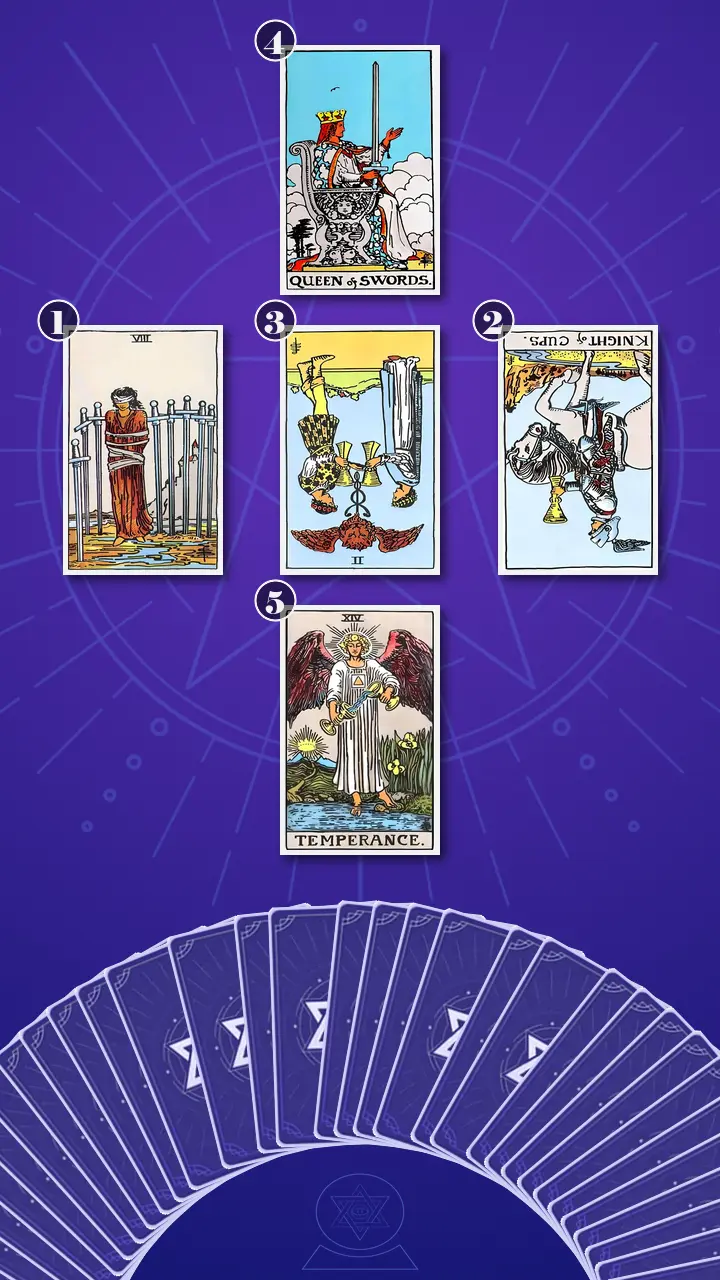
Reading the Map: You / Them / The Dynamic
Position 1: Your lived experience right now
“Now flipped over,” I said, “is the card representing your lived experience right now: the concrete thoughts and behaviors you fall into when the ‘work spouse’ label appears.”
The Eight of Swords, upright.
In a modern workplace, this card is the drafts-folder problem. It’s Slack open, reactions rolling in, the coworker dropping “work spouse 😉,” and you can think of three reasonable responses—yet the moment you picture your team watching, every option gets tagged as risky. So you default to a polite emoji… then later spend 20–40 minutes drafting a boundary message you never send.
Energetically, the Eight of Swords is blockage—not because you don’t have words, but because your mind is acting like your reputation is a fragile glass you’re carrying through a crowded room. The blindfold is the “social spotlight” effect. The bindings are looser than they look—meaning you have more options than your panic tells you.
I said it plainly: “It’s not that you’re trapped by them; you’re trapped by the story of how you’ll look.”
Jordan gave a small, bitter little laugh—quick, almost embarrassed—then exhaled like she’d been holding it. “That’s… uncomfortably accurate. I literally type three versions and delete them. Like it’s a hobby.”
“If you have to draft it three times,” I told her gently, “it probably needs to be one sentence.”
Position 2: Their approach
“Now we look at their approach: what your coworker’s tone and behavior suggests about how they’re framing the connection at work.”
Knight of Cups, reversed.
This isn’t me diagnosing anyone. In tarot, “their approach” is what shows up behaviorally—the vibe, the timing, the audience. And the Knight of Cups reversed is charm that’s a little too theatrical for the setting: the helpful coworker who’s also testing closeness through tone—winks, inside jokes, couple-coded labels—especially when there’s a group chat to laugh along.
Energetically, it’s excess and spillover: emotional framing outpacing the actual agreement. The horse is moving; the cup is extended; reversed, the accountability is missing. The label becomes a performance—like the workplace version of an algorithm. The first time people react with 😂, that “engagement signal” teaches the joke to keep auto-firing.
Jordan’s shoulders crept up, then she forced them down. “He’s genuinely good at his job,” she said. “And that’s what makes me feel insane. Like—why do I care so much?”
“Because your body is registering a boundary shift,” I said. “Not a crime. A shift.”
Position 3: The dynamic between you
“Now flipped over is the dynamic: what’s actually being co-created between you, especially where expectations and labels are misaligned.”
Two of Cups, reversed.
In real life, this looks like: on paper, you collaborate well. In practice, the ‘work spouse’ label feels like your coworker quietly upgraded the relationship without asking. You’re left managing the implications—how people perceive you, what stories spread—while still trying to be pleasant.
Energetically, Two of Cups reversed is imbalance. The card is built on mutuality—two cups raised, an agreement made visible. Reversed, one checkbox is unchecked. I told Jordan, “Imagine this like a shared Google Doc. You’re both working fine… and then someone changes the title to a couple-y inside joke and acts like it’s official. Without asking you.”
Her face went still, like a screen went dim for a second. “Yes,” she said after a pause. “I didn’t agree to this label, but everyone’s acting like I did.”
“Exactly,” I replied. “So the question isn’t ‘Is this harmless?’ The question is: Is this mutual and work-appropriate for you?”
When the Queen of Swords Spoke in Plain English
Position 4 (Key Card): The boundary to set
I felt the room settle before I even turned the next card—like when the background noise drops in a café and you suddenly hear the milk steamer stop. “This,” I said, “is the heart of the reading.”
“Now flipped over is the card representing the boundary: the cleanest line to draw that protects your professionalism without over-explaining.”
The Queen of Swords, upright.
Her message is crisp. In the most practical sense, she’s a clean API: one clear request, no extra parameters, no emotional attachments. This is the part of you that doesn’t audition for approval. She looks straight ahead and speaks in simple language.
And here’s where I used one of the tools I’ve honed across decades—what I call Relationship Pattern Recognition. I told Jordan, “This ‘work spouse’ thing is a script. A recurring emotional line that gets reinforced every time you laugh to keep the moment smooth. Your coworker may be charming, but the pattern is: label → audience reward → your polite laugh → label repeats. The Queen doesn’t fight the person; she interrupts the script.”
Setup: I named it the way Jordan had lived it. “You know that moment when they drop ‘work spouse’ in a Slack thread and the reactions start rolling in—your face does the polite smile, but your jaw locks like you’re bracing for impact.”
Delivery:
Stop trying to escape the awkwardness by staying silent; choose one clean sentence that cuts through the ‘work spouse’ script like the Queen’s raised sword.
I let that sit. No extra explanation. No softening laugh to undo the truth.
Reinforcement: Jordan’s reaction came in waves—three steps, almost textbook. First, a freeze: her breath paused, fingers still on her mug as if she’d been caught mid-scroll. Then, the thought landed: her gaze unfocused for a moment, like her mind replayed every Zoom “😂” and every unsent Slack draft at 9:36 PM. Finally, release: her shoulders dropped a fraction, and she let out a shaky little exhale that sounded half relief, half annoyance at how long she’d carried it.
“But if I say it,” she blurted, a flash of irritation behind her eyes, “doesn’t that mean I’ve been… kind of participating? Like I’m the one who made it a thing?”
I didn’t rush her out of that. “It means you’re updating the default setting,” I said. “Not confessing guilt. You don’t need a perfect reason to reject a label—just a clear preference. Friendly isn’t the same as fused.”
I offered her a practice structure—simple, time-boxed, and kind: “Set a 7-minute timer and write one ‘Queen of Swords sentence’ plus one ‘Temperance redirect.’ Example: ‘Please don’t call me your work spouse—let’s keep it coworker vibes.’ + ‘Anyway, for the Friday deliverable, I’m thinking we…’ Read it out loud three times in a normal voice. If you start spiraling or your chest tightens, pause, unclench your jaw, and stop—this is practice, not punishment. Save the line as a Slack snippet or Notes shortcut so you don’t have to improvise later.”
Then I demonstrated the Queen’s boundary in three tonal options—same words, different temperature:
“Calm: ‘Please don’t call me your work spouse—coworker is great.’”
“Lightly amused: ‘Haha—no work spouse stuff for me. Coworker is perfect.’”
“Neutral-professional: ‘Please don’t use “work spouse” for me. Thanks.’”
“No extra words,” I added. “No backstory. No negotiation.”
And I asked the question I always ask at the turning point: “Now, with this new lens—think back to last week. Was there a moment when one clean sentence would have changed how your body felt in the room?”
Jordan swallowed. “Thursday Zoom. When he said it and the chat filled up. My chest did that tight thing. I could’ve just… corrected it. And moved on.”
That’s the pivot—the emotional transformation beginning to click: from polite laughter and private rumination to calm, precise boundary-setting with steady, professional warmth.
Position 5: The delivery in real life
“Now flipped over,” I said, “is the card representing the delivery: the most workable way to communicate and reinforce the boundary in real life this week.”
Temperance, upright.
Temperance is the art of keeping it small. It’s the “two-cup blend”: one cup is your boundary (Air—clear words). The other is your redirect (Water—respectful tone). Poured together, it becomes a low-drama reset.
Energetically, Temperance is balance. It’s regulated delivery: steady volume, relaxed face, no nervous laugh to undo your own sentence. You say the line, then you pivot to the agenda so the other person has a clean exit ramp back to professionalism.
And because my work is rooted in nature’s rhythms, I offered a grounded timing note—not superstition, strategy. “Don’t try this for the first time on a King West patio after a drink,” I said, and Jordan snorted. “Choose a calmer moment—early in the day, or in a Slack reply when you can be brief. In the Highlands, we don’t plant seeds in a storm and then blame the seed.”
The One-Page Script: Boundary + Redirect (No Backstory Required)
I pulled the five cards into one clean story for her.
The Eight of Swords showed why she felt stuck: she was trying to avoid awkwardness now, and paying for it later in rumination and self-editing. The Knight of Cups reversed explained the pressure: charm, audience reward, a relationship tone being set through jokes. The Two of Cups reversed named the real issue: a mismatch in definition and consent—effective teammate versus implied couple. The Queen of Swords gave the medicine: one clean preference sentence. Temperance showed how to deliver it so it lands as professional alignment, not drama.
Her blind spot, gently: she’d been treating this like an optics problem to manage (avoid 1:1, over-CC, stiffen up) instead of a language problem to correct. The transformation direction was clear: move from indirect signal-sending to one clear sentence that names what you prefer to be called and redirects the relationship back to a professional lane.
Then I gave her next steps that were small enough to do on a Tuesday—because awkward for ten seconds beats stressed for ten hours.
- Write the Queen Sentence (12 words max)In your Notes app, write: “Please don’t call me your work spouse—coworker is great.” Pick the version that sounds like you and keep it unchanged.If you feel the urge to explain, stop at one sentence. You’re stating a preference, not presenting a case.
- Save it as a repeatable Slack snippetCopy the sentence into a Slack saved reply (or a keyboard shortcut). If it happens in a thread, paste it once, then immediately follow with a work-related line.Lower the difficulty: don’t invent language under pressure. Let the snippet do the heavy lifting.
- Use the Two-Cup Reply once this weekSay: (1) “Please don’t call me your work spouse.” (2) “For the Friday deliverable, are we leading with timeline or risks?” Keep your face neutral and your voice calm.If they say “It’s just a joke,” repeat your preference once and pivot. Don’t litigate intent—consistency resets the dynamic.

A Week Later: The Quiet Proof
A week after our session, Jordan messaged me: “It happened again in a group thread. I pasted the line. Then I asked a timeline question. No one made it a thing. My hands were shaking, but… it worked.”
She added one more detail that mattered to me: “I slept through the night. I still woke up thinking ‘what if I sounded rude?’—but I laughed. Like, a real laugh.”
That’s what a Journey to Clarity looks like in real life: not a personality overhaul, not a perfectly controlled workplace, but a steadier internal rhythm. Your work day stops being split between doing the job and managing the vibes around the job.
And if I can leave you with one anchor from this reading, it’s this: When you laugh at a label you didn’t choose just to keep the vibe smooth, it can feel like your body is paying the price—tight jaw, clenched chest—so everyone else stays comfortable.
If you trusted that belonging at work doesn’t require being claimable, what’s the one simple sentence you’d want on repeat the next time it comes up?