From Late-Night 'Miss You' Spirals to a Clean, Values-Based Choice

Finding Clarity in the 10:57 p.m. Phone Glow
If you’re a 20-something in a city like Toronto, staring at a glowing phone at 11 PM because your ex texted “miss you” the exact week you finally met someone decent—welcome to choice paralysis.
Taylor sat on the edge of her condo bed while streetlight glow leaked through the blinds in thin, pale stripes. Her phone screen lit her face from below, the way it does when you’re trying to pretend you’re “just checking something” but you’re actually bracing for impact. She re-read miss you for what had to be the tenth time. The glassy tap of her thumbnail on the keyboard sounded loud in the quiet.
Her hands had that buzzy, phantom-vibration feeling—like her nervous system was still waiting for the next buzz even when nothing was buzzing. Her chest felt cinched, not dramatic-heartbreak cinched, but the kind that makes you take shallow little sips of air without noticing. It was confusion with extra ingredients: longing, guilt, anticipation, all layered like too many tracks fighting for the same frequency.
She said it the way people do when they’re trying to sound rational about something that isn’t rational at all. “Why did he say it now, the exact moment I finally started moving on?”
I watched her eyes flick between the ex’s thread and the newer chat like a split-screen. It reminded me of a soundboard—two channels open, both peaking, and the instinct to keep turning knobs instead of muting one track. The inner math was immediate and brutal.
“If I reply,” she said, “it means I’m opening a door. If I don’t, it means I’m… I don’t know. Cold. Like I’m erasing what we had.”
“And if you choose the new person,” I added gently, “part of you worries you’ll regret it later. Like you’ll find out you were ‘wrong.’”
She nodded once, too fast. “Exactly. I don’t want to be the kind of person who picks comfort over growth. But… I also don’t want to be reckless.”
I’ve hosted enough late-night radio segments on heartbreak to know this moment: the phone becomes a tiny courtroom, and two words become evidence. “We’re not going to try to force a verdict tonight,” I told her. “We’re going to do something simpler and kinder: we’re going to find clarity by mapping what’s actually happening—so your next move can match your values, not your adrenaline.”

Choosing the Compass: How the Decision Cross Tarot Spread Works
I asked Taylor to set her phone face-down for a minute—no dramatic ritual, just a nervous-system reset. “One slow breath in,” I said, “and let your shoulders drop a millimeter. We’re not predicting your future. We’re organizing your present.”
As I shuffled, the cards made that soft, papery whisper I’ve always loved—like static turning into signal. In my work with sound energy, I think of it as creating a clean listening environment. You can’t hear what you need to hear when everything’s blaring.
“Today, we’ll use the Decision Cross,” I said. “It’s a classic spread for a relationship crossroads—especially when the emotions are loud and the thinking is louder.”
For you reading along: the reason I like the Decision Cross for my ex texted ‘miss you’ when I started dating someone new situations is that it keeps the comparison honest. It separates the ex-path from the new-connection path without pretending the deeper attachment pattern isn’t part of the story. It also ends with something practical: a decision rule and a boundary—because clarity usually comes from what you do, not what you obsessively decode.
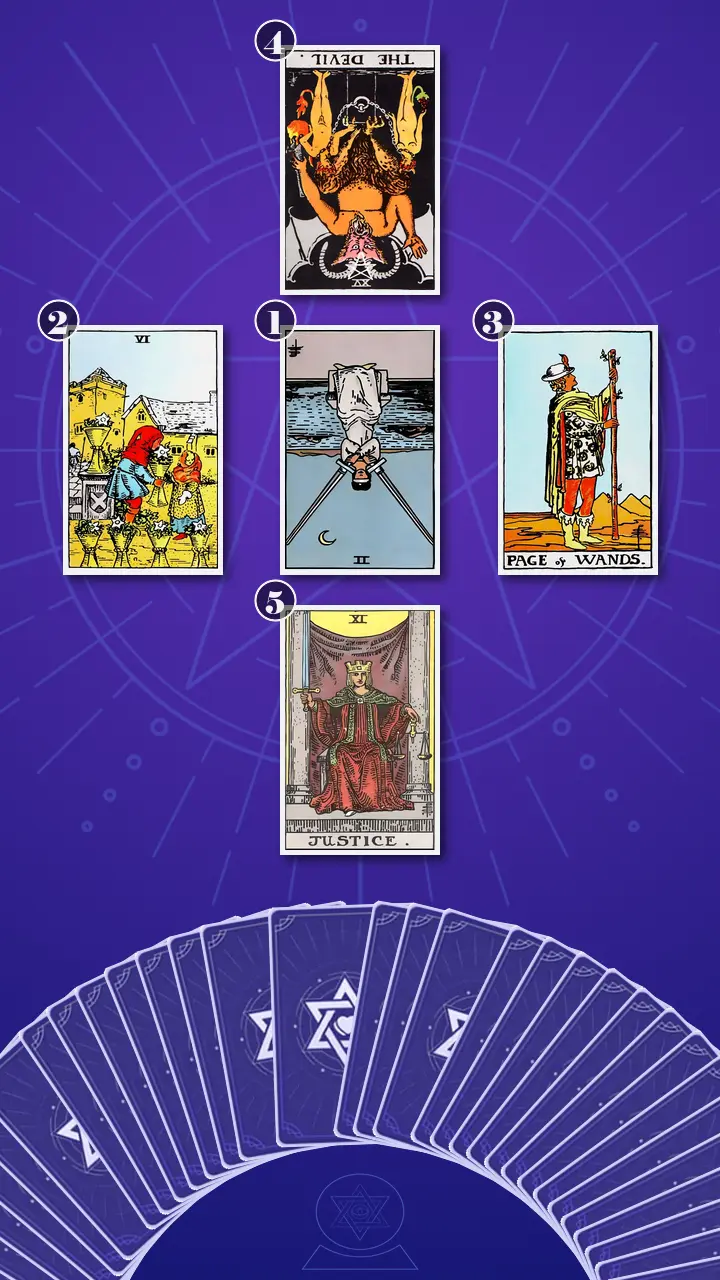
Here’s the map we used:
Card 1 sits at the center—the current crossroads, what’s keeping you stuck in the moment the text landed.
Card 2 goes left—Path A: the ex, the emotional climate you step into if you re-open that door.
Card 3 goes right—Path B: the new person, the tone of prioritizing what’s in front of you now.
Card 4 hovers above—the hidden driver, the fear or pattern making the choice feel urgent or impossible.
Card 5 anchors below—guidance for a self-respecting choice, the boundary + values principle that brings grounded clarity.
Reading the Map: The Crossroads, the Two Paths, and the Noise Between
Position 1: The current crossroads—what’s keeping you stuck
“Now flipping over is the card that represents the current crossroads: what’s keeping you stuck in the moment you received ‘miss you’,” I said.
Two of Swords, in reversed position.
“This is like,” I told her, “being at your desk between meetings, opening the ex thread like it’s a puzzle. You draft replies you never send because sending anything feels like it ‘means something.’ Then you flip to the new person’s chat to test whether their steady tone calms you. You call it being thoughtful, but it’s really a freeze response—staying in limbo so you don’t have to risk loss.”
The reversed Two of Swords is Air energy that can’t settle. In balance, Swords can help you choose cleanly. Here, it’s blocked and leaking—decision energy spilling out as rumination, rewriting, comparison loops. The blindfold in the card is the belief: I’ll decide when I feel certain. The crossed swords are the defense: If I don’t choose, I can’t be wrong. But reversal shows the defense is failing—your body feels it first.
I asked her the question this position always begs: “What do you do in the first 60 seconds after you see ‘miss you’—and what feeling are you trying to avoid?”
Taylor let out a small laugh that had no joy in it. “That’s… kind of brutal. But accurate.” Her fingers rubbed the edge of her phone case like she was sanding down a sharp corner.
I kept my voice steady. “Confusion isn’t a sign you’re broken—it's a sign you’re negotiating with two different versions of your life.”
In my head, I flashed to a studio moment—levels peaking, headphones too loud, that instinct to keep adjusting instead of hitting mute. Overthinking is like keeping 18 tabs open because you’re sure the next one will contain the answer, while your laptop fan is screaming. It feels like control. It’s actually overload.
Position 2: Path A (the ex)—what energy you’re stepping into if you re-open that door
“Now flipping over is the card for Path A—the ex,” I said. “What energy you’re stepping into if you re-open that door.”
Six of Cups, upright.
I didn’t need to reach for anything mystical. The card translated itself into modern life immediately. “The ex path feels like stepping back into a warm, familiar playlist: inside jokes, early-days chemistry, the comfort of being known.”
She swallowed—one of those tiny swallows that’s half memory, half grief.
“But here’s the catch,” I said, and I made sure my tone stayed kind. “The warmth comes from memory, not from today’s behavior. So you start craving the feeling of ‘us’ while forgetting how often you were waiting for consistency.”
Six of Cups is Water energy, and Water isn’t wrong. It’s just not always current. In excess, it becomes a highlight reel—an algorithm serving you the best scenes and editing out the nights you cried in the bathroom. I said the line I always say when this card shows up in an ex-vs-new reading:
Nostalgia is real emotion, not reliable guidance.
Taylor’s eyes flicked up to mine as if she wanted to argue—then she didn’t. Her shoulders stayed high, but her jaw loosened a fraction. Like her body had been waiting for permission to admit the obvious: this text landed so hard because it reopened an old storyline that still knows all her lines.
“If you replied and re-opened the ex door this week,” I asked, “what pattern do you already know might come back within a month—based on history, not hope?”
Her mouth twisted. “The inconsistency. The… waiting. Me trying to be chill about things I wasn’t chill about.”
Position 3: Path B (the new person)—what energy you’re stepping into if you prioritize the new connection
“Now flipping over is the card for Path B—the new person,” I said. “What energy you’re stepping into if you prioritize the new connection.”
Page of Wands, upright.
“This is the energy of an experiment,” I told her. “Not a verdict. The new connection feels like trying a different dating rhythm: you make a simple plan, they follow through, and you feel lighter afterward.”
And I could see it land—because she’d described almost that exact moment walking along Queen West after a low-key date, breathing easier… until her brain tried to turn calm into suspicion.
Page of Wands is Fire that’s healthy and curious—not locked in, not demanding certainty. Its gift is movement and information. When you’ve been trained on intensity spikes, steady presence can feel like “maybe it’s not real.” But that’s nervous-system conditioning, not fate.
I asked, “What’s one small, low-pressure next step you genuinely want with the new person—and what fear shows up when you imagine doing it without keeping the ex door open?”
Taylor stared at the Page like it might blink first. “I want to see him again. Like… a normal plan. Coffee. Sunday.”
Then, quieter: “And the fear is… if I fully step into it, I’m closing the other door.”
“Exactly,” I said. “The fear isn’t coffee. The fear is finality.”
Position 4: The hidden driver—the underlying pattern making the choice feel urgent or impossible
“Now flipping over is the card that represents the hidden driver,” I said. “The underlying pattern, need, or fear making this feel like a high-stakes verdict.”
The Devil, in reversed position.
The air in the room changed the way it does when a song hits the exact lyric you’ve been avoiding. Taylor’s hand went straight to her phone—then stopped halfway, like her body had shown its tell before her mind could edit it.
“This is the hook,” I said. “Not in a shame way. In a mechanical way.”
And I used the modern translation that always makes people go still: “You notice you’re not just deciding between two people—you’re reacting to a validation hook. The ex’s late-night ‘miss you’ acts like a mood regulator. You feel pulled to reply so you don’t become ‘the bad one,’ and you keep checking your phone to see if you’re still wanted.”
Reversed Devil isn’t doom. It’s an opening. The chains are loose—meaning the compulsion loop is not mandatory, even if it feels like it at 10:57 p.m. This is attachment energy that’s been running as autopilot, and reversal is the moment you see the button that still works.
I leaned in slightly. “Polite isn’t the same as available.”
Taylor exhaled—small, but real. Her shoulders dropped a millimeter. Then she frowned, like the relief made her mad at herself. “But if I don’t answer, I’m… mean.”
“Or,” I offered, “you’re protecting your nervous system. That’s not meanness. That’s maturity.”
Then I said the line that tends to become a turning point:
If the text is the trigger, the boundary is the medicine—not the reply.
Her eyes went unfocused for a second—memory replay. Then she nodded once, slow. The three-part reaction came in a wave: her breathing paused, then her gaze drifted to the window like she was watching an older version of herself on a loop, and finally she released a deeper breath from her chest, the kind that makes your ribs feel like they’re unclenching.
“When you imagine choosing ‘wrong,’” I asked, “what’s the actual worst-case story your mind tells you about you?”
She whispered it. “That I end up alone. And it proves I’m not… safe. Like I can’t make smart choices.”
“There it is,” I said softly. “The decision isn’t only about them. It’s about whether you trust yourself without certainty.”
When Justice Spoke: The Scales That End Midnight Negotiations
Position 5: Guidance for a self-respecting choice—the decision rule and boundary that brings clarity
I held the deck a second longer than usual. “We’re flipping the anchor card now,” I said. “The one that turns this from comparison fatigue into actionable advice.”
“Now flipping over is the card that represents guidance for a self-respecting choice,” I said. “The decision rule and boundary that brings clarity.”
Justice, upright.
Justice is values-based decision-making. It’s the part of you that stops asking the internet, the group chat, or the two-word text to decide for you. It’s clarity that’s built, not granted.
And because my work lives at the intersection of psychology and sound, I brought in my Melodic Mirror—my way of seeing emotional patterns through what we listen to when we’re not being brave.
Melodic Mirror: What Your Playlists Reveal About Your “Ex vs New” Nervous System
“Quick question,” I said. “When you spiral on your ex, what do you put on?”
Taylor blinked. “Uh. Literally… ‘sad girl autumn.’ And that one playlist I made when we broke up.”
“And after a date with the new person?”
“More… upbeat. Like, not even hype. Just normal. Podcasts sometimes.”
“That’s Justice,” I told her. “Not because happy songs mean the new person is ‘right,’ but because your body is giving you data. Your ex playlist is built to metabolize intensity—big swells, dramatic lyrics, that familiar ache. Your new-person sound is steadier. Justice says: stop treating intensity as proof. Treat present-day behavior as evidence.”
Then I slowed down, because this is where the reading pivots.
Setup (the moment you’re stuck in): It’s 10:57 PM, your room is dark except for your phone, and you’re re-reading “miss you” like it’s a clue that will finally make the decision painless. You’re trying to secure certainty through comparison—like if you analyze hard enough, you’ll avoid regret.
Delivery (the sentence that changes the room):
Not a verdict from a text—choose with clear scales, set one boundary, and let Justice anchor you in what’s true.
The words hung there for a beat. Even the city outside sounded quieter—just a faint rush of tires on wet pavement, like a distant white noise machine.
Reinforcement (what it does in the body): Taylor went completely still. First, that micro-freeze: her inhale stopped halfway, her eyes widening just a touch. Then the cognition landed—her gaze drifted off the card, unfocused, as if her brain was replaying every night she’d negotiated with herself at midnight, thumb hovering, heart racing. Finally, the emotion moved: her shoulders lowered, slow and reluctant, like they’d been carrying a backpack she forgot was heavy. Her mouth opened, closed, then she let out a breath that sounded almost like a laugh and almost like a sob.
“But… if I do that,” she said, and there was a flash of anger under the tenderness, “doesn’t it mean I was wrong before? Like I wasted time?”
I nodded. “That reaction makes sense. Justice can feel sharp because it’s honest. But it’s not here to punish you. It’s here to stop you from paying for safety with endless uncertainty.”
I slid her a notebook. “Try this for 10 minutes: open Notes and write two non-negotiables—behavioral, not vibes—plus one boundary for the ex thread for the next 7 days. If you feel overwhelmed at any point, you can stop and come back later—this is an experiment, not a punishment, and you get to choose the pace.”
Then I asked the question that turns insight into lived memory: “Now, with this new lens—can you think of a moment last week when the ex text spiked your body, and this boundary would’ve made you feel different?”
Her eyes got glossy, not from romance, but from recognition. “Monday night. Netflix paused. I kept picking up my phone every two minutes. I wasn’t even trying to talk to him. I was trying to… regulate.”
“That,” I said, “is the shift. This isn’t just a dating decision. It’s a move from certainty-chasing rumination and mixed signals to self-respecting clarity and steadier self-trust.”
The Justice Rule: Actionable Next Steps You Can Start Tonight
When I stitched the whole Decision Cross together for Taylor, it told a clean story: the center was a reversed Two of Swords—overthinking as self-protection, now turning into noise. The left side was Six of Cups—nostalgia as a highlight reel, a familiar playlist that makes the past feel safer than it was. The right side was Page of Wands—future-facing curiosity and real-time information through small plans. Above it all, reversed Devil—the hook: attention as regulation. And underneath, Justice—the anchor: standards plus one boundary, so your life stops being run by two words on a screen.
The cognitive blind spot was obvious once the cards were laid out: Taylor had been treating certainty like the requirement for a “good” choice. But the transformation direction Justice offered was different: choose based on present-day behavior and a clean boundary you can live with—so you stop negotiating with yourself at midnight.
I made it practical. “Choose clean, not perfect,” I said. “Let’s make it doable.”
- The 7-Day Daylight-Only Boundary ExperimentFor the next 7 days, don’t reply to your ex after 7 PM. If you choose to reply, do it once, in daylight, with one clear sentence about what you are and aren’t available for.Expect your brain to argue (“This is harsh”). Set a 20-minute timer before any reply and put your phone in another room—your nervous system deserves a buffer.
- The Needs vs Consistency Overlay (10 Minutes, Private)Write two short paragraphs: (1) “What I need to feel safe in a relationship.” (2) “What this person has consistently shown.” Then circle only the overlap.If you freeze, start with one unpoetic sentence: “I feel safe when ____.” Keep it behavioral (e.g., “they follow through”).
- The Justice Rule in Your Notes AppCreate a two-line decision rule: “My non-negotiables are: ____ and ____.” + “My boundary is: ____.” Save it where you can see it during the 11 PM spiral.Think of it like your personal Terms of Service. You’re not being dramatic—you’re being clear.
- One Small Next Step With the New PersonPick one low-pressure plan that matches your real interest (not your anxiety): “Want to grab coffee at 11 on Sunday?” Keep it simple—no relationship summit.If you start drafting a paragraph, you’ve left Page of Wands energy. Return to one sentence.
Because Taylor responds well to sound-based tools, I also gave her a tiny add-on using my Emotional BPM strategy: “For one week, notice the tempo you live at with each person. Does your body speed up into frantic checking? Or settle into steady breath? You’re not judging the feeling—you’re collecting data.”

A Week Later: The Quiet Proof of Self-Trust
Eight days later, Taylor DM’d me a screenshot—not of the ex text, but of her Notes app. Two non-negotiables. One boundary. Under it, a sent message to the new person: “Coffee Sunday?”
Then she added: “I didn’t reply to my ex at night. I woke up still thinking ‘what if I’m wrong?’—but I kind of smiled. It didn’t feel like an emergency anymore.”
That’s the part people underestimate about how tarot works in real life. A Decision Cross tarot spread for choosing between an ex and a new connection doesn’t hand you a prophecy. It hands you a structure: separate nostalgia from novelty, name the hook, and anchor your next step in standards you can live with. That’s how you get from dating limbo to finding clarity—one clean boundary at a time.
When a two-word “miss you” can tighten your chest and make you doubt your own judgment, it’s not that you’re bad at choosing—it’s that you’ve been trying to use certainty to buy safety.
If you let present-day behavior—not nostalgia, not adrenaline—be the deciding factor for one week, what boundary would make you feel most like you’re on your own side?