From a Miss-You Text Spiral to a Calm Reply You Respect Tomorrow

The 11:58 p.m. iMessage Spiral
“If you’ve opened the same iMessage thread 20 times since your ex texted ‘miss you,’ and somehow your thumbs are sweating like you’re about to take an exam—yeah,” I told Taylor, “this is that attachment-triggered texting spiral.”
She gave me a look that was half relief, half how did you just read my soul through my lock screen?
It was late in Toronto when we met—one of those Sunday nights where the city is bright but your apartment is quiet. Taylor sat cross-legged on her bed in her condo, the glow from the streetlights leaking through the blinds in thin, stubborn stripes. Her phone was warm in her palm, like it had been there long enough to start feeling like part of her body. Somewhere below, a streetcar bell rang faintly and then disappeared, like the city was reminding her that life keeps moving even when your chest doesn’t.
She showed me the message without saying much. Two words. Miss you. Intimate. Vague. The kind of text that lands like a hand on your shoulder and a hook behind your ribs at the same time.
“I hate how one text can undo a week of progress,” she said. “I keep typing something that sounds chill, and then I delete it. If I answer too fast I look desperate, but if I wait I feel like I’m failing some test.”
I watched her fingers—restless, quick, hovering over the keyboard like they wanted to hit send before her mind had signed off. Her breath was shallow. Her shoulders had crept up toward her ears. The longing wasn’t abstract; it was physical, like her heart was trying to sprint while the rest of her stayed stuck in place.
Underneath her question—what should I reply?—I could hear the real contradiction humming: wanting reassurance and connection from your ex, while fearing you’ll repeat an on-and-off dynamic that quietly eats your self-respect.
“That tight chest and those restless hands?” I said gently. “That’s not you being ‘too much.’ That’s your nervous system acting like this text is a referendum on your worth.”
Her eyes flicked up. “It really feels like that.”
“Okay,” I said. “Let’s not treat this like a pass/fail exam. Let’s treat it like a map. Our whole goal tonight is finding clarity—so you can reply, or not reply, from steadiness instead of from that craving for immediate relief.”

Choosing the Compass: The Celtic Cross · Context Edition
I had Taylor take one long inhale and a slow exhale—nothing mystical, just a clean gear shift from reaction into awareness. I shuffled while she held the question in mind: My ex just texted ‘miss you’—what old pattern shapes my reply?
“Today,” I said, “we’ll use a spread called the Celtic Cross · Context Edition.”
For anyone reading along who’s ever wondered how tarot works in moments like this: I don’t use these cards as a fixed prediction. I use them the way I’d use a psychological mirror—patterns, pressures, blind spots, and the most empowering stance you can choose inside the uncertainty.
This situation needs a deep chain—present symptom → underlying root → key reframe → integration. The Celtic Cross does that naturally. And in this context edition, two positions are tuned to texting reality: Position 6 becomes your default next move (the autopilot reply dynamic), and Position 10 becomes your best stance, not a destiny. Because the point isn’t guessing what your ex will do. The point is helping you lead yourself.
“Here’s what we’re looking for,” I told Taylor. “The first card is the exact internal state that hits when you see the text. The card crossing it is the sticky pattern—the hook. And at the top, we’ll find the stance that protects your calm and your self-respect.”
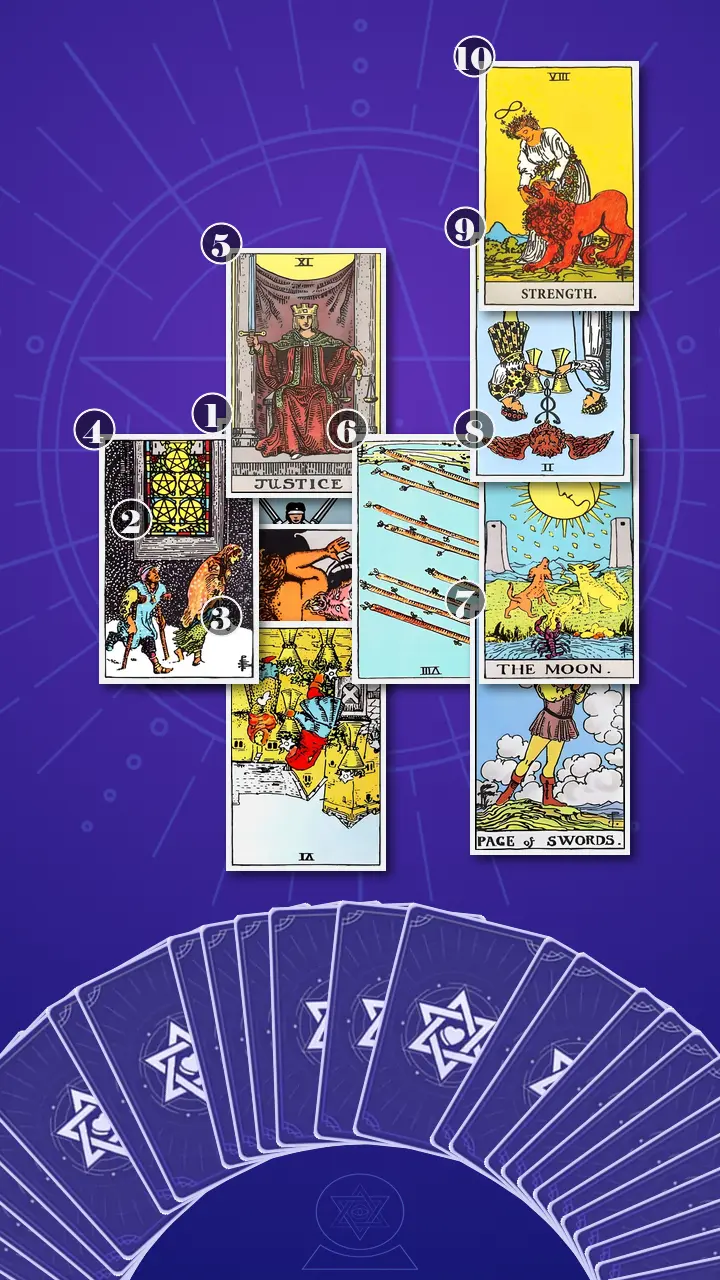
Reading the Map: From Freeze to Fog
Position 1 — What’s happening right now: the immediate impulse
“Now the card we turn over represents what’s happening right now—your immediate internal state when you see the text,” I said.
Two of Swords, upright.
“This,” I said, tapping the blindfolded figure with crossed blades, “is you going emotionally blank on the outside while your inside is loud. You reopen the chat, draft a reply that reveals nothing, and try to make a heart decision from the neck up—because naming the longing feels risky.”
The Two of Swords is protective energy in a blockage state: not balanced discernment, but a freeze response. Your body braces as if the text is danger, even while your heart wants contact. It’s why you can type ten versions of a reply and still feel like you’ve said nothing real.
Taylor let out a small laugh that sounded like it had a bruise inside it. “That’s… accurate. Kind of brutal.”
“I know,” I said softly. “And it makes sense. When you’ve been hurt, neutrality can feel safer than honesty. But I’m going to ask you a very clean question: what feeling are you preventing yourself from naming before you hit send?”
Her gaze dropped to the card. Her thumb stopped moving for the first time since we started.
Position 2 — The main obstacle: the sticky attachment hook
“Now the card we turn over represents the main obstacle—the attachment pattern that makes the reply feel urgent or loaded,” I said.
The Devil, upright.
Even before I explained it, I felt Taylor’s shoulders tense like she recognized the shape of the trap.
“The Devil isn’t about you being bad,” I said, “it’s about compulsion. This is the text hitting like a hook. Even though it’s vague, your body treats it like proof you’re still ‘in,’ so replying feels urgent and high-stakes. You’re not answering a message—you’re answering a craving for reassurance.”
I leaned into a micro-scene, because that’s where the truth lives: “Thumb hovering. Phone warm. Heartbeat up. The inner monologue goes, If I reply right, I get comfort. If I reply wrong, I lose belonging.”
That’s the Devil’s energy in excess: a dopamine slot machine. One tiny payout of hope makes you pull the lever again—even when you promised yourself you were done with this subscription. It’s like your nervous system hits auto-renew on an on-and-off dynamic you meant to cancel.
Then I pointed to the detail most people miss. “See the chains? They’re loose. Not welded. That matters.”
Taylor’s eyes narrowed, like she was trying to see the removable link. She gave a tight nod. Quiet. A little stunned. The resonance was there: called out gently, not shamed.
“The choice point can be as small as two minutes,” I added. “Put the phone face-down. Let your body come down from the spike. That’s not playing games. That’s consent with yourself.”
Position 3 — The root: the deeper belief shaping your texts
“Now the card we turn over represents the root—the often unconscious belief about love, worth, or safety that shapes how you text back,” I said.
Six of Cups, reversed.
“This is nostalgia bias,” I told her. “You scroll back to the sweetest part of the thread—the cute jokes, the soft ‘good morning’ era—and your brain edits the relationship into a highlight reel. Your reply starts trying to recreate ‘old us’ tone, even though adult-you knows the old pattern included uncertainty and you shrinking yourself.”
The Six of Cups reversed is emotional memory in a distorted state: sweetness gets weighted as evidence, and pain gets filed away as ‘complicated.’ It’s why a two-word text can start feeling like a portal.
“Missing them is real,” I said, letting my voice turn more tender. “Forgetting what hurt is optional.”
Taylor swallowed, and her hand went to her sternum without thinking—like she was trying to press down the part of her that wanted to time-travel. Her eyes looked slightly glassy, but steadier than before. Defense softening.
Position 4 — Recent past: what you’ve been carrying from the breakup
“Now the card we turn over represents the recent past—what’s been priming you to respond this way,” I said.
Five of Pentacles, upright.
“This is the ‘in the cold’ feeling,” I said. “Like you weren’t fully chosen. Like you were left outside the warm window.”
I described the card’s snow and the lit stained-glass window, and I watched Taylor’s jaw clench like she could feel that winter again in her bones. Five of Pentacles is scarcity energy in a wound state: when loneliness hits, almost any warmth looks like rescue.
“So when ‘miss you’ arrives on a quiet night,” I continued, “it doesn’t just feel romantic. It feels like relief. And the temptation is to trade clarity for warmth.”
Taylor exhaled through her nose, slow and shaky. “I don’t even know if I want him,” she admitted. “I just… want to feel inside something again.”
“That’s an incredibly honest sentence,” I told her. “And honesty is where self-respect starts.”
Position 5 — Conscious aim: how you want to handle it
“Now the card we turn over represents your conscious aim—what you think you should do, the ‘right’ way you want to handle this,” I said.
Justice, upright.
Justice always changes the temperature in a reading. It’s the moment the nervous system stops begging for vibes and starts asking for structure.
“A part of you wants to handle this like an adult with standards,” I said. “Not ‘what do they mean,’ but ‘what do I need to be true if I engage?’”
Justice is clarity energy in balance—scales and sword, both. And I couldn’t help a small inner flashback: years ago, on transoceanic voyages, I trained cruise staff to read human energy shifts the way you read weather. I learned that panic loves vagueness—but good decisions love clean data.
So I used the echo technique on purpose—receipts language. “Taylor, you know how you’d never approve a marketing campaign with missing info?” I asked. “Like… no brief, no target audience, no timeline—and someone’s like, ‘Trust me, it’ll work’?”
She snorted. “Absolutely not.”
“Exactly. So why are we treating a vague ‘miss you’ like it’s a full proposal?” I paused, then said the pivot line I wanted her to keep: “You don’t need a perfect reply—you need a reply you can respect tomorrow.”
Her shoulders dropped a fraction. A small exhale—less frantic, more oriented.
“Here’s the Justice question,” I added, “the one clean standard you can ask before you text back: What information do I actually need before I keep engaging?”
Position 6 — Default next move: the texting autopilot
“Now the card we turn over represents your default next move—what your reply dynamics become if you follow the old script without pausing,” I said.
Eight of Wands, reversed.
“Stop-and-go texting,” I said immediately. “Draft, delete, wait, check, panic, almost-send, over-edit. The conversation becomes about timing and momentum until you’re exhausted—and your message no longer reflects what you actually want.”
Eight of Wands reversed is communication energy in a scatter state: velocity controls you instead of you choosing the pace. It’s why your brain turns the reply into an optimization problem—tone, timing, implication—like you’re trying to hack uncertainty.
Taylor pressed her lips together and looked away from the cards toward the dark window. The city glow looked harsher for a second, like it was exposing the loop.
“Yeah,” she said quietly. “And then I feel gross after. Like I performed.”
“That’s a real data point,” I said. “If it feels like a performance review for your worth, it’s probably not aligned with your needs.”
The Staff of the Spread: You, the Fog, and the Ache for Reciprocity
Position 7 — You in the dynamic: your coping posture
“Now the card we turn over represents you in the dynamic—your self-image and coping style in this moment,” I said.
Page of Swords, upright.
“You show up as the Watcher,” I told her. “Scanning for subtext, reading between lines, trying to anticipate their next move. You turn two words into a full investigation—thread rereads, social media checks, tone rehearsals—because certainty feels safer than vulnerability.”
Page of Swords is mental energy in excess: not curiosity, but surveillance. The raised sword in the wind is readiness—bracing.
“Let’s use the Page in its healthiest form,” I said. “One clean question. No spiraling. What information do I actually need? Not ‘how do I keep them,’ but ‘what do I need to know to decide whether this is emotionally safe for me?’”
Taylor nodded, slower this time. Her grip on her phone loosened, like she’d stopped clutching it as a life raft.
Position 8 — The field around you: the fog and mixed signals
“Now the card we turn over represents the environment—the ambiguity and context that influences your interpretation,” I said.
The Moon, upright.
“This is the fog,” I said. “Vague intimacy. No plan. No clarity. The context is foggy on purpose, and your mind tries to complete the story—hope and fear both fill in the blanks.”
I used the split-screen technique, because The Moon demands it.
Left side: facts. Two words. No specifics. No accountability offered. No request made.
Right side: the movie your brain writes. They’ve changed. They regret it. They’re lonely. They’re coming back. Or: they’re bored, they’re breadcrumbing, they’ll disappear again. The loudest story feels like the truest story, because it has the most adrenaline.
“You’re not crazy,” I told Taylor. “The environment is unclear, so your nervous system tries to manufacture certainty out of subtext.”
Her face flushed—embarrassed recognition—then softened into relief. “I literally checked his Stories like it was… an emotional weather app.”
“Exactly,” I said. “And The Moon says: step-by-step. One data point at a time. Not a sprint powered by projection.”
Position 9 — Hopes and fears: the ache and the doubt
“Now the card we turn over represents your hopes and fears—what you want this text to mean, and what you’re scared it might mean instead,” I said.
Two of Cups, reversed.
“This is the ache for mutual repair,” I said. “You want reciprocity—real two-way care—not just chemistry. But you’re afraid it’ll be another round of closeness without follow-through.”
Two of Cups reversed is connection energy in a misalignment state. It makes the reply feel like a bid to earn closeness quickly, because the fear underneath says: If I don’t secure it, I’ll lose it.
“Here’s the central question this card asks,” I said. “Not ‘do they miss me,’ but: is there equal exchange available here?”
Taylor’s eyes closed for a beat. When she opened them, they were glossy and a little angry—not at me, but at the pattern. “I’m tired of being the one who makes it okay,” she said.
“That’s Strength knocking early,” I told her. “That’s your self-respect remembering itself.”
When Strength Held the Lion’s Mouth
Position 10 — Integration and best stance: the empowering posture
I let the room get quiet before I turned the last card. The building’s hallway noise faded. Even the fridge hum seemed to recede in Taylor’s mind. This was the core of the reading—the antidote.
“Now the card we turn over represents integration and best stance—the most empowering emotional posture for replying (or choosing not to) with clarity and self-respect,” I said.
Strength, upright.
“This card is saying something very specific,” I told her. “Your reply doesn’t need to prove your worth; it needs to protect your calm and tell the truth you can stand behind tomorrow.”
Strength is fire energy in balance: not impulsive heat, but steady warmth. It’s the calm woman with her hands on the lion—skilled containment. Not suppression. Not aggression. Just inner authority.
Setup: It’s late, your apartment is quiet, and that two-word text makes your body buzz like you’re back in the relationship. You’re staring at the thread, trying to draft a reply that keeps you wanted and keeps you safe—two goals that keep fighting each other.
Delivery:
Stop letting the text chain you to old cravings; choose a calm, courageous reply from the lion-heart of Strength.
I let that sentence sit between us. Like a door closing softly, not slamming.
Reinforcement: Taylor’s breath caught—just for half a second—like her body had been bracing for a different kind of instruction. Her eyes unfocused, as if her mind replayed a whole highlight reel: the good week, the disappear-for-three-days week, the “are we doing this or not?” conversations that never landed. Her fingers, which had been curled around her phone, slowly uncrossed. Then her shoulders lowered, not dramatically, but in that unmistakable way someone’s nervous system comes down from a ledge. She pressed her tongue to the back of her teeth, thinking hard, and I saw the tiniest tremble in her lower eyelid—the vulnerable moment after clarity arrives, when you realize you’re responsible for what you do with it.
“But if I’m firm,” she said, voice thin, “won’t I lose him?”
“Maybe,” I said honestly. “And also: if you have to abandon yourself to keep the connection, you’re already losing something. Strength isn’t ‘be cold.’ Strength is ‘be true.’ Clarity isn’t harsh. It’s kind to the version of you who has to live with the aftermath.”
Then I brought in my Choice X-Ray—the lens I use when a decision looks like two options but it’s really four dimensions. “Let’s X-ray two possible replies,” I said. “Not to judge you. To reveal hidden costs.”
“Reply A: the reassurance-chasing version. Benefit: quick warmth, quick ‘I’m wanted’ hit. Hidden cost: you teach your body that vagueness gets access to you, and your self-respect pays the fee later.”
“Reply B: the Strength version. Benefit: calm stays intact, and you get clean data. Hidden cost: you might feel exposed for a minute, because you’re not hiding behind tone-management.”
Her face tightened, then softened—like the truth stung but also relieved her. She nodded once, firm. “I want B.”
I asked her the question I always ask at this turning point: “Now, with this new lens—can you remember a moment last week where this would’ve changed how you felt? A moment you chased a clue instead of holding your ground?”
She stared at the Strength card, and her voice got steadier. “Thursday night. I almost texted him first. I kept telling myself it was casual. It wasn’t.”
“That’s the emotional transformation right there,” I said. “Not from longing to not caring—no. From craving immediate relief to building self-trust. From being yanked by a notification to choosing your pace.”
From Insight to Action: A Port Decision Model for Your Next 48 Hours
I leaned back and let the whole spread come into one story.
“Here’s the arc,” I said. “Two of Swords shows the freeze: you try to protect yourself by going blank and perfecting a safe reply. The Devil shows the hook: you treat vagueness like intimacy because it briefly soothes the Five of Pentacles wound—the feeling of being out in the cold. Six of Cups reversed shows the root bias: the highlight reel pulls you backward. The Moon shows the foggy environment that makes projection feel irresistible. Justice is your conscious standard—the part of you that wants receipts, accountability, and real clarity. And Strength is the integration: you can feel the longing without letting it drive the keyboard.”
“The blind spot,” I added, “is thinking the right phrasing will protect you from the wrong pattern. Like if you can manage tone perfectly, you won’t get hurt. But this isn’t a wording problem—it’s an alignment problem.”
Then I gave her the transformation direction in one line: “Shift from replying to reduce discomfort in the moment to replying only after you’ve checked alignment with your needs and boundaries.”
“On a ship,” I said, letting my Venetian-cruise side come forward, “there are ports you don’t dock in when visibility is low. Not because the destination is evil—because the conditions make mistakes expensive. You wait. You gather data. You choose your timing. That’s what we’re doing here.”
“Let’s turn that into a small, doable plan,” I said. Taylor immediately tensed.
“I can’t do a whole self-care routine,” she blurted. “I barely have five minutes. Work tomorrow is insane.”
“Perfect,” I said. “Then we’ll do the five-minute version. Action isn’t about doing it perfectly. It’s about interrupting the autopilot.”
- The 20-Minute Timer (or 5-Minute Mini)Before any reply, set a timer. Put your phone face-down. Do one grounding task: wash one dish, change into comfy clothes, or step onto your balcony for fresh air. When the timer ends, write one sentence in Notes. No sending yet.If 20 minutes feels impossible, do 5. Pausing isn’t punishment; it’s consent with yourself.
- Two-List Reality Check (Nostalgia Interrupt)In your Notes app, make two lists: “What I miss” (3 bullets) and “What actually hurt” (3 bullets). Then read your draft and ask: does this message honor both realities?If you catch yourself romanticizing, repeat: “Missing them is real. Forgetting what hurt is optional.”
- The Strength Sentence (One Line You’ll Respect Tomorrow)Choose one calm template and commit to no more than two edits: “I got your text—what did you mean by that?” or “I’m open to a real conversation, but I’m not doing vague check-ins.”Read it out loud once. If it sounds like a performance review, rewrite it to sound like a human.
- The Moon Rule (48-Hour Reality Testing)For the next 48 hours, no Instagram checking of your ex after you read their text. If you need a data point, ask for one directly: “Do you want to meet up and talk this week?”If the answer stays vague, treat that as the answer—clean inputs help your nervous system settle.
“This is your Port Decision Model,” I said. “We don’t dock in fog. We slow down, check conditions, and choose a response you can live with.”

A Week Later: Ownership, Not Certainty
Six days after our session, I got a message from Taylor.
“I did the timer,” she wrote. “Five minutes, because that’s all I had. I made the two lists. And I sent: ‘I got your text—what did you mean by that?’ No emojis. Two edits. I didn’t check his Stories.”
Then a second text came in, quieter: “My chest still tightened when I hit send. But it didn’t turn into a spiral. After, I just… made tea and watched Netflix like a normal person.”
I could picture it—bittersweet in a very real way: the steadiness was lighter, but it didn’t come with fireworks. She chose herself, and the room stayed ordinary. That’s how change often looks at first.
When I think back on Taylor’s Journey to Clarity, I don’t remember a dramatic ending. I remember a small, powerful one: she stopped treating a vague text like a verdict, and started treating her own calm like something worth protecting.
When a single notification can make your chest go tight and your hands go restless, it’s not because you’re “too much”—it’s because part of you is still trying to earn belonging from someone who once made it feel conditional.
If you let yourself pause just long enough to hear your own needs under the longing, what’s the smallest, truest sentence you’d want to send—or keep for yourself—tonight?